Arts & Entertainment
Deck the halls
Gifts for the home make lasting, tangible treasures


Gifts for the home make lasting, tangible treasures. (Photo by Bigstock)
Gay-owned Mitchell Gold & Bob Williams (1526 14th St. N.W.) specializes in furniture, but the store also has an array of eye-catching accent pieces for your home, including a set of mercury glass jars. The jars come in assorted styles and range in price from $75-108. For a more affordable option, consider the decorative glass balls in various styles and sizes, ranging in value from $25-120.
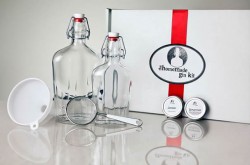
HomeMade Gin Kit
Hill’s Kitchen (713 D St. N.E.) has the perfect gift for anyone who appreciates a fine spirit. The HomeMade Gin Kit ($50) has everything you need to make gin out of your favorite vodka. It includes instructions, spices and all necessary tools. Refills of the spices can be ordered at any time at homemadegin.com. Now through December, take advantage of the limited edition Christmas botanical blend, which includes cinnamon and other seasonal spices. The kit is the product of a small business based in Arlington. Complement the Gin Kit with a few D.C.-themed cocktail glasses ($9.95-10.95 each) from Hill’s Kitchen, and round out your order with a sphere ice mold for $11.50.
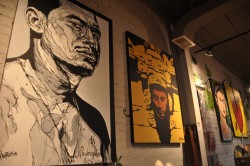
Miss Pixie’s (Washington Blade photo by Michael Key)
For vintage home furnishings and accessories, look no further than Miss Pixie’s (1626 14th St. N.W.). The store has everything from chairs and tables to rotary phones, but art lovers should consider one of the many paintings, ranging anywhere from $150-700. On Dec. 5 from 6-8 p.m., Miss Pixie’s is hosting a customer appreciation event, which includes a 10 percent discount throughout the store. Miss Pixie’s also offers a delivery service for $35 within most of the D.C. metro area or $45 outside of D.C.
Salvage Modern is an increasingly popular source for mid-century modern and vintage furniture and accessories in the greater Baltimore/D.C. area. Check out the ever-changing inventory through online store fronts, or contact the owners for an appointment. Looking for something specific? Let them know and they will source it for you. Salvage Modern offers incredibly low prices and multiple item discounts, as well as limited curb-side delivery to the metro area. They also offer some refinishing and painting services. Mention the Blade Gift Guide and get 10 percent off select items. More info is atetsy.com/shop/salvagemodern, krrb.com/salvagemodern or facebook.com/salvageforthesoul
For a simpler, more affordable gift option, visit Millennium Decorative Arts (1528 U St. N.W.). Their assorted Blenko glass paperweights come in a variety of shapes and colors and will make a lovely addition to a home office ($35 each). For someone unafraid of bold colors, consider the tri-colored laminate cubes ($110 each). They can be stacked and rearranged to fit in with the design theme of the room and make for great additional surfaces.
iPhone users may enjoy the iPhone Wood Stand from Appalachian Spring (1415 Wisconsin Ave. N.W.). The product is handcrafted in the U.S. and comes in a variety of designs. Rest your phone on it overnight on your bedside table when using it as an alarm clock or as a tidy spot to place your phone when charging. The wood stand is valued at $26.
For Virginia residents, Merrifield Garden Center is a great place to stop by when shopping for holiday supplies. With locations in Fairfax (12101 Lee Highway), Merrifield (8132 Lee Highway) and Gainesville (6895 Wellington Road), it’s a convenient resource for anything from silk and dried flower arrangements to collectible ornaments and decorations. Merrifield Garden Center also sells fresh cut and everlasting Christmas trees as well as custom wreaths and centerpieces.
D.C. residents can get their fill of holiday decorations at World Market (5335 Wisconsin Ave. N.W.). The store offers a range of options from nutcrackers and ornaments to themed kitchenware, like this four-piece Victorian Christmas Plates set for $24.99. Some nice gift ideas from World Market include the Painted Wood Desk Box, on sale for $19.99 or the beautiful wood and glass Chemex 8-cup Coffeemaker for $39.99.
Logan Home Rule (1807 14th St. N.W.) has several noteworthy gift options. Corkcicles can be frozen, inserted into bottles to chill wine and reused. At $24.99, it would be a welcome addition to any kitchen. They also carry models for beer bottles designed to let you drink as it chills your beverage. For something a little more personal, coffee drinkers will appreciate a horoscope mug ($12.99 each).

Piggy Cutting Board (Washington Blade photo by Michael Key)
tabletop (1608 20th St. N.W.) offers several gift options great for anyone who knows their way around a kitchen. The Copenhagen carafes come in a variety of sizes, and their simple design will complement almost any serving set at a dinner party ($34-40). One of their more popular products, however, is their piggy cutting board, which is only $24. Spice up your dinner prep work by having a cute piggy to look at as you chop.
Anthropologie (950 F St. N.W.) has a set of Cholet hollow vases in the shape of a goose, a doe and a hare. The individual vases sell for $24-38 and make a quirky gift perfect for anyone with a casual design sense.
While Design Within Reach (3306 M St. N.W.) sells many high-end products, they also offer affordable, practical gifts Consider the Kaleido Trays, which sell for $16. The multi-colored trays come in a variety of sizes and abstract shapes and are perfect for organizing anything from keys and mail to jewelry.





Photos
PHOTOS: Helen Hayes Awards
D.C.-area productions honored at Theatre Washington’s annual ceremony

Theatre Washington’s 42nd Helen Hayes Awards were held at The Anthem on Monday, May 18.
(Washington Blade photos by Michael Key)


Movies
Quest for fame becomes an obsession in entertaining ‘Lurker’
Psychological thriller explores the dynamics of power and control

It was nearly 60 years ago when über-queer icon Andy Warhol pronounced to the world his prediction that “in the future, everyone will be famous for 15 minutes.” While it may have been an overstatement, we’re now experiencing the future he was talking about; and though it remains statistically impossible for “everybody” to achieve fame, that doesn’t mean that we can’t all “feel” like we’re famous. If social media has delivered any gift to the human race, that might just be it.
In the real-life dystopia that is 2026, Warhol’s 1967 quip has become a kind of cultural mantra: influencers are more famous than movie stars, podcasters can shape political policy, and anybody with a “hot take” can change the way we perceive even the most fundamentally held opinions. Whether or not this is progress is probably a moot point; it’s the reality we live in, and we have a government full of “cosplaying” charlatans to prove it.
That’s why Alex Russell’s “Lurker” – a 2025 Sundance favorite that’s now streaming on HBO Max after a limited theatrical run last summer – cuts so close to the quick. A psychological thriller exploring the dynamics of power and control within the entourage of a rock star, it strikes some uncomfortably familiar chords for an era when “bootlicking” seems to have become a national pastime.
It centers on Matthew (Théodore Pellerin), a young Angeleno who lives in his grandmother’s apartment and works in a trendy designer boutique on Melrose Avenue. When rising pop musician Oliver (Archie Madekwe) brings his entourage to the store one afternoon, Matthew sees a chance to make an impression; plugging his phone into the shop’s sound system, he plays a song that he knows the pop star admires – and minutes later, he’s been given a backstage pass to Oliver’s next concert and invited to hang out with the star himself.
Their relationship continues to develop quickly at the show. Though he’s met at first with some discomfortable hazing from members of the entourage, by the end of the evening he’s on his way to becoming part of the inner circle. Chosen by Oliver to become his “official documentarian,” he’s soon a fixture in the entourage himself, sparking jealousy from members higher in the “pecking order” than he is; but Matthew is better at the game than they suspect, and despite their attempts to keep him in his place, he uses his proximity to Oliver – and a few surgically precise acts of sabotage – to rise quickly to the top.
Staying there, however, is not so easy. Within the volatile social politics of the entourage, he must always be on guard, and his efforts to thwart others from displacing him become increasingly ruthless. Eventually, he crosses a line, resulting in a fall from Oliver’s grace and his ejection from the group; but being close to fame leads to its own kind of fame, and Matthew has worked too hard to give it up so easily – even if it means using his Machiavellian powers to go after Oliver himself.
Slick, stylish, and as hypervisual as any viral pop music video you can imagine, Russell’s sardonically amoral exploration of fame – or rather, the desire for it – is as much a satire as it is a psychological drama, but it plays like a horror movie. Matthew is a protagonist cut from the same cloth as the title character of “The Talented Mr. Ripley,” a schemer whose endearingly awkward appearance masks a devious purpose and a diabolical mind. Oliver, whose creativity seems more about his “vibe” than his actual music, is charismatic but aloof, beneficent but mercurial, and seemingly blind to the massive ego that hides beneath his “chill” persona. There’s a kind of tension between these two characters that feels distinctly romantic, even homoerotic, and though it’s expressed only through subtext, it provides a palpable edge that makes their relationship feel dangerous – as if this were a love story in which anyone who tries to come between them is likely to get hurt.
As to what they actually feel about each other, “Lurker” keeps quiet about it. Matthew “reads” like a queer character, but his inner life is never revealed to us save through the conclusions we can draw from his behavior, and Oliver seems so much in love with himself that nobody else can compare; even so, there’s something between them that plays as much more intimate than the enthusiastic “bro”-ish affection that they exhibit together.
In the end, however, the “love story” here is not about romance, nor even sex; it’s about fame. Matthew, even if his own creative talents may be more solid than Oliver’s, is enamored primarily with fame; perhaps he longs for importance, for a life of more excitement and opportunity than his thankless existence as a low-level retail employee, and as the movie proceeds it becomes clear that he is willing to go as far as he has to go in order to achieve it. For Oliver, maybe it’s about the longing of the famous for something more than sycophantic lip-service, for finding the adulation of his fans personified in an authentic, tangible, and individual form. Whatever it is, there’s very little love involved.
Of course, there’s an unavoidable comparison to be made between the mentality on display in “Lurker” with the prevailing trend in our American consciousness, in which performative loyalty and opportunistic friendship feel like the order of the day; from the fickleness of “fan culture” to the escalation of outrage-baiting on social media to the barely-concealed cutthroat narcissism on daily display in our very government, the message that comes through loud and clear is a chilling throwback to the Reagan-era “greed is good” philosophy: loyalty, feelings, and friendship are for suckers, and the most vicious player is the winner who takes it all.
As usual in a character-driven piece like this one, it’s ultimately the actors who make it work; Pellerin (a Canadian actor who won his country’s equivalent of an Oscar for “Family First” in 2018) is the lynch pin, and he delivers such an endlessly fascinating portrait of obsessively determined duplicity that we find ourselves rooting for him even as we recoil from the coldness of his tactics; Madekwe (“Saltburn”) captures the vapid pretension of a pop artist who has faked his way to success, but infuses Oliver with enough well-meaning sincerity that we can still feel a little bit sorry for him. In a smaller role, Hannah Rose Liu (“Bottoms”) makes an impression as the manager who keeps Oliver’s life running, offering an anchor of relative sanity in a sea of madness.
Russell’s taut and tantalizingly opaque screenplay manages to capture all these things and more into a compact narrative that keeps us engaged while weaving its observations seamlessly into the plot, and his direction – which somehow yields an expansive scope through an intimate and sometimes frenetic focus – reinforces the unpredictable instability of fame, status, power, and the social hierarchy that governs them all. There are occasionally twists that feel a bit too convenient to be believable, but all in all, it’s a solid piece of cinematic workmanship.

Katrina Campbell-Frazier will host “Black Queer Joy: Brunch and Day Party” on Saturday, May 23 at 12 p.m. at Mixxed Food and Drinks.
This event will bring together beautiful energy, music, games, and unforgettable moments — because joy like this deserves to be shared.
Guests can expect unlimited rainbow mimosa flights, a “Build Your Pride” cocktail bar, full food menu and music by DJ Kei-Note K69, among other things.
This event is free and more details are available on Eventbrite.

PHOTOS: Helen Hayes Awards

A magical Mercedes

When impunity meets history

Comings & Goings

I’m a 64-year-old single gay man and I hate my life

Cuba marks IDAHOBiT amid heightened tensions with U.S.

Texas Children’s Hospital reaches $10 million settlement with DOJ over gender-affirming care

Vt. lawmaker equates transgender identity with bestiality

Anti-LGBTQ commentator Tyler O’Neil to testify in Southern Poverty Law Center probe

PHOTOS: Equality Prince William Pride
-

 Cuba5 days ago
Cuba marks IDAHOBiT amid heightened tensions with U.S.
-
Federal Government4 days ago
Texas Children’s Hospital reaches $10 million settlement with DOJ over gender-affirming care
-
Vermont3 days ago
Vt. lawmaker equates transgender identity with bestiality
-
LGBTQ Non-Profit Organizations4 days ago
Anti-LGBTQ commentator Tyler O’Neil to testify in Southern Poverty Law Center probe