News
Republicans ignore LGBT issues at CPAC
Log Cabin criticizes organizers for exclusion from ‘outreach’ panel
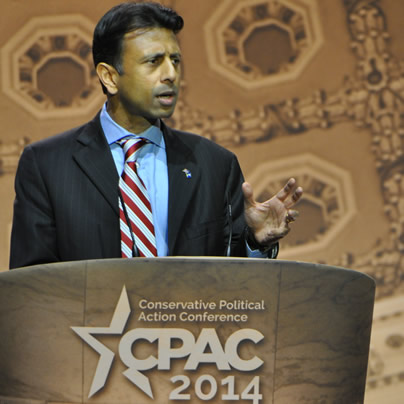
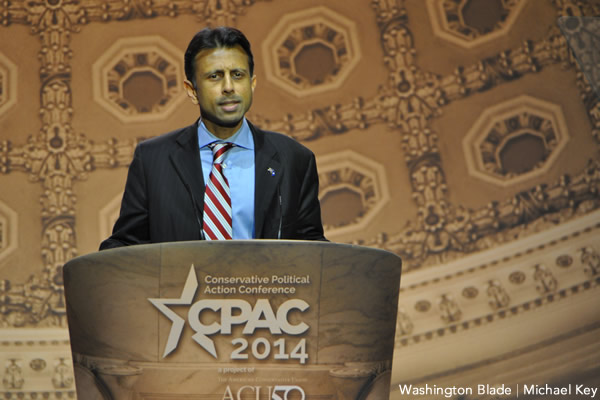
Gov. Bobby Jindal (R-La.) speaking at the 2014 Conservative Political Action Conference. (Washington Blade photo by Michael Key)
NATIONAL HARBOR, Md. — Amid growing support for LGBT rights and following a string of court victories on marriage equality, high-profile Republican speakers avoided those subjects at the first day of the 2014 Conservative Political Action Conference.
Although many of the speakers have previously articulated their opposition to same-sex marriage — with some going as far as supporting a Federal Marriage Amendment — none took the opportunity while speaking before an estimated 8,500 conservatives in attendance to attack gay rights or made statements against the many recent judicial rulings in favor of marriage equality.
Republican Gov. Bobby Jindal (R-La.) most closely approached LGBT issues when he defended his earlier statement supporting Phil Robertson of “Duck Dynasty” for controversial comments equating homosexuality to sinful behavior.
“But the reality is this: I stood up for their right to speak up and articulate their beliefs because I’m tired of the left,” Jindal said. “I’m tired of the left that claims they’re tolerant, claims they’re for diversity — and they are — they are tolerant and they are for diversity except for when you dare to disagree with them.”
Jindal made the reference to “Duck Dynasty” after criticizing the Obama administration for supposedly impinging on the religious liberties of Americans.
Another veiled reference to LGBT issues came up when Sen. Tim Scott (R-S.C.) praised the restaurant chain Chick-fil-A — despite the company’s history of anti-gay donations and controversial comments in opposition to same-sex marriage by owner Dan Cathy.
You would have to look off stage at CPAC to find anti-LGBT sentiments. According to Right Wing Watch, the ultra-conservative Catholic group Tradition, Family, and Property distributed fliers at the event depicting the gay conservative group GOProud as a rainbow-colored beaver, explaining “Why GOProud Does Not Belong at CPAC.”
“Why is GOProud a welcomed and official guest at CPAC, when it advocates the legalization of same-sex ‘marriage,’ thus undermining the votes and dreams of millions of God-fearing Americans?” the flier reportedly says.
Ross Hemminger, co-director of GOProud who helped the group regain its guest status at CPAC after two years of being banned, responded to the flier succinctly.
“I think it’s hilarious,” Hemminger said. “We will proudly be the rainbow beavers.”
Even though no one on stage at CPAC took the opportunity to oppose LGBT rights, no one speaking on stage said anything in favor of them either.
That absence was most acute during a panel titled “Reaching Out: The Rest of the Story,” which looked at the ways the conservative movement can expand into minority groups.
On the panel, moderated by Revolvis Consulting partner Jason Roe, was Republican U.S. Senate candidate from Virginia Ed Gillespie; Robert Woodson, president of the Center for Neighborhood Enterprise and Elroy Sailor, CEO of J.C. Watts Companies.
Although the panel talked at length about the Republican Party entering the black and Latino communities to win over those heavily Democratic constituents, not once did any mention of LGBT outreach come up, nor was the word “gay” even uttered.
Gregory Angelo, executive director of the Log Cabin Republicans, attended CPAC as a guest and criticized the lack of LGBT outreach on the panel in an interview with the Blade.
“The silence is deafening there, as least as far as I’m concerned,” Angelo said. “This is a constituency that the conservative movement needs to reach out to and formally acknowledging that in some capacity is something I think it needs to do.”
In the wake of GOProud’s readmission as a guest to CPAC, Angelo penned an op-ed piece for The Daily Caller saying Log Cabin had sought “meaningful” participation at CPAC, such as a seat on the outreach panel, but was “rebuffed.” The American Conservation Union, which hosts CPAC, didn’t respond to a request for comment.
“Our ask was that we have a voice at the conference — that’s it — whether that was introducing speakers, introducing panelists, or being part of a panel,” Angelo said. “From our perspective, that was a simply non-controversial proposal that would have shown the country that gay conservatives are a meaningful part of this movement, in a vehicle that wasn’t all about ‘gay policy issues.'”
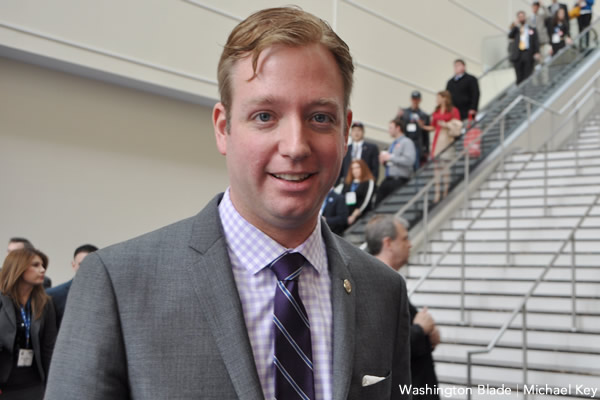
Log Cabin executive director Gregory Angelo (Washington Blade photo by Michael Key)
While remaining silent on LGBT issues, a number of prominent Republicans who spoke on stage at CPAC — many of whom are seen as Republican presidential contenders — addressed other relevant issues of the day, often attacking President Obama.
New Jersey Gov. Chris Christie (R) talked about the importance of the “three-legged stool” of the conservative movement — social issues, fiscal issues and national security issues — that Republicans say led to Ronald Reagan’s wide victories during presidential elections in the 1980s.
“When we say that we’re pro-life, and that we’re proudly pro-life, that doesn’t mean that we’re pro-life just when that human being is in the womb,” Christie said. “It means we have to be in favor of an educational system that’s accountable, so that child, as they grow, can have a world-class education. It means that we have to be in favor of a society that creates opportunity and jobs for them — not one that has the government control what they think is good or fair in our society.”
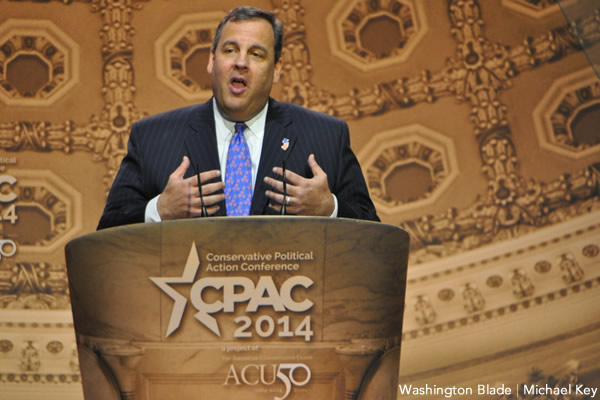
Gov. Chris Christie (R-N.J.) speaking at the 2014 Conservative Political Action Conference. (Washington Blade photo by Michael Key)
Amid concern over Russia’s military incursion into Ukraine, Sen. Marco Rubio (R-Fla.) derided the Obama administration for what he said was allowing the growth of totalitarian regimes in North Korea, Iran, China and Russia.
“All the problems of the world, all the conflicts of the world are being created by totalitarian regimes who are more interested in forcing people to do what they want them to do than truly achieving peace and prosperity and respect for the rights of others,” Rubio said.
Sen. Ted Cruz (R-Texas), another rising Republican star, enumerated several policy items he wanted to achieve, including repeal of Obamacare and Dodd-Frank financial reform, abolition of the IRS and the establishment of the flat-tax.
Following his speech, Cruz took a shot at former Secretary of State Hillary Clinton, whom many see as the likely Democratic presidential nominee in 2016, when asked about her candidacy.
“I’m less concerned about Hillary Clinton than I am about the direction this is country is going,” Cruz said. “We will have had eight years of a failed economic agenda that is resulting in a lack of leadership across the world. It is allowing Russia and China and Iran to expand their spheres of influence and make the world a much more dangerous place, and at home people are hurting. We’ve got the lowest labor force participation since 1978. Let me tell you, we can’t afford eight more years of this: Hillary Clinton would continue the failed Obama economic agenda.”
It should be noted Cruz is an opponent of marriage equality and has introduced in the Senate the State Defense Marriage Act, which would prohibit the federal government from recognizing same-sex unions in states where they’re illegal.
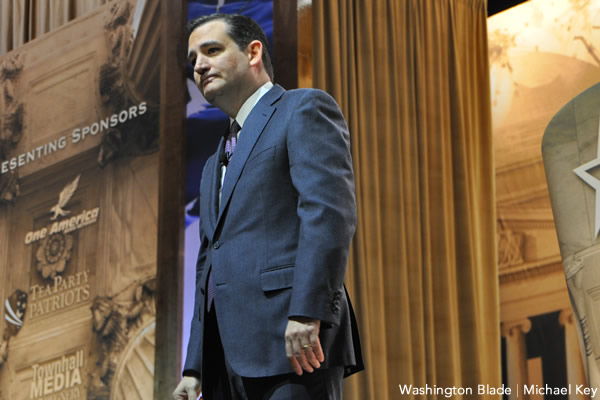
Sen. Ted Cruz (R-Texas) speaking at CPAC 2014. (Washington Blade photo by Michael Key)




District of Columbia
Bet Mishpachah participates in D.C. Oct. 7 commemoration ceremony
Wednesday marked three years since Hamas attacked Israel
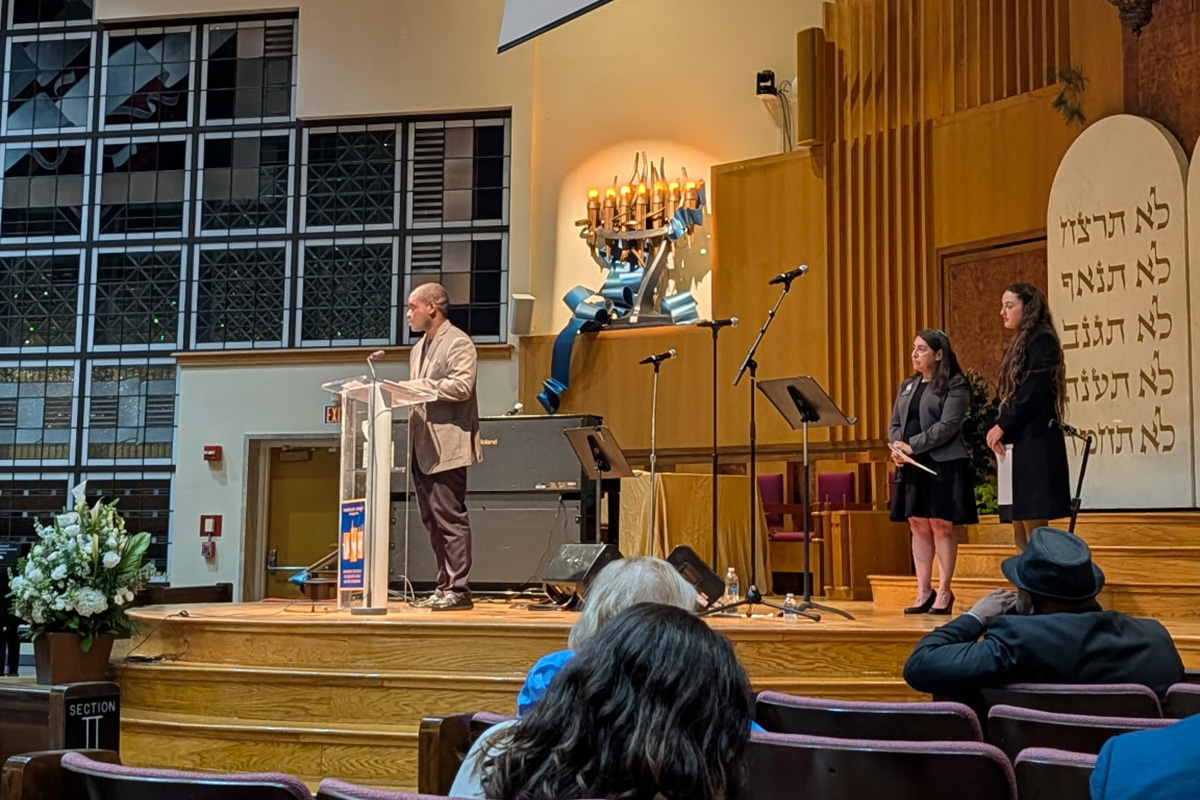
Bet Mishpachah Executive Director Joshua Maxey on Wednesday was among those who spoke at a ceremony in D.C. that marked the third anniversary of the Oct. 7 attack in Israel.
The Jewish Federation of Greater Washington hosted the ceremony that took place at the Washington Hebrew Congregation in Northwest D.C. Bet Mishpachah is the city’s LGBTQ synagogue.
“It was a deeply moving evening, especially hearing the stories of people who knew those who were murdered and those who survived and experiencing music that gave a voice to grief and hope,” Maxey told the Washington Blade.
Hamas militants on Oct. 7, 2023, killed roughly 1,200 people, including upwards of 360 partygoers at the Nova Music Festival near Re’im, a kibbutz that is a couple miles from the Gaza Strip, when it launched its surprise attack on Israel. The militants also kidnapped more than 200 people.
The Hamas-controlled Gaza Health Ministry says Israeli forces have killed more than 74,000 people in the enclave since Oct. 7.
The International Criminal Court in 2024 issued arrest warrants for Israeli Prime Minister Benjamin Netanyahu; former Israeli Defense Minister Yoav Gallant; former Hamas leader Yahya Sinwar; Mohamed Diab Ibrahim al-Masri, the head of Hamas’s military wing known as the Qassam Brigades; and Ismail Haniyeh, chair of the Hamas Political Bureau, after it accused them of committing war crimes and crimes against humanity in Gaza and Israel.
The Israeli government has strongly denied it has committed genocide in Gaza.
An Israeli airstrike on a compound in Khan Younis, a city in southern Gaza, on July 13, 2024, killed killed Deif, one of the alleged Oct. 7 masterminds. Israel less than three weeks later assassinated Haniyah in Tehran, the Iranian capital. Israel Defense Forces soldiers on Oct. 16, 2024, killed Sinwar in Rafah, a city in southern Gaza.
Hamas last October released the remaining hostages in Gaza as part of a ceasefire agreement that President Donald Trump helped broker. Israel has continued to conduct airstrikes and other military operations in Gaza since the official suspension of hostilities took effect.
“For Bet Mishpachah, it was especially meaningful to lift up the names of LGBTQ+ people, those whose identities we know and those whose stories may never be fully known, who were murdered, and to honor the LGBTQ+ survivors whose resilience continues to inspire us,” said Maxey, referring to his participation in Wednesday’s ceremony. “Emily Damari’s story is particularly poignant: while held hostage, she had to hide the fact that she was gay because she feared that revealing her identity to her captors could put her life at even more risk. Yet, she survived.”
“Her story, like so many others, reminds us of the extraordinary courage it takes simply to remain human in the face of hatred,” he added. “May we continue to remember and to mourn, to honor, and to work toward a future rooted in peace and hope.”
National
Man charged in Mall of America shooting plot inspired by Pulse massacre: report
Suspect exchanged hundreds of messages, pledged loyalty to ISIS
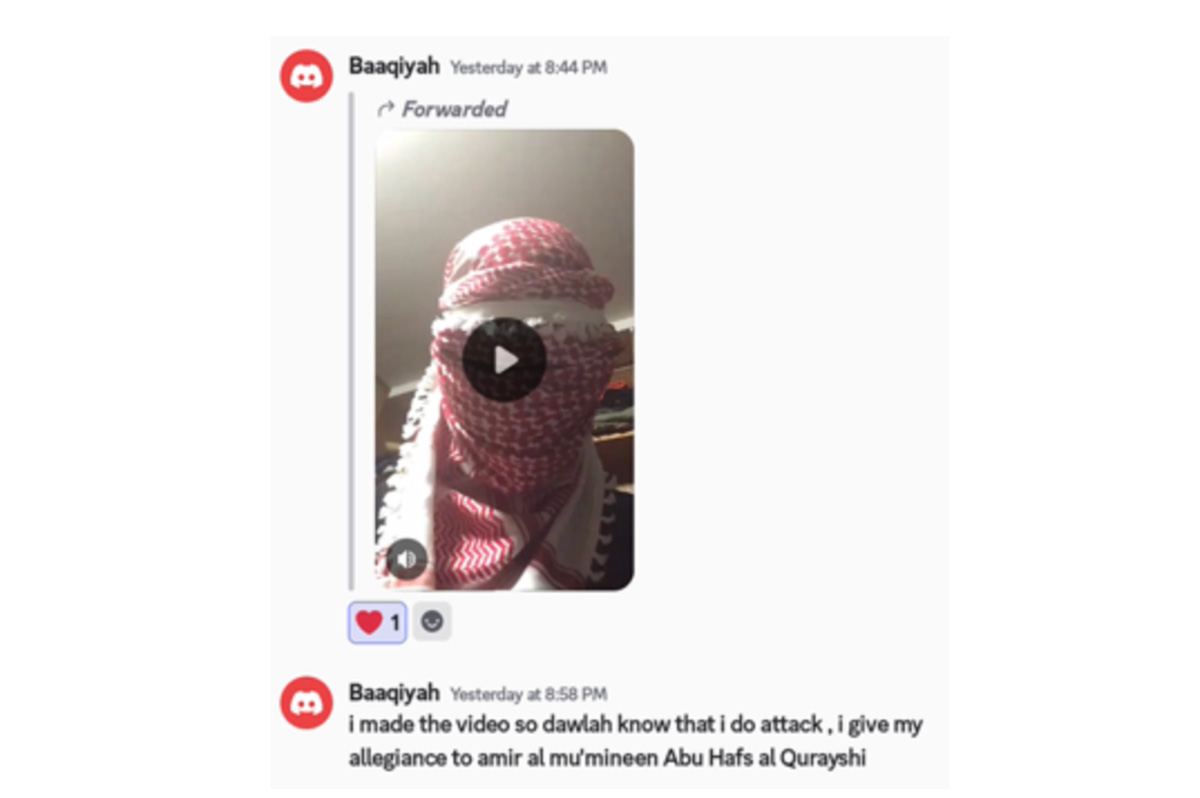
The U.S. Department of Justice charged Sheikhdoon Abdullahi Mohamud, 18, of Richfield, Minn., on Oct. 7 with one count of knowingly receiving a firearm and ammunition in order to commit a federal crime of terrorism. Mohamud allegedly planned to carry out a mass-casualty attack in support of ISIS, inspired in part by the Pulse nightclub massacre that took place on June 12, 2016 when then-29-year-old Omar Mateen murdered 49 people and wounded 58 – one of the deadliest mass shootings in U.S. history, and the deadliest targeting the LGBTQ+ community.
According to a DOJ statement release, Mohamud was arrested on Oct. 6 by the FBI, which had arranged to sell him an AK-47 assault rifle, magazines, and ammunition through an undercover FBI employee. Mohamud was arrested shortly after paying $600 in cash and taking possession of those items; he reaffirmed his intention to shoot people at the Mall of America during the transaction.
“Mohamud allegedly sought to carry out a mass-casualty shooting at the Mall of America, expressing a desire to emulate some of the most horrific ISIS-inspired attacks in the United States, including the atrocities at Pulse Nightclub and 2025 New Year’s Day attack in New Orleans,” said Assistant Attorney General for National Security John A. Eisenberg in the statement by the DOJ. “The National Security Division will continue to work closely with the FBI and Joint Terrorism Task Force to track down and prosecute ISIS-inspired terrorists in the United States.”
According to the complaint, beginning on or about December 2024, Mohamud had exchanged hundreds of messages through multiple social media and messaging apps with a confidential source, and expressed a desire to travel to Somalia to join a designated foreign terrorist organization to fight on their behalf.
The defendant stated many times that if he was unable to travel overseas because of a lack of funds, he planned to carry out a mass-casualty event in Minnesota in support of ISIS.
According to the DOJ, “In July 2026, Mohamud sent messages discussing his intent to carry out a mass-casualty shooting attack at the Mall of America because he claimed it was owned by Jews. He wrote that [he] wanted to kill 30 to 60 people so no one would go there.”
“During the course of his communications, Mohamud stated that he wanted to commit an attack similar to those of the Pulse Nightclub mass-shooting in Orlando, the Bondi Beach mass-shooting in Australia, and the New Year’s Day vehicle-ramming attack in New Orleans.”
This case is being prosecuted by Trial Attorney Ryan White of the National Security Division’s Counterterrorism Section and Assistant U.S. Attorney Benjamin Bejar for the District of Minnesota.
Obituary
U.S. int’l trade negotiator, consultant James Bedore dies at 82
Longtime D.C. resident was prominent supporter of Dignity Washington
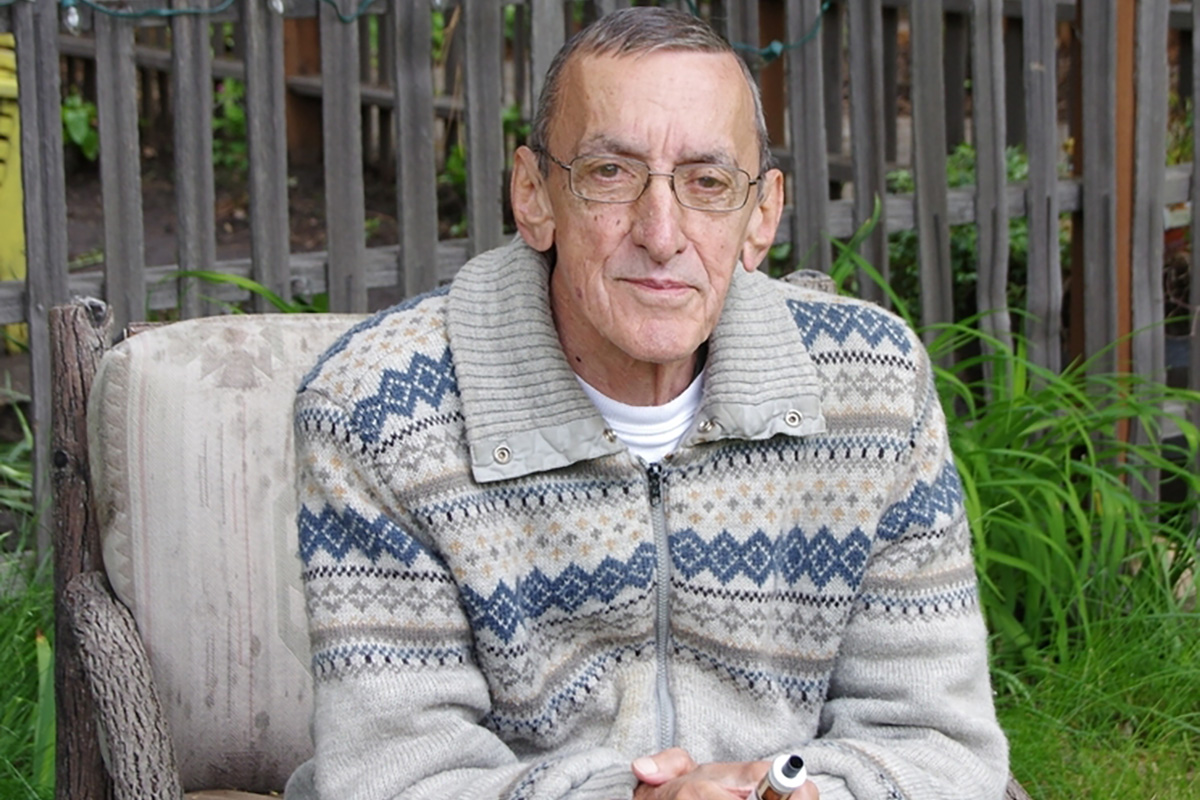
James “Jim” Bedore, an international affairs specialist whose career included work for the U.S. Department of State and as a private sector consultant in Europe with a focus on Middle Eastern and African development before his retirement in 2000, died on Sept. 2 at his home in D.C. He was 82.
His sister, Carol Bedore, said the cause of death was lung cancer.
Dignity Washington, the D.C.-based LGBTQ Catholic organization, released a detailed statement on Bedore’s life and career that, among other things, says Dignity Washington “became a huge part of Jim’s social life after his retirement in 2000.”
Carol Bedore said her brother was born and raised in Unionville, Mich., as the sixth of eight kids and the oldest boy in their family. She said he graduated from high school there before going on to “amazing” things in a distinguished career.
The Dignity Washington statement says upon the completion of his “B.A. in History and Economics,” Bedore served in the U.S. Peace Corps in West Africa in the mid-1960s. The statement says after completing his Peace Corps service Bedore taught briefly at Voorhees College, a historically Black college in South Carolina. He next earned a master’s degree from the East-West Center in Honolulu before undertaking advanced graduate work at the London School of Economics, according to the statement.
“During the Vietnam War, he served a two-year assignment in the Mekong Delta with the U.S. Department of State,” the statement continues. “He later worked in the private sector in Hong Kong, Saudi Arabia, and London, residing in London for fifteen years,” it says, adding, “He served as a Research Fellow at Chatham House (the Royal Institute of International Affairs in London) and co-authored a volume on Middle East Industrialization, (Macmillan in 1979).”
The statement says other articles and commentaries that Bedore wrote appeared in several prominent publications, including the journals Foreign Affairs, International Affairs, the Financial Times of London, and the International Herald Tribune. It says he remained active in international affairs after his retirement in 2000, including involvements with ‘think tank” organizations in D.C.
The Dignity Washington statement says Bedore, who lived for many years until the time of his passing in a condominium in D.C.’s Dupont Circle neighborhood, was a dedicated volunteer and organizer of Dignity related events.
“He did what he could to organize practical and social events, including some 14 years cooking and feeding approximately 100 homeless individuals monthly at Christ House,” the statement says, referring to the D.C. Adams Morgan neighborhood organization that provides medical care and other services for homeless people.
“Additionally, he initiated the ‘Moon Over Washington’ pot-luck event on the incredible roof on his condominium building,” it says. “The event continues to be one of Dignity Washington’s signature events to this day.” Among other things, it says Bedore was part of Dignity Washington’s annual LGBTQ Pride parade contingent, and he helped to sew 60 AIDS Memorial Quilts.
The statement says Bedore also “built a good relationship with St. Matthews’s Cathedral and created a gay chapter there, where he collaborated with parents with gay children.”
Dignity Washington President Peter Edwards called Bedore a beloved, dedicated Dignity Washington member. Edwards said the group recently issued its Willick Award to Bedore, which he said, “is a special award that we give to people who have done wonderful things for our community.”
“We will remember Jim for his sharp mind, his humor, his generosity, and his unwavering belief in the power of human connection,” the statement adds. “He lived a life shaped by service, curiosity, and love – and he leaves behind a community forever enriched by his presence,” it concludes.
Edwards said Dignity Washington will hold a Catholic Mass in Bedore’s honor in the coming weeks.
The statement says Bedore was pre-deceased by two life partners, Geoffrey Lawrence of 19 years, and Al Lunde, who the statement says passed away in 1999.
Bedore’s sister, Carol, said Bedore was cremated and his ashes have been returned to the family’s hometown in Michigan where an interment is being planned at the family’s cemetery plot.

Bet Mishpachah participates in D.C. Oct. 7 commemoration ceremony

Man charged in Mall of America shooting plot inspired by Pulse massacre: report

Bar Betsie, inviting and intimate, marks one-year anniversary

Trump, Netanyahu, and Putin are all war criminals

Center Arts Gallery celebrates 10 years with reception, auction

Eliot Glazer’s new book an engaging collection of essays

Equality Chamber hosts Pride in Business Expo and Profits & Pours

Learn more about Virginia’s queer history

‘Merrily’ is for Sondheim super fans, the uninitiated, and anyone in between

The financial realities facing LGBTQ+ first-time buyers
-

 Books5 days ago
Eliot Glazer’s new book an engaging collection of essays
-
Out & About5 days ago
Equality Chamber hosts Pride in Business Expo and Profits & Pours
-
Out & About5 days ago
Learn more about Virginia’s queer history
-
Brazil5 days ago
Lula, Flávio Bolsonaro to face off in second round of Brazilian presidential election