Arts & Entertainment
Tone balancing
Screen-to-stage adaptation is multi-media delight
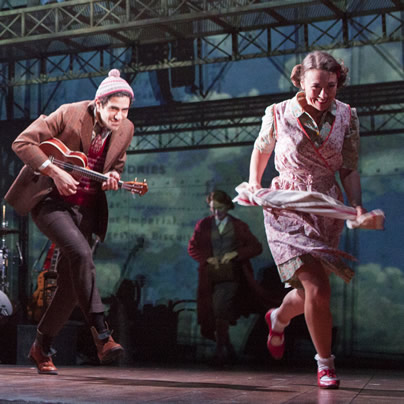
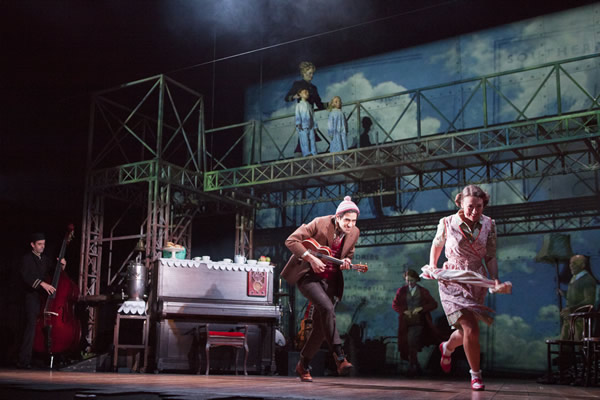
The cast of Kneehigh’s U.S. tour of ‘Brief Encounters’ by Jim Cox. (Photo courtesy STC)
‘Brief Encounter’
Through April 13
Shakespeare Theatre Company
The Lansburgh Theatre
450 7th Street, NW
$30-75
202-547-1122
Conventional wisdom says don’t mess with a classic. Typically the result is a letdown. But there are exceptions. Case in point is the UK-based Kneehigh Theatre’s delightful production of “Brief Encounter,” an adaptation of the same-named 1945 British film.
In bringing the iconic screen romance to the stage, director/playwright Emma Rice blends theater and film incorporating projections, musical numbers and myriad clever touches, all now on display at the Shakespeare Theatre Company’s Lansburgh Theatre.
The David Lean film is based on Noël Coward’s “Still Life,” one of many plays the gay sophisticate wrote and performed with longtime pal Gertrude Lawrence. It follows the short-lived romance of two married people who meet cute at a train station when Alec, a handsome doctor, removes a cinder from housewife Laura’s eye. The pair begin meeting weekly, mostly in the station tearoom or restaurants, and though their feelings are intense, their relationship remains chaste, never going beyond a kiss. And while the inevitable return to their respective respectable lives and practical mates happens as expected, it’s still a painful outcome. Rice’s adaptation draws from the film and the play.
The action kicks off in the Lansburgh lobby with a zippy string quartet of cast members dressed as ‘40s movie theater ushers performing a selection of vintage tunes. Inside, the stage’s usual curtain has been swapped out for one that’s brighter and redder, reminiscent of those found in old movie palaces. There’s a big movie screen that plays black-and-white footage, a nod to the source film and an exploration of the protagonists’ experience. When not on stage, Alec (Jim Sturgeon) and Laura (Hannah Yelland in her Tony-nominated role from when the show ran on Broadway in 2010) can sometimes be found seated amongst the audience; after all, their first date was a trip to the cinema. They also may slip through a slit in the movie screen only to reappear as bigger-than-life projections.
While meeting in public, the pair is reserved. Their muted passion is represented by film of fast moving clouds and raging tides. As the romantic tension mounts, Laura begins to grapple with doing the right thing. It’s she who suggests they part ways.
Director Emma Rice’s precise and inventive staging is wondrous, the cast is superb and her team’s spectacular technical, multi-media design is top notch. Neil Murray’s set is ingeniously serviceable and his period costumes are impeccably drawn. As the besotted but staid lovers, Yelland and Sturgeon play it straight, never mocking the necessarily formal dialogue. But the supporting ensemble has no such restraints. They’re free to camp it up and play for laughs, and they do, expertly. It’s an effective balance.
The tearoom’s other regulars are its manager Myrtle (Annette McLauglin), an amusingly genteel type whose breaks are spent trysting with the amorous station manager Fred (Joe Alessi); and Beryl (Dorothy Atkinson), a cheeky waitress who is dating the cute young station snack seller, Stanley (Damon Daunno). The cast play multiple parts and along with Dave Brown and James Gow, they also sing and play instruments. Songs include Coward’s “Mad About the Boy,” “A Room with a View,” and melodic original music.
The music is put to especially good effect with another Coward song, “Go Slow, Johnny” sung poignantly by Daunno during a key scene in which the Alec and Laura are alone drying off after having fallen out of a rowboat.
Most of the play takes place in the train station. Not surprisingly, there’s a moment when it seems that Laura might throw herself on the tracks and end it all. But no, she’s too sensible for that. Instead, she returns home (two leather club chairs and a big radio) where her patient husband (Alessi, again) and young son and daughter (a pair of life-sized puppets) are waiting.
“Brief Encounter” is part of the really terrific STC Presentation whose mission is to present world class international productions to D.C. audiences. This memorable production is a testament to both the vibrancy of theater and Coward’s enduring genius.


Movies
‘Stop! That! Train!’ is made for fans, but fun for all
RuPaul stars as President Gagwell trying to avert a tragedy

Before I can begin a review of “Stop! That! Train!” (the movie that’s been algorithmically dominating your queer social media feed in the form of ads for weeks now), I feel it’s necessary to provide a disclaimer: I am not a superfan of “RuPaul’s Drag Race.”
That doesn’t mean I’m NOT a fan, mind you. I’m just disclosing that I have never been the loyal viewer for whom each new episode is the highlight of the week, or followed the careers of the contestants I loved the most; I don’t know who won each season, or how many times they’ve been on the show. I barely even know any of the catch phrases. I say all this because you should know that, as someone who didn’t get any of the show references I’ve been told were laced throughout the movie, I’m probably not the person RuPaul and filmmaker Adam Shankman had in mind when they were making it.
I do, however, respect and adore the art of drag, not just as an expression of queer identity tied to a long tradition stretching back centuries, but as a powerful tool for satire. It’s a queer-eyed view that exposes the hypocritical norms and mainstream social “morality” in a form that goes right over the heads of anyone who isn’t in on the joke, and the Queens of “Drag Race” not only honor that tradition but live up to it. Make no mistake, the queer spirit of rebellion is alive and well in “Stop! That Train!” – even if it sometimes feels like it’s just along for the ride.
Mounted as a parody of old-school “disaster movies” – a genre that found its heyday in the same ‘70s and ‘80s period that also saw the success of classic movie spoofs like “Young Frankenstein” and “Airplane!” (which clearly serves as the primary blueprint) – Shankman’s film seems driven by an impulse toward the absurd as a kind of de facto social commentary, but puts the most emphasis on landing its jokes. It imagines a contemporary world where high-speed train travel is an actual thing in America (wouldn’t that be nice?) and a Black drag queen can be elected president (OK, maybe she’s a cisgender woman in context of the plot, but still), but in which everything is pretty much just as “off the rails” as it really is, anyway.
In the middle of it all are Tess and DeeDee (Ginger Minj and Jujubee, both popular “Drag Race” veterans), two “train stewardesses” who fake their way into jobs on the prestigious “Glamazonian Express” railway line and face hostility from the “mean girl” attendants who work there. The popularity contest soon takes a back seat, however, when the train finds itself speeding into a catastrophic “storm-o-ganza,” and they’re faced with the challenge of saving themselves – along with the train’s assortment of passengers – from all-but-certain doom. Fortunately, they’re not alone; under-appreciated train dispatcher Donna Dusk (Rachel Bloom) is doing her best to guide them from afar toward the least catastrophic outcome, and no less than American President Judy Gagwell (RuPaul Charles, of course) takes a personal interest in averting the disaster; after all, it could take a few points off of her popularity rating if she doesn’t. Can this plucky alliance of women-with-something-to-prove shepherd this runaway train (and everyone on board) to safety? Of course they can, and in the most ridiculous way possible.
Like the aforementioned “Airplane!” (the zany 1980 farce that was itself modeled after the popular “Airport” series of all-star disaster epics), “Stop! That! Train!” takes an approach to comedy that’s more like facing a high-speed pitching machine in a batting cage than watching a movie in a theater; it’s one joke after another, thrown rapid fire against the wall on the theory that at least some of them will stick – a time-honored tradition that, admittedly, results in a lot of them that don’t. For every belly laugh, there’s a real groaner, and a fair number of the chuckles are “polite” ones, at best; but that, of course, is part of the appeal. Screenwriters Christina Friel and Connor Wright skew their humor toward the lowbrow – something the popular drag movement fully embraces, anyway – and make most of their characters into clowns as they freely transplant plot points and tropes into their ludicrous scenario; all of it’s on purpose, and most of it works, because this is the kind of movie that is intended to be as “stupid” as possible and we wouldn’t want it any other way.
Of course, some viewers will inevitably be underwhelmed by the movie’s humor; its borrowed tropes may feel less funny for being too familiar, sometimes the “lowbrow” might edge too closely on the “tasteless,” and the overall spirit of “bitchiness” could easily come across as just plain “mean” if one is in the wrong mood. Let’s face it, though: most of those people will probably not be going to see “Stop! That! Train!,” anyway. For the rest of us, even if more of its jokes fall flat than we might hope and some of the zingers don’t have the “zing” that they should, there’s still a cumulative effect that leaves the impression of a whole being greater than its parts. After all, sometimes we just want to have brainless fun at the movies instead of having to think too much about it, and nobody was expecting an Oscar-winner, were they?
As for the disaster movie plot, it’s impossible to take seriously, of course, but it does provide the opportunity to showcase a lot of characters – and caricatures – along the way. Minj and Jujubee are essentially the stars of the show, and their easy chemistry together helps them carry the film; RuPaul, every inch the superstar as ever, strides confidently into his presidential role and rightfully dominates every scene that he’s in, yet is graceful enough not to overwhelm or overshadow the work of his co-stars, especially Matt Rogers, who, as President Gagwell’s possibly psychopathic press secretary and confidante, shares more screen time with him than anyone else.
Veteran comic actor (and “SNL” alumnus) Chris Parnell uses his hilariously deadpan lunacy to great advantage as the train’s conductor, and Brian Jordan Alvarez (“The English Teacher”) brings a smarmy charm as the co-conductor who doesn’t know how to operate a train – despite the questionable choice of using an exaggerated “Bill and Ted” era Keanu Reaves impression for his character’s voice. There’s a whole gallery of familiar faces on hand in bit parts and cameos as passengers on the train, who arguably provide more genuine comedy and interest than the main storyline. And even if she never sets foot on the train herself, Bloom (“Crazy Ex-Girlfriend”) is every bit on board for the ride, serving as a grounding force even as she gives herself over completely to the silliness.
And silly it certainly is. It’s as insubstantial as the AI-generated backgrounds used to create the action scenes of speeding train and the storm. And at the risk of repeating myself, we wouldn’t have it any other way.

Friday, June 19
Trans and Genderqueer Game Night will be at 7 p.m. at the DC LGBTQ+ Community Center. This is a relaxing, laid-back evening of games and fun. For more details, visit the DC Center’s website.
Saturday, June 20
Go Gay DC will host “LGBTQ+ Community Pride Brunch” at 11 a.m. at Freddie’s Beach Bar & Restaurant. This fun weekly event brings the DMV area LGBTQ+ community, including allies, together for delicious food and conversation. Attendance is free and more details are available on Eventbrite.
LGBTQ People of Color will be at 7 p.m. on Zoom. This peer support group is an outlet for LGBTQ people of color to come together and talk about anything affecting them in a space that strives to be safe and judgement free. There will be all sorts of activities like watching movies, poetry events, storytelling, and just hanging out with others. For more details, visit thedccenter.org/poc or facebook.com/centerpoc.
The DC LGBTQ+ Community Center will host “Sunday Supper on Saturday” at 2 p.m. It’s more than just an event; it’s an opportunity to step away from the busyness of life and invest in something meaningful, and enjoy delicious food, genuine laughter, and conversations that spark connection and inspiration. For more details, visit the Center’s website.
Sunday, June 21
Kinetic Presents will host “DiscoVERS: Pride with Alexis Tucci & Clinton Foster” at 10 p.m. at Sax Restaurant and Lounge. Alexis Tucci and Clinton Foster trade off behind the decks all night, weaving uplifting disco and driving house into one continuous set. Throughout the evening, surprise performances unfold across the room, woven into the music rather than stacked on top of it. Tickets cost $41.76 and are available on Eventbrite.
Monday, June 22
“Center Aging: Monday Coffee Klatch” will be at 10 a.m. on Zoom. This is a social hour for older LGBTQ+ adults. Guests are encouraged to bring a beverage of choice. For more information, contact Adam ([email protected]).
Center Faith will host “Pride Interfaith Service” at 7 p.m. at St. Mark’s Episcopal Church. This is the 43rd annual LGBTQ+ community celebration of religious pluralism and interfaith collaboration. Founded during the era of the Names Project AIDS memorial quilts, we continue to connect and weave many LGBTQ+ faith communities. For more details, email [email protected].
Queer Book Club will be at 7 p.m. on Zoom. The Queer Book Club meets on the fourth Monday of the month to discuss queer books by queer authors. This month’s reading is “The Skin and it’s Girl” by Sarah Cypher. For more details, visit the DC Center’s website.
Tuesday, June 23
Genderqueer DC will be at 7 p.m. on Zoom. This is a support group for people who identify outside of the gender binary, whether you’re bigender, agender, genderfluid, or just know that you’re not 100% cis. For more details, visit genderqueerdc.org or Facebook.
“Self-Defense Class with Avi Rome” will be at 12:30 p.m. Rome is a proud member of the LGBTQ+ community and a full time Martial Arts instructor with 25 years of teaching experience. He holds a 5th Degree Black Belt in Jhoon Rhee Tae Kwon Do and is the director of the studio’s Adaptive Tae Kwon Do program for students with special needs. He has also run numerous self-defense workshops for various groups and situations. For more details, visit the center’s website.
Wednesday, June 24
Job Club will be at 6 p.m. on Zoom upon request. This is a weekly job support program to help job entrants and seekers, including the long-term unemployed, improve self-confidence, motivation, resilience and productivity for effective job searches and networking — allowing participants to move away from being merely “applicants” toward being “candidates.” For more information, email [email protected] or visit thedccenter.org/careers.
Thursday, June 25
The DC LGBTQ+ Community Center’s Fresh Produce Program will be held all day at the center. People will be informed on Wednesday at 5:00 pm if they are picked to receive a produce box. No proof of residency or income is required. For more information, email [email protected] or call 202-682-2245.
Virtual Yoga Class will be at 7 p.m. on Zoom. This free weekly class is a combination of yoga, breathwork and meditation that allows LGBTQ+ community members to continue their healing journey with somatic and mindfulness practices. For more details, visit the DC LGBTQ+ Community Center’s website.
Sports
Minor league team in York, Pa., forfeits Pride Night game after some players refuse to wear special jersey
City is roughly 20 miles north of Md. border
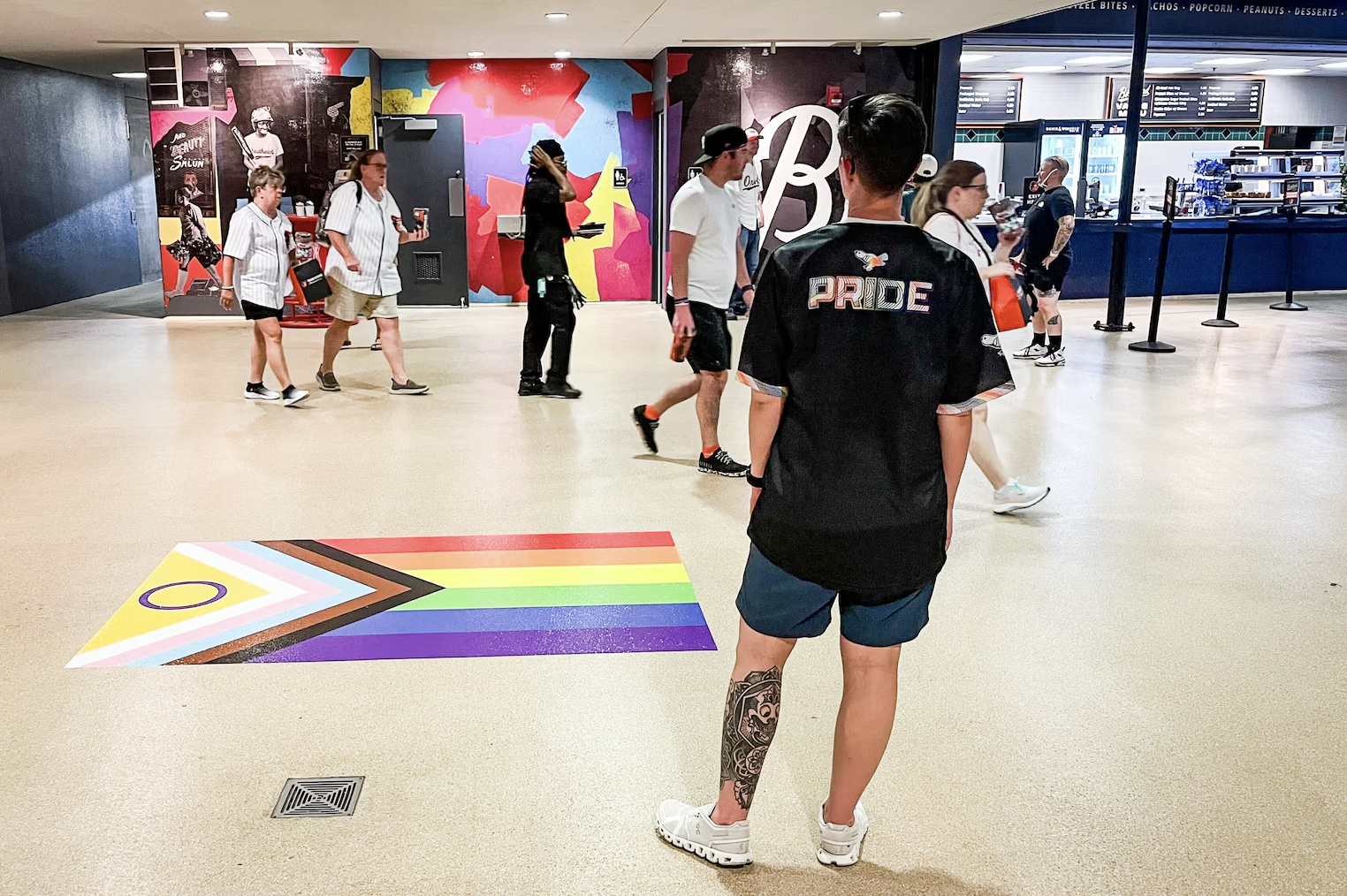
An independent minor league baseball team says it is forfeiting a game because some of its players refused to wear a special Pride Night jersey.
The Atlantic League Pro Baseball’s York Revolution were planning to hold their 11th annual Pride Night event Thursday for a game against the Southern Maryland Blue Crabs.
But the Revolution announced the day of the game that it wouldn’t be played. York is about 20 miles north of the Maryland line. The Blue Crabs play in Waldorf.
The rest of this article can be found on the Baltimore Banner’s website.

‘Stop! That! Train!’ is made for fans, but fun for all

Delaware guv signs bill to protect children born using assisted reproduction

Calendar: June 19-25

My trans daughter thrived in Chicago public schools

Minor league team in York, Pa., forfeits Pride Night game after some players refuse to wear special jersey

Gay San Diego mayor elected US Conference of Mayors president

UFC fighter says ‘Michelle Obama is a man’ at White House event

This John Waters interview has been edited for readability — but perhaps not human decency

There is no Pride in detention

Calif. governor’s race spotlights Becerra’s LGBTQ advocacy
-

 California4 days ago
Gay San Diego mayor elected US Conference of Mayors president
-
National4 days ago
UFC fighter says ‘Michelle Obama is a man’ at White House event
-
Opinions5 days ago
There is no Pride in detention
-
Baltimore4 days ago
This John Waters interview has been edited for readability — but perhaps not human decency