News
Baldwin pledges ‘no’ vote on bill barring Syrian refugees
Lesbian senator calls on NGOs to step up efforts for LGBT asylum-seekers
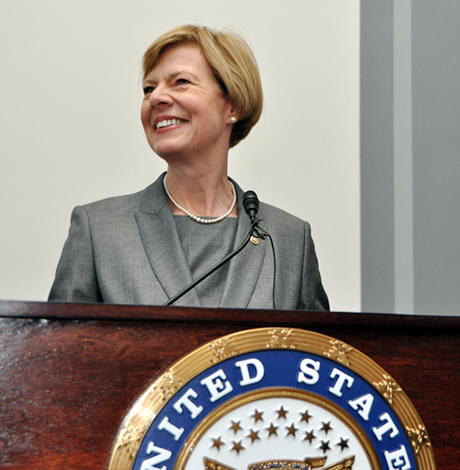
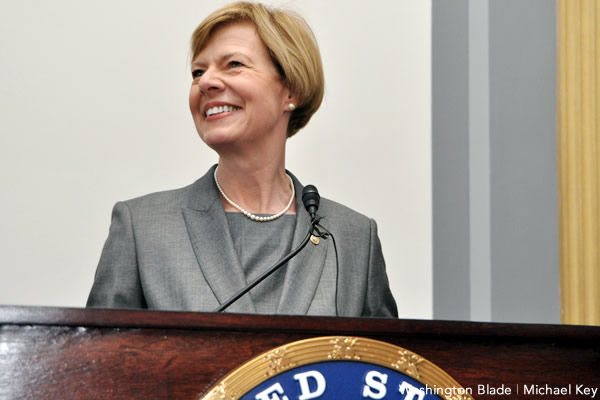
Sen. Tammy Baldwin said she would vote “no” on legislation barring Syrian refugees. (Washington Blade file photo by Michael Key)
Following anger in the LGBT community over gay and bisexual members of the U.S. House voting for legislation seen to bar Syrian refugees from entering the United States, Sen. Tammy Baldwin (D-Wis.) said Thursday she’d vote “no” if the same bill came to the floor of the U.S. Senate.
Baldwin made the remarks during a panel of the Atlantic LGBT Summit titled “Unfinished Business” in D.C. in response to a question from the Washington Blade, saying, “I would vote ‘no’ on that legislation if it were to come before the Senate.”
The only out lesbian in the Senate emphasized the rigorous nature of the system for screening refugees before they enter the United States, saying it contrasts with the visa program President Obama has placed under review following the San Bernardino shootings.
“Our refugee process is the most rigorous of all the ways to get into the United States, often taking between 18 and 24 months,” Baldwin said. “Visa waiver? Another thing altogether. And so, we need to be rational and certainly not just playing the politics of the moment, or tacking it to people’s fearfulness, but we need to be informed and educated, and I can use my position in the Senate, hopefully, to educate my constituency and my colleagues to some degree.”
Baldwin also expressed confidence the need for her to vote against the legislation would never arise, saying, “I think you’ve seen what we thought was going to be an immediate reaction in the Senate to take up the House-passed bill to a real pivot in the conservation, and sort of let’s look where we need to be looking.”
The U.S. House passed the legislation, the American Security Against Foreign Enemies Act, by a vote of 289-137 last month. The bill would expand background checks on Iraqi and Syrian refugees hoping to enter the United States, but critics say the legislation would have the effect of barring them entirely.
Among those joining Republicans in voting in favor of the legislation were 47 Democrats, including Rep. Jared Polis (D-Colo.), who’s gay; Rep. Sean Patrick Maloney (D-N.Y.), who’s gay; and Rep. Kyrsten Sinema (D-Ariz.), who’s bisexual. The support of these three lawmakers for the legislation has invoked the ire of some LGBT advocates who argue members of the LGBT community should support another community facing persecution.
Anti-LGBT persecution is among the hardships refugees are fleeing from the areas controlled by ISIS. Reports have shown men perceived as gay being thrown to their death from rooftops.
Asked by the Blade after the panel whether she sees any imperative as an LGBT advocate to support Syrian refugees because they face anti-LGBT discrimination, Baldwin said “we saw this also during the Iraq war” and talked about the importance of efforts from non-governmental organizations.
“It is important to me that the international institutions that help refugees, especially with their passage through various places before there’s an ultimate determination of where they get final refugee status, that there’s a sensitivity in those NGOs as well as government-sponsored organizations to the struggles and the victimization of LGBT refugees,” Baldwin said. “Often times, that is not a priority, that’s not even on folks’ radar screens, and yet they’re a particularly vulnerable population.”
Baldwin added, “Often times, in the interim as a final refugee determination is being made, they’re in countries or locations with hostile laws, hostile customs, etc. And so, I think our international efforts have to focus on greater security, safety and protection, and frankly, knowledge and competence about LGBT issues.”
Amid calls for the Obama administration to set aside 500 slots for LGBT people among the additional 10,000 refugees anticipated from Syria, White House Press Secretary Josh Earnest said this week the administration doesn’t institute quotas for certain types of refugees, but those facing persecution like the anti-LGBT violence perpetuated by ISIS would be considered a priority for asylum cases.




Rehoboth Beach
BLUF leather social set for April 10 in Rehoboth
Attendees encouraged to wear appropriate gear

Diego’s in Rehoboth Beach hosts a monthly leather happy hour. April’s edition is scheduled for Friday, April 10, 5-7 p.m. Attendees are encouraged to wear appropriate gear. The event is billed as an official event of BLUF, the free community group for men interested in leather. After happy hour, the attendees are encouraged to reconvene at Local Bootlegging Company for dinner, which allows cigar smoking. There’s no cover charge for either event.
District of Columbia
Celebrations of life planned for Sean Bartel
Two memorial events scheduled in D.C.

Two celebrations of life are planned for Sean Christopher Bartel, 48, who was found deceased on a hiking trail in Argentina on or around March 15. Bartel began his career as a television news reporter and news anchor at stations in Louisville, Ky., and Evansville, Ind., before serving as Senior Video Producer for the D.C.-based International Brotherhood of Electrical Workers union from 2013 to 2024.
A memorial gathering is planned for Friday, April 10, 11:30 a.m.-1:30 p.m. at the IBEW International Office (900 7th St., N.W.), according to a statement by the DC Gay Flag Football League, where Bartel was a longtime member. A celebration of life is planned that same evening, 6-8 p.m. at Trade (1410 14th St., N.W.).
Puerto Rico
The ‘X’ returns to court
1st Circuit hears case over legal recognition of nonbinary Puerto Ricans

Eight months ago, I wrote about this issue at a time when it had not yet reached the judicial level it faces today. Back then, the conversation moved through administrative decisions, public debate, and political resistance. It was unresolved, but it had not yet reached this point.
That has now changed.
Lambda Legal appeared before the 1st U.S. Court of Appeals in Boston, urging the court to uphold a lower court ruling that requires the government of Puerto Rico to issue birth certificates that accurately reflect the identities of nonbinary individuals. The appeal follows a district court decision that found the denial of such recognition to be a violation of the U.S. Constitution.
This marks a turning point. The issue is no longer theoretical. A court has already determined that unequal treatment exists.
The argument presented by the plaintiffs is grounded in Puerto Rico’s own legal framework. Identity birth certificates are not static historical records. They are functional documents used in everyday life. They are required to access employment, education, and essential services. Their purpose is practical, not symbolic.
Within that framework, the exclusion of nonbinary individuals does not stem from a legal limitation. Puerto Rico already allows gender marker corrections on birth certificates for transgender individuals under the precedent established in Arroyo Gonzalez v. Rosselló Nevares. In addition, the current Civil Code recognizes the existence of identity documents that reflect a person’s lived identity beyond the original birth record.
The issue lies in how the law is applied.
Recognition is granted within specific categories, while those who do not identify within that binary structure remain excluded. That exclusion is now at the center of this case.
Lambda Legal’s position is straightforward. Requiring individuals to carry documents that do not reflect who they are forces them into misrepresentation in essential aspects of daily life. This creates practical barriers, exposes them to scrutiny, and places them in a constant state of vulnerability.
The plaintiffs, who were born in Puerto Rico, have made clear that access to accurate identification is not symbolic. It is a basic condition for moving through the world without contradiction imposed by the state.
The fact that this case is now being addressed in the federal court system adds another layer of significance. This is not a pending policy discussion or a legislative proposal. It is a constitutional question. The analysis is not about political preference, but about rights and equal protection under the law.
This case does not exist in isolation.
It unfolds within a broader context in which debates over identity and rights have increasingly been shaped by the growing influence of conservative perspectives in public policy, both in the United States and in Puerto Rico. At the local level, this influence has been reflected in legislative discussions where religious arguments have begun to intersect with decisions that should be grounded in constitutional principles. That intersection creates tension around the separation of church and state and has direct consequences for access to rights.
Recognizing this context is not an attack on faith or religious practice. It is an acknowledgment that when certain perspectives move into the realm of public authority, they can shape outcomes that affect specific communities.
From within Puerto Rico, this is not a distant debate. It is a lived reality. It is present in the difficulty of presenting identification that does not match one’s identity, and in the consequences that follow in workplaces, schools, and government spaces.
The progression of this case introduces the possibility of change within the applicable legal framework. Not because it resolves every tension surrounding the issue, but because it establishes a legal examination of a practice that has long operated under exclusion.
Eight months ago, the conversation centered on ongoing developments. Today, there is already a judicial finding that identifies a violation of rights. What remains is whether that finding will be upheld on appeal.
That process does not guarantee an immediate outcome, but it shifts the ground.
The debate is no longer theoretical.
It is now before the courts.

Calendar: April 10-16

BLUF leather social set for April 10 in Rehoboth

Celebrations of life planned for Sean Bartel

The ‘X’ returns to court

LGBTQ community explores arming up during heated political times

D.C. is the place for the Democratic Socialists of America

Key lifestyle changes can help patients cope with diabetes

Man faces first S.C. ‘hate intimidation’ charge

Trump budget would codify expanded global gag rule

Police mental health struggles gain growing attention
-

 Opinions5 days ago
D.C. is the place for the Democratic Socialists of America
-
South Carolina4 days ago
Man faces first S.C. ‘hate intimidation’ charge
-
District of Columbia5 days ago
Key lifestyle changes can help patients cope with diabetes
-
The White House4 days ago
Trump budget would codify expanded global gag rule