National
Minnesota to keep N.C. travel ban as other states demur
Gov. Dayton enacted policy in protest over HB2
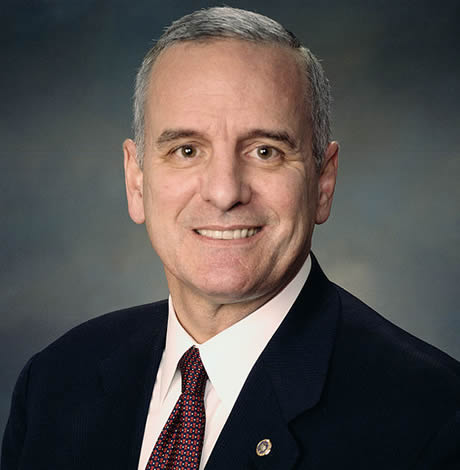
Gov. Mark Dayton will keep the travel ban to N.C. (Photo public domain)
Minnesota has become the first state to announce it will retain its travel ban to North Carolina enacted in protest over anti-LGBT bill House Bill 2 despite the governor signing into law a replacement measure.
Gov. Mark Dayton signed the travel ban in April, directing state employees not to travel to North Carolina for nonessential business, after the enactment of HB2 in the state.
Although North Carolina Gov. Roy Cooper, a fellow Democrat, has signed into law a replacement measure he says alleviates the situation, Sam Fettig, a Dayton spokesperson, told the Washington Blade on Wednesday, “No, we are not going to lift the ban.”
Criticized by LGBT rights supporters as a deal that doubles down on discrimination, the agreement between Cooper and Republican leaders in the legislature was reached amid an ongoing economic boycott of state as result of HB2.
The new law, House Bill 142, prohibits municipalities, state agencies and the University of North Carolina from the “regulation of access” to bathrooms, locker rooms and showers without the legislature’s permission. It also bans municipalities from enacting LGBT-inclusive nondiscrimination measures that would apply to private employment or public accommodations until 2020.
Numerous cities that had enacted similar travel bans in protest of HB2 — the District of Columbia, New York City, Oakland, Seattle, San Fransisco, Santa Fe, Salt Lake City and Cincinnati — have declared those bans will remain in place in the aftermath of the deal because of the discriminatory impact of the new law.
But the states haven’t been as forthcoming. At least six — California, Minnesota, New York, Vermont, Connecticut and Washington State — had enacted travel bans to North Carolina as a result of HB2.
A spokesperson for New York Gov. Andrew Cuomo, Rich Azzopardi, stopped short of affirming the ban will remain in place, although he said it remains for the time being.
“Our review of the new North Carolina law is ongoing, and the Governor’s Executive Order currently remains in effect,” Azzopardi said.
In Washington State, the travel ban has actually expired as a result of the new law in North Carolina. The memo that Inslee signed in 2016 states the travel ban would remain in effect “so long as the recently approved HB2 exists in its current form.”
Tara Lee, an Inslee spokesperson, confirmed that as a result of the deal Cooper signed into law “the travel ban no longer applies.”
“However, the governor feels that the changes to their state law are a disappointing half-measure towards the equal protections every person should receive,” Lee said.
In response to a follow-up inquiry on whether Inslee is considering putting a new travel ban in place, Lee replied, “We are considering options.”
California has ban on travel to North Carolina as result of Assembly Bill 1887, a law signed by Gov. Jerry Brown that allows the attorney general to maintain a list of states with laws rolling back LGBT rights and prohibit state-sponsored travel to those states. An official with Attorney General Xavier Becerra’s office said his office is reviewing whether North Carolina no longer warrants inclusion on the travel restriction list after the HB2 deal.
Connecticut Gov. Dan Malloy is also reviewing the new law in North Carolina before making a decision on whether to affirm the travel ban he signed last year, a spokesperson said.
“We don’t have an update, yet,” said Malloy spokesperson Kelly Donnelly. “We are still reviewing the new legislation.”
The offices of Vermont Gov. Phil Scott, a Republican, didn’t respond to a request for comment on the travel ban former Gov. Peter Shumlin, a Democrat, enacted last year.




National
Lou Chibbaro Jr. documentary wins award from NLGJA
‘Lou’s Legacy’ produced by D.C.’s Mattachine Society

“Lou’s Legacy: a Reporter’s Life at the Washington Blade,” a documentary produced by The Mattachine Society of Washington, D.C., will receive an Excellence in Journalism Award from NLGJA, the Association of LGBTQ+ Journalists.
The film premiered on WETA PBS in D.C. and Maryland Public Television (MPT) in June of 2025. The documentary’s Emmy-nominated director and producer Patrick Sammon will accept the award for Excellence in Local Television on Sept. 11 at NLGJA’s National Convention in San Francisco.
“Lou’s Legacy” was produced in association with the Mattachine Society of Washington, D.C., a non-profit LGBTQ history society dedicated to conducting original archival research. Aside from Sammon, the NLGJA is recognizing other members of the film’s production team including Producer Julianne Donofrio, Editor Amir Jaffer, Executive Producer Charles Francis, and Executive Producer Pate Felts.
“Lou’s Legacy” tells the story of two D.C. icons — legendary Washington Blade reporter Lou Chibbaro Jr. and beloved drag performer Donnell Robinson, known to generations of Washington audiences as “Ella Fitzgerald.” Through Lou’s nearly five-decade career at the Blade and Ella’s return to the stage after a three-year hiatus following COVID, the 29-minute documentary explores the history of Washington’s LGBTQ community and today’s rising backlash against LGBTQ rights, including laws targeting drag performers.
“All students of journalism can learn a lot from the story of Lou Chibbaro, Jr. Lou has chronicled nearly five decades of LGBTQ+ life and the community’s struggle for equality in Washington, D.C. Lou’s work and the role of the queer press has been essential in covering stories the mainstream media would often ignore or erase,” said Ryan Levi, president of the D.C. chapter of the NLGJA.
“We are thrilled to receive this award from the NLGJA,” said the film’s director Patrick Sammon. “Lou Chibbaro’s nearly five decade career at the Washington Blade demonstrates the essential role LGBTQ journalism plays in telling our community’s stories and documenting its history. This recognition from journalists who follow in Lou’s footsteps is particularly meaningful to me and the rest of our production team.”
Arizona
Shooting outside gay bar in Ariz. leaves three dead
Tucson police investigating double murder-suicide as a hate crime
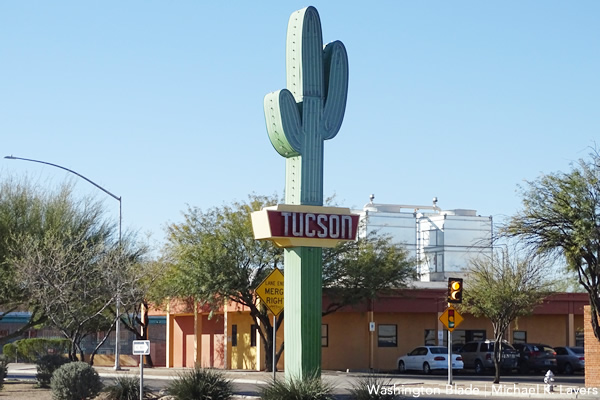
Three people were fatally shot outside a gay bar in Tucson, Ariz., early Monday morning, about a mile from the city’s nightlife district.
Police have said the shooting, which took place in the parking lot of Venture-N bar at 1239 N. 6th Ave., was likely a hate crime and a double murder-suicide following a verbal altercation.
The suspect, Ousman Ceesay, allegedly shot Vincent Anthony Siqueiros and Cameron Davis Capara while they were outside the club around 12:30 a.m. Monday.
Reports show Capara and Siqueiros were pronounced dead at the scene. Ceesay died after being taken to a local hospital with gunshot wounds.
Police have also said that Ceesay was carrying a list of LGBTQ businesses at the time of the shooting.
Arizona Public Media has said police are investigating the case as a hate crime because the suspect was carrying a note containing the names of multiple LGBTQ-associated businesses.
“I am deeply saddened that another senseless loss of life has happened in our community,” Tucson Police Chief Monica Prieto said in a statement. “Bias-based crimes are especially heinous and have no place in our community.”
According to Prieto, there is no imminent threat to the community, and the Tucson Police Department is working to provide extra protection to various LGBTQ businesses across town.
Congresswoman Adelita Grijalva, who represents the area, issued a statement condemning the act of violence, which appears to have been at least in part motivated by homophobia.
“I am disgusted and deeply saddened to learn of a targeted act of hate and the cold-blooded murder of two members of our LGBTQIA+ community, Vincent Siqueiros and Cameron Capara, at the Venture-N bar in Tucson last night. This horrific attack is a painful reminder that even in welcoming communities like Tucson, hate and violence against the LGBTQIA+ community still exist.”
“When that hate is combined with easy access to firearms, the consequences can be deadly. I am sick and tired of Congress refusing to lift a finger to protect our communities while, every day, dozens of people are shot and killed across the country. It does not have to be this way. The House of Representatives is returning to session this week, and our first action should be passing common-sense gun safety reforms that we know can save lives.”
Other federal lawmakers also condemned the shooting.
The Congressional Equality Caucus, which is made up of federal legislators advancing LGBTQ interests, issued a statement after news broke.
“Our hearts are with the friends and loved ones of the victims of this devastating attack outside a Tucson gay bar and with the Tucson LGBTQI+ community,” it said on X. “No one should fear violence because of who they are — and we’re going to continue fighting to build a world where no one does.”
The Human Rights Campaign, the largest LGBTQ organization in the country, released a statement following the shooting.
“We are heartbroken by the loss of Vincent Anthony Siqueiros and Cameron Davis Capara and our hearts are with their families, loved ones, and the entire Tucson LGBTQ+ community. Once again, we are reminded that gun violence robs people of their lives, destroys families, and devastates communities.”
A candlelight vigil honoring the victims is planned for Sept. 2 at 6:30 p.m. at Catalina Park in North Tucson.
Congress
HRC president campaigns for Chris Pappas in NH
Gay congressman running to succeed retiring U.S. Sen. Jeanne Shaheen

Human Rights Campaign President Kelley Robinson on Sunday campaigned for U.S. Rep. Chris Pappas (D-N.H.) in New Hampshire.
Robinson traveled to Manchester, the state’s largest city, nine days before the Sept. 8 primary that will determine who will vie for retiring U.S. Sen. Jeanne Shaheen (D-N.H.)’s seat.
We’re hitting the pavement across New Hampshire to fight for a freer, fairer future for everyone.
Glad to have Human Rights Campaign President @KelleyJRobinson join us for a canvass launch in Manchester today. pic.twitter.com/XWCEaQxy4o
— Chris Pappas (@ChrisPappasNH) August 30, 2026
Former U.S. Sen. John E. Sununu, who represented New Hampshire in the U.S. Senate from 2003-2009, will face off against former U.S. Sen. Scott Brown, who represented Massachusetts in the U.S. Senate from 2010-2013, in the Republican primary.
Karishma Manzur is among the Democrats challenging Pappas.
A poll the University of New Hampshire Survey Center released on Aug. 26 shows Sununu is ahead of Brown. The same survey shows Pappas ahead of Manzur and his other Democratic challengers.
The UNH Survey Center poll shows Sununu ahead of Pappas by a 45-43 percent margin if they were to face off in the general election. The margin of error is +/-2.1 percent.
Pappas would become the first openly gay man elected to the U.S. Senate if he were to win in November.

Lou Chibbaro Jr. documentary wins award from NLGJA

Beloved D.C. ‘Old Catholic’ Bishop Charles Braun dies at 86

Blade welcomes fall intern

PHOTOS: Miss Gay Old Bay

SUNFESTIVAL takes center stage as Rehoboth Beach closes out summer

San Francisco, long a queer safe haven, remains competitive for homebuyers

Actor Tim Curry dies at 80

E-INFOSOL leaders encourage youth to pursue tech careers
Archuleta to host book signing in Rehoboth Beach