News
Trump’s day of anti-LGBT acts: A new low or par for the course?
Trans military ban undermines claim he’s an ally
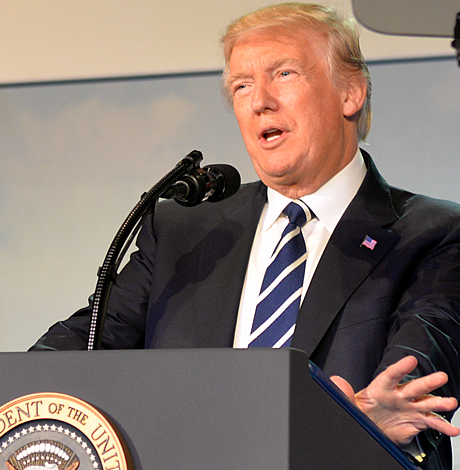
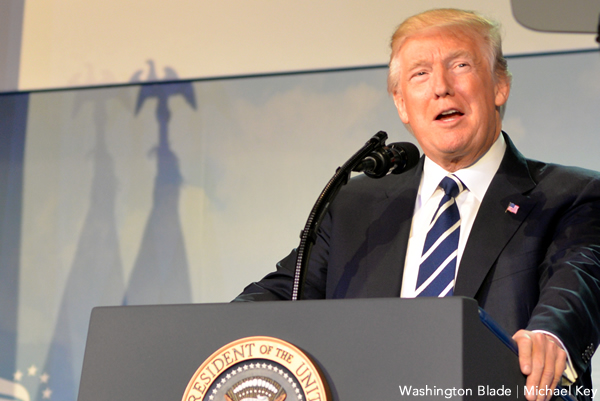
President Trump‘s professed support for LGBT rights will now be a harder sell. (Washington Blade file photo by Michael Key)
Once a self-proclaimed friend to the LGBT community, President Trump will find such words a harder — if not impossible — sell in the aftermath of major actions he took against LGBT rights in the past week.
In one day, President Trump announced — via tweets, no less — that transgender people won’t be allowed to serve in the U.S. military “in any capacity,” overturning an Obama-era change allowing them into the armed forces. On the same day, Trump’s Justice Department filed a friend-of-the-court brief arguing lesbian, gay and bisexual people are entitled to no protections under the Civil Rights Act of 1964.
To top that off, Trump on the same day announced he’d appoint as U.S. ambassador-at-large for international religious freedom Kansas Gov. Sam Brownback, who’s undermined LGBT rights over his political career in the name of religious liberty.
Trump has taken actions before that have disappointed LGBT people, but the unilateral imposition of a transgender service ban — after Congress rejected a measure that would have restricted transition-related care for service members — and a voluntary friend-of-the-court brief undermining basic employment protections have taken things up a notch.
What gives? Over the course of his presidential campaign, Trump billed himself as a new kind of Republican candidate who unlike his predecessors or his competitors for the 2016 Republican nomination would support LGBT people.
During the Republican National Convention, Trump was the first Republican presidential nominee in history to mention LGBT people in a positive way during his acceptance speech for the nomination, citing the recent shooting at a gay nightclub in Orlando, Fla., that left 49 people dead and 53 wounded.
“As your president, I will do everything in my power to protect our LGBTQ citizens from the violence and oppression of a hateful foreign ideology,” Trump said. “Believe me.”
Trump at a later event criticized his opponent Hillary Clinton for donations the Clinton Foundation accepted from Middle Eastern countries that impose the death penalty and imprisonment for homosexuality.
“Ask the gays what they think and what they do in not only Saudi Arabia, in many of these countries with the gay community,” Trump said. “Let’s ask. Then you tell me: Who’s your friend, Donald Trump or Hillary Clinton?”
Referencing Clinton’s immigration policy and support for increased refugees in a subsequent message on Twitter, Trump said, “Thank you to the LGBT community! I will fight for you while Hillary brings in more people that will threaten your freedoms and beliefs.”
Those words, of course, ignore Clinton’s detailed commitment to LGBT rights and specific policy plans on LGBT issues, including support for transgender military service and protections for gay people under civil federal law, which Trump never promised over his presidential campaign.
The Human Rights Campaign, which had never accepted Trump’s overtures to LGBT people as he campaigned against Clinton, produced a video in the aftermath of his administration’s recent anti-LGBT action proclaiming him “Liar-in-Chief.”
Critics of Trump are quick to point out he expressed solidarity with LGBT people in terms of sowing opposition to Muslims, or least raising fears about Islamic extremism.
But at the start of the administration, the White House declared Trump was “respectful and supportive” of LGBT rights without making such references in a statement declaring he’d keep intact former President Obama’s 2014 executive order against anti-LGBT workplace discrimination among federal contractors.
Gregory Angelo, president of Log Cabin Republicans, denied any kind of shift from Trump in his approach to LGBT issues despite his organization’s criticism of the transgender military ban.
“Then-candidate and now-President Trump has always pursued balancing religious liberty and LGBT equality, and I don’t think there has been any fundamental shift from that position,” Angelo said. “What I see in Trump is someone who in an often clumsy — but nonetheless admirable — way is attempting to address a Republican electorate with vastly divergent views on LGBT-related issues.”
White House Press Secretary Sarah Huckabee Sanders insisted Trump had a holistic approach to his presidency when asked if he betrayed LGBT people with his recent actions.
“I think the president had made very clear he’s committed to fighting for all Americans,” Sanders said.
There’s a long list of anti-LGBT actions from Trump. Most notably, his administration rescinded Obama-era guidance to schools assuring transgender kids access to public restrooms consistent with their gender identity. The removal of LGBT questions from federal health surveys and their omission in the upcoming census also riled his LGBT critics.
The president has also refused to condemn reports of anti-gay violence in the semi-autonomous Republic of Chechnya, despite multiple entreaties from LGBT rights groups to speak out, and declined to issue a proclamation recognizing June as Pride month.
Sarah Kate Ellis, CEO of GLAAD, said recent actions from his administration are just par for the course for a president who has no intention of keeping his campaign promises.
“President Trump and his administration have shown over the last couple weeks that they are willing to be more public about their anti-LGBTQ agenda and goal to erase LGBTQ Americans from the fabric of this nation,” Ellis said. “From the ban on transgender soldiers from serving in the U.S. military, the Justice Department’s choice to exclude LGBTQ people as a protected class under the Civil Rights Act, and confirming closed-door meetings with anti-LGBTQ activists at the White House, President Trump has revealed that his campaign pledge to protect LGBTQ Americans was nothing more than a con job.”


Poland
Polish court rules country must recognize same-sex marriages from EU states
Poland ‘must comply with European Union law’
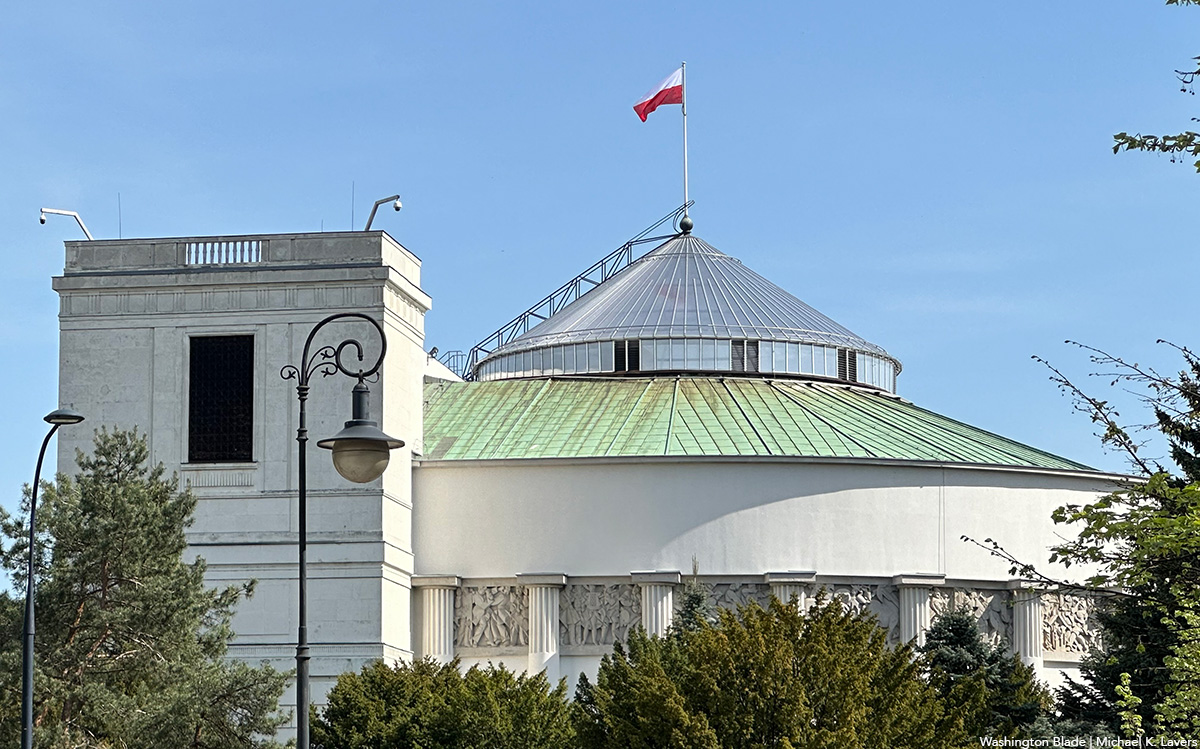
Poland’s Supreme Administrative Court on March 20 ruled the country must recognize same-sex marriages legally performed in other European Union states.
The EU Court of Justice in Luxembourg last November ruled in favor of a same-sex couple who challenged Poland’s refusal to recognize their German marriage.
The couple, who lives in Poland, brought their case to Polish courts in 2019. The Supreme Administrative Court referred it to the EU Court of Justice.
“Today’s ruling by the Supreme Administrative Court clearly demonstrates that Poland, as a member state of the European Union, must comply with European Union law,” said Przemek Walas, advocacy manager for the Campaign Against Homophobia, a Polish LGBTQ advocacy group, in a statement. “The Supreme Administrative Court rightly upheld the interpretation of the Court in Luxembourg and indicated that the only way to implement this ruling is to allow the transcription of a foreign marriage certificate.”
“This ruling is a significant step towards marital equality, but certainly not sufficient,” added Walas.
Ireland, Portugal, Spain, France, Luxembourg, Belgium, the Netherlands, Germany, Denmark, Austria, Slovenia, Malta, Greece, Sweden, Finland, and Estonia are the EU countries that have extended full marriage rights to same-sex couples. Poland — along with Romania, Bulgaria, and Slovakia — are the four EU countries with no legal recognition of same-sex couples.
District of Columbia
Capital Stonewall Democrats 50th anniversary gala draws ‘sold out’ crowd
D.C. elected officials, mayoral candidates praise LGBTQ Democratic group

A sold-out crowd of 186 people, including D.C. elected officials and candidates running for D.C. mayor, turned out Friday, March 20, for the Capital Stonewall Democrats 50th anniversary celebration.
Among those attending the event, held at the Pepco Edison Place Gallery building next to the city’s Chinatown neighborhood, were seven D.C. Council members and four Democratic candidates running for mayor.
But at the request of Capital Stonewall Democrats leaders, the Council members, most of whom are running for re-election, and mayoral contenders did not give campaign speeches. Instead, they mingled with the crowd and focused on the accomplishments of the LGBTQ Democratic group over the past 50 years, with some presenting the group’s special “honor” awards to about a dozen prominent LGBTQ Democratic activists.
D.C. Mayor Muriel Bowser, who was initially expected to attend the event, did not attend.
The mayoral candidates attending included D.C. Council member Janeese Lewis George (D-Ward 4) and former At-Large Council member Kenyan McDuffie, an independent turned Democrat, who are considered the leading mayoral contenders in the city’s June 16 Democratic Primary. Both have strong, longtime records of support for LGBTQ rights issues.
The other two mayoral candidates attending the event were Gary Goodweather, a real estate manager, and Rini Sampath, a cybersecurity consultant. Sampath told the Washington Blade she self-identifies as queer. Both have expressed strong support on LGBTQ-related issues.
The D.C. Council members attending the event included Lewis George; Council Chair Phil Mendelson (D-At-Large); Anita Bonds (D-At-Large); Robert White (D-At-Large); Matt Frumin (D-Ward 3); Zachary Parker (D-Ward 5), the Council’s only gay member; and Charles Allen (D-Ward 6).
“Tonight we celebrate not just 50 years of history but 50 years of showing up,” Howard Garrett, Capital Stonewall Democrats immediate past president, told the gathering in opening remarks. “Showing up when it was easy, showing up when it wasn’t popular,” he said, adding, “This work only continues if we continue to show up.”
He noted that the deadline for joining the organization in time to be eligible to vote on its endorsement of candidates running in D.C.’s 2026 election was midnight that night. He urged attendees who were not members to go to two tables at the event to join.
The group’s current president, Stevie McCarty, thanked the group’s longtime members who he said played a key role in what he called its historic work in building political support for the D.C. LGBTQ community. Among those he thanked was Paul Kuntzler, 84, one of the group’s founding members in January 1976, when it was initially named the Gertrude Stein Democratic Club.
Members voted to rename the group the Capital Stonewall Democrats in 2021.
Among the LGBTQ advocates who were honored at the event was Rayceen Pendarvis, the longtime host of a D.C. LGBTQ online interview show that included interviews of candidates for public office. Pendarvis also served as emcee for the Capital Stonewall Democrats 50th anniversary event.
“Thank you everyone in this room who has done the work to make this world a better place,” Pendarvis said in opening remarks. “To all our prestigious activists in the room, all of our amazing politicians in the room who are doing the work, we love you and we honor you.”
Among the honorees in addition to Pendarvis was Malcolm Kenyatta, the Democratic National Committee’s vice chair who became the first openly LGBTQ person of color to win election to the Pennsylvania General Assembly in 2018.
Other honorees included Parker; Earl Fowlkes, founder of the International Federation of Black Prides; Vita Rangel, a transgender woman who serves as deputy director of the D.C. Mayor’s Office of Talent and Appointments; Heidi Ellis, director of the D.C. LGBTQ Budget Coalition; and Philip Pannell, longtime LGBTQ Democratic activist, Ward 8 civic leader, and longtime Capital Stonewall Democrats member.
The 50th anniversary event included an open bar and refreshments and entertainment by three drag performers.
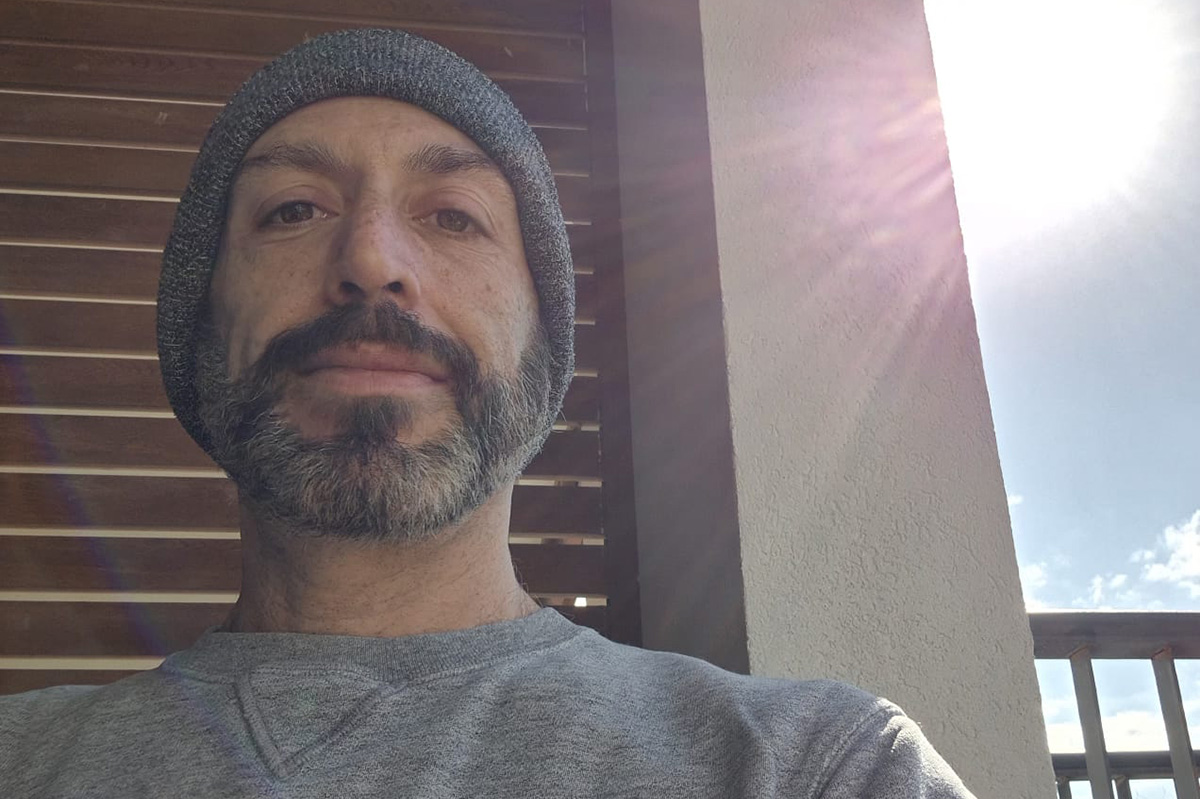
The Washington Blade on Wednesday spoke with Max Polonsky, a queer American who lives in Israel, about the Iran war and its impact on the country.
“It’s been tiring,” Polonsky told the Blade during a telephone interview from his home in Jaffa, an ancient port city with a large Arab population that is now part of Tel Aviv.
Polonsky grew up in Cherry Hill, N.J. He lived in D.C. for eight years before he moved to Israel in March 2022.
Israel and the U.S. on Feb. 28 launched airstrikes against Iran.
One of them killed Supreme Leader Ayatollah Ali Khamenei. Iran in response launched missiles and drones against Israel and other countries that include Kuwait, Bahrain, Qatar, the United Arab Emirates, Jordan, Saudi Arabia, Azerbaijan, and Cyprus.
An Iranian missile on March 1 killed nine people and injured 27 others in Beit Shemesh, an Israeli town that is roughly 20 miles west of Jerusalem. Shrapnel from an Iranian missile that struck a hair salon in Beit Awa, a Palestinian town in the West Bank, on Wednesday killed four women and injured more than a dozen others.
An Iranian drone that hit a command center in Kuwait on March 1 killed six U.S. soldiers: Sgt. Declan Coady, Sgt. 1st Class Nicole Amor, Capt. Cody Khork, Sgt. 1st Class Noah Tietjens, Chief Warrant Officer 3 Robert Marzan, and Maj. Jeffrey O’Brien. Another American servicemember, Sgt. Benjamin Pennington, died on March 8, a week after Iranian drones and missiles targeted the Prince Sultan Air Base in Saudi Arabia.
Iranian drones and missiles have damaged hotels, airports, oil refineries, and other civilian and energy infrastructure in the United Arab Emirates, Kuwait, Qatar, and elsewhere. Israel on Wednesday attacked Iran’s South Pars natural gas field in the Persian Gulf.
The Associated Press notes roughly 20 percent of the world’s crude oil passes through the Strait of Hormuz that connects the Persian Gulf and the Gulf of Oman. Gas prices in the U.S. and around the world continue to increase because the war has essentially closed the strategic waterway to ship traffic.
The war also left hundreds of thousands of people who were traveling in the Middle East stranded.
The Blade on March 6 spoke with Mario, who had stopped in his native Lebanon while traveling from the U.S. to India for work.
Mario was about to board a flight at Rafic Hariri International Airport in Beirut, the Lebanese capital, on Feb. 28 when the war began and authorities closed the country’s airspace. Mario is now back in the U.S.
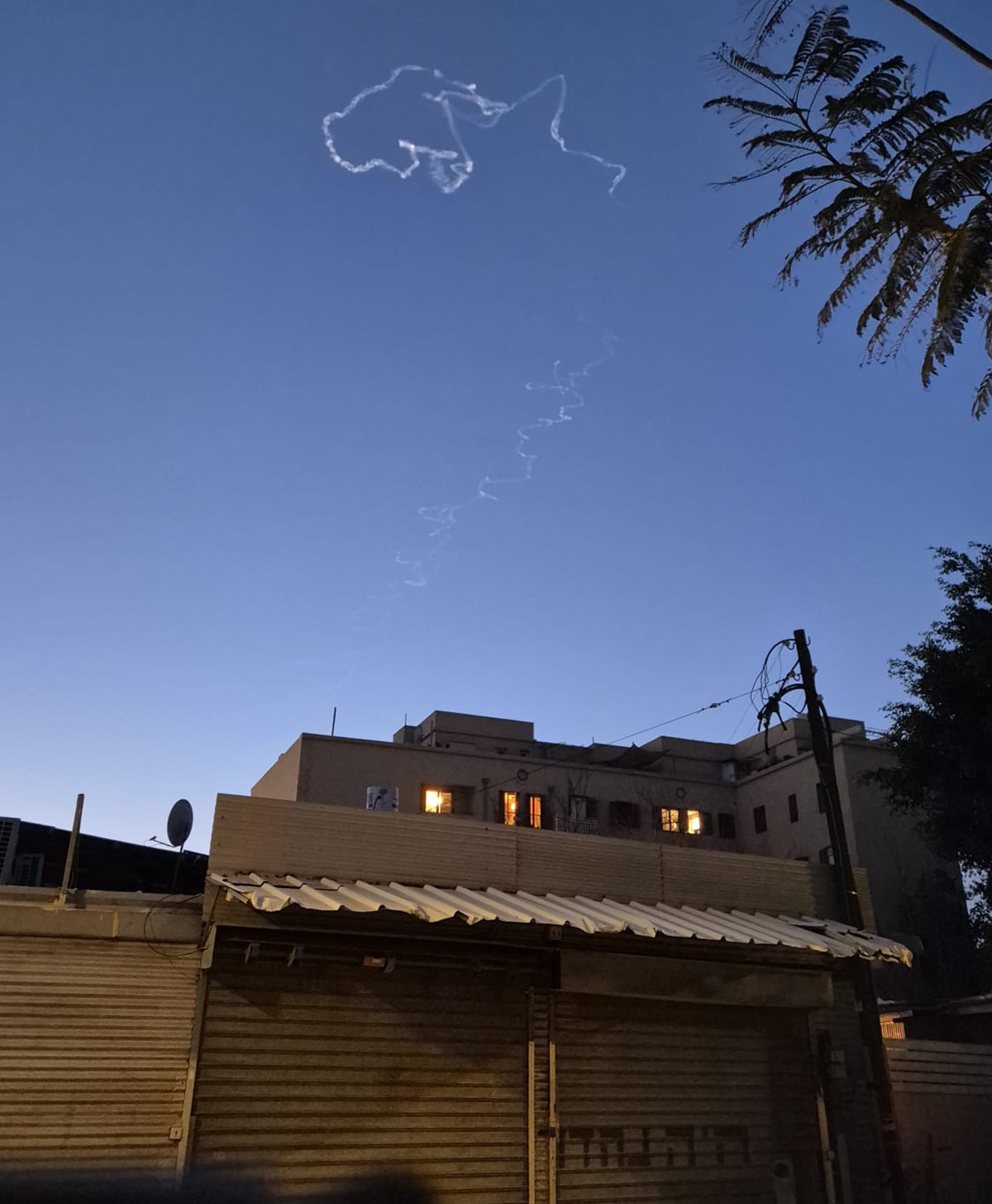
Polonsky told the Blade there were “alarms all day … sometimes multiple alarms an hour, sometimes every hour, every two hours” on Feb. 28.
Israel’s Home Front Command typically issues warnings about 10 minutes ahead of an anticipated Iranian missile attack. Sirens then sound 90 seconds before an expected strike.
People in Tel Aviv, Jerusalem, and in other cities in central Israel have 90 seconds to seek shelter if a rocket or missile is fired from Lebanon or the Gaza Strip. (Hezbollah, an Iran-backed Shia militant group in Lebanon that Israel and the U.S. have designated a terrorist organization, launched rockets at the Jewish State after Khamenei’s death. Israel, in turn, continues to carry out airstrikes against Hezbollah targets in Lebanon. Hamas militants on Oct. 7, 2023, killed upwards of 1,200 people when they launched a surprise attack against Israel from the Gaza Strip.) People who live close to Lebanon and Gaza have 15 seconds to seek shelter.
Polonsky has a safe room — known as a “mamad” — in his apartment. Polonsky also uses it as his home office and a second bedroom.
He told the Blade the alerts in recent days have become less frequent.
“We’ll get maybe a handful of alarms during the day, maybe some at night,” said Polonsky.
Israel on June 12, 2025, launched airstrikes against Iran that targeted the country’s nuclear and military facilities. The subsequent war, which lasted 12 days, prompted the cancellation of Tel Aviv’s annual Pride parade. An Iranian missile destroyed Mash Central, the city’s last gay bar.
Iran on Oct. 1, 2024, launched upwards of 200 ballistic missiles at Israel. This reporter arrived in Israel three days later to cover the first anniversary of Oct. 7 and the impact the subsequent war in the Gaza Strip had on LGBTQ Israelis and Palestinians.
‘Iranian regime was bad’
Polonsky admitted he doesn’t “know what to think” about the latest war against Iran.
“I don’t know what I think about the war,” he said. “Ultimately what happens is just not in my personal control: whatever Donald Trump, [Israeli Prime Minister Benjamin] Netanyahu, the ayatollah, whoever is running Iran are going to organize and launch attacks and reach any deals is not anything I personally have any control over, so I try to just kind of let that aspect of it go as I’m living my life.”
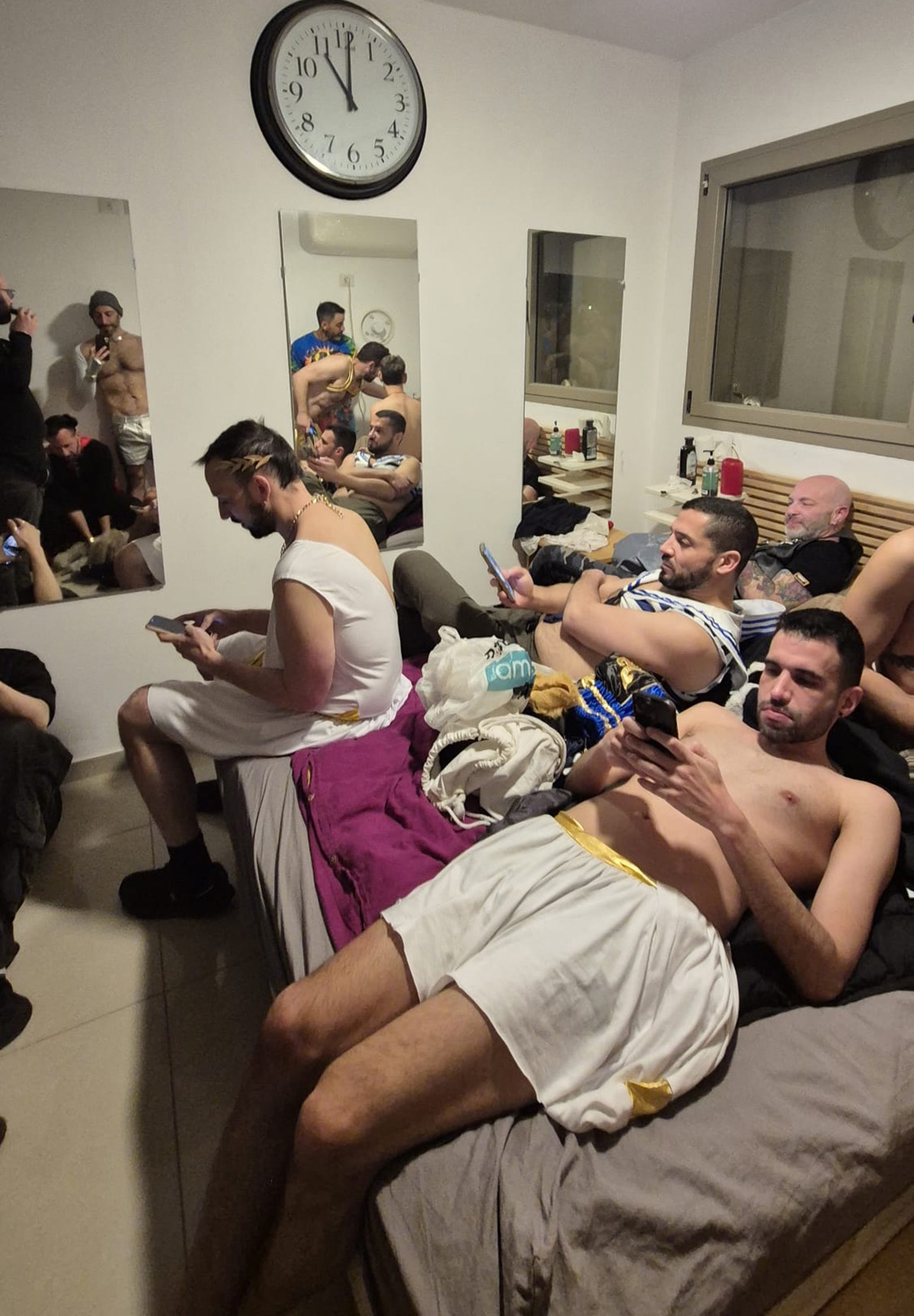
Polonsky told the Blade he understands “there are very serious questions about how” the war started, and Congress’s role in it.
“Those are serious and valid, important questions,” he said. “And at the same time, the Iranian regime was bad.”
Polonsky noted Iran has supported and funded Hezbollah, Hamas, Houthi rebels in Yemen, and other groups “who were attacking Israel.” Polonsky added the Iranian government has “terribly oppressed their people.”
Iran is among the handful of countries in which consensual same-sex sexual relations remain punishable by death.
Reports indicate Iranian authorities killed upwards of 30,000 people during anti-government protests that began late last year. Sources with whom the Blade spoke said LGBTQ Iranians are among those who participated in the demonstrations.
“I’m not sad to see them pressured,” said Polonsky, referring to the Iranian regime.
He also described Khamenei as “a bad guy.”
“Him not being there is better,” said Polonsky.

Polish court rules country must recognize same-sex marriages from EU states

Capital Stonewall Democrats 50th anniversary gala draws ‘sold out’ crowd

PHOTOS: Capital Stonewall Democrats 50th anniversary

Small is beautiful: subcompact SUVs

‘Inherit the Wind’ isn’t about science vs. religion, but the right to think

SAVE Act could silence millions of trans voters

The frightening rise of antisemitism, Islamophobia

‘It’s Dorothy’ traces lasting influence of a cultural icon
Protesters say SAVE Act targets voters, transgender youth