Opinions
Celebrating victory with Biden and Harris
Let us do all we can to ‘build back better’
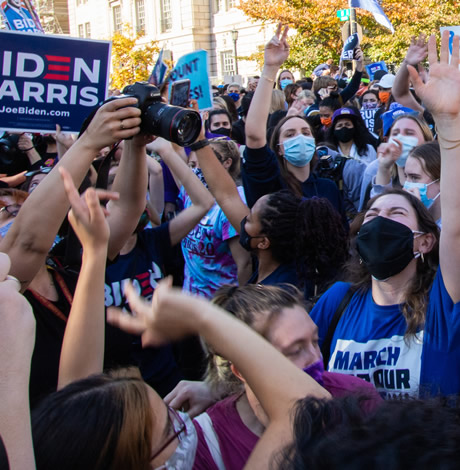
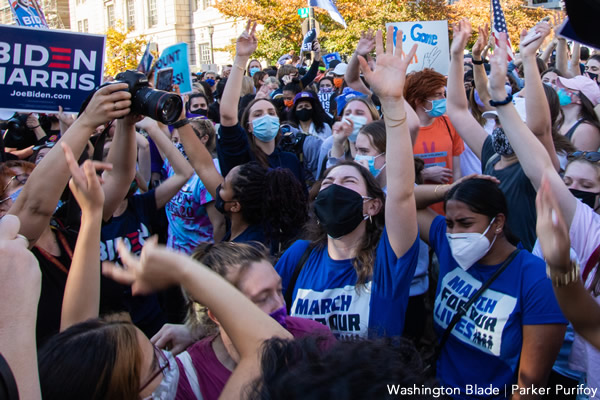
Last Sunday morning like so many Americans and people around the world I woke up able to take a deep breath of fresh air and consider a host of new possibilities. When the networks finally called the election on Saturday and told us Joe Biden was president-elect and Kamala Harris was vice president-elect we could finally believe we are moving forward into a brighter future.
We took to the streets to celebrate. Living in D.C., I headed to the White House with thousands of others. We cheered each other, touching elbows with strangers, all the while wearing our face masks. The same scene occurred in cities around the country; spontaneous, jubilant crowds celebrating Biden and Harris’s win and Trump’s loss. Many have worked for this result since he defeated Hillary in 2016. We celebrated Harris because for the first time a woman was elected on a national ticket; the daughter of immigrants, an African American with Indian heritage. I only wish the congresswoman I worked for, Bella S. Abzug (D-NY) had lived to see this. She would be so proud.
On Saturday evening the president-elect and vice president-elect spoke to the nation. They both made it abundantly clear they were speaking to everyone. Biden said “I am a proud Democrat but I will govern as an American.” He made a plea to those in both parties to stop the demonization of each other and realize we are all Americans. I applaud him for saying that but know for many it will be hard to do. I will try to follow his lead.
What comes simultaneously as Biden begins to lay out his first 100-day plans will be the dissection of the campaign by each party, and the factions within the parties. I read an interview the New York Times conducted with Rep. Alexandria Ocasio-Cortez (D-N.Y.) the proud Democratic Socialist who has become a leading voice for the left. It was disappointing to say the least. She discussed what she called the hostility to her and her views by the Democratic Party. She challenged moderates who said some of their losses were the fault of progressives like her. At the end of the interview when asked if she would consider a Senate run in two years she said “I genuinely don’t know. I don’t even know if I want to be in politics. You know, for real, in the first six months of my term, I didn’t even know if I was going to run for re-election this year.” What bothers me about this is the apparent lack of understanding of how American democracy and our Congress work. What it means to fight for what you believe and to do so for as many years as it takes to win. What would have happened if women gave up before they got the right to vote, or African Americans and the LGBTQ+ community didn’t stay in the fight demanding full equality?
We will dissect the results to determine why some Democrats lost their seats and others won theirs and why we didn’t win Florida or take the Senate.
While this is happening Democrats have another chance to take over the Senate with the two run-off races in Georgia on Jan. 5. Those races will determine whether President Biden is forced to negotiate every issue with Mitch McConnell or whether Vice President Kamala Harris as president of the Senate can break a tie and give Democrats a win.
While this happens, President-elect Biden will be planning his coronavirus task force and determining how he will fight the pandemic, which is out of control around the world, and how to rebuild the American economy. He is right when he says unless we get the virus under control the second issue will be more difficult. President Trump apparently will not cooperate with the president-elect and this will be the first time in recent American history a losing incumbent hasn’t worked toward a smooth transition.
So as we celebrate Joe and Kamala, let us as Americans do all they ask of us so we can “Build back better.”
Peter Rosenstein is a longtime LGBTQ rights and Democratic Party activist. He writes regularly for the Blade.



Opinions
How arts institutions built the city that politics couldn’t
Doing the work that politicians have left undone

Washington is often described as a city consumed by politics. The story is usually about power — who has it, who wants it, who just lost it. But that version of Washington barely scratches the surface.
The real texture of this place — its neighborhoods, its memory, its communities, its soul— rarely fits inside the horse-race coverage that so often defines the city from the outside. Much of that texture lives in the city’s cultural institutions: its theaters, choruses, galleries, and community arts spaces.
And right now, that foundation is under threat from pressures such as rising costs, shrinking grants, and uncertain funding cycles. When arts organizations in this city close or cut back, what disappears is not a season of concerts. It is the room where a teenager finds out the city has a place for them. It is the stage where a neighborhood tells its own story. It is years of civic life, built slowly and at great cost.
I serve as the executive director of the Gay Men’s Chorus of Washington, DC (GMCW). We were founded in 1981, the same year the AIDS crisis began reshaping our community in ways we are still reckoning with. Our first public performance was at the District Building, at Mayor Marion Barry’s invitation. Our first holiday concert was a collaboration with the DC Area Feminist Chorus and D.C.’s Different Drummers. From the very beginning, we were not just a singing group. We were a civic statement. And we were part of a city that had been making civic statements through art for a very long time.
In 1965, Frank Kameny and the Mattachine Society of Washington organized the first gay rights picket at the White House. A decade later, Lambda Rising — founded as the first non-bar business in D.C. serving the gay community — hosted the city’s first official Gay Pride event and became what participants called “The Community Building”: bookstore, meeting hall, political nerve center, and arts hub all at once. DC Black Pride launched in 1991, born directly from the urgent organizing that the HIV/AIDS crisis demanded. In a city where queer people had been fired from federal jobs for who they were, cultural space was a form of resistance.
That is the history we inherited when GMCW held its organizing meeting on June 28, 1981, deliberately chosen as the 12th anniversary of Stonewall. We struggled early on to find a church willing to host us. St. Mark’s Episcopal finally said yes. It was the same church that had hosted Mattachine Society meetings. In that small fact, you can see how Washington works: religious space, movement history, and performing arts overlapping to create something the city needed.
Over more than four decades, we have tried to honor that inheritance. We have performed at the White House and at Washington National Cathedral. We were the first queer choral group invited to perform at a presidential inauguration, appearing during Bill Clinton’s second inaugural in 1997. We have partnered with Whitman-Walker Health, the Library of Congress, and community organizations across the District.

Some of the work I am most proud of is the work we are doing for the future. Our GenOUT Youth Chorus, launched in 2015, was the first LGBTQ+ youth chorus in the D.C. area. These young people find in GenOUT a place that tells them they are not problems to be managed. They are artists. They are part of this community. They belong here, and they have something to say.
That is what arts institutions do that no policy document fully captures. They create the conditions for people to recognize themselves and each other. Dance Place turned an abandoned Brookland warehouse into a community cultural center. GALA Hispanic Theatre has tied performance to youth education for nearly 50 years. Woolly Mammoth has challenged and expanded what theater can hold. Shakespeare Theatre Company’s Free For All has drawn thousands to classical performance, free of charge, year after year.
These organizations are infrastructure. Right now, this infrastructure is fragile. Arts organizations run on thin margins, on the faith of donors and audiences and grantmakers, on the labor of people who could earn more doing something else and choose not to. When that support erodes — as it periodically does, often in the name of austerity or political expediency — what is lost is the connective tissue of civic life.
Washington is a political city. But it is also a city where queer people have sung, mourned, celebrated, and organized for decades. It is a city where arts institutions have again and again shown up to do the work that politics left undone.
Justin Fyala is executive director of the Gay Men’s Chorus of Washington, D.C.
A right does not need to be banned to be restricted. Sometimes it only needs to be made uncertain.
That is what emerges from a closer examination of adoption access for same-sex couples across different countries. There is no broad legal rollback. What appears instead is a more subtle pattern: rights that remain on paper but become fragile, conditional, and uneven in practice.
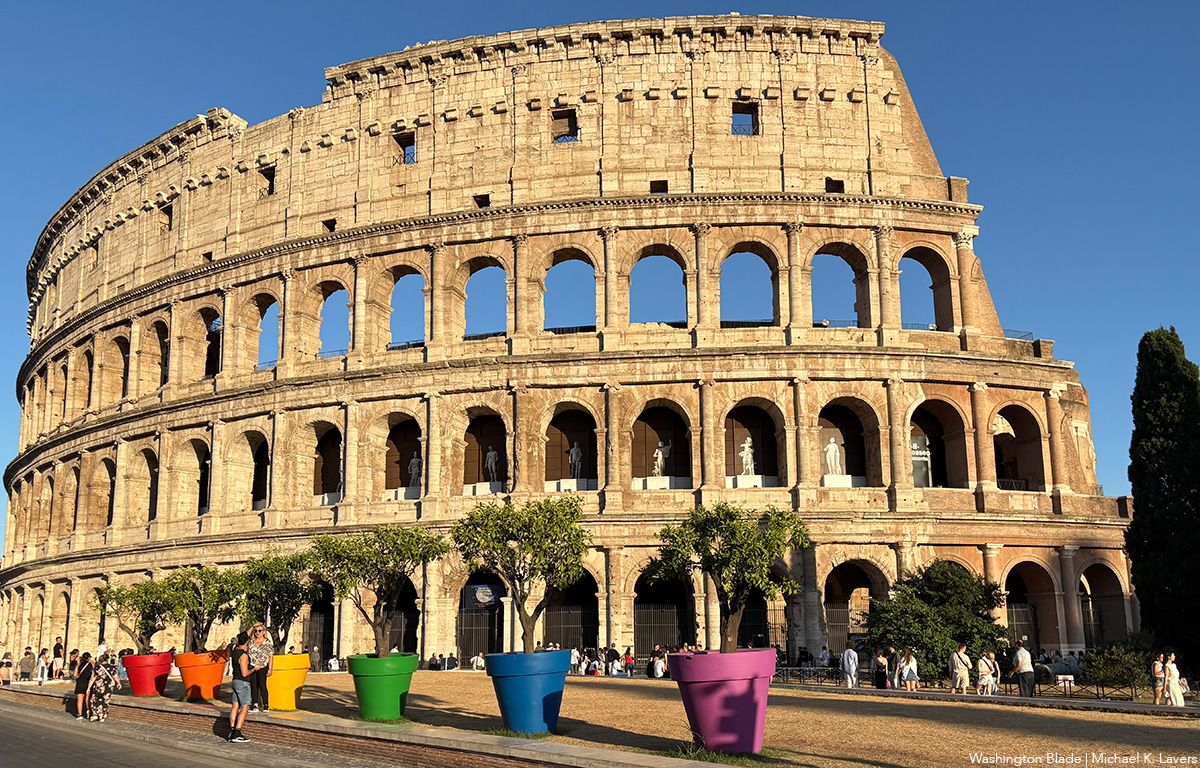
Italy provides a clear example.
Since 2023, under the government of Giorgia Meloni, administrative decisions have limited the automatic recognition of both mothers in female same-sex couples, particularly in cases involving assisted reproduction abroad. In practice, many families have been forced into additional legal proceedings to validate relationships already established.
At the same time, Italy has intensified its opposition to surrogacy, extending penalties even to those who pursue it outside the country. Human rights organizations have warned that these measures disproportionately affect LGBTQ families, particularly male couples.
The judiciary, however, has pushed back.
In 2025, the Constitutional Court ruled that a non-biological mother cannot be excluded from legal recognition when there is a shared parental project. It also removed a long-standing restriction that prevented single individuals from accessing international adoption.
Italy has not eliminated these rights. But it has made them unstable.
When a right depends on litigation, judicial timelines, or shifting interpretations, it is no longer fully guaranteed.
In the United States, the structure differs, but the outcome converges.
At the federal level, same-sex couples can adopt. Yet the system varies widely across states.
Data from the Movement Advancement Project show that while some states explicitly prohibit discrimination in adoption, others provide no clear protections. In several states, licensed agencies can refuse to work with same-sex couples based on religious objections.
Access, therefore, is shaped not only by law, but by geography, institutions, and applied standards.
Research from the Williams Institute further complicates the narrative. Same-sex couples adopt and foster children at higher rates than different-sex couples.
The contradiction is clear.
Child welfare is invoked, yet the pool of available families is reduced. Faith is cited, yet it is used as a filter within publicly funded systems.
The consequences are tangible
children remain longer in care
processes become more complex
families face unequal scrutiny
What is happening in Italy and the United States is not isolated. Across parts of Europe, conservative governments have advanced legal frameworks that reinforce traditional definitions of family while limiting recognition of diverse ones.
Adoption is not always addressed directly. But the impact accumulates.
Options are restricted while the language of protection is used to justify it.
There is no need to soften it.
This is not only a debate about family models. It is a decision about who is recognized as family and who must continue asking for permission.
That is not neutral.
It is political.
And when a right depends on where you live, who evaluates you, or how hard you are willing to fight for it, that right is already being weakened.
Opinions
ROSENSTEIN: Chavous for Democratic D.C. Council-at-Large
Committed to fighting for statehood for our 700,000 residents
Kevin Chavous said, “I’m running for D.C. Council At-Large because Washingtonians deserve leadership focused on improving their everyday quality of life. Throughout my career, I’ve worked on the practical business of city government, and public policy, focused on solving real problems, and making government work better for the people it serves.”
Kevin’s experience spans safer streets, affordable housing, early education and school readiness, workforce and economic opportunity, support for seniors, and the day-to-day operations of city government. The knowledge he brings to the office is grounded in experience, clear-eyed oversight, and a commitment to delivering results. His platform outlines his priorities and approach, but as he has said, “it’s not the end of the conversation. I believe the best solutions come from listening and working together.”
Kevin believes safe streets are the foundation of strong neighborhoods. He is committed to having Washingtonians feel secure in their neighborhoods, and working to ensure all public safety efforts are smart, fair, and effective. To Kevin that means an approach focusing on enforcement that works, prevention that matters, and a range of services to stop crime before it happens. Kevin supports smart, effective policing, with a focus on violent crime, and getting repeat offenders off the streets. To do this he will work to strengthen community policing with the aim of rebuilding trust in every community, which will improve neighborhood-level safety. He will introduce legislation to expand targeted mental health and crisis-response services. The goal again, to prevent violence before it occurs. He will work to see government coordinates youth diversion, workforce, and support programs, which can intervene early, and reduce recidivism.
Kevin understands housing stability is essential for families, seniors, and workers, to stay and thrive in D.C. His housing priorities focus on increasing the supply of affordable housing, helping people build long-term stability in the neighborhoods they call home. He will work to increase the affordable housing supply through zoning updates, ADUs, and adaptive reuse of vacant properties. He will submit legislation to strengthen programs that help first-time, and longtime homeowners, buy and then stay in their homes. He will work to expand permanent supportive housing and targeted rental assistance for vulnerable residents, and protect tenants ensuring housing laws are enforced clearly, and consistently.
Kevin believes “every child should enter school ready to learn, with the support needed to succeed from day one. Early investment pays lifelong dividends – for families and for the District.” He will work on the Council to expand early childhood education, and school-readiness programs, citywide. He supports quality and affordable childcare for all children, birth to three, including seeing students begin the school year healthy, by supporting access to medical and dental screenings for all children.
Kevin knows economic opportunity allows families and communities to thrive. He will fight to see D.C.’s growth creates real pathways to good jobs, strong local businesses, and long-term stability for residents in every ward. His approach connects workforce training, worker protections, and neighborhood investment, so that growth benefits the people who live here. He will work to expand job training, apprenticeships, and career pipelines tied to high-demand fields, including construction, healthcare, and infrastructure. He will fight to strengthen First Source and local hiring requirements, so D.C. residents benefit directly from major development projects such as the new RFK site. He will demand the government protect workers by enforcing wage, safety, and labor standards, and holding bad actors accountable. He will introduce legislation to invest more in neighborhood-based economic development, including small businesses, BIDs, and commercial-to-residential revitalization.
Kevin has spoken out for the seniors in our city saying, “seniors built this city – and D.C. must ensure they can age with dignity, security, and independence.” Kevin will work to expand property tax relief and housing supports, so seniors can age in place. He will work with the AG to strengthen protections against fraud, exploitation, and predatory practices targeting seniors. He will support and work to expand nutrition, transportation, and community-based programs, that reduce the isolation many seniors face.
Kevin’s experience working for the Council, in the oversight role he had, gives him a practical understanding of what works, what doesn’t, and how to fix it – without delay. He will use that experience as he works to strengthen agency oversight to ensure laws are implemented as intended, and to improve service delivery by fixing bottlenecks, and outdated processes. Ensuring clear standards and accountability in inspections, enforcement, and permitting. Kevin will demand government use technology responsibly to improve efficiency, while protecting residents from fraud and abuse.
For all these reasons and more, I support Kevin Chavous. The more includes the fact Kevin has spoken out clearly, about the need to fight the antisemitism, Islamophobia, racism, sexism and homophobia, all once again rearing their ugly heads in our society. He will fight to keep ICE out of our city, and to keep immigrants safe. He is committed to fighting for statehood for the 700,000 residents of the District of Columbia, while fighting for budget and legislative autonomy as we work toward statehood.
Again, I urge the voters of D.C. to cast their ballot for Kevin Chavous for DC Council-at-Large.
Peter Rosenstein is a longtime LGBTQ rights and Democratic Party activist.

Prominent activists join ‘Living History’ panel at Freddie’s Beach Bar

How arts institutions built the city that politics couldn’t

DC Center marks one year at new location

Calendar: April 24-30

Adoption under suspicion

Inside the lonely world of MAGA gay men

PHOTOS: Night of Champions

PHOTOS: National Champagne Brunch

‘Big Mistakes’ an uneven – but worthy – comedic showcase