Books
James Ivory on movies, beauty — and a love of penises
If you enjoy film and wit you’ll love ‘Solid Ivory’
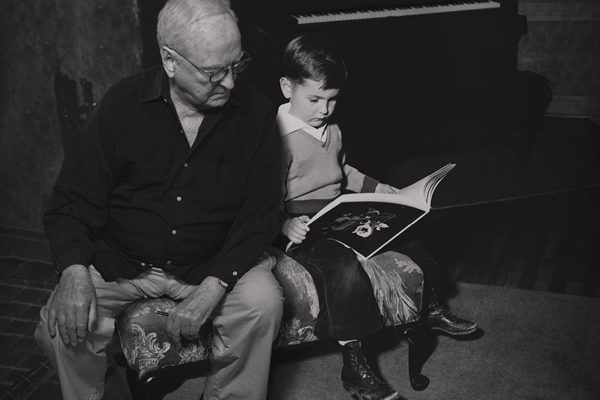
‘Solid Ivory: Memoirs’
By James Ivory
C.2021, Farrar, Straus & Giroux
$30/399 pages
Few things have been more pleasurable to me during the pandemic than Merchant/Ivory films. COVID becomes a dim memory as I ogle the costumes, beautiful vistas from Italy to India, music and spot-on dialogue of “A Room with a View,” “Maurice,” “Remains of the Day” and other Merchant/Ivory movies.
For decades, fans from gay men to grandmas have enjoyed these films, directed by James Ivory and produced by Ismail Merchant in partnership with the writer Ruth Prawer Jhabvala.
In “Solid Ivory,” Ivory, 93, gives us his memories of movie making, growing up gay, his decades-long romantic and professional partnership with Merchant and (you’re reading this correctly) the penises he has known.
If you believe that elders don’t enjoy sex, Ivory’s memoir will blow your ageism to smithereens.
From watching the movies he’s directed and knowing his age, you might think (as I did) that Ivory would be shy about talking of his sexuality. Wow, was I wrong!
Ivory appreciates penises as a sommelier savors fine wine.
Ivory knew that he liked boys early on. Ivory recalls playing at age seven with a boy named Eddy. He and Eddy were “putting our penises into each other’s mouths,” Ivory writes, “…I made it clear that Eddy’s dick must not touch my lips or tongue, nor the inside of my mouth. I had learned all about germs at school by then.”
Though Ivory and Merchant were devoted partners, they each had other lovers. Bruce Chatwin, the travel writer who died from AIDS, was Ivory’s friend, and sometimes, lover.
Chatwin’s penis was “Uncut, rosy, schoolboy-looking,” Ivory writes.
Ivory’s memoir isn’t prurient. His sexuality doesn’t overpower the narrative. It runs through “Solid Ivory” like a flavorful spice.
The book is more an impressionistic mosaic than a chronological memoir. Ivory, often, tells the stories of his life through letters he’s written and received (from lovers, friends and professional contacts) as well as from diary entries.
Many of the chapters in the memoir were previously published in other publications such as The New Yorker.
“Solid Ivory” was originally published in a limited edition by Shrinking Violet Press. The Press is a small press run by Peter Cameron, a novelist, and editor of “Solid Ivory.” Ivory grew up in Klamath Falls, Ore. He was originally named Richard Jerome Hazen. His parents changed his name when they adopted him. Some of the most engaging moments of the memoir are when Ivory writes about what life was like for a child during the Depression.
Ivory’s father lost his savings when the stock market crashed, and his mother frequently gave food to “tramps” who came to the door.
His “eating tastes were definitely formed during the Depression,” Ivory writes.
Since that time, Ivory has lived everywhere from England to Italy. “But although I consider myself an advanced expert in the more sophisticated forms of cuisine,” Ivory writes, “My gastronomical roots remain dug deep in the impoverished soil of the American Depression.” Ivory became smitten with movies when he saw his first picture when he was five.
He and Merchant, a Muslim from India who died in 2005, fell in love when they met on the steps of the Indian consulate in New York in 1961. I wish Ivory had written more about the 30+ movies that he made (mostly with Merchant and Jhabvala, who died in 2013).
Yet, he provides tantalizing recollections of filmmaking, actors and celebs.
The chapters on “Difficult Women like Raquel Welch and Vanessa Redgrave” are fun to read.
Welch, a bombshell brat, doesn’t want to play a love scene in “The Wild Party.” During the filming of “The Bostonians,” Boston is captivated by the drama of Redgrave’s off-screen politics.
Ivory isn’t that impressed when in 2018, at age 89, he becomes the oldest Academy Award winner when he receives the Best Adapted Screenplay Oscar for “Call Me By Your Name.” “Its fame eclipses even Michelangelo’s David and the Statue of Liberty,” Ivory says, with irony, of the Oscar statue.
If you enjoy the movies, beauty and wit, you’ll love “Solid Ivory.”






Books
Something’s off about Dad. When is it time to step in?
‘When Memory Fades’ can help when families face dementia

‘When Memory Fades’
By Nathaniel Chin, MD
c.2026, St. Martin’s Essentials
$30/422 pages
Mom called you in a panic the other day.
She’d lost her keys and by the time you arrived to help, she’d found them. In the refrigerator.
These kinds of things keep happening, not often but often enough, and you don’t know quite what to worry about. But in the new book “When Memory Fades” by Nathaniel Chin, MD, you’ll learn about the journey ahead, for both of you.
You can’t remember why you walked into a room. You got lost last week, going to the bank. Popular wisdom says that things like that are normal as we age, but Chin says that’s not true – although the answer may not be a worst-case scenario, either. Yes, memory problems could just be signs of stress, dehydration, or lack of sleep – or is it time to see a doctor?
Chin says maybe, yes.
He was working his way through medical residency when his father, a geriatrician in Madison, Wisc., was diagnosed with Alzheimer’s. Chin, now a geriatrician, was blindsided, but that diagnosis also changed his life.
Here, he writes about the brain, and how Alzheimer’s and dementia are diagnosed, explaining that dementia has many faces and, depending on a doctor’s evaluation, memory problems might be slowed or improved. He shares his father’s illness with readers, but he also writes about his mother, a steadfast, steady caretaker.
Her story reminds reader-guardians to care for themselves, too.
Know how to talk the talk, so that you can have “a more productive” conversation with your doctor. Understand that there’s nothing “normal” about dementia or Alzheimer’s. Know the statistics – African Americans are affected with dementia twice as much as whites – and know how to lower your risks. Learn here what questions to ask, how to break the news to everyone, and any legal matters that will be important soon. And know how to tend to you.
Says Chin, “The best action you can take is to educate yourself… The more you understand, the better equipped you are to make sound judgments.”
Something’s off about Dad, just a lot of little things that don’t add up. When is it time to step in? “When Memory Fades” can help you decide.
Wise, wide-spread, comprehensive, and compassionately helpful, this is a book you can read and then take it to the doctor with your loved one. It’s a book that makes sense when nothing else does, and its biggest feature is that it smoothly transitions from easy-to-grasp science and charts, to gentle coaching for caregivers. Author Nathaniel Chin, MD writes with storytelling, humility, grace, and experience from both sides of the Alzheimer’s/dementia issue, and his words are reassuring but also urgent. Learn, but don’t wait, he says. Know how to safeguard yourself. See your doctor, and don’t fear testing. Watch for signs of depression. And never, ever stop asking for help.
Read those last seven words, and find “When Memory Fades” now. It’s a book to have on your shelf, whether you’re 45 or 95 because, as you’ll see, dementia happens and knowledge is key.
Books
New book chronicles gay man’s life in hippie commune
Vietnam War-era tale a serious, sexy, joyous memoir
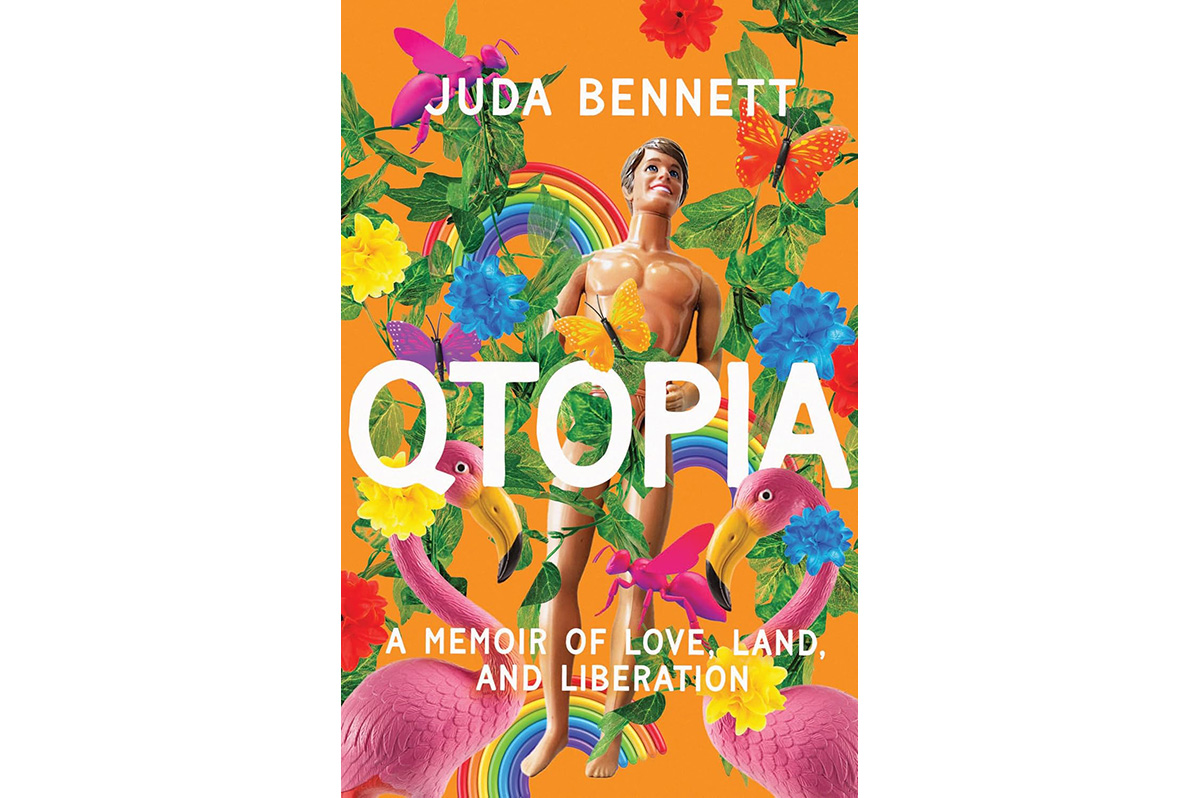
‘Qtopia: A Memoir of Love, Land and Liberation’
2026, University of Wisconsin Press
By Juda Bennett
Duffel packed, the new high school graduate could not fall asleep. “On the night before my departure, I stared at the duffel bag as if it were a body bag. We lived close to Dover, where the dead from Vietnam were shipped.”
It is 1971, and Charles was leaving home to join a hippie commune in rural Virginia. “I kept imagining bodies fitting into the bag and popping out in the middle of the night,” Juda Bennett writes in his memoir, “Qtopia: A Memoir of Love, Land and Liberation.” During Bennett’s high school years from 1968-1971 some 35,000 U.S. soldiers were killed in the Vietnam War, the vast majority processed at Dover Air Force Base.
Young Bennett was clueless about what lay ahead but he had a commune’s brochure in his pocket, certain his destiny was not in the military. “My father was a walking recruitment center, and my mother could have worked for the USO. Uncle Sam and the Andrews Sisters had nothing on them.” Inspired to find his way out of suburban Wilmington, Del., he boarded a Greyhound bus to Lexington, Va., and communes yet unknown. “Qtopia” is a serious, sexy and joyous memoir about a young man who knows he’s different in search of chosen family and, over coming decades, his own queer Utopia.
“We are leaving; you don’t need us,” was the popular refrain in the day from the Crosby, Stills & Nash song “Wooden Ships.” Communards like young Charles (going by the moniker C.B. with a full beard covering his handsome, androgynous features) were living it. How far this is from urban queer stories of the ‘70s. For this reason alone, it is marvelous reading about hot naked hippies farming together in the country, living and loving in secluded teepees when everything seemed possible. Novels like “Drop City” by T.C. Boyle (2003) and “Arcadia” (2012) by Lauren Groff set in hippie communes had no gay characters, only free-love for straights. When C.B.’s parents arrive to visit his back-to-the-land commune North Mountain bearing gifts like the orange powder Tang and Frosted Flakes, he “maintained” as the saying went. “It was a great time for visitors to see how hard we had worked—fields of sorghum swaying in the breeze, acres of vegetables in neat rows with beans, tomatoes and peppers hanging down….I was still thin as a matchstick, but I was a strong and muscular matchstick,” he tells the story of his development. By contrast, he had considered suicide before leaving home; this memoir fills in the pain, too.
There are times when C.B.’s voice as a teen communard with a secret is so authentic and rich, it is like reading fictional stories of American innocents on journeys of their own like J.D. Salinger’s character Holden Caulfield or Demon Copperhead from rural Virginia by Barbara Kingsolver. He tells us there was this guy Mark at North Mountain who had been pressuring him to sleep on the mattress next to his. C.B. was known as the only gay at North Mountain. One of the hippie women warned him Mark is “a square, the biggest downer.” Stepping out of the memoir, C.B. directly addresses the reader about the Mark issue, “I don’t want to write about Mark anymore because he’s not important to my story, and I didn’t even like him.” Got it. Hitchhiking with C.B. is like that, too.
“I got my best ride of the whole hike from a truck driver named TJ….If an eighteen wheeler…is willing to stop for you, it is because the driver wants something from you…I will forever remember this trucker as the most beautiful man I could have had sex with if I weren’t so innocent.”
North Mountain required the hippies work one week a month in Richmond to earn cash for the commune. For C.B., this translated into seven communards living in one small apartment on this cultish mission. It was in a Richmond park where he meets a stranger who would sexually abuse him over a month until C.B. ends it. Furious, the man threatens to shut down the commune if he does not obey. In a state of panic, C.B. attempts suicide by overdosing on every pill he can get his hands on. The memoir takes the reader through the author’s horror by deepening the shadows. What was the specific nature of the abuse? How did this stranger have credible power to threaten the commune? Entitled “What It’s Like to Die,” the chapter is a skillfully told, expressionistic turning point from an innocent’s hell to salvation at the intentional queer Lavender Hill commune in Central New York. C.B. desperately needed to “find my people.”
He’s a resilient young man after living in three communes by the time he hit San Francisco. His two gay neighbors on Ashbury Street—Crow and Moonsnake—pressure him to get a new “hippie name.” Walking home from Golden Gate Park he zeroes in on a passing streetcar, “North Judah.” Goodbye “Charles,” Judah will be his new hippie name. Crow and Moonsnake, approve: “If that’s what the Universe called out to you.” If you remember the Sixties…
“Too often,” Bennett writes, “we think of dropouts as withdrawing from life, but in truth, I think they are in a heightened state of seeking their rightful path and purpose. Nothing stays the same.” Juda Bennett remains a believer to this day, “Always putting my faith in my journey to Utopia”.
(Charles Francis is president of the Mattachine Society of Washington, D.C., and author of “Archive Activism: Memoir of a ‘Uniquely Nasty’ Journey.”)
Books
Liza’s book a tale that’s better than most celebrity memoirs
‘Kids, Wait Till You Hear This!’ dishes on marriages, heartbreak

‘Kids, Wait Till You Hear This! My Memoir’
By Liza Minnelli, as told to Michael Feinstein
c.2026, Grand Central
$36/ 421 pages
Twenty feet In front of you, and you can’t see a thing.
Even the closest faces are in shadow – lit, but not quite enough for you to see for sure what the people there are thinking. Still, you can hear them, their gasps, their laughter, and applause. Such is life, on-stage. Now read “Kids, Wait Till You Hear This! My Memoir” by Liza Minnelli, as told to Michael Feinstein, and read about it beyond the spotlight.

Almost from the moment she was born, Liza Minnelli was famous.
It was inevitable: her mother was Judy Garland. Her father was director Vincente Minnelli. Her godparents were Hollywood glitterati, her neighbors were famous, her playmates would be famous someday, too.
But her life wasn’t all starlight and happiness.
She made her stage debut as a toddler. She became her “mother’s caretaker” at age 13.
At 16, she had a growing career of her own – one that her mother tried to stop. But, she says, “In her own way, Mama was wonderful to me. Try understanding – she was my mother, not a movie star…. I knew her as the person who loved me and always would.”
At 19, Minnelli was working, happy, and madly in love with the man who’d become her first husband, and life was wonderful – until she came home one day to find him in their bed with another man. Before they were divorced, she lost her beloved mother, and became “engaged” to two other men simultaneously, neither of which made it to the altar with her.
She married her second husband, the son of one of her mother’s former co-stars, in 1974 but her love affairs and addictions led to a second divorce.
Her third husband was a stage manager.
She doesn’t have much good to say about her fourth, and last, husband.
Overall, she says, “You gotta play the comedy for all it’s worth and leave ‘em laughing. Even when your heart is breaking.”
Are you expecting bluntness, sass, or attitude here? Good, because that’s what you get inside “Kids, Wait Till You Hear This!” It’s strong on honesty and don’t-give-a-flip. It’s wonderfully edited, so it moves fast. It’s eye-opening and funny and a pleasant surprise for a first, and only (so far), memoir.
Even better, author Liza Minnelli (with best friend, Michael Feinstein) is really quite candid and nicely gossipy, starting from the beginning. There are some Hollywood folks, in fact, who are feeling edgy because of what’s inside this book and the secrets spilled. Minnelli and Feinstein seemed to have fun telling her story, and they comfortably lure readers in.
That’s not to say that it’s all a cabaret. Minnelli tells about her addictions and recoveries, her marriages and why she wed two gay men, and the losses she endured, including miscarriages, deaths, and broken relationships. The bad balances well with the good for a tale that’s several notches above most celebrity memoirs. “Kids, Wait Till You Hear This!” is, in fact, a real joy to read, a genuine bright spot.
The Blade may receive commissions from qualifying purchases made via this post.

Flanagan beats Craig in Minn. Senate primary after winning key LGBTQ endorsements

Gay ANC commissioner sues D.C. over police ‘failure’ to pay reward money

New LGBTQ visitor center slated for Wilmington, Del.

Jason DePuy on coping with homophobia in ‘Big Brother’ house