Virginia
Arlington candidates greet LGBTQ voters at ‘Ice Cream Social’
150 turn out at home of gay bar owner Freddie Lutz
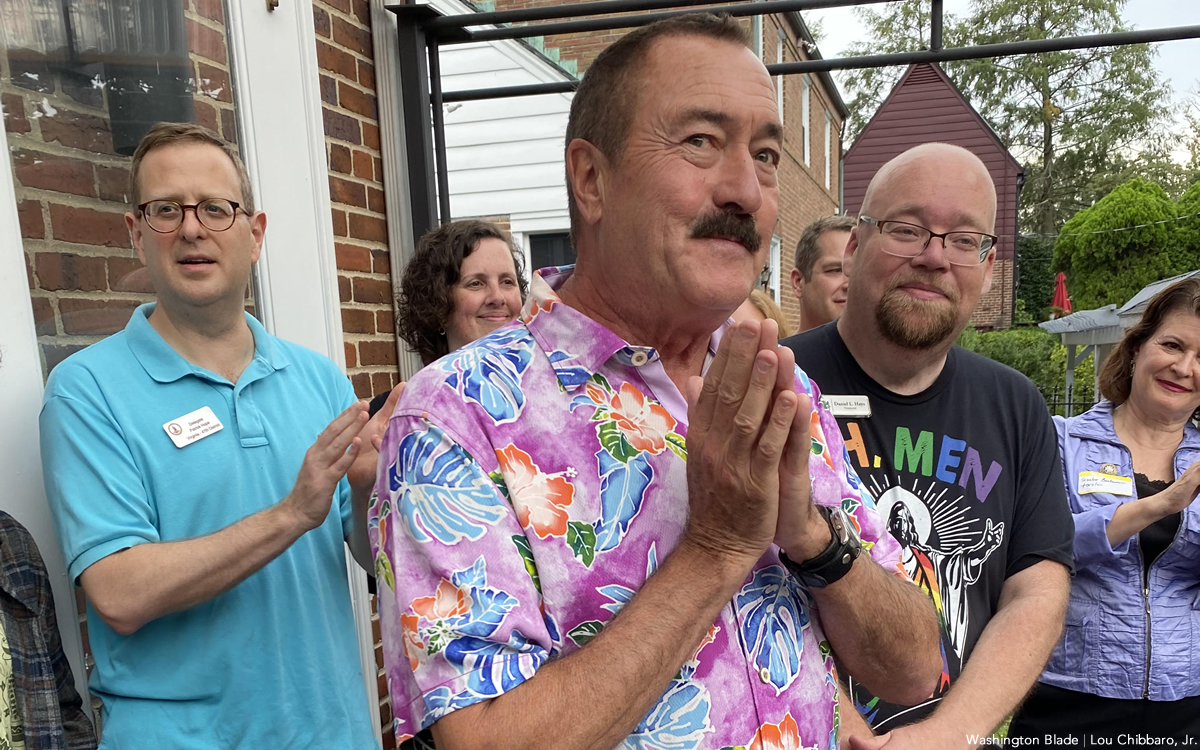
About a dozen elected officials or candidates running for public office this year in Arlington, Va. and surrounding Northern Virginia areas expressed strong support for LGBTQ rights at an event organized by the Arlington Gay & Lesbian Alliance (AGLA) that drew more than 150 LGBTQ and allied residents of Northern Virginia.
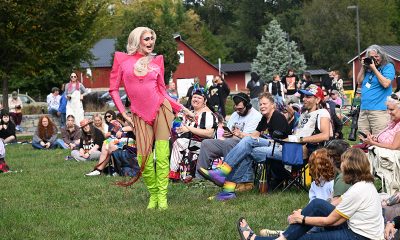
The event, billed as an Ice Cream Social, took place on Sunday, Sept. 25 at the Arlington home of Freddie Lutz, the owner of the Arlington gay bar Freddie’s Beach Bar and the nearby restaurant Federico’s, and Lutz’s husband Johnny Cervantes. The two served as hosts for an event that appeared more like a meet-and-greet for local politicians.
Throughout the event attendees had access to unlimited free servings of ice cream from a commercial ice cream vendors truck parked in the driveway of Lutz and Cervante’s house.
Among those who spoke at the event was gay Virginia State Sen. Adam Ebbin (D), whose district includes parts of Arlington, Alexandria, and Fairfax County. Ebbin, along with several of the other speakers, expressed strong opposition to Virginia Gov. Glenn Youngkin’s recently proposed policy guidelines for transgender students in the state’s public schools.
The proposed policy, which Youngkin says will take effect after a 30-day period of public comment, rescinds the trans supportive school policies put in place by former Gov. Ralph Northam’s administration that allowed trans students to use the bathrooms, changing rooms and other facilities that match their gender identity.
Under the new policy guidelines released by the state’s Department of Education, whose leaders were appointed by Youngkin, the state’s 133 school districts must require transgender students to access school facilities and programs that match their biological gender. They also require teachers and school officials to inform parents if their child attempts to present as transgender in school, a development that critics say is the equivalent of “outing” trans kids in a way that could create mental health issues.
“We want to be clear that we value our transgender students,” Ebbin told the gathering. “The governor is bullying and endangering students for cheap political points,” he said. “And his new guidelines are in violation of not just federal court rulings but of the Virginia Human Rights Act, which explicitly states that there shall be no discrimination against transgender people, including in public schools,” Ebbin said.
Others who expressed similar views along with general support for LGBTQ rights, including marriage equality, were State Sen. Barbara Favola (D-Arlington), and Virginia House of Delegates members Alfonso Lopez (D-Arlington/Fairfax Counties), Patrick Hope (D-Arlington), and Elizabeth Bennett-Parker (D-Arlington/Alexandria/Fairfax).
Bennett-Parker defeated gay House of Delegates member Mark Levine in the June 2021 Democratic primary. Like others who spoke at the AGLA event, Bennett-Parker urged LGBTQ residents of Northern Virginia to do all they can to support state, local, and congressional Democrats in this year’s election and in 2023, when the entire Virginia General Assembly is up for election.
“We need your help to make sure we maintain a commonwealth that will be safe and welcoming and inclusive towards all,” she said.
Arlington County Board members Matt de Ferranti and Kattie Cristol said they and their colleagues on the Arlington Board, which serves as the county’s legislative body, would continue their strong support for the LGBTQ community. De Ferranti noted that the board’s recent legislative actions in support of LGBTQ rights prompted the Human Rights Campaign, the nation’s largest LGBTQ rights organization, to award Arlington a 100 percent rating among municipalities nationwide on LGBTQ-related issues.
AGLA Treasurer Daniel Hays, who served as moderator for the part of the event in which the candidates or public officials spoke, said the LGBTQ group invited all candidates and elected officials representing Arlington to attend and speak at the event, including Republicans and independents as well as Democrats.
Among those who spoke were Karina Lipsman, the Republican candidate running against incumbent U.S. Rep. Don Beyer (D-Arlington), a longtime supporter of LGBTQ rights.
“I am pro-marriage equality,” said Lipsman, who identified herself as “the only Ukrainian born refugee immigrant running for Congress in the entire country.”
Also speaking was Matthew Hurtt, communications director for the Arlington County Republican Committee.
The LGBTQ attendees, which local activists say was reflective of the largely Democratic electorate of Arlington and Northern Virginia in general, responded with polite applause for Lipsman and Hurtt as well as for Adam Theo, a candidate for the Arlington County Board who described himself as a progressive libertarian running as an independent.
One of the final speakers was gay D.C. Advisory Neighborhood Commissioner Travis Swanson of ANC 7B03 in Ward 7, who thanked the speakers for their support of the LGBTQ community and called on those attending the event to urge their members of Congress to support D.C. statehood.
“AGLA is not endorsing any of the candidates you heard today,” Hays told the gathering in closing remarks, noting that it is a nonpartisan group.
“However, what we strongly endorse is that you go out and make sure you are fully aware of what the individuals who are asking for your vote to be able to have another two years or four years or six years in office, that you know exactly what they’ve done or what they’re going to do,” he said.





Virginia
Campaign urges Virginia High School League to reverse stance on trans athletes
Equality Arlington and other advocacy groups behind ‘Right 2 Play’ VA’ initiative

Virginia advocacy groups have launched a campaign that urges the Virginia High School League to once again allow student athletes to compete on sports teams that correspond with their gender identity.
Equality Arlington on Sept. 16 published an article about the “Right 2 Play VA” campaign. Amy, a group representative, spoke about the initiative with the Washington Blade.
“The primary goal is to reverse the Virginia High School League’s discriminatory ban on allowing transgender girls to play on girls’ sports and replace it with a policy that is fair for all students.” they said.
The Virginia High School League in 2025 announced the policy, which reversed a previous position in support of transgender and nonbinary athletes. The 2025 policy coincided with President Donald Trump’s executive order — “Keeping Men Out of Women’s Sports” — that threatened to “rescind all funds from educational programs that deprive women and girls of fair athletic opportunities, which results in the endangerment, humiliation, and silencing of women and girls.”
The Arlington Gender Identity Alliance, Equality Virginia, and the American Civil Liberties Union of Virginia have also joined the “Right 2 Play VA” campaign.
“We had a policy in Virginia for 12 years that allowed transgender girls to play on girls’ sports teams, and we had not one instance — not one instance — that was brought forward demonstrating an unfair advantage or any type of safety concern,” said Amy.
Amy then discussed what they described are the benefits of trans youth playing sports.
“There are physical benefits. There are mental health benefits. There are community and social development benefits, and those are all well documented,” they said. “All kids should have the right to benefit from playing youth sports. We are talking about kids. We are talking about youth. We are not talking about Olympians. We are not talking about Division One college athletes. We are talking about kids in Virginia, and because the benefits of sports are so well documented, we think that every kid should have the ability to play sports.”
Virginia
Gay Va. couple hopeful voters will enshrine marriage equality in state constitution
Early voting has already begun in the state
A referendum on whether to enshrine marriage equality in Virginia’s constitutional amendment is on the ballot this year.
If voters approve Question 2, it will codify the U.S. Supreme Court’s Obergefell ruling in 2015 that extended marriage rights to same-sex couples across the country — gays and lesbians have been able to legally marry in Virginia since Oct. 6, 2014.
Ron Bookbinder and James Fisher are a married couple who live in Arlington.
They have been together for 38 years — Bookbinder and Fisher married in 2014.
“We think this is a critical vote to remove this discriminatory language from the constitution and to ensure that going forward, no matter what happens, the state of Virginia will ensure marriage equality,” Fisher told the Washington Blade. “It is it is really difficult and upsetting to think that our current state constitution would prohibit same-sex marriage, even though the federal government overrides that now. There’s no saying what may happen in the future.”
Bookbinder said it was important for him and Fisher to get married “to gain social equality.”
“I was surprised how good it felt, how important it was to begin to say, ‘my husband rather than my partner,'” Bookbinder said.
Bookbinder then explained why it feels good to be married.
“Is it a legal partner, a business partner, a tennis partner, you know, or a romantic partner? But when you say my husband James, everyone knows exactly what you mean and confers an equal status with everyone else who’s married, and we were both surprised at how good it felt and how equal it felt to suddenly be married and be able to state that you were married and discuss your husband rather than your partner, and I would hate to lose that,” he said.
Bookbinder and Fisher said they are hopeful that voters will approve the amendment, noting Virginia has become more progressive over the years.
“I think people have, with the Supreme Court decision, people have seen that a same-sex marriage is just a marriage,” stated Fisher. “It’s just two people who love each other, and I think more and more people have attended a same-sex marriage, someone in their family or a friend, and the experience of what this is, firsthand experience, is so important in shaping people’s opinions, and I think the period of time that we’ve had since the Obergefell decision has given a lot of voters that experience, which I think is really important and powerful.”
The couple also said the push to enshrine marriage equality in Virginia’s constitution is in response to the Trump-Vance administration.
“And I think due to President Trump doing all the horrible things he’s done to so many groups, including LGBTQ, especially trans people, that Virginians are kind of pushed to be even more progressive to protect those who need protection, which would include the LGBTQ community in terms of marriage equality, so I’m confident it will pass,” said Bookbinder.
Narissa Rahaman, executive director of Equality Virginia, sent the Blade a statement about early voting on Question 2 that has already begun.
“With early voting now underway, our focus is making sure every Virginian knows Question 2 is on their ballot,” said Rahaman. “The outdated ban on same-sex marriage still in Virginia’s state constitution leaves a gap in protections for the thousands of same-sex couples that call this state home, but after 20 years we have the chance to fix it.”
Log onto www.mobilize.us/vaformarriage to find out more about the campaign in support of Question 2.
Virginia
Virginia Anti-Violence Project struggles to fill federal funding gaps
Group has lost 54 percent of funding since 2020
A loss of federal funding has threatened to adversely impact the Virginia Anti-Violence Project’s work in the state.
The group’s mission is to assist LGBTQ and BIPOC (Black, Indigenous and people of color) victims of domestic, sexual, interpersonal, and state violence with direct support, education, and advocacy. The VAVP seeks to build a future where LGBTQ and BIPOC individuals can live freely without a sense for worry about violence.
“Virginia Anti-Violence Project helps to close the distance between services existing and LGBTQIA+ survivors actually being able to reach safety, stable housing, and support that they can trust,” VAVP Executive Director Ebony Clark told the Washington Blade on Tuesday. “Our mission is to provide direct services and advocacy to LGBTQ+ survivors across Virginia.”
Clark said obtaining state and federal funds has become increasingly difficult.
“One of the reasons that we can talk about is politics and how you know queer diverse, queer communities are targets when it comes to politics, and so that may be a reason why the funding is decreasing in in very niche areas, but overall, state funding, federal funding has been lost or significantly reduced when it comes to culturally specific marginalized populations,” Clark said. “The bigger picture is that funding that was purposed for diversity, equity, inclusion, marginalized populations, or you know culturally competent programming, those funds have been strategically reduced or eliminated on state and federal levels overall.”
Even more so with the current Trump-Vance administration.
Data shows federal funding for one “major federal victim-services funding stream in” Virginia has dropped 54 percent over the last six years: from $25.1 million in fiscal year 2020 to $11.6 million in fiscal year 2026.
Clark noted some federal funding has been denied due to VAVP’s DEI policies — it has had to “water down” their language. These cuts have forced VAVP to limit housing and economic support, which has resulted in fewer resources for its clients.
The organization has set up a goal for receiving between $250,000-$300,000 a year that would allow it to operate — and focus on client housing.
“Housing is fundamental to safety,” Clark told the Blade. “If you know leaving violence puts someone on the street or forces them back to the person harming them, that means the crisis isn’t over. So there needs to be other prevention strategies and reactive strategies in place to be able to prevent further violence from folks.”
VAVP has set up a link for anyone who is interested in making a donation. It is here.
The VAVP website is also accepting donations.

In ‘The Lost Brontë,’ a complicated lie can lead to danger

CAMP Rehoboth Block Party returns Oct. 18

Essential queer horror classics for Halloween

Solidarity beyond the parade: the actual cost of Pride

Physician: addiction doesn’t always look the way you think it does

Bessent says Trump chose him for his qualifications, not his sexuality

10 years later, we still can’t shake Barry Jenkins’s ‘Moonlight’

‘Some Like It Hot’ a wild ride at renovated Bernard Family Theatre

D.C.’s LGBTQ homeless facilities face possible hit from Trump funding cuts

Trump uses anti-trans slur against Democratic Senate candidate
-

 Federal Government5 days ago
Bessent says Trump chose him for his qualifications, not his sexuality
-
Movies4 days ago
10 years later, we still can’t shake Barry Jenkins’s ‘Moonlight’
-
Theater4 days ago
‘Some Like It Hot’ a wild ride at renovated Bernard Family Theatre
-
District of Columbia4 days ago
D.C.’s LGBTQ homeless facilities face possible hit from Trump funding cuts