European Union
Latvia elects first openly gay president
Edgars Rinkēvičs has been country’s foreign minister since 2011

The Latvian Parliament elected Edgars Rinkēvičs as the country’s next president in a vote held Wednesday. When he assumes office on July 8, he will be the country’s first openly gay head of state, as well as the first openly gay head of state of an EU country or a former Soviet country.
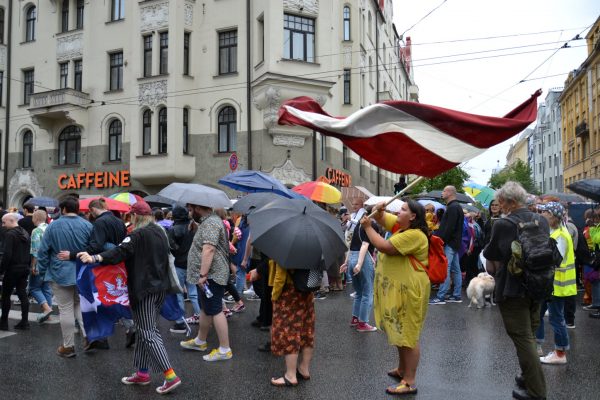
Latvia’s president is a largely ceremonial role that is elected by the national Parliament. He won a narrow majority of 52 out of 100 votes on the third ballot, held coincidentally during Pride week in the capital, Riga.
Rinkēvičs has served as Latvia’s foreign minister since 2011, a post where he became popular for championing European integration.
In 2014, he became the first Latvian political figure to come out publicly, while the country debated a same-sex civil union law. To date, the Latvian Parliament has still been unable to pass any laws recognizing same-sex couples, despite multiple court decisions ordering it to do so.
Reached for comment after the election, the Latvian LGBTQ advocacy group Mozaika and Riga Pride released a joint statement saying they are thrilled with the election.
“We are thrilled about the fact that Edgars Rinkēvičs will be the next president of Latvia. First and foremost, he is one of the most popular and professional politicians in Latvia, and with this election he broke the glass ceiling. He is an absolute inspiration to many young people and the LGBTQ community at large.
We are hopeful that he will stand behind his promise to have human rights and democracy as one of his priorities and we believe he will play an instrumental role to strengthen Latvia’s society and will make it safer not just for the LGBT community but for many vulnerable groups,” the groups say.
Not everyone has been so thrilled. Former Member of the European Parliament Andrejs Mamikins, tweeted that “God will no longer bless Latvia,” in response to the election.
“Today, godlessness won the presidential election in Latvia. Disgrace and misery @edgarsrinkevics,” he wrote.
Latvian TV reports that the State Police have opened an investigation into Mamikins’ post for possible violations of the law banning incitement to hatred.
Latvia, a deeply conservative Baltic nation of about 1.8 million people about one-third of whom are Russian-speakers, regained its independence amid the breakup of the Soviet Union. Since that time, it has taken a stridently pro-Western political orientation, including joining NATO, the European Union and the Eurozone.
But the country’s political elite has never warmly embraced LGBTQ rights. According to ILGA-Europe’s Rainbow Index 2023, Latvia scored only 22 percent on a list of legislated rights for LGBT people, placing it 37th among 49 ranked countries.
Latvia’s neighbors on the Baltic Sea have also been slow to advance LGBTQ rights, although Estonia’s government is expected to advance a same-sex marriage bill in Parliament next week, and Lithuania’s parliament passed a civil union bill through a second reading vote in May.
While openly gay and lesbian people have served as prime minister of several other EU countries — including Ireland’s Leo Varadkar, Luxembourg’s Xavier Bettel and Belgium’s Elio Di Rupo — Rinkēvičs will be the first gay person to hold the role of head of state of an EU country. The only other openly gay head of state in modern history was Paolo Rondelli, who was one of the two Captains Regent of the microstate San Marino for six months in 2022.
********************************************************************************

Rob Salerno is a writer, journalist and actor based in Los Angeles, California, and Toronto, Canada.






European Union
Poland’s top court rejects recognition of same-sex marriages from other EU countries
Ruling sets up potential clash with bloc

Poland’s top court this week rejected the recognition of same-sex marriages legally performed in other EU countries.
The EU Court of Justice in Luxembourg last November ruled in favor of a same-sex couple who challenged Poland’s refusal to recognize their German marriage. Poland’s Supreme Administrative Court in March reaffirmed the decision.
The couple, who lives in Poland, brought their case to Polish courts in 2019. The Supreme Administrative Court referred it to the EU Court of Justice.
The Polish government in May announced it will recognize same-sex marriages legally performed in other EU countries. Polish President Karol Nawrocki on July 17 vetoed bills that would have extended rights to same-sex couples.
The Constitutional Tribunal ruling, which it issued on July 28, was unanimous and final. It also sets up a potential clash between it and the EU Court of Justice.
European Union
European Commission says all EU countries should ban conversion therapy
Recommendation ‘an important step forward for LGBTI rights across Europe’

The European Commission on Wednesday said all European Union countries should ban so-called conversion therapy.
The recommendation comes weeks after the European Parliament voted in favor of prohibiting the widely discredited practice across the EU. More than 1.2 million people signed a campaign in support of the ban that ACT (Against Conversion Therapy) LGBT launched in 2024 through the EU’s European Citizens Initiative framework.
“We warmly welcome today’s commitment from the European Commission to a recommendation on ending conversion practices, an important step forward for LGBTI rights across Europe,” said ILGA Europe in a statement.
Seven EU countries — Belgium, Cyprus, France, Malta, Norway, Portugal, and Spain — have banned conversion therapy outright.
Greece in 2022 banned the practice for minors. German lawmakers in 2020 passed a law that prohibits conversion therapy for minors and for adults who have not consented to undergoing the widely discredited practice.
ILGA Europe said the European Commission’s recommendation “highlights how much work remains to be done.”
“Ending conversion practices cannot stop at symbolic commitments or fragmented national approaches,” stressed the advocacy group. “We need coordinated EU action, proper training for professionals, and survivor-centered support systems that recognize the serious harm these practices cause.”
“More than one million people supported the European Citizens’ Initiative calling for change,” added ILGA Europe. “The message is clear: conversion practices are not therapy or belief, they are a form of violence that Europe can and should end.”
European Union
European Parliament backs EU-wide conversion therapy ban
More than 1.2 million people backed campaign
The European Parliament on Wednesday voted in favor of banning so-called conversion therapy across the European Union.
ACT (Against Conversion Therapy) LGBT in 2024 launched a campaign in support of the ban through the EU’s European Citizens Initiative framework. More than 1.2 million people ultimately signed it.
The proposed ban had the support of 405 MEPs. The European Commission is expected to formally respond to it by May 18.
Seven EU countries — Belgium, Cyprus, France, Malta, Norway, Portugal, and Spain — have banned conversion therapy outright.
Greece in 2022 banned the practice for minors. German lawmakers in 2020 passed a law that prohibits conversion therapy for minors and for adults who have not consented to undergoing the widely discredited practice.

Trump asks Supreme Court to allow restrictions on gender-affirming care in prisons

Education Department rolls back protections for LGBTQ students under Title IX

Debbie Allen shares on loss, love, and the power of speaking out

Baltimore’s oldest gay bar to reopen this week

Dr. Fauci ‘honored to be part of’ LGBTQ history

Colombia withdraws from Equal Rights Coalition

Trump-appointed judge restores White House TV pool access

Writing a play about Lincoln leads down a rabbit hole to a closet

Philadelphia event to launch 2026 LGBT History Month

Being a female firefighter comes with unique risks, and rewards
-

 Colombia5 days ago
Colombia withdraws from Equal Rights Coalition
-
White House5 days ago
Trump-appointed judge restores White House TV pool access
-
a&e features5 days ago
Writing a play about Lincoln leads down a rabbit hole to a closet
-
National5 days ago
Philadelphia event to launch 2026 LGBT History Month