District of Columbia
HIV-positive D.C. attorney commissioned as officer with U.S. Army National Guard
Longtime National Guard member successfully challenged military HIV policy
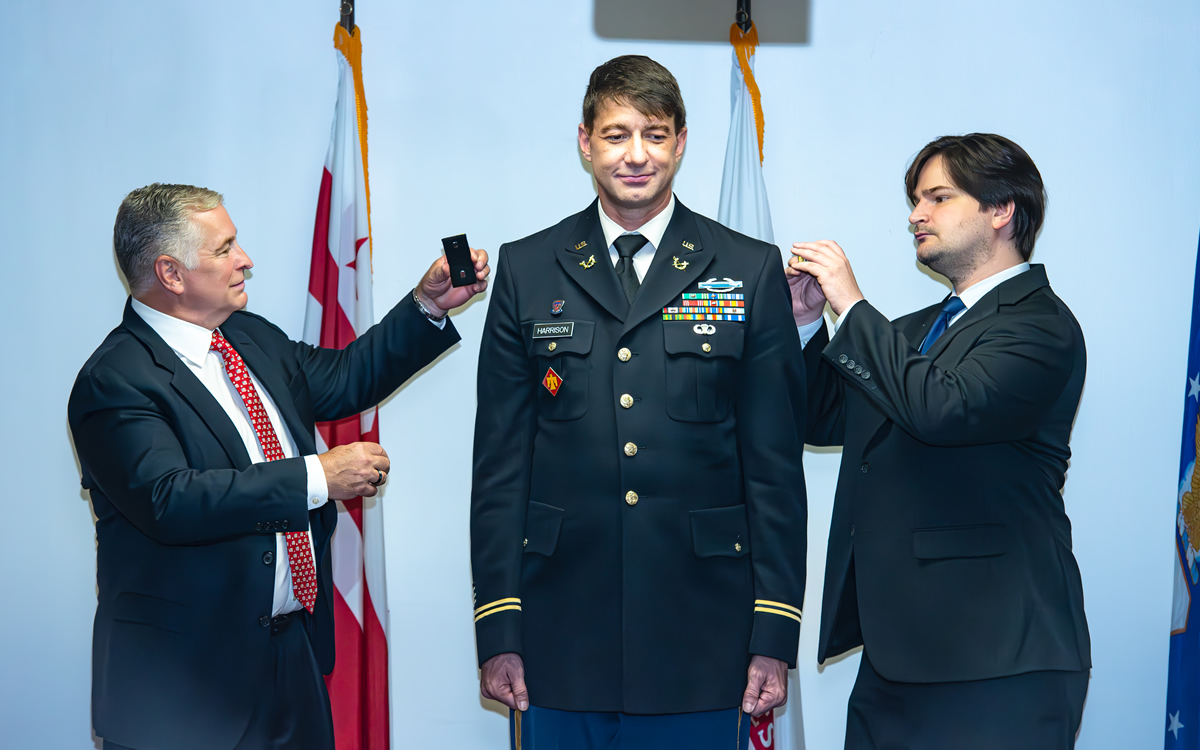
Gay D.C. attorney Nicholas Harrison, a longtime member of the U.S. Army National Guard, was officially commissioned as a First Lieutenant in the D.C. Army National Guard at an Aug. 5 ceremony.
The ceremony at the D.C. National Guard Armory located next to RFK Stadium took place a little over a year after Harrison, who was diagnosed with HIV in 2012, successfully challenged the military’s longstanding policy of banning soldiers with HIV from becoming commissioned officers in a lawsuit initially filed in 2018.
In what LGBTQ and AIDS activists consider a landmark ruling, the U.S. District Court for the Eastern District of Virginia handed down a decision in April 2022 declaring the military’s HIV restrictions unconstitutional. The decision ordered the U.S. Department of Defense to discontinue its policy of refusing to deploy and commission as officers members of the military with HIV if they are asymptomatic and otherwise physically capable of serving.
Two months after that ruling, the Biden administration announced it would not contest the court ruling in an appeal, and a short time later U.S. Secretary of Defense Lloyd Austin issued a memorandum announcing changes in the military policy that would allow members of the military with HIV to be deployed and become officers in accordance with the court ruling.
The memorandum states that individuals “who have been identified as HIV positive, are asymptomatic, and who have clinically confirmed undetectable viral load will have no restrictions applied to their deployability or to their ability to commission while a service member solely on the basis of their HIV-positive status.”
Kevin Jennings, CEO of Lambda Legal, the LGBTQ litigation organization that represented Harrison in his lawsuit and who attended Harrison’s commissioning ceremony, called the court ruling and the Biden administration’s decision not to appeal the ruling an important advancement in efforts to remove barriers to people with HIV who wish to serve in the military.
“Today is a historic day in Washington, D.C., as we witness the commissioning of Nick Harrison,” Jennings and Lambda Legal Senior Attorney Kara Ingelhart said in a statement. “Although the journey to wearing his officer’s bars took several years, Nick’s perseverance, along with his legal team and other involved service members, helped to realize his dream of becoming an officer in the District of Columbia Army National Guard,” Jennings and Ingelhart said.
Among the more than 50 people who attended Harrison’s commissioning ceremony were family members, friends, LGBTQ rights advocates, and fellow service members.
Serving as master of ceremonies at the event was Dr. Joshua Fontanez, chair of the board for the Modern Military Association of America, the nation’s largest organization representing LGBTQ military service members, their spouses, family members, and veterans. The association joined Lambda Legal in supporting Harrison’s lawsuit to overturn the military’s HIV policy.
Donald Cravins Jr., the U.S. Under Secretary of Commerce for Minority Business Development, administered the oath of office commissioning Harrison to the rank of First Lieutenant.
And Jennings of Lambda Legal and Baraq Stein, Harrison’s partner, performed the ceremonial “Pinning of Rank” by attaching the lieutenant’s rank insignia on each side of the shoulder of the Army uniform that Harrison was wearing at the ceremony.
“This commissioning ceremony, steeped in long-standing military tradition, is intentionally focused on honoring the network of support and inspiration that brought me to this juncture,” Harrison said in remarks following his official commissioning.
“My own path has been far from conventional, leading me into the heart of a storm that allowed me to become part of a larger narrative – challenging the military’s discriminatory HIV policies through a landmark court case brought by Lambda Legal and the Modern Military Association of America,” he said.
A native of Oklahoma, Harrison joined the U.S. Army in September 2000 at the age of 23, at the time he was about to enter his third year as a student at the University of Central Oklahoma. He said he served for three years as an airborne paratrooper with a Parachute Infantry Regiment in Anchorage, Alaska.
After completing his initial enlistment in the Army, he resumed his university studies while joining the Oklahoma National Guard. He graduated in May 2005 with a bachelor’s degree and “proceeded to Oklahoma City University’s law school,” he told the Blade in a statement.
In March 2006, while enrolled in law school, he was deployed to Afghanistan with the Oklahoma National Guard’s 45th Infantry Division, he recounted in his statement. Upon his return, he said he had to restart his law school studies at the University of Oklahoma in August 2007.
After receiving a law degree and Master of Business Administration degree he was deployed once again, this time to Kuwait and Iraq. “On my return, I passed the bar and began job hunting, which led me to Washington, D.C. in July 2013,” he says in his statement.
In October of 2013, he transferred his National Guard membership from Oklahoma to D.C. by joining the D.C. National Guard, where he was assigned to a military police company with the rank of sergeant, he said. During that same year, he was selected for a Judge Advocate General position, which involves duties similar to a civilian judge.
Having been diagnosed with HIV the previous year, he requested a waiver from the military’s HIV policy that would have allowed him to take on his new JAG position. But his request was turned down, prompting him to initiate a campaign to challenge what he and many others believed to be an outdated policy denying fully capable people with HIV from serving in positions as military officers.
A short time later, through support from Lambda Legal and an organization that later became the Modern Military Association of America, he filed his lawsuit challenging the military’s HIV policy that has led to what his supporters are calling the landmark event on Aug. 5 during which he became a commissioned officer.
Harrison, however, said the Army has interpreted the changed HIV rules in a way that has forced him to take his case once again to court to challenge a decision by Army officials to have him reapply to join the National Guard under the new policy rather than commission him as an officer retroactively based on his 23 years of military service.
Having to reapply, Harrison told the Washington Blade, would require him to serve in the National Guard for another eight years, even though he became eligible to retire in 2020. He has contested the decision to require him to reapply before the same court that overturned the military’s discriminatory HIV policy and before the Army Board for the Correction of Military Records, which he says has the authority to “rectify” the Army’s position on reenlistment.
Jennings of Lambda Legal said at Harrison’s commissioning ceremony that Harrison’s ongoing dispute with military officials indicates that some details related to Harrison’s case must still be worked out.
“But today we really should just celebrate Nick’s perseverance,” Jennings told the Blade. “His determination, and the fact that he has made history has paved the way for thousands of people.”
In his remarks following his commissioning, Harrison said among the lessons he has learned in his many years in the military is the need to be respectful of the military as an institution and to engage in “respectful disagreement” when at odds with others.
“When I chose to don the uniform, to become part of an institution that has had its share of failures, it was not a decision made lightly,” he said. “I embarked on this journey because I believe in the potential for change from within, in the power of standing up from within a marginalized community to serve, protect, and defend a nation that doesn’t always reciprocate in kind,” he told the gathering.
Harrison currently serves as managing partner for the downtown D.C. law firm Harrison-Stein.




District of Columbia
Nearly 6,000 turn out for Pride Night Out at the Nationals
Gay Men’s Chorus sings National Anthem

“Just shy of” 6,000 people purchased tickets for the Wednesday, June 24, 21st annual Pride Night Out at the Washington Nationals baseball stadium, which the Nationals said is the longest running LGBTQ Pride event in Major League Baseball, according to a Nationals spokesperson.
The event was organized with the Nationals by Team D.C., the local LGBTQ sports group that organizes similar Pride Nights for other professional D.C. area sports teams.
“It was a good time had by all as the Nationals celebrated the LGBTQ+ community during the Nationals 21st Pride Night Out, presented by Team D.C.” the Nationals said in a statement.
Nationals spokesperson Erica George said the overall game attendance was 27,200.
Similar to recent past years, the Gay Men’s Chorus of Washington sung the National Anthem at the start of the game, drawing loud cheers from people throughout the stadium.
The Nationals lost the game to the Philadelphia Phillies by a score of 5-4. Although most of the LGBTQ attendees of the event, held in the right-field mezzanine section of the stadium, were cheering for the Nationals, a sizeable number also cheered for the Phillies.
Miguel Ayala, one of Team D.C.’s lead organizers, said he noticed fans displaying Pride flags and recognized LGBTQ people in all parts of the stadium, indicating significantly more LGBTQ people and their supporters attended the game beyond the close to 6,000 or more who purchased the specific Pride Night Out tickets.
“It was a great excitement last night,” he told the Washington Blade on the day following the event. “I saw a lot of big crowds of our people, I saw everybody I can think of in the community. And it was really great to see the turnout.”
Also, like in previous years, Team D.C. along with the Nationals helped to organize a pre-game show on the large concourse platform area next to the stadium seating area involving a drag show led by local drag performer Shi-Queeta Lee.
“During pregame ceremonies, the Nationals Pride employee resource group was recognized on the field,” the statement released by the Nationals says. “Dr. Demetre Daskalakis, a physician and public health leader who has had a profound impact on the LGBTQ+ community and those living with or vulnerable to HIV, threw out the ceremonial first pitch as the guest of Team D.C.,” the statement says.
It adds that Team D.C.’s scholarship recipient Spencer Doll made the ceremonial call to “Play Ball.”
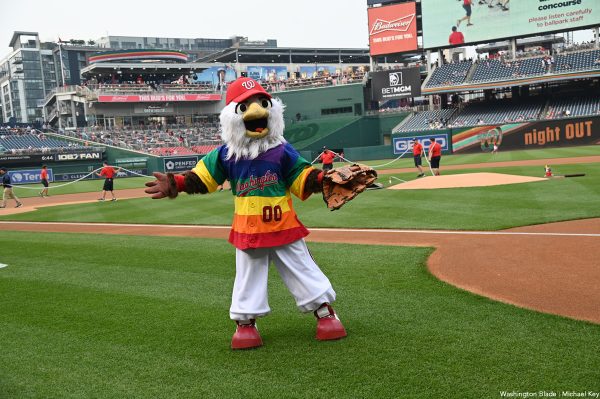
As if all that were not enough, a Nationals employee who entertains during the Nationals pre-game shows on the field dressed as a giant eagle named “Screech” wearing an eagle’s head mask appeared in the seating area where the Pride Night Out crowd was seated and mingled with the LGBTQ fans, many of whom posed for photos with Screech.
District of Columbia
Washington Blade names new publisher
Longtime ad exec Brian Pitts to assume role from Lynne Brown

The Washington Blade announced this week that its longtime publisher, Lynne Brown, who has worked at the publication for nearly 40 years, is retiring from her day-to-day duties.
Blade co-owner and longtime advertising executive Brian Pitts will assume the role of publisher effective June 26.
Pitts, 46, is a native of Fredericksburg, Va. In 2004, he moved to Washington, D.C., from Rehoboth Beach, Del., to work at the Blade as a 24-year-old sales executive. Pitts, along with Brown and Blade Editor Kevin Naff have owned the Blade since 2009. Pitts has served as the Blade’s lead sales executive since then.
“We’ve been through a lot over the last 17 years, including a recession and a pandemic,” said Pitts. “Lynne has been a steady hand throughout and I’m excited to take the reins and help steer the Blade into its next chapter.”
Brown will assume the title of publisher emerita and remain a part owner of the Washington Blade and Los Angeles Blade and contribute to the business via special projects.
As for what’s next, she said, “I will take the summer to regroup. I have one more LGBTQ community project in mind, and a few personal goals to check off the list. I am a Washingtonian. I will continue to live, work, and love here in D.C. Of course every Friday morning, I will grab a cup of coffee and read the Blade.”
Asked what advice she has for Pitts as he takes over the publisher’s job, Brown replied, “Brian is going to be great. He has all the skills needed to run this business. He also has a deep, silent passion for the Blade. My only advice: Slow and steady wins the race.”
Pitts said his primary goal as publisher is to ensure the Blade continues its mission as America’s LGBTQ news source.
“Another goal is to reach a younger audience and to include an educational component,” he added. “Some younger community members may be newer to the Blade and less familiar with LGBTQ history. Recently, we published a special commemorative magazine to coincide with America 250, chronicling LGBTQ history and contributions to U.S. culture. It’s so important not to let our history get erased and to remember where we came from and to work toward where we want to go.”
He described the biggest challenge to queer media as the Trump administration’s attacks on DEI.
“We have companies that have advertised with us for years who are now afraid of the potential consequences,” he said.
Brown joined the Blade in 1987. She was named publisher in 2007 by previous owner Window Media. In 2009, Window Media filed for bankruptcy; shortly after, Brown, Naff, and Pitts acquired the Blade’s assets from the bankruptcy court and relaunched the brand with Brown as publisher.
She said the period after the bankruptcy became her biggest challenge as publisher.
“The crisis that birthed Brown Naff Pitts Omnimedia kept me overly focused on millions of details,” she recalls. “My greatest personal challenge was delegating and letting go of details. Trusting staff with their strengths and skills to do their jobs was slow to come. It has proved to be most rewarding. Building the right team — knowing the people you work with are committed, professional, and honest — is a great thing.”
Pitts described the bankruptcy and rebirth of the Blade in 2009 as his proudest moment with the company.
“Working at the paper has been great, but becoming a co-owner was a dream come true,” he said.
Naff praised both of his colleagues.
“Lynne has been a rock, helping us navigate financial crises and a pandemic. The Blade wouldn’t have survived without her dedication,” he said. “She is the publisher every editor would want. Brian has terrific instincts, a passion for the Blade’s important mission, and an eye on growth. I am proud to call both of them friends and mentors and look forward to the next chapter.”
Asked why LGBTQ media are still relevant, Brown cited the recent erosion of queer rights as evidence that the Blade’s work remains important.
“The Blade helps fight invisibility and isolation,” she said. “We may have rights today, but we have seen rights eroded or erased. The Blade reports on those rights authentically and accurately and serves as a communication tool and a historian for the community.”
Pitts added, “While mainstream media may cover LGBTQ+ issues, no one covers them quite like us. These are our community’s stories and voices and this is your news source.”
The Blade will host a happy hour event later this summer where the community can meet Pitts and thank Brown for her decades of service.
District of Columbia
New report says LGBTQ young adults in D.C. facing affordability crisis
79 percent of respondents reported difficulty paying rent or mortgage

A newly released report on the findings of a survey of 304 LGBTQ young people aged 18-30 who live in D.C. shows as many as 79 percent of those surveyed report they are struggling to pay rent or a mortgage.
The report, entitled Out and Counted: 2026 LGBTQ+ Young People Community Survey Findings, also shows at least 80 percent of those surveyed “feel isolated often or some of the time” and their reported use of tobacco-nicotine products, alcohol, and marijuana was “significantly higher” than that of the general adult population.
“Nearly one third of respondents have considered leaving the District, driven by housing insecurity,” the report says.
The survey and report were prepared jointly by the D.C.-based Wanda Alston Foundation, which provides housing and other support services for at-risk and homeless LGBTQ youth, and the Los Angeles-based Loyola Marymount University’s LGBTQ+ Politics Research Initiative.
The report says the LGBTQ young people completed the detailed survey in March and April of 2026 “thanks to multiple outreach strategies, including paid digital ads, in-person outreach, and other communication channels.”
Cesar Toledo, executive director of the Wanda Alston Foundation, said the survey included as many as 80 questions and a number of local LGBTQ organizations helped in arranging for the young people to take the survey.
“These findings suggest the District’s LGBTQ+ young people are being pushed to the brink,” Toledo said in a statement released by the Alston Foundation. “They are working hard, yet hitting an affordability cliff, deepened by a loneliness paradox and alarming health-risk behaviors,” he said.
He added, “To ignore these findings is to accept a ‘Queer Flight’ that will displace our LGBTQ+ community and drain the very lavender economic engine that Wells Fargo once famously noted as a secret sauce to economic growth.”
Gabriel Magni, associate professor of political science and Director of the LGBTQ+ Politics Research Initiative at Loyola Marymount University, said in the statement that the survey finding indicate that LGBTQ young people can be priced out of “traditional LGBTQ+ hubs” that have historically been important in advancing LGBTQ equality.
“These findings raise serious concerns regarding affordability and the mental health of LGBTQ+ youth in a city that has long welcomed the LGBTQ+ community,” he said in the statement.
The report says about 41 percent of the survey respondents identified as gay, 17 percent as lesbian, 16 percent as bisexual, 14 percent as queer, 8 percent as pansexual, 1 percent as asexual, and 1 percent as demisexual.
The full report can be accessed here.

Buttigieg says false report temporarily separated him from his children

11 years after Obergefell, marriage equality remains under scrutiny

Federal officials launch Title IX probe into Md. schools over trans athletes

Comings & Goings

‘Leviticus’ demonizes homophobia for gripping queer horror yarn

New report says LGBTQ young adults in D.C. facing affordability crisis

Nepalese Supreme Court issues landmark marriage equality ruling

Television loses a legend, longtime ‘Will & Grace’ director James Burrows

Del. AG Jennings seeks third term touting LGBTQ support, decline in crime

LGBTQ political candidates see surge in threats, harassment: report
-

 District of Columbia5 days ago
New report says LGBTQ young adults in D.C. facing affordability crisis
-
Nepal5 days ago
Nepalese Supreme Court issues landmark marriage equality ruling
-
a&e features5 days ago
Television loses a legend, longtime ‘Will & Grace’ director James Burrows
-
Delaware5 days ago
Del. AG Jennings seeks third term touting LGBTQ support, decline in crime