European Union
Memorial to LGBTQ Holocaust victims vandalized in Berlin
Anti-queer attacks on the rise in Germany
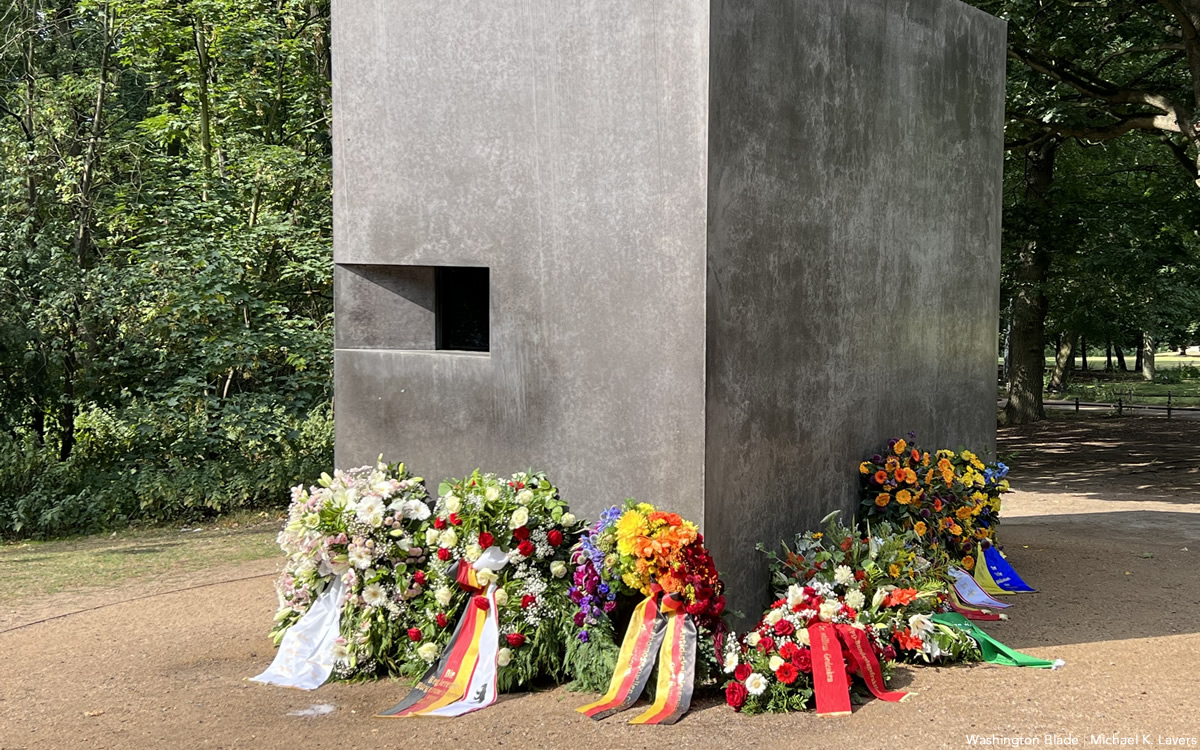
The Memorial to Persecuted Homosexuals under National Socialism located at the edge of the German capital city’s famed Tiergarten Park was vandalized this past weekend, according to a Berlin Police spokesperson.
The Berlin Police said that a park security official observed a male suspect “papering” the monument with slips of paper later found to contain Biblical verses condemning homosexuality and then attempting to set the memorial ablaze by tossing a burning object at it. The suspect fled when confronted by the guard.
Berlin Police are investigating this incident and another attack against a memorial for victims of the Holocaust, the “Platform 17” memorial, inside the Berlin-Grünewald train station.
The Memorial to Persecuted Homosexuals under National Socialism, in the shape of a cube with a window insert where a video of a same-sex couple kissing can be seen, was first erected in 2008.
German public broadcaster Deutsche Welle reported that under the Nazi regime in Germany from 1933-1945, gay people were systematically repressed and persecuted, with some 50,000 being convicted on account of their sexuality.
Many thousands of them were deported to concentration camps and large numbers murdered there.
The second arson attack took place at the”Platform 17″ memorial, which honors the German Jewish people who were sent to their deaths during the Holocaust from the Grünewald train station.
In a statement issued Monday the Berlin-Brandenburg Lesbian and Gay Association decried both incidents:
“We are shocked by the inflammatory energy of both acts and hope that the person responsible in both cases will be caught quickly.”
These past two weekend incidents are among a rising rate of anti-LGBTQ sentiments in Germany, Zweites Deutsches Fernsehen, a German television station, reported.
According to the Federal Ministry of the Interior, the number of attacks against queer people increased in 2022. Last year, 1,005 cases were counted, including 227 violent crimes and 341 insults. That is about 15 percent more cases than in the previous year. The gay anti-violence project “Maneo” in Berlin also reports a slightly higher number of cases. According to Maneo, they will be “at a high level” overall in 2022.
The queer commissioner of the federal government assumes that the vast majority wants queer people to be able to live without fear and have equal rights. However, the results of a study from 2023 showed “that this consent is not stable and self-evident.”
Kerstin Thost, the spokesperson for Berlin-Brandenburg Lesbian and Gay Association told ZDF:
“We all have a responsibility now to work tirelessly to protect and treat everyone equally,” said Thost. “In this situation, everyone should position themselves for human rights and democracy. Even those who are not affected by queer hostility themselves.”




European Union
Poland’s top court rejects recognition of same-sex marriages from other EU countries
Ruling sets up potential clash with bloc

Poland’s top court this week rejected the recognition of same-sex marriages legally performed in other EU countries.
The EU Court of Justice in Luxembourg last November ruled in favor of a same-sex couple who challenged Poland’s refusal to recognize their German marriage. Poland’s Supreme Administrative Court in March reaffirmed the decision.
The couple, who lives in Poland, brought their case to Polish courts in 2019. The Supreme Administrative Court referred it to the EU Court of Justice.
The Polish government in May announced it will recognize same-sex marriages legally performed in other EU countries. Polish President Karol Nawrocki on July 17 vetoed bills that would have extended rights to same-sex couples.
The Constitutional Tribunal ruling, which it issued on July 28, was unanimous and final. It also sets up a potential clash between it and the EU Court of Justice.
European Union
European Commission says all EU countries should ban conversion therapy
Recommendation ‘an important step forward for LGBTI rights across Europe’

The European Commission on Wednesday said all European Union countries should ban so-called conversion therapy.
The recommendation comes weeks after the European Parliament voted in favor of prohibiting the widely discredited practice across the EU. More than 1.2 million people signed a campaign in support of the ban that ACT (Against Conversion Therapy) LGBT launched in 2024 through the EU’s European Citizens Initiative framework.
“We warmly welcome today’s commitment from the European Commission to a recommendation on ending conversion practices, an important step forward for LGBTI rights across Europe,” said ILGA Europe in a statement.
Seven EU countries — Belgium, Cyprus, France, Malta, Norway, Portugal, and Spain — have banned conversion therapy outright.
Greece in 2022 banned the practice for minors. German lawmakers in 2020 passed a law that prohibits conversion therapy for minors and for adults who have not consented to undergoing the widely discredited practice.
ILGA Europe said the European Commission’s recommendation “highlights how much work remains to be done.”
“Ending conversion practices cannot stop at symbolic commitments or fragmented national approaches,” stressed the advocacy group. “We need coordinated EU action, proper training for professionals, and survivor-centered support systems that recognize the serious harm these practices cause.”
“More than one million people supported the European Citizens’ Initiative calling for change,” added ILGA Europe. “The message is clear: conversion practices are not therapy or belief, they are a form of violence that Europe can and should end.”
European Union
European Parliament backs EU-wide conversion therapy ban
More than 1.2 million people backed campaign
The European Parliament on Wednesday voted in favor of banning so-called conversion therapy across the European Union.
ACT (Against Conversion Therapy) LGBT in 2024 launched a campaign in support of the ban through the EU’s European Citizens Initiative framework. More than 1.2 million people ultimately signed it.
The proposed ban had the support of 405 MEPs. The European Commission is expected to formally respond to it by May 18.
Seven EU countries — Belgium, Cyprus, France, Malta, Norway, Portugal, and Spain — have banned conversion therapy outright.
Greece in 2022 banned the practice for minors. German lawmakers in 2020 passed a law that prohibits conversion therapy for minors and for adults who have not consented to undergoing the widely discredited practice.

Annapolis Pride arrives this weekend

Calendar: October 2-8

Renee Good’s family files two federal lawsuits

House Democrats urge White House to confront Turkish government over anti-LGBTQ crackdown

988 restores crisis services for LGBTQ youth

HRC National Dinner 2026: A night of music, activism, LGBTQ history

Education Department rolls back protections for LGBTQ students under Title IX

Trump asks Supreme Court to allow restrictions on gender-affirming care in prisons

Lesbian Bar Project co-founder: purity politics could destroy our remaining spaces

529 openly LGBTQ candidates running in Brazilian election
-

 LGBTQ Non-Profit Organizations4 days ago
HRC National Dinner 2026: A night of music, activism, LGBTQ history
-
Federal Government5 days ago
Education Department rolls back protections for LGBTQ students under Title IX
-
U.S. Supreme Court5 days ago
Trump asks Supreme Court to allow restrictions on gender-affirming care in prisons
-
Bars & Parties4 days ago
Lesbian Bar Project co-founder: purity politics could destroy our remaining spaces