Politics
Court records raise concerns about right-wing TikTok investor’s influence
Jeff Yass is a Pa. billionaire who has funded anti-LGBTQ causes

The role played by Pennsylvania billionaire Jeff Yass in the creation of TikTok might be far greater than was previously understood, according to new reporting that raises questions about the extent of the right-wing megadonor’s influence over matters at the intersection of social media, federal regulations, and electoral politics.
In 2012, Yass’s firm, Susquehanna International Group, spent $5 million for 15 percent of the short-form video hosting platform’s Chinese-owned parent, ByteDance. In the years since, as TikTok grew from a nascent startup to a tech giant with 1.5 billion active monthly users and an estimated $225 billion valuation, Yass and his firm pocketed tens of billions of dollars.
Beyond the size of Susquehanna’s ownership stake, little was known about its relationship with ByteDance until documents from a lawsuit filed against the firm by its former contractors were accidentally unsealed last month, leading to new reporting by the New York Times on Thursday that shows Susquehanna was hardly a passive investor.
In 2009 the firm used a proprietary, sophisticated search algorithm to build a home-buying site called 99Fang, tapping software engineer and entrepreneur Zhang Yiming to serve as its CEO. The company folded. And then, per the Times’s review of the court records, in 2012 Susquehanna picked Yiming to be the founder of its new startup ByteDance and repurposed the technology from 99Fang for use in the new venture.
Importantly, the documents do not provide insight into Yass’s personal involvement in the formation of ByteDance. And Susquehanna denies that the company’s search algorithm technologies were carried over from the real estate venture — which, if true, would presumably undermine the basis for the lawsuit brought by the firm’s former contractors who are seeking compensation for the tech used by ByteDance.
Questions about Yass’s influence come at a pivotal political moment
In recent weeks, federal lawmakers have moved forward with a proposal that would force ByteDance to divest TikTok or ban the platform’s use in the U.S. altogether, citing the potential threats to U.S. national security interests stemming from the company’s Chinese ownership.
The bill was passed on March 13 with wide bipartisan margins in the House but faced an uncertain future in the Senate. However, on Wednesday, House Speaker Mike Johnson (R-La.) announced plans to fold the proposal into a measure that includes foreign aid to Ukraine, Israel, and Taiwan, likely bolstering its chances of passage by both chambers.
Last month, shortly after meeting with Yass at his home in Mar-a-Lago, former President Donald Trump changed his longtime stance and came out against Congress’s effort to break up or ban TikTok. The timing led to speculation about whether the billionaire businessman was behind Trump’s change of heart, perhaps by contributing to the cash-strapped Republican presidential nominee’s electoral campaign or through other means.
Meanwhile, Yass has emerged as the largest donor of the 2024 election cycle. A coalition of public interest and government watchdog groups have called attention to the vast network of right-wing political causes and candidates supported by the billionaire, often via contributions funneled through dark money PACs that are designed to conceal or obscure the identities of their donors.
The Action Center on Race and the Economy, Make the Road, POWER Metro: Faith in Action, Free the Ballot, and Little Sis launched a website called All Eyes on Yass that features research into the various causes he supports, along with insight into the networks connecting the entities funded by his contributions.
Broadly, in Pennsylvania they fall into five categories: Advocacy against reproductive freedom and LGBTQ rights via the Pennsylvania Family Institute, lobbying on behalf of oil and gas industry interests by the Pennsylvania Manufacturers’ Association, anti-union groups supported by Commonwealth Partners, a privately owned registered investment advisory firm/independent broker-dealer, the Commonwealth Foundation for Public Policy Alternatives, which seeks to privatize public schools and defeat proposed increases to the minimum wage, and the Citizens Alliance of Pennsylvania, which advocates for lowering taxes on corporations and the rich.
Additionally, All Eyes on Yass reports that the billionaire has given massive contributions to Club for Growth and direct spending to support the electoral campaigns of right-wing Republicans including Florida Gov. Ron DeSantis; U.S. Sens. Ted Cruz (Texas), Rand Paul (Ky.), and Josh Hawley (MO); U.S. Rep. Lauren Boebert (Colo.), and former U.S. Rep. Madison Cawthorn (N.C.).





2026 Midterm Elections
Markey’s primary win deemed success for LGBTQ activists
Mass. lawmaker champions transgender rights
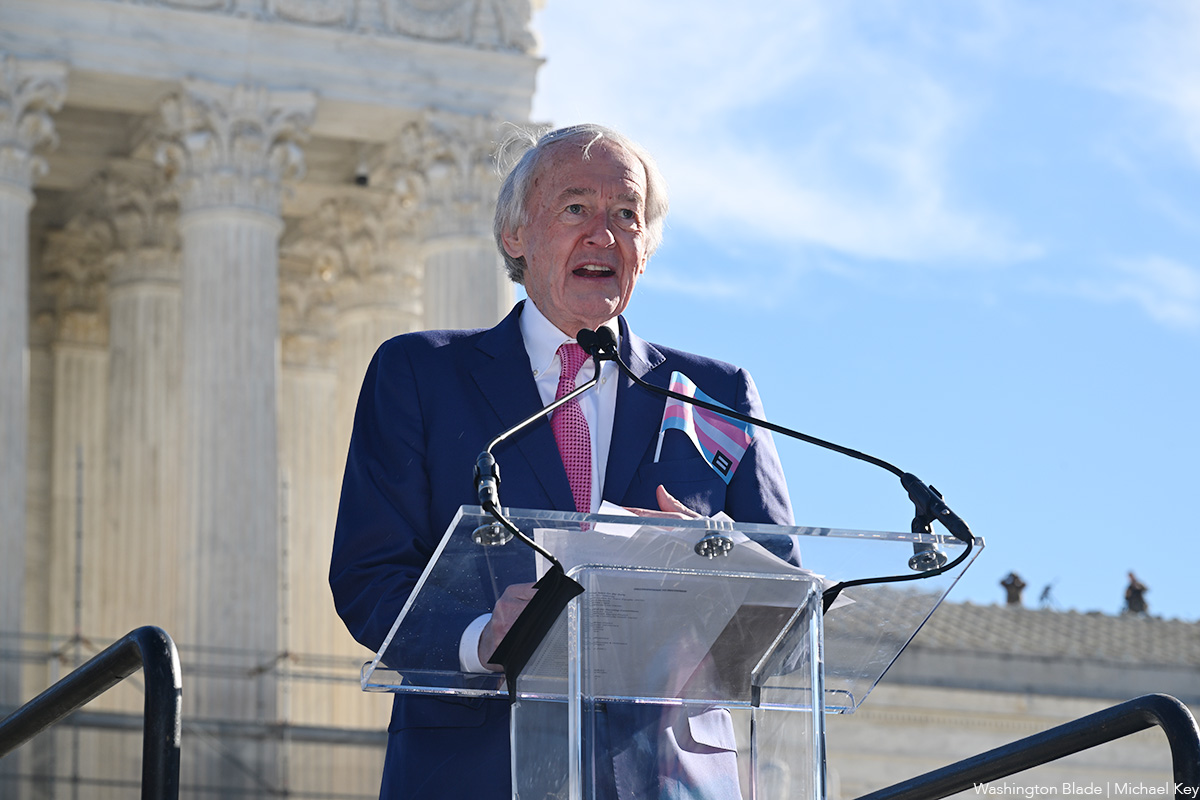
U.S. Sen. Ed Markey (D-Mass.) clinched the Democratic seat for his reelection campaign in Massachusetts’s primary election on Tuesday.
Markey won the deep-blue state with 64.8 percent of the vote, according to NBC News, triumphing over Marine Corps combat veteran and Congressman Seth Moulton, who received 35.2 percent of the vote.
Massachusetts’s primary election, which determined which Democratic candidate will head to the polls to face off against the Republican challenger in November, is being considered a victory for LGBTQ-inclusive policy, as well as for a divisive pro-transgender rights candidate — both things Markey has become an outspoken champion of.
Markey has experience at multiple levels of government, from the state level, where he served three terms in the state House of Representatives, to his federal tenure, including 20 terms in the U.S. House of Representatives and is now serving his second term as a senator. He has become a fixture of a changing Democratic Party in one of the most consistently blue places in the U.S.
This primary — and much of the national discussion surrounding the Senate seat — focused a lot of campaigning power on fighting the growing sentiment, led mostly by Republicans, that the frustration many Americans feel lends itself to an anti-establishment and anti-incumbent attitude.
Markey ran his campaign using his past as a reflection of his commitment to constantly putting his best foot forward for Bay Staters — particularly with apprehension for issues younger and more progressive democrats have been righting for — including Green New Deal and “Medicare for All” while Moulton — who was also elected to federal office prior to this run — campaigned on being younger than Markey, arguing that he was not the same type of established politician.
Moulton also faced backlash for negative comments about trans athletes, sparking criticism for those who did want younger candidate but want for trans rights to be protected.
Markey’s track record of supporting the LGBTQ community is one of the most clear in federal politics, one that has garnered a “100 percent lifetime voting record” on the Human Rights Campaign’s PAC politician review scorecard.
That list of Markey’s actions includes being a cosponsor of the Equality Act, driving landmark legislation to ensure federal protections for LGBTQ Americans, and being one of the most vocal proponents for trans rights in the federal government — specifically in multiple appropriations bills and in the National Defense Authorization Act. He was also the lead sponsor of the Transgender Health Care Access Act and the Transgender Bill of Rights resolution.
Markey first introduced the Transgender Bill of Rights in the Senate in 2023, where it ultimately failed to be brought to law. He reintroduced the legislation this year once again. This was a direct response to the attitude pushed by many conservatives after 2021, when the push to minimize trans rights started to become a key part of their cause and has been constantly propped up by the Trump-Vance administration.
“Massachusetts needs a senator who stands up and fights back, a senator who never forgets who they are fighting for,” Markey said during his victory speech. “That has been the mission of my life, and it always will be.”
Following the calling of the primary, a slew of LGBTQ organizations rallied behind Markey, many pushing his past as an asset that puts his money where his mouth is through advocating for legislation specifically protecting the LGBTQ community.
Tyler Hack, the executive director of the Christopher Street Project, an organization dedicated to pushing for legal protections for trans americans, released a statement following Markey’s win. Hack argued that putting forward such a staunchly pro-trans candidate is a win for the community, especially after endorsing him earlier this year.
“Tonight, anti-trans politics lost. Massachusetts rejected the idea that attacking transgender people is a shortcut to political power. Voters chose a different path: one where equality is not negotiable, cruelty is not courage, and transgender people do not have to disappear for Democrats to succeed.”
The Human Rights Campaign also endorsed him as a candidate earlier this year and issued a statement via its president, Kelley Robinson.
“Ed Markey has spent decades fighting for LGBTQ+ equality, for working people, and for a more livable world,” Robinson said. “He knows why equality matters. He’s stood with us no matter what. We were proud to endorse him this year, and when a pro-equality majority takes back the Senate this fall, we will continue to count on him as a champion for our community.”
Markey is running for reelection against Republican John Deaton in November, where he is expected to win.
Congress
HRC president campaigns for Chris Pappas in NH
Gay congressman running to succeed retiring U.S. Sen. Jeanne Shaheen

Human Rights Campaign President Kelley Robinson on Sunday campaigned for U.S. Rep. Chris Pappas (D-N.H.) in New Hampshire.
Robinson traveled to Manchester, the state’s largest city, nine days before the Sept. 8 primary that will determine who will vie for retiring U.S. Sen. Jeanne Shaheen (D-N.H.)’s seat.
We’re hitting the pavement across New Hampshire to fight for a freer, fairer future for everyone.
Glad to have Human Rights Campaign President @KelleyJRobinson join us for a canvass launch in Manchester today. pic.twitter.com/XWCEaQxy4o
— Chris Pappas (@ChrisPappasNH) August 30, 2026
Former U.S. Sen. John E. Sununu, who represented New Hampshire in the U.S. Senate from 2003-2009, will face off against former U.S. Sen. Scott Brown, who represented Massachusetts in the U.S. Senate from 2010-2013, in the Republican primary.
Karishma Manzur is among the Democrats challenging Pappas.
A poll the University of New Hampshire Survey Center released on Aug. 26 shows Sununu is ahead of Brown. The same survey shows Pappas ahead of Manzur and his other Democratic challengers.
The UNH Survey Center poll shows Sununu ahead of Pappas by a 45-43 percent margin if they were to face off in the general election. The margin of error is +/-2.1 percent.
Pappas would become the first openly gay man elected to the U.S. Senate if he were to win in November.
Congress
Chris Van Hollen says the Democratic Party needs change. Is he the one to lead it?
Senator is backing anti-establishment Democrats across the country
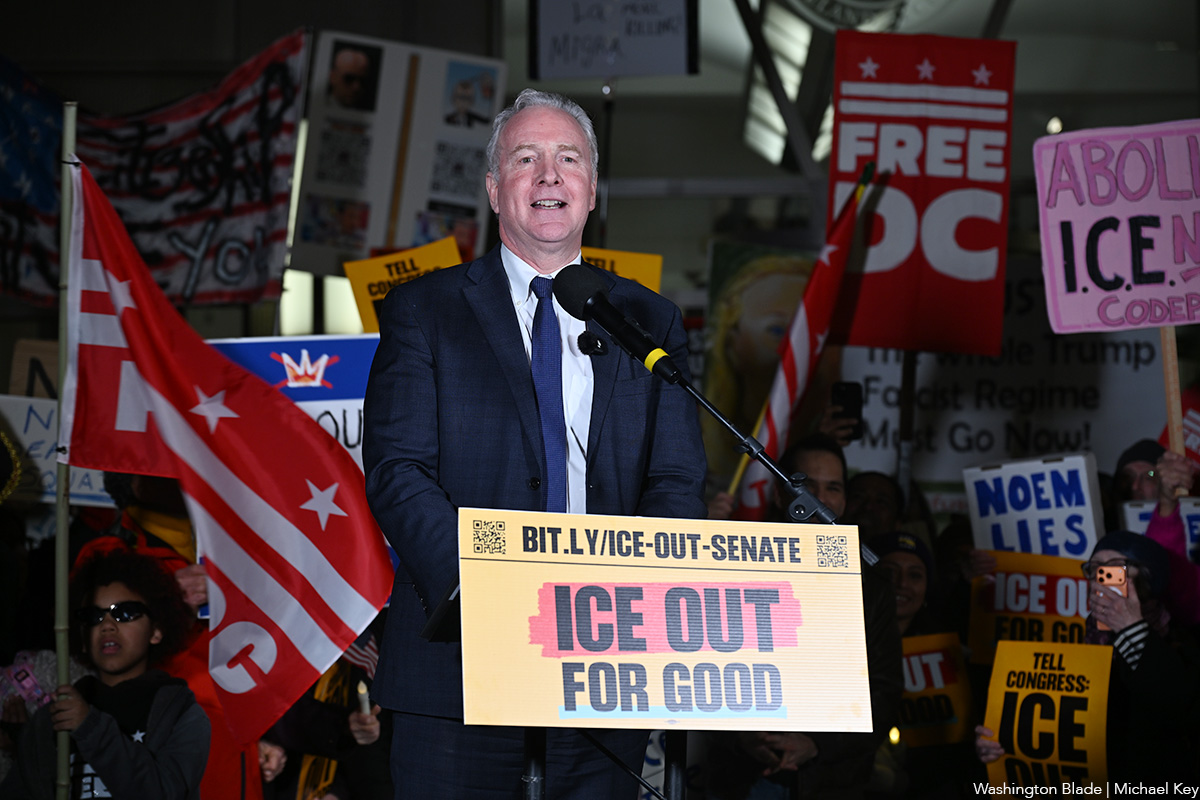
By LEE O. SANDERLIN | The Democratic Party is having something of an identity crisis — losing to President Donald Trump twice in three elections will do that.
Should the party embrace anti-establishment figures who espouse progressive policy ideas like Medicare for all and rhetoric about unrigging the economy for the 1 percent? Or should Democrats try to appeal to moderates who want to return to semi-normalcy in a time of political upheaval?
Although he’s been in Congress since 2002, with key leadership roles throughout his tenure, Maryland Sen. Chris Van Hollen, 67, counts himself firmly in the anti-establishment camp.
The rest of this article can be found on the Baltimore Banner’s website.

Pentagon expands testosterone screening as trans troops face hormone therapy restrictions

Calendar: September 4-10

Swiss government backs nationwide conversion therapy ban

Gloria Steinem dies at 92

The mastery of love

Poland begins to legally recognize same-sex marriages from other countries

HRC president campaigns for Chris Pappas in NH

We’re getting married but our parents object

Prominent French activist attacked outside Paris bar