Commentary
On National Coming Out Day: No more silent compromises
Rejecting half-truths, embracing the whole me, and redefining my worth

Though I’ve never lived “in the closet” over the years, I realized I hadn’t fully stepped out of it in every aspect of life. While I embraced being out, certain moments hindered my personal and professional growth.
Have you ever let someone assume something about your life, like having a wife or girlfriend, because it was easier than correcting them? Perhaps you thought, “I’m not in the closet, so it doesn’t matter.” But looking back, did it matter?
This question lingered in my mind for far too long. We must ask whether our actions reflect who we are or if we’re choosing a more convenient version of ourselves. When someone asked, “Is your girlfriend coming to happy hour?” I wasn’t offended, but I wasn’t being entirely authentic, either.
As a gay man, I found it flattering when people assumed I was straight. Was I accepting it as validation of my masculinity? Perhaps. But over time, I realized that allowing these assumptions to persist wasn’t as harmless as I initially believed.
I’ve been fortunate never to experience the closet. The unwavering support from my family, friends, and colleagues has empowered me to live authentically.
Having a family was, and still is, my guiding light. But by my late 20s, that vision began to fade. By my mid 30s, I saw family life, as a gay man, was a possibility, but I buried myself in building a company. I convinced myself that balancing family and business was unattainable since finding someone with shared values seemed impossible. But was it?
As an entrepreneur, I’ve experienced the highs and lows of building something from scratch, always embracing challenges. It’s easy when you love what you do. Like building a business, personal growth is shaped by what you choose to invest in and what you attract into your life. Despite my successes, something still felt misaligned. What was I doing wrong?
I remember moments like vendors taking us to after-hours bars or strip clubs. I recall one instance at a national expo when a vendor took us to a female strip club. I’ve never enjoyed strip clubs, gay or straight; I’d instead host a dinner party. Early into the night, someone arranged a lap dance for me, and I jokingly asked if she could switch places with the security guy. We both laughed, but here’s the issue: I never told them why I got up and left, only her. At that moment, did I sell myself short? Would it affect our partnership? I wasn’t in the closet but wasn’t entirely out either.
Another moment came in my 30s when I was learning how to navigate dating. A friend suggested I downplay my career to avoid intimidating potential partners. I agreed initially but eventually asked myself: Why should I downplay my accomplishments to make others comfortable? By minimizing my worth, I wasn’t just being inauthentic; I was undervaluing myself and the hard work I put into it. What was I trying to attract into my life?
As my journey continued, I became increasingly aware of what I was inviting into my life. My personal and professional lives were out of alignment. When I opened an office in India, I came out to the local director before signing business documents. Why? Friends and colleagues struggle because their business partners don’t know their authentic selves, and I refused to let this happen. More importantly, I owed being genuine to myself.
Many of us create barriers between our personal and professional lives. While change can be difficult, I needed to align them. We believe we’re not lying because we’re “not in the closet.” But by not fully expressing our authentic selves, we hold ourselves back. For me, dismantling those barriers allowed me to transform what I was attracting into my life, personally and professionally.
Had I not become self-aware, I’d still be stuck in a cycle of inauthenticity, missing out on my full potential. Without changing my mindset, I would have continued letting others’ assumptions define me and limit my growth. I only began breaking free from that cycle by fully embracing my true self.
Even though I’ve never lived in the closet, I still fear what being this open might bring. But that’s precisely why I need to do it. My personal and professional allies have shown unwavering support, standing by me through everything. To those who have supported me on this journey, thank you, it’s now my turn to support others.
Authenticity isn’t just a choice; it’s essential for a fulfilled life. You must ask, you must act, and yes, you will fail and learn along the way, but that’s OK. Every time you act, you move closer to your authentic self. Embrace vulnerability and the discomfort of feeling exposed, it’s then you will begin to reclaim your strength.
To the person on the partner track who’s afraid to bring their partner to a company retreat: bring them! To the young adult worried about being kicked out of the house: seek local support; someone will help you! To the person fearful of losing their job because of who they are: quit! To the person who wants a family, look around; someone shares those values! If someone offers to set you up with a girl or guy, ask if they have a brother or sister, and you might get a date! To those still searching for the right partner, ditch the apps and be present!
I kept my personal life “private” for years because I thought, “I’m not in the closet.” I’m not referring to social media; this is about deep-rooted beliefs that live rent-free in our minds, filtering our responses and decisions. While writing this piece, I mistakenly typed, “I’m not out,” perhaps it wasn’t a mistake; it was a sign. I am grateful those filters expired long ago and are now evicted for living rent-free.
We live in a world where mental health is still stigmatized. Small acts of inauthenticity can cause anxiety that spills into our professional lives. It makes us seem “off” and can lead to missed opportunities. Worst of all, you may feel trapped and remain silent.
It’s time to stop allowing these things to hold us back. We must discuss mental health, authenticity, and their impact on our lives. The journey isn’t about becoming someone new; it’s about shedding what doesn’t define you so you can fully embrace who you’ve always been.
As I continue my journey, I will do so boldly, out loud, and unapologetically. Note to readers: If you’re struggling, want to discuss this topic further, or just need a virtual coffee chat, feel free to reach out via Instagram, @gregorybarretta.
Gregory Barretta is a serial entrepreneur overseeing several companies, committed to mentoring, leading, and empowering others to grow.



Commentary
What LGBTQ veterans are building after ‘Don’t Ask, Don’t Tell’
DADT repeal took effect on Sept. 20, 2011. Trans servicemember ban reinstated

Fifteen years ago this month, the repeal of “Don’t Ask, Don’t Tell” took effect. At the time, the importance of the change was obvious: gay, lesbian, and bisexual Americans would no longer have to hide who they were to wear the uniform. What was harder to see was what would follow: a generation of LGBTQ veterans able to carry their service openly into American civic life.
Earlier this month, Alaska state Rep. Andrew Gray, an Army veteran, stood before the Anchorage Assembly and asked the city to recognize Sept. 20 as LGBTQ Veterans Day.
His former command sergeant major, Mike Grunst, followed him to the microphone. A 35-year veteran who had served in combat, Grunst called troops who had served while hiding who they were “the bravest I have ever served with.”
Then Denise Sudbeck stepped forward. A Vietnam-era Navy veteran, she thanked the country for the privilege of serving and asked that the next generation have the same chance.
The Assembly approved the recognition.
Nothing about the scene required a new vocabulary. A veteran made a request of his community. A commander vouched for those who served beside him. Another veteran asked that younger Americans inherit the opportunity she valued. They entered the civic record simply as veterans.
That identity can do more than win recognition.
When federal policy abruptly ended the careers of transgender servicemembers this year, veterans and servicemembers in California began asking a practical question: What happens when those Americans come home?
Republican Assemblyman Jeff Gonzalez, a Marine combat veteran, began one hearing with questions about transgender military service. He listened as veterans explained how the military handles medical care and deployment case by case.
Then the discussion turned to separation.
“I don’t wanna see any veteran homeless,” Gonzalez said. Before the hearing ended, he was asking: “How can I help? How can I understand? How can I be a good advocate?”
The legislation that followed would provide housing, employment and transition assistance to discharged servicemembers. Republican state Sen. Shannon Grove spoke for it. The Senate passed it 32 to 0.
Americans have plainly not settled their disagreements over transgender people. Nor should military service be a prerequisite for rights that belong to every citizen.
But military service creates relationships that are difficult to reduce to the abstractions of the culture war. Before a legislature, “the transgender issue” can become a veteran who deployed, an officer who led troops, or the person who once stood beside you.
The political question changes because the human relationship has already changed.
The pattern is beginning to appear across the country. Kansas is among the states recognizing LGBTQ Veterans Day for the first time this year. New York and Virginia are pursuing broader state-level programs for LGBTQ veterans.
Sept. 20 is deliberate. On that day in 2011, “Don’t Ask, Don’t Tell” ended.
We usually remember repeal for what LGBTQ Americans gained: the ability to serve openly. Fifteen years later, we can also see what the country gained.
A gay veteran can stand before his local government beside the commander who once led him. A transgender servicemember can sit before a legislator who begins with doubts and ends by asking how he can help. A veteran from an older generation can ask her neighbors to give those who follow her the same chance to serve.
This is citizenship in practice.
The enduring legacy of “Don’t Ask, Don’t Tell” repeal is not only that Americans were finally allowed to serve openly. It is also what they can now build after coming home.
Commentary
Anti-science, anti-LGBTQ movements go hand in hand
HHS under RFK Jr. has blocked gender-affirming care for youth

A newborn baby died after contracting measles in Pennsylvania last month, and, as if it wasn’t enough grief for his parents, anti-vax activists are trying to track down and harass his family. Apparently, Gov. Josh Shapiro tangled with Robert F. Kennedy Jr. over his “inaccurate and misleading claims.”
On Aug. 26, RFK Jr., the secretary of the U.S. Department of Health and Human Services, declared that the deaths could be fabricated. We live in peculiar times, when it is government officials, not freaks on the internet, who are spreading conspiracy theories. The new spread of measles in the United States since Donald Trump came to power is one of the most shameful parts of the story of modern American politics, and the tragedy of parents who lost their baby because more and more people refused to vaccinate may seem absolutely unrelated to LGBTQ rights, but actually, there is a pretty solid connection.
Because RFK Jr., the same man who was fighting vaccination, promoted the false idea that vaccines caused autism, and even curated the anti-vaccine organization Children’s Health Defense before going into politics, is also a known opponent of transgender rights. Under his “leadership,” gender-affirming care for trans minors was banned, and there were also created new healthcare guidelines recognizing only two genders.
All around the globe, there is a weird correlation between anti-LGBTQ — particularly anti-trans — ideas and anti-science movements. And it should be clearer to the general public. People who are speaking against LGBTQ rights are not just threatening minorities. They are a danger to everyone.
The Trump-Vance administration is an iconic example of such tendencies.
Trump himself is a known critic of modern scientific studies — for example, believing in the same anti-vax conspiracies that Kennedy promoted, and showing obvious skepticism that global warming exists, despite all the evidence that has been shown by climatologists. And he is also a man who used trans people as boogeymen. Under his command, trans people were kicked out of the military. And even worse, recently he made an extremely chilling statement about the 2026 midterm elections, urging voters to “pretend I’m on the ballot” and vote for Republicans, and while discussing what he says is at stake, he said that if Republicans win, “transgenderism” will “end.” This is an offensive statement at best and genocidal at worst.
And, of course, I think everyone remembers the Department of Government Efficiency (DOGE), which was led by infamous billionaire Elon Musk, who announced to the world that he would destroy the “woke mind virus” that killed his child just because his trans daughter, Vivian Wilson, well, is happy to be a trans person.
DOGE is known not just for cancelling academic research around LGBTQ studies and gender studies. No, this agency abruptly canceled and froze thousands of federal science, research, and health grants, attacking such vital health programs as cancer research, vaccination research, and diabetes research, among others. As you can see, they are not just attacking people who are “affected” by the “mind” virus — they are dangerous to everyone, even if most of the public standing of Musk was around his anti-trans politics and he tried to present himself as a pro-science, pro-progress man by supporting the space industry.
An even more vivid example is the so-called Dark Enlightenment movement.
This extremely reactionary political movement was born in the late 2000s, and originally grew from very democratical classical liberal ideas. Until it became anti-democratic itself. And also often It was created by American software engineer Curtis Yarvin (writing under the pseudonym Mencius Moldbug) and expanded by British philosopher Nick Land. The movement is popular among some Silicon Valley businessmen, and got support from PayPal founder Peter Thiel, and one of their main ideas is that modernity is bad. They are basically obscurantists, who see modern universities as part of “the Cathedral” — a system that, in their opinion, promotes equality and modern science that society doesn’t need. Of course, the movement’s followers are mostly anti-LGBTQ rights, and, as you can see, anti-queerness once again go hand in hand with obscurantism. Unfortunately, the movement got the support of extremely prominent politicians, including U.S. Vice President JD Vance.
In his speech from 2021, Vance proved to be an obscurantist when he claimed that universities are the enemy. He is also a known homophobe and transphobe.
So, why are anti-vaxxers, people who oppose modern scientific studies, and people who hate universities more likely to be queerphobic? Why do the same people who are defending their transphobia by showing that they support common sense actually often show zero such sense when it comes to protecting themselves and their children from measles or decreasing the chances of getting cancer?
We don’t have any statistics or studies that show that all obscurantists are queerphobic, but around the globe, the same dynamic is visible.
In Russian anti-LGBTQ censorship, books about animal biology and zoology have been censored because the censors saw “LGBT propaganda” in them. The famous pro-Putin philosopher Alexander Dugin, who is extremely anti-queer, also speaks up against modernity itself.
In Taliban’s Afghanistan, modern science and LGBTQ rights are attacked at the same time.
Even in the UK, Reform UK is known as the most anti-trans and anti-queer party, and they are facing widespread criticism from scientists and medical experts for promoting climate change denial and anti-vaccine ideas. It doesn’t mean that LGBTQ supporters never believe in conspiracy theories or that progressive politicians always support science.
No, it just means that explicit anti-science and anti-LGBTQ statements often go hand in hand.
I think there are two reasons for this correlation.
First, LGBTQ people are real. You cannot deny that sex is not binary, gender and sex are different, and transition improves the quality of life of actual trans people. Or that same-sex relationships are natural, because even animals have same-sex sexual contacts. To deny it, you need an ideology or a conspiracy theory.
The second reason is that anti-scientific populism and anti-LGBTQ conspiracy theories are popular among the same category of people. It’s a “bundle” of ideas — a trend that conservative voters often adopt together. Studies also show that people who are likely to believe in one conspiracy theory are more likely to believe in another.
But the question is more broad. We don’t speak enough about the harm anti-scientific conspiracy theories and obscurantist politicians around the globe create for mankind in general. Not all people would suffer from a prohibition of hormone therapy, or attacks on same-sex marriage. But anti-global warming ideas, anti-vax advocates, and restrictions on modern research, especially medical research, are potentially dangerous to any human being.
And one of the best things LGBTQ activists could do is just show society that they are being used — that the same people who are stealing LGBTQ rights are also destroying medicine and the environment, and it’s a threat to their own traditional families and future of all kids no less than to queer people.
Commentary
Please join me in supporting the Washington Blade Foundation
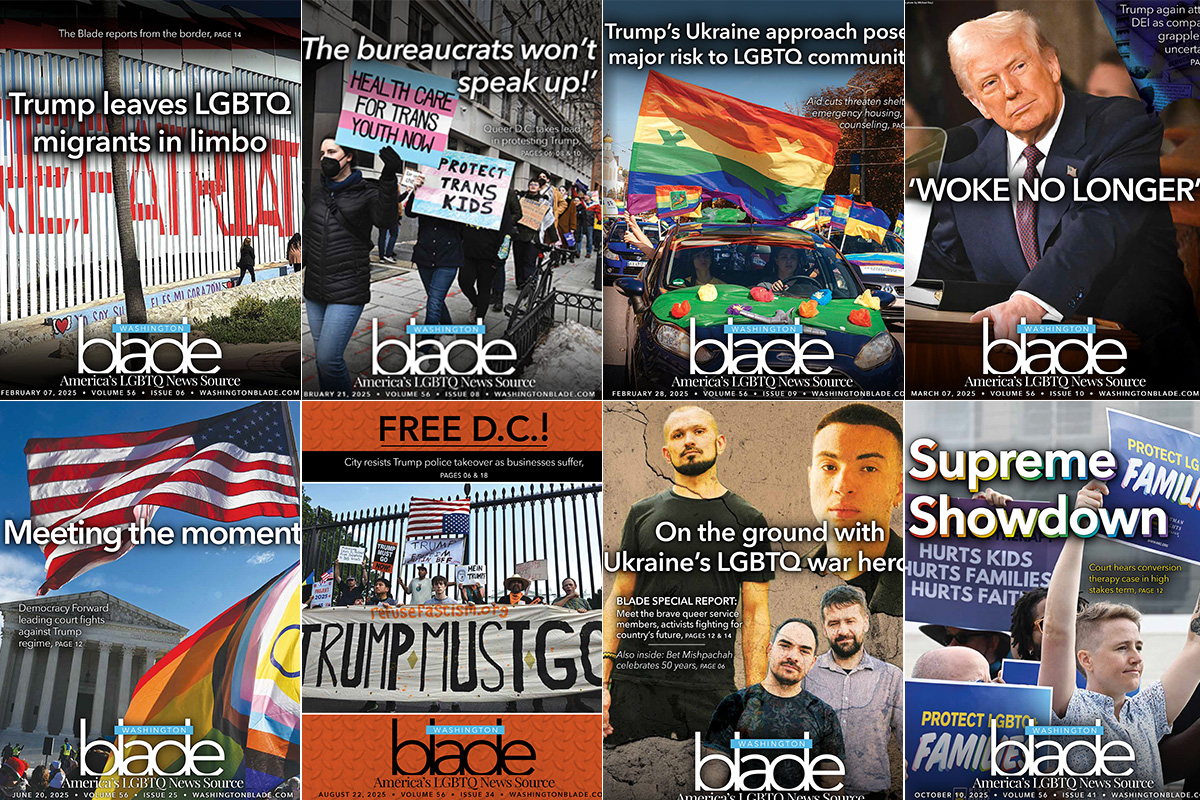
An important event impacting the LGBTQ community will be held on Sept. 12 in Rehoboth Beach, Del.
The event is a fundraiser for the Washington Blade Foundation. Whether you can join us in person, or just be with us from a distance, I ask you to seriously consider becoming a sponsor of this event. You may ask why should you care, why is this important, and how the Blade Foundation supports the LGBTQ community.
The event will feature an open bar, food catered by the Blue Moon, entertainment, and speeches from Blade staff along with remarks from Rehoboth’s Mayor-elect Susan Stewart and another surprise guest or two. You can buy tickets on Eventbrite; if you’re interested in sponsoring the event, contact Publisher Brian Pitts at [email protected].
The Blade Foundation was begun to ensure the history of our community, written in the pages of the Washington Blade, was archived, and never lost. That effort was a success thanks to the support of the DC Public Library. Now the Blade Foundation works to help ensure there will be future LGBTQ journalists working throughout the media, not just for the Blade. By funding interns and fellowships for LGBTQ journalism students, we help make that possible. By helping to fund the international news section of the Blade, the Foundation helps to keep the LGBTQ community around the world connected. In many countries where our community is either still not accepted, or worse, tortured, members of our community living in those places may only get news of their communities by reading the Blade online.
I know many of you reading this already know, the Washington Blade newspaper has been in existence, and reporting on the LGBTQ community, for more than 56 years. The paper’s reporting is done by those who are part of the community, and that makes a real difference. The paper is proud of its journalists, and the numerous awards they have won. One is Lou Chibbaro Jr., who recently was the subject of a documentary aired on PBS. He, and others like him, report the news honestly, without bias, but with fervor, because they actually live the stories.
In those 50-plus years since Stonewall, the Blade has been reporting on the progress our community has made. The steps forward, the stumbles, those allies who have worked with us, and those people who have tried to stop us from living our lives as who we were born to be. Again, the news is being reported by members of our own community. It is not others writing about us, but us, writing about ourselves. The Blade is followed by many mainstream media outlets, and stories that first only the Blade covered, ignored by mainstream media, were then picked up and reported garnering the widespread coverage they deserve. The Blade is the best place to find out about what the members of our own community are doing, and what others are doing to, and for, us.
It is sad that today the Blade has to report we are at a place in history where we are fighting just to keep the strides for equality we have made over the past 50 years. Because of that, it is even more important than ever, that the Washington Blade keeps publishing. Today, the Blade is the only LGBTQ news outlet with a dedicated seat in the White House briefing room. That is important for the Blade, and for all the members of our own community. It is important the Blade be where the action is.
The Blade’s international coverage helps us in the United States to understand where we can help those in our community who may be suffering and less fortunate, but also to celebrate with those who are even more free in many ways. The recent stories about World Pride in Amsterdam inspire us to fight even harder for our rights here, so we never again have a president who will work to keep our community from being all it can be. That we will never again have a President who threatens the lives of our trans sisters and brothers, threatens their healthcare, and throws our community’s heroes out of our military. Those news stories are important to write, and they often only get written about fully, in the Blade.
So again, I ask you to consider being a sponsor, and joining us in Rehoboth on Sept. 12. Or if you can’t be in Rehoboth, that you support our work from a distance, and support this important event. The Washington Blade Foundation is a 501c(3) non-profit. So, whether you are a business supporting the community, an individual ally, or a member of the community, please dig deep, and help to support the future of LGBTQ journalism, and future LGBTQ journalists. By doing so, you are supporting the future of the LGBTQ community. You can donate online at bladefoundation.org/donate.
Peter Rosenstein is a longtime LGBTQ rights and Democratic Party activist.

UN human rights chief sounds alarm over ‘comprehensive onslaught’ against LGBTQ rights

White House press pool pushes back after Trump bars three outlets

PHOTOS: Shenandoah Valley Pride

Long-time DignityUSA executive director announces retirement

PHOTOS: Walk and 5K to End HIV

Jeremy Moss looks to bring LGBTQ advocacy from Lansing to Capitol Hill

Republican challenger misgenders McBride during forum, forced to leave

Activists protest outside Turkish Embassy in D.C.

Queer mega stars coming to D.C. this fall

A roundup of fall events not to be missed
-

 Congress5 days ago
Jeremy Moss looks to bring LGBTQ advocacy from Lansing to Capitol Hill
-
Delaware4 days ago
Republican challenger misgenders McBride during forum, forced to leave
-
Turkey4 days ago
Activists protest outside Turkish Embassy in D.C.
-
Music & Concerts4 days ago
Queer mega stars coming to D.C. this fall