Congress
Garcia warns U.S. government faces a ‘five-alarm fire’
Congressman blasted Senate Leader Schumer for supporting GOP budget

Although U.S. Rep. Robert Garcia (D) has only served in Congress since 2023, the representative for California’s 42nd Congressional District quickly emerged as a rising star in the Democratic Party who has become known as an especially outspoken critic of President Donald Trump since his return to the White House in January.
Delivering memorable hits on cable news programs, punchy sound bites in congressional hearings, and spirited spats with political opponents on X, Garcia is among a handful of leaders on the left who have been feted for their outspokenness at a time when pushback against the administration by Democrats has widely been criticized as anemic, ineffectual, inconsistent, or insufficiently aggressive.
Last week, the California congressman, who is gay, sat down with the Washington Blade in his office for an interview that was continued by phone on Tuesday in the wake of Friday’s move by nine Senate Democrats and their leader Chuck Schumer (N.Y.) to avert a government shutdown by supporting the controversial budget proposal advanced by congressional Republicans.
Critics blasted Schumer and the senators who voted with him, arguing that they had voluntarily forfeited leverage that their party will rarely again have the opportunity to exercise — at least, not until the 120th Congress is seated in 2027, and only then if Democrats are able to recapture control of either or both legislative chambers.
Calling the Democratic leader’s decision “out of touch” and “a huge disservice to the American people,” Garcia said he was “incredibly angered and beyond disappointed,” adding “I think that he’s turned his back, in my opinion, on the rank and file base of the party, and certainly on his own members.”
The congressman said he agrees with remarks made in recent days by Senate Democrats who have deemed this battle over the budget “the moment to actually stand up to Donald Trump and Elon Musk in a way that was forceful and strong.”
“Those that voted to support this budget resolution are completely not aligned with the vast majority of Americans and certainly [not with] Democrats who wanted to actually fight Elon Musk and push back much harder,” Garcia said, contrasting Schumer’s leadership with Jeffries who “did the right thing” and was able to bring “the caucus together,” successfully convincing “everyone, I mean, almost unanimously, to vote against the budget.”
More than that, Garcia said Friday’s vote exemplifies a broader failure among some elected Democrats “especially, maybe, among those that have been in government for a long time” to reckon with the existential risks presented by the Trump administration and powerful allies like Musk.
The congressman said these political leaders “are thinking that somehow this is just another year or just another cycle, and things will just get better and go back to the way they were” because they have failed to recognize the ultimate ambitions of the president, his administration, Musk, and their allies, who endeavor to “fundamentally restructure the way government works, to build a system where you have an authoritarian at the top with enormous amounts of power” unchecked by the federal judiciary or the legislative branch.
“It’s supreme executive authority,” he said, coupled with “disregard” for the powers ordained by the Constitution to the courts and to the Congress. “That is a very dangerous formula when you’re sitting on top of the wealthiest country in the world with an enormous military and enormous power over what happens in the rest of the world.”
“We live in a very dangerous time and I just don’t feel like everyone is understanding that, including people in our own party,” Garcia added.
The congressman noted that reasonable people might reach different conclusions about whether Trump’s second term has yet presented such a grave threat to America’s political and democratic institutions and the rule of law that the time has come to declare a state of emergency or break the glass, to to speak, to release the fire alarm.
In Garcia’s view, “you have the richest man on the planet who’s getting only richer since the election of Trump, who has an unobstructed ability to go into agency after agency, access people’s personal information, essentially eliminate jobs, directly email federal employees about having to report their activities to him — that is a five alarm fire.”
“That is unconstitutional and it’s a real challenge to the way we operate our government,” he added.
Organizing grassroots resistance at home
Returning to more familiar territory for inter-party debate the congressman criticized the GOP’s budget package, warning that it might “slash other types of health care, could slash Social Security,” but because it proposes trillions of dollars in cuts, lawmakers will have no option but to “take Medicare and Medicaid apart.”
Together with the “destruction of our agencies” led by Musk’s Department of Government Efficiency, Garcia said the effort by congressional Republicans to trim the budget in ways that will imperil access to critical medical care for populations that depend on it, including “low-income folks, seniors, and working class people” is meant to free up money for “huge tax cuts to Elon Musk, the billionaires, and large corporations.”
More specifically, during an interview Friday with MSNBC’s Alex Witt, Garcia warned the funding bill will “cut billions and billions of dollars, for example, for veterans’ health care” while prohibiting Congress from pushing back “on the tariffs that Donald Trump is trying to implement,” giving “a rubber stamp of approval to what Elon Musk is doing raiding our federal agencies,” and gutting programs by agencies like the U.S. Department of Education that serve students with disabilities and special needs.
Garcia further explained that “sending the money to the states as Trump wants to do essentially gives states the ability to send that money to private schools and to provide a system where actually public schools get defunded because private schools won’t take those programs up.”
Speaking with the Blade on Tuesday from Long Beach, the city in the center of CA-42 where he served as mayor from 2014 to 2022, Garcia explained how he was using the House’s district work period to organize opposition against the Trump regime.
After the congressman’s plane touched down from Washington, he took the opportunity to record a video for social media to explain that “We should be investing in our airports and passenger safety, not cutting 400 FAA positions” as the administration did last month.
“We need to hire more air traffic controllers and ensure that flying remains the safest way to travel,” he said.
We should be investing in our airports and passenger safety, not cutting 400 FAA positions. We need to hire more air traffic controllers and ensure that flying remains the safest way to travel. pic.twitter.com/3QSL6EcIIr
— Congressman Robert Garcia (@RepRobertGarcia) March 17, 2025
After Republican leadership encouraged its members to avoid holding in-person meetings with constituents because they had complained and expressed anger about the cutting or suspension of federal agencies, grants, programs, and services, Garcia announced he would hold town halls in GOP districts in California, a strategy that has been touted by other leaders in his party like Minnesota Gov. Tim Walz, the 2024 Democratic candidate for vice president.
“Not this weekend but the next weekend I’ll be launching in a Republican member’s district in California and doing a town hall there,” Garcia told the Blade. “It will be in a Republican swing district.”
In the meantime, the congressman said he has been visiting with and listening to his constituents. “I just left a school here in southeast L.A. where I met with the principal and a bunch of teachers, and talked about the students that they have in special programs that are receiving funds from the federal government.”
“They were showing me kind of a center where they have, like, toiletries and shoes and backpacks for kids that they’ve received through support from the U.S. Department of Education,” he said. “So there’s just so much need, in talking to folks, and so much anger from people about what’s happening.”
“Earlier today, I was at the Social Security Administration center here in one of the cities I represent, so I am going around talking to people where they are getting their services and people are really frustrated,” Garcia added. “I don’t think people realize that most of these people that depend on a lot of these programs are working families, that they need the support to survive, and yet they have the richest man on the planet cutting their services because he feels like it and he wants a bigger tax cut.”
During last week’s interview, when asked what he hopes to gain from engaging with constituents in competitive neighboring districts that are now represented by Republicans, the congressman said he hopes that attendees recognize that “you have a member of Congress too scared to actually answer these questions” but his aim is foremost to listen to their concerns and address their questions.
Garcia recounted some of the reports in the media detailing scenes from town halls in GOP districts that were held prior to the effort by party leadership to contain the bad press. Attendees “were pissed,” he said. “They were demanding answers. Why am I losing my job? Why are my veterans’ benefits going to be cut? Why are you trying to dismantle the federal Department of Education when my kid has a disability and depends on these programs?”
Democratic leaders bring different strengths, styles
None of the nine House Republicans that the Democratic National Committee identified as “most vulnerable” represent districts in California, and it remains to be seen how many House Democrats will follow Garcia’s lead and stage town halls in red or purple areas of their respective states to take advantage of the anger and frustration over Trump’s second term.
Nevertheless, and notwithstanding his criticism for the Senate Democrats who cosigned the Republican budget, or his concerns that some leaders in the party may not have come to terms with the exigencies demanded by this tumultuous moment in American politics, Garcia stressed that House Democrats benefit from the different strengths and different styles brought by its diverse members.
There is even room to accommodate differences of opinion, he said, on questions like whether and in which circumstances transgender female athletes should be permitted to participate in girls’ and women’s sports.
Breaking from the position that, at least in recent years, has been held almost without exception by Democratic elected officials serving in national and statewide office, California’s ardently pro-LGBTQ Democratic Gov. Gavin Newsom argued during an interview earlier this month that allowing these athletes to compete against their cisgender counterparts was “deeply unfair.”
The comments, which drew criticism from groups like the Human Rights Campaign, came as some Democrats had begun to question whether their electoral defeat in 2024 might have been partly attributable to daylight between the party’s position and where the broader electorate lands on the issue, with most Americans tending to support restrictions targeting trans players in at least some circumstances, according to data from surveys and polls.
Garcia said his position is and always has been that far too much focus and attention has been paid to the issue, which ultimately concerns such a small population that becomes smaller, still, when the aperture is narrowed further to focus just on athletes. Young people, he said, should be able to reap the benefits that come with participating in competitive sports, including those who will encounter additional challenges or hardship because they are trans.
Still, the congressman said he continues to support the governor, noting that few Americans have done more for LGBTQ rights than Newsom has.
Besides, Garcia said, rather than trying to reconcile minor party differences about the sports question, Democrats should instead band together against extreme efforts by the anti-trans Republicans “trying to police bathrooms or trying to take away their health care.”
“People are gonna have different positions,” Garcia said, and “our party has various different positions on this issue” just as Democrats can bring different approaches to communicating about policy or styles of messaging about politics to their work on Capitol Hill.
While “some of us have figured out ways of taking on the administration that also get some attention” or offer chances to “shine a light on the policies” thus exposing their harms, on the other hand Garcia said “There are other people in our caucus that are so good at what they do, and I would have a hard time doing what they do, because they’re so good at it.”
Leaning in to differences
During his time in Congress, the California Democrat, 47, said he has tried to capitalize on his knowledge of pop culture and entertainment “to get attention on a policy issue.”
For instance, last summer when Republicans went after Hunter Biden’s overseas business dealings during an Oversight Committee hearing and in response Democrats sought to redirect the focus toward Trump’s conduct involving foreign business interests during his first term, Garcia quoted from a monologue delivered by Heather Gay during the finale episode of Season 4 of Bravo’s “The Real Housewives of Salt Lake City.”
In 2023, amid a GOP-led effort to restrict young people’s access to drag performances, the congressman kicked off Pride month with a tribute on the House floor honoring “RuPaul’s Drag Race,” the popular program that has been credited with bringing the art form to wider attention and appreciation, including among non-LGBTQ audiences.
“The show has served as a critical space to discuss issues around inclusion, trans rights, mental health and self worth,” Garcia said at the time. “And this message couldn’t be more important as the LGBTQ-plus community continues to fight for equality and acceptance.”
Last month, a couple of years after Republican U.S. Rep. Marjorie Taylor Greene famously displayed explicit photos of Hunter Biden that were taken when the former president’s son was struggling with substance abuse, Garcia referenced the incident during the first hearing of the House Subcommittee on Delivering on Government Efficiency.
After announcing that he had a “dick pic” to share, a large image of Musk’s face appeared on screen behind the congressman, who then delivered a message about how the controversial tech billionaire was “trying to take away your Medicare and Social Security and doing all these awful things to you.”
Garcia explained that this kind of creativity can help Democrats reach audiences that might be less inclined to see or less eager to consume traditional sources of information about politics. “I think that we have to remember that not everybody reads The New York Times and watches cable news,” he said. “You can do all the cable news you want. You can get quoted in The New York Times as much as you want, and put out statements, [but] there’s a huge segment of the population that’s never going to see that.”
“It’s important that we use moments that speak to different groups to drive a message,” the congressman added. “Because I am gay, and because I know a lot about pop culture and stuff — because, you know, we like to know a lot about stuff like that, I think it does help. I am still actively watching RuPaul. I follow things that maybe the average political person is not following.”
This familiarity that comes with membership in marginalized communities can become especially important in the context of working in a legislative body where their rights and protections are under attack.
“There’s an active dismantling of our rights,” Garcia said, “and gay marriage could be on the line [along with] gay adoptions, teaching history about leaders in our community in our schools. All of that is on the line, and so we’ve got to be very clear about that.”
Reciprocally, the congressman said, that responsibility also applies when people who belong to marginalized communities are present in those spaces. “I talk to gay friends back home, and I remind them there’s an attack happening right now on trans people, on gay people,” he said, “and you have to wake up to that and know that it’s your job to, like, stand up and be loud, and you just can’t live your life every day thinking everything’s just gonna get better when Donald Trump’s not the president.”
Standing up to Musk and the Trump administration can be risky
Of course, there is always a risk of attracting negative attention, particularly when a member of Congress stands up to a public figure as polarizing and powerful as Musk or Trump and with a message that is designed to reach audiences that might not otherwise watch clips from a hearing or floor debate in the U.S. House of Representatives.
In February, Garcia was targeted by Ed Martin, a close Trump ally who shortly after his appointment by the president to serve as U.S. attorney for D.C. issued a “letter of inquiry” to the congressman’s office over remarks he had made during an interview on CNN.
“When asked how Democrats can stop Elon Musk,” Martin explained, “you spoke clearly: ‘What the American public wants is for us to bring actual weapons to this bar fight. This is an actual fight for democracy.’”
He continued, “This sounds to some like a threat to Mr. Musk – an appointed representative of President Donald Trump who you call a ‘dick’ – and government staff who work for him. Their concerns have led to this inquiry.”
In response, Garcia vowed that his criticism would not be stifled by attempts to intimidate him with the specter of an investigation or charges by the Justice Department for comments that any reasonable person would interpret as a metaphor or figure of speech rather than a legally actionable call for violence against a public official.
The congressman told the Blade he believes the effort was meant to silence not just his criticism of Musk but also to create a chilling effect that would dissuade others from speaking out publicly against the billionaire.
“And so we’re going to continue to call out what Elon Musk does, the damage he’s doing, and I’m certainly not going to stop using metaphors,” Garcia said.
As of Tuesday, the congressman said his office did not reply after their receipt of the letter from Martin, adding that he had consulted with House counsel “which is the proper approach.”
Asked to share how he evaluates the risks and potential rewards of speaking out against powerful interests who lead a regime that is bent on retribution against critics and political enemies, Garcia said that as a lifelong comic book aficionado, to some extent he sees taking on real-life villains in Congress as a necessary part of his work on behalf of the people.
“I’ve learned my values through comic books,” he said, “and I view the world very much in terms of people that are doing the right thing in truth and justice and people that are, I mean, who better exemplifies Lex Luthor than folks like Elon Musk?”
Garcia said that earning the ire of Musk, Trump, and Republican colleagues like the anti-trans extremist U.S. Rep. Nancy Mace (S.C.) is a sign that he is on the right path, adding that these folks should feel opposition from elected Democrats and other leaders along with the anger they might witness from X users who might post on the platform to vent their frustrations with its owner, demonstrators who might picket outside the White House, or angry constituents who might show up to their representative’s town hall meetings.
Additionally, he said, “I’ve told other members of Congress this, whether we’re in a meeting or sharing a meal, I said, ‘when you look back at this moment, and we think about who should be opposing Elon Musk and Donald Trump in this moment, that’s us.”
Garcia also expressed gratitude for his “fantastic, very supportive” family and close friends including pals from college who are part of his “great support system back home.” The congressman said that while he and his husband split up and are now divorced, the two have remained “very close” and share custody of their cat.
Support also comes from strangers, he said, who increasingly have been approaching him in public to express gratitude because they feel he is giving voice to their feelings about the administration. In fact, Garcia said he feels more embraced than ever before by his community in Long Beach, including compared to his tenure as mayor.
What’s next for the Democratic Party?
Garcia is realistic about the extent to which he and his Democratic colleagues can hold the administration accountable so long as they remain in the minority, where they are unable to even access all the documents and paperwork necessary to do their work on the Oversight Committee let alone pass legislation without buy-in from Republicans.
At the same time, he cautions that Democrats must not focus on the midterms to such an extent that they do not recognize or call attention to their opponents’ effort to gut the federal government, causing harm on a scale that will be difficult to quantify for savings that will be used to carve out tax breaks for the country’s richest people and corporations.
As Democrats work to rebuild after their losses in the 2024 cycle, Garcia said he has been influenced by proposals such as those floated recently by Ezra Klein of The New York Times, who has urged the party to focus on creating a politics of abundance as an alternative to the politics of scarcity that empowers Republican coalitions.
The Democratic Party has “made it difficult to build housing, by over regulating, by not allowing there to be more for everyone,” the congressman said. “I’ve seen it happen in the way we do our environmental policy, our housing policies,” the latter being a challenge that “I struggled with when I was mayor.”
“In our states and in our cities, everyone is talking about this question,” he said. “I mean, maybe they’re not calling it ‘abundance’ in the way that Ezra Klein is referring to it,” but there has been a lot of self-reflection and dialogue among Democrats about how “we have been creating communities in states where people are leaving,” where because they can no longer afford to live there, “working class people are leaving.”
Garcia in November helped to launch the bipartisan YIMBY caucus which works to promote the development of new housing across the country, leading the effort with fellow founding co-chairs, U.S. Reps. Scott Peters (D-Calif.), Marc Molinaro (R-N.Y.), Juan Ciscomani (R-Ariz.), Jake Auchincloss (D-Mass.), Brittany Pettersen (D-Colo.), and Chuck Edwards (R-N.C.).
Along with substantive reforms designed to deliver real results for working people, the congressman discussed some of the ways he would like to see Democrats refine their media strategy, including by making appearances on conservative media outlets like Fox News — without compromising or softening their message or policy positions.
Watching former Transportation Secretary Pete Buttigieg spar with the network’s right-wing hosts, Garcia said, was eye-opening in terms of how the segments were mutually beneficial for the Democratic cabinet secretary and members of the right-wing cable network’s audience.
The California Democrat said that he was probably the only guest who appeared on Griff Jenkins’ 60-minute Fox News program during his most recent interview on March 1 with the network’s Washington based national correspondent to offer a take that was critical of Musk but grounded in facts.
“It’s about reaching as many people as possible and in as many venues as possible,”
Garcia said. “That’s why I’m going on Fox News. And honestly, I encourage all Democrats to do it. I feel good about our growing opposition. But, you know, it’s also taken us a while — I mean, we went through a really bad loss, and I think that a lot of the party apparatus was unprepared for how strong and fast Trump was going to be.”





Congress
Jeremy Moss looks to bring LGBTQ advocacy from Lansing to Capitol Hill
Congressional candidate would represent Detroit suburbs if elected
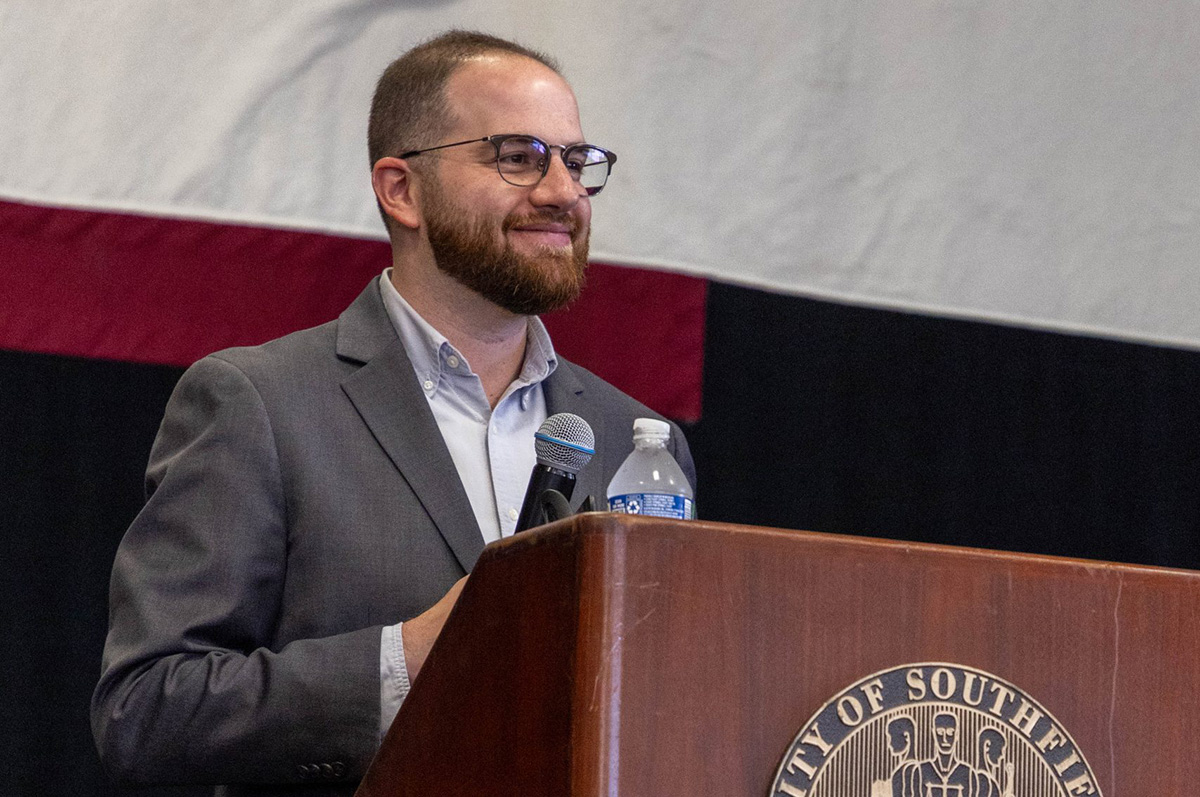
With fall comes swapping out T-shirts for sweaters, raking leaves and, of course, elections. The summer’s primaries have narrowed the playing field in a slew of races, but the big ones — the actual races for seats in federal and local elections — are still to come.
Jeremy Moss is one of those people running for a congressional seat in Michigan. Despite his young age, Moss has quickly learned the ropes of politics in the state, already serving terms in the Great Lakes State’s House of Representatives and Senate.
Moss sat down with the Washington Blade to discuss his history in Michigan politics, his experience as an openly LGBTQ legislator and his vision for a better America as he looks toward Congress.
He currently represents Michigan’s 7th Senate District, but now he is setting his sights beyond Lansing toward Capitol Hill to represent Michigan’s 11th Congressional District, which includes Detroit’s northern suburbs.
Moss earned his bachelor’s degree in journalism from Michigan State University, where just a few years later he made history as the first openly gay person elected to the Michigan Senate and the first to serve as its president pro tempore.
His political experience stretches across multiple offices.
Moss worked in the offices of Southfield Mayor Brenda Lawrence, who also served in the U.S. House of Representatives, and State Rep. Paul Condino.
Moss, at age 25, was elected to the Southfield City Council in 2011, becoming the youngest member elected in the body’s history. He then switched over to the state legislature, representing Michigan’s 35th House of Representatives District in the Michigan House of Representatives from 2014-2018, becoming the second openly gay member elected to the Michigan legislature.
He then moved from Michigan’s House to its Senate in 2018, elected to represent the 11th Michigan Senate District and becoming the Assistant Democratic Leader. Moss started his second term in the Michigan Senate in 2023, this time representing District 7.
He currently has a long list of priorities listed on his campaign website, many of which have become standard for Democrats running across the country, with a particular focus on minimizing — and cleaning up — issues that the Republican-controlled federal government has created under President Donald Trump.
Those goals include lowering healthcare costs, tackling the cost of living crisis, holding U.S. Immigration and Customs Enforcement accountable and fixing the broken immigration system, restoring national voting rights, protecting rights — with a particular focus on abortion access and LGBTQ rights — combating corruption in politics, preventing gun violence and strengthening gun safety, empowering Michigan workers, and preserving the environment.
Why Moss is running for Congress
When asked why he wants to run for Congress, Moss pointed to his lengthy resume in state leadership, with a clear voice arguing that if he can do it in Lansing, he can get it done in Washington.
“I’ve served 12 years in the legislature and have ascended into leadership as president pro tem of the Senate,” Moss explained to the Blade. “We flipped our state legislative chamber to a Democratic majority for the first time in 40 years in 2022, and we passed some big, generational-changing, consequential Democratic wins that had languished for a generation, but had improved people’s lives in our state.
“We’ve passed the first gun safety laws in a generation that are saving lives. We protected the right to vote amidst attacks from Donald Trump and other conspiracies. We pushed forward and finally put LGBTQ rights in our state civil rights law. We provided free school meals and lunches for all public school children in the state of Michigan.
“The problems from Washington, D.C., aren’t getting less severe over time,” he continued. “They’re getting more severe. So this district unexpectedly opened up due to a series of retirements and it was just a great opportunity for me to continue to advocate for big change that we’ve already achieved here in the state legislature.”
“I’m a product of this district. I grew up here. I’ve represented a bulk of the district already in the state legislature, and I knew that I was going to earn grassroots support to be able to wage this campaign. We sought it out, we earned it, including some premier endorsements from Gov. (Gretchen) Whitmer, among many others, and were highly successful in the primary because we were in tune to the needs of this district.”
Moss has been endorsed by a slew of Democratic leaders and organizations, including, as he pointed out, by Whitmer.
Other endorsements include former Gov. Jim Blanchard, Secretary of State Jocelyn Benson, Attorney General Dana Nessel, the Equality PAC, the Human Rights Campaign, the Unity Fund, and the LGBTQ+ Victory Fund.
His political identity and the Democratic Party
Moss described himself as being “on the liberal end of the spectrum,” but argued that the Democratic Party’s internal divisions should not be the central focus.
“I’m certainly on the liberal end of the spectrum, but I don’t even think it necessarily has to be this progressive versus establishment fight that we’ve seen play out,” Moss said when asked about various elements of in-party disagreements. “It has to be between action and, and inaction, fighters versus folders.”
He said that distinction between action and inaction is central to how he would approach Washington.
“At this moment, I think we need to demonstrate that we are ready to take on Donald Trump and MAGA chaos with boldness and effectiveness. I’ve been saying all along our campaign trail, we can no longer be the party that shows up to the knife fight carrying a pie chart, and so I think we have to be showing that we have spine and we have punch, and we’re really ready to be tough fighters for, for Michiganders and the American people.”
“We can’t walk on eggshells anymore. We can’t pull our punches,” he added. “We can’t fear that we’re offending someone, you know, one way or another with how we act. People are expecting a bold party to take on MAGA, and I think that’s exactly what the Democratic Party needs.”
Becoming an LGBTQ legislator
Moss also reminisced with the Blade about his first run for elected office — at a time when Michigan had no openly LGBTQ members serving in the state legislature — and how that experience became deeply connected to his identity and his approach to LGBTQ politics.
In 2014, Michigan was in the pre-marriage equality era, and the state had no openly LGBTQ members serving in the legislature.
“12 years ago in 2014 — this was pre-marriage, the pre-marriage equality era — we had zero people from our community serving in the legislature, and still they were talking about us.
“The big topic then in Michigan was whether or not to expand our civil rights law to include LGBTQ protections, so that people from our community would no longer face discrimination in housing and employment. And they were talking about us regardless of whether or not we were at the table.”
Moss eventually helped lead the effort to expand Michigan’s civil rights protections to include LGBTQ people, a measure that passed with bipartisan support.
He said his experience as an openly gay lawmaker allowed him to make the case for LGBTQ protections in terms that extended beyond LGBTQ issues.
“One thing I definitely aligned with Gov. Whitmer at the time was making the case that discrimination was not only morally wrong, but it was bad for business,” he said. “By not having these protections for our LGBTQ neighbors and family members and friends and community members, we were actually holding back our economy. We were essentially allowing people to be kicked out of Michigan as consumers and workers, because of who they are and how they identified.”
That led to various efforts — including committee hearings and meetings with advocates, businesses and the public — that helped make Michigan what the Movement Advancement Project deems the 16th most LGBTQ-friendly state, solidly above other states due to its robust LGBTQ-related legislation.
“I wanted to meet everybody where they were, including those who may have not been involved with or engaged with the LGBTQ community as legislators, but understood that we couldn’t sustain the economic impact of discriminating against our community,” Moss said. “And as I’ve said all along, discrimination is bad for business. That’s something I think helped broaden the vote and earn some bipartisan support for it.”
Representation and LGBTQ youth
For Moss, the importance of LGBTQ representation also comes from his own experience growing up.
“I think about when I was younger, when I was 18 years old. It was in 2004, and, you know, there are certain things that really shaped me in that time … Michigan had a ballot proposal that passed to have the strictest language banning marriage equality in our state constitution. We didn’t even allow civil unions in that language in our constitution to exist, and there were scandal-plagued LGBTQ politicians.”
“It was the same year that Jim McGreevey was forced to resign as he came out,” he said. “So it really was a signal to me that, you know, you don’t have a future. Not just you don’t have a future in politics; you might not even have a future. Period, and it was pretty defining for me.”
Despite those fears, Moss continued to pursue public office.
“And you can’t be what you can’t see, and so to be able to break the barriers at the state level and at this congressional level, I think is a signal to anybody who is struggling with wondering where their place is?”
“I think that visibility is incredibly important, and it’s something that I needed when I was much younger, and it’s something that I’ve been honored to be able to provide for the, for the next generation of emerging leaders.”
His LGBTQ priorities in Congress
When asked what LGBTQ issues he would prioritize in Congress, Moss emphasized the importance of growing the number of LGBTQ lawmakers while also expanding federal nondiscrimination protections.
“To have a caucus in the legislature has made all the difference because you can, you know, run these issues across the field. You can have somebody take on marriage. You can have somebody take on trans rights. You can have somebody take on LGBTQ youth. You can have somebody take on discrimination protections.”
He sees much of the work he wants to get done on Capitol Hill as a direct follow-up to his work in Lansing — most importantly, the passage of the Equality Act. The legislation has been debated in some form for more than 50 years at the federal level, with the goal of protecting LGBTQ people from discrimination under federal law.
“I think the Equality Act is incredibly important. That’s kind of the, the counterpart to what we’ve done in the state legislature, ensuring discrimination protections for the LGBTQ community,” he said.
“I think housing and, and workplace discrimination is, is everything, you know, to protect our community so that they can have a safe place to call home and earn a living … That’s incredibly important across the board. And I would really want to take a leading role in telling the story of how we were able to do it in Michigan after 50 years since this act was first written — and finally finished the job federally to ensure their federal protections in, in, in, in employment and housing.”
LGBTQ political organizations and Congress
Moss said the LGBTQ political organizations that have supported his political career from its early stages have helped him along the way.
“Obviously, I’ve been affiliated with Victory Fund since I first ran for office, and they were early endorsers, but Equality PAC, which is the political arm of the LGBTQ caucus in Congress, has been an incredible part of my support system. From day one they helped me out.
“I’ve been getting to know a lot of the members of Congress who are LGBTQ, really over the last year of this campaign. So I’m eager to join them. I’m eager to be one of the players on the field here to be able to advocate and advance our issues.”
Voting rights
Voting rights are another major focus for Moss, an issue he said dates back to his experience during the 2004 campaign over marriage equality.
“Something I’m very passionate about is voting rights, and it really does go back to that 2004 campaign where it was very evident that elections can determine your future.
“Elections can determine what rights you do have and don’t have, and so I’ve been very laser focused on increasing access to the ballot box, making sure our democracy remains whole and accessible.”
He explained how Trump’s recent attacks on voting legitimacy and mail-in voting have only made his desire to help that much stronger.
“We went through a real trial of that in 2020 with, with Michigan’s presidential election, with Donald Trump and Rudy Giuliani — as he jetted into Michigan and tried to overturn our valid and accurate election results. We were kind of the spotlight of the nation in that stop this deal movement that led to Jan. 6.”
That, according to Moss, spurred direct action on his end.
“I took the helm as chair of the Senate Elections Committee, and we wrote the law to implement pieces of that ballot proposal, including drafting the law that implemented nine days of early voting here in Michigan, increased access to absentee ballot. We further secured our canvassing and certifications so that nobody could jet in with an alternative slate of electors and send them to Congress on Jan. 6.”
“So I’ve been on the front lines in Michigan on defending our election systems and strengthening protections for both voters to access the ballot box and protections against those who want to overturn our election results.”
Those issues are still present today, he explained.
“He’s pushing for suppressive tactics like the Save Act. The Supreme Court has eroded the federal Voting Rights Act,” Moss said. “I want to really get into Congress as an election expert, we have a Michigan story to tell. I wrote a lot of that story, and, and I think the most urgent thing that we could pass is the John Lewis Voting Rights Act to make sure that there’s no pocket of discrimination anywhere in our country, and that people have the ability to exercise their constitutionally guaranteed right to vote.”
What he would do differently in Washington
Moss also shared that he believes Democrats should communicate differently in Washington, with an emphasis on getting things done.
“Yeah, again, we’ve, we’ve seen politics evolve in this Trump era, and I think that Democrats need to communicate differently.
“He talks so brazenly, and how proud he is that he’s renamed the Gulf of Mexico or Lake Ontario. I put that in the stupid category.
“He’s also done things in the harmful category that he boasts about, like cutting Medicaid and cutting SNAP. And of course, he’s doing things in the dangerous category, but proud of it, like trying to overturn our elections or suppressing the vote.
“What we’re doing is both popular and good for people, whether it’s growing our economy from the middle class outward, whether it’s lowering costs, whether it’s making healthcare more affordable, whether it’s strengthening the core functions of our democracy, we have to be talking about it with the same gusto and confidence that MAGA talks about their agenda.
“I think this is a party that needs more spine and more punch, and really meet this moment because I think that’s what people are looking for, and that’s really what I think a new generation will bring into this next Congress.”
Congress
HRC president campaigns for Chris Pappas in NH
Gay congressman running to succeed retiring U.S. Sen. Jeanne Shaheen

Human Rights Campaign President Kelley Robinson on Sunday campaigned for U.S. Rep. Chris Pappas (D-N.H.) in New Hampshire.
Robinson traveled to Manchester, the state’s largest city, nine days before the Sept. 8 primary that will determine who will vie for retiring U.S. Sen. Jeanne Shaheen (D-N.H.)’s seat.
We’re hitting the pavement across New Hampshire to fight for a freer, fairer future for everyone.
Glad to have Human Rights Campaign President @KelleyJRobinson join us for a canvass launch in Manchester today. pic.twitter.com/XWCEaQxy4o
— Chris Pappas (@ChrisPappasNH) August 30, 2026
Former U.S. Sen. John E. Sununu, who represented New Hampshire in the U.S. Senate from 2003-2009, will face off against former U.S. Sen. Scott Brown, who represented Massachusetts in the U.S. Senate from 2010-2013, in the Republican primary.
Karishma Manzur is among the Democrats challenging Pappas.
A poll the University of New Hampshire Survey Center released on Aug. 26 shows Sununu is ahead of Brown. The same survey shows Pappas ahead of Manzur and his other Democratic challengers.
The UNH Survey Center poll shows Sununu ahead of Pappas by a 45-43 percent margin if they were to face off in the general election. The margin of error is +/-2.1 percent.
Pappas would become the first openly gay man elected to the U.S. Senate if he were to win in November.
Congress
Chris Van Hollen says the Democratic Party needs change. Is he the one to lead it?
Senator is backing anti-establishment Democrats across the country

By LEE O. SANDERLIN | The Democratic Party is having something of an identity crisis — losing to President Donald Trump twice in three elections will do that.
Should the party embrace anti-establishment figures who espouse progressive policy ideas like Medicare for all and rhetoric about unrigging the economy for the 1 percent? Or should Democrats try to appeal to moderates who want to return to semi-normalcy in a time of political upheaval?
Although he’s been in Congress since 2002, with key leadership roles throughout his tenure, Maryland Sen. Chris Van Hollen, 67, counts himself firmly in the anti-establishment camp.
The rest of this article can be found on the Baltimore Banner’s website.

Annapolis Pride arrives this weekend

Calendar: October 2-8

Renee Good’s family files two federal lawsuits

House Democrats urge White House to confront Turkish government over anti-LGBTQ crackdown

988 restores crisis services for LGBTQ youth

Lesbian Bar Project co-founder: purity politics could destroy our remaining spaces

529 openly LGBTQ candidates running in Brazilian election

HRC report: LGBTQ students face ‘far greater challenges’ in non-supportive states

Meet the LGBTQ candidates running for U.S. House, Senate

Ana Brnabić becomes world’s first openly lesbian head of state
-

 Bars & Parties5 days ago
Lesbian Bar Project co-founder: purity politics could destroy our remaining spaces
-
Brazil5 days ago
529 openly LGBTQ candidates running in Brazilian election
-
National5 days ago
HRC report: LGBTQ students face ‘far greater challenges’ in non-supportive states
-
2026 Midterm Elections4 days ago
Meet the LGBTQ candidates running for U.S. House, Senate