News
Trump’s day of anti-LGBT acts: A new low or par for the course?
Trans military ban undermines claim he’s an ally
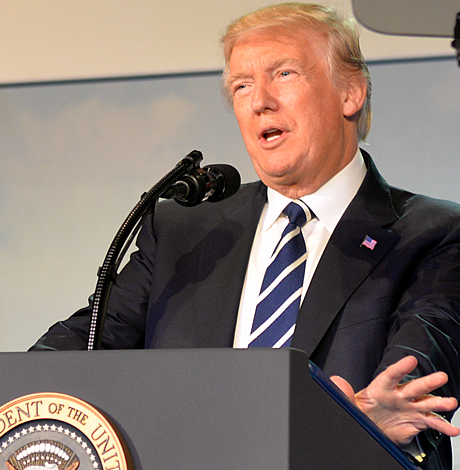
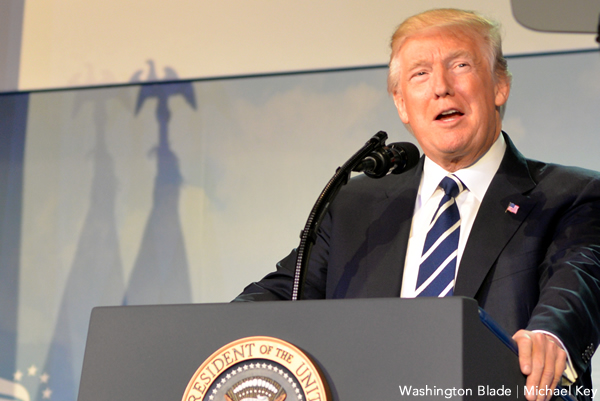
President Trump‘s professed support for LGBT rights will now be a harder sell. (Washington Blade file photo by Michael Key)
Once a self-proclaimed friend to the LGBT community, President Trump will find such words a harder — if not impossible — sell in the aftermath of major actions he took against LGBT rights in the past week.
In one day, President Trump announced — via tweets, no less — that transgender people won’t be allowed to serve in the U.S. military “in any capacity,” overturning an Obama-era change allowing them into the armed forces. On the same day, Trump’s Justice Department filed a friend-of-the-court brief arguing lesbian, gay and bisexual people are entitled to no protections under the Civil Rights Act of 1964.
To top that off, Trump on the same day announced he’d appoint as U.S. ambassador-at-large for international religious freedom Kansas Gov. Sam Brownback, who’s undermined LGBT rights over his political career in the name of religious liberty.
Trump has taken actions before that have disappointed LGBT people, but the unilateral imposition of a transgender service ban — after Congress rejected a measure that would have restricted transition-related care for service members — and a voluntary friend-of-the-court brief undermining basic employment protections have taken things up a notch.
What gives? Over the course of his presidential campaign, Trump billed himself as a new kind of Republican candidate who unlike his predecessors or his competitors for the 2016 Republican nomination would support LGBT people.
During the Republican National Convention, Trump was the first Republican presidential nominee in history to mention LGBT people in a positive way during his acceptance speech for the nomination, citing the recent shooting at a gay nightclub in Orlando, Fla., that left 49 people dead and 53 wounded.
“As your president, I will do everything in my power to protect our LGBTQ citizens from the violence and oppression of a hateful foreign ideology,” Trump said. “Believe me.”
Trump at a later event criticized his opponent Hillary Clinton for donations the Clinton Foundation accepted from Middle Eastern countries that impose the death penalty and imprisonment for homosexuality.
“Ask the gays what they think and what they do in not only Saudi Arabia, in many of these countries with the gay community,” Trump said. “Let’s ask. Then you tell me: Who’s your friend, Donald Trump or Hillary Clinton?”
Referencing Clinton’s immigration policy and support for increased refugees in a subsequent message on Twitter, Trump said, “Thank you to the LGBT community! I will fight for you while Hillary brings in more people that will threaten your freedoms and beliefs.”
Those words, of course, ignore Clinton’s detailed commitment to LGBT rights and specific policy plans on LGBT issues, including support for transgender military service and protections for gay people under civil federal law, which Trump never promised over his presidential campaign.
The Human Rights Campaign, which had never accepted Trump’s overtures to LGBT people as he campaigned against Clinton, produced a video in the aftermath of his administration’s recent anti-LGBT action proclaiming him “Liar-in-Chief.”
Critics of Trump are quick to point out he expressed solidarity with LGBT people in terms of sowing opposition to Muslims, or least raising fears about Islamic extremism.
But at the start of the administration, the White House declared Trump was “respectful and supportive” of LGBT rights without making such references in a statement declaring he’d keep intact former President Obama’s 2014 executive order against anti-LGBT workplace discrimination among federal contractors.
Gregory Angelo, president of Log Cabin Republicans, denied any kind of shift from Trump in his approach to LGBT issues despite his organization’s criticism of the transgender military ban.
“Then-candidate and now-President Trump has always pursued balancing religious liberty and LGBT equality, and I don’t think there has been any fundamental shift from that position,” Angelo said. “What I see in Trump is someone who in an often clumsy — but nonetheless admirable — way is attempting to address a Republican electorate with vastly divergent views on LGBT-related issues.”
White House Press Secretary Sarah Huckabee Sanders insisted Trump had a holistic approach to his presidency when asked if he betrayed LGBT people with his recent actions.
“I think the president had made very clear he’s committed to fighting for all Americans,” Sanders said.
There’s a long list of anti-LGBT actions from Trump. Most notably, his administration rescinded Obama-era guidance to schools assuring transgender kids access to public restrooms consistent with their gender identity. The removal of LGBT questions from federal health surveys and their omission in the upcoming census also riled his LGBT critics.
The president has also refused to condemn reports of anti-gay violence in the semi-autonomous Republic of Chechnya, despite multiple entreaties from LGBT rights groups to speak out, and declined to issue a proclamation recognizing June as Pride month.
Sarah Kate Ellis, CEO of GLAAD, said recent actions from his administration are just par for the course for a president who has no intention of keeping his campaign promises.
“President Trump and his administration have shown over the last couple weeks that they are willing to be more public about their anti-LGBTQ agenda and goal to erase LGBTQ Americans from the fabric of this nation,” Ellis said. “From the ban on transgender soldiers from serving in the U.S. military, the Justice Department’s choice to exclude LGBTQ people as a protected class under the Civil Rights Act, and confirming closed-door meetings with anti-LGBTQ activists at the White House, President Trump has revealed that his campaign pledge to protect LGBTQ Americans was nothing more than a con job.”


Congress
Jeremy Moss looks to bring LGBTQ advocacy from Lansing to Capitol Hill
Congressional candidate would represent Detroit suburbs if elected
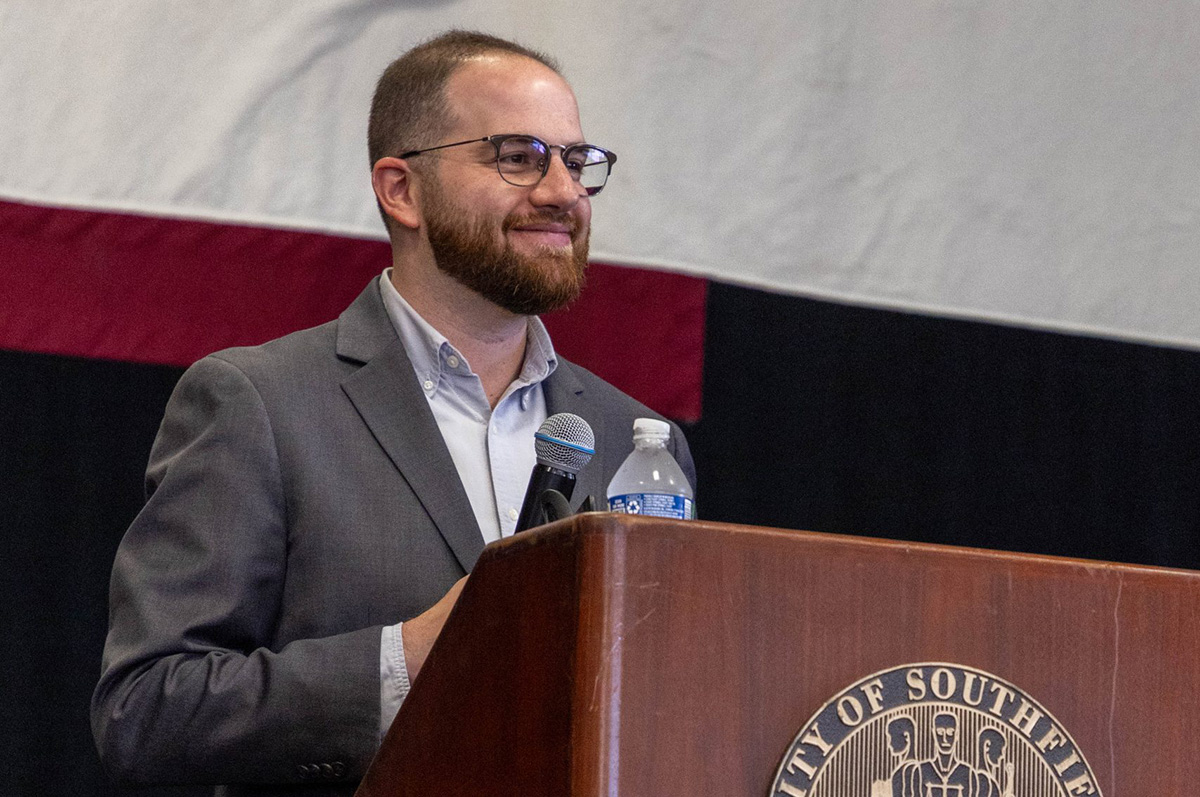
With fall comes swapping out T-shirts for sweaters, raking leaves and, of course, elections. The summer’s primaries have narrowed the playing field in a slew of races, but the big ones — the actual races for seats in federal and local elections — are still to come.
Jeremy Moss is one of those people running for a congressional seat in Michigan. Despite his young age, Moss has quickly learned the ropes of politics in the state, already serving terms in the Great Lakes State’s House of Representatives and Senate.
Moss sat down with the Washington Blade to discuss his history in Michigan politics, his experience as an openly LGBTQ legislator and his vision for a better America as he looks toward Congress.
He currently represents Michigan’s 7th Senate District, but now he is setting his sights beyond Lansing toward Capitol Hill to represent Michigan’s 11th Congressional District, which includes Detroit’s northern suburbs.
Moss earned his bachelor’s degree in journalism from Michigan State University, where just a few years later he made history as the first openly gay person elected to the Michigan Senate and the first to serve as its president pro tempore.
His political experience stretches across multiple offices.
Moss worked in the offices of Southfield Mayor Brenda Lawrence, who also served in the U.S. House of Representatives, and State Rep. Paul Condino.
Moss, at age 25, was elected to the Southfield City Council in 2011, becoming the youngest member elected in the body’s history. He then switched over to the state legislature, representing Michigan’s 35th House of Representatives District in the Michigan House of Representatives from 2014-2018, becoming the second openly gay member elected to the Michigan legislature.
He then moved from Michigan’s House to its Senate in 2018, elected to represent the 11th Michigan Senate District and becoming the Assistant Democratic Leader. Moss started his second term in the Michigan Senate in 2023, this time representing District 7.
He currently has a long list of priorities listed on his campaign website, many of which have become standard for Democrats running across the country, with a particular focus on minimizing — and cleaning up — issues that the Republican-controlled federal government has created under President Donald Trump.
Those goals include lowering healthcare costs, tackling the cost of living crisis, holding U.S. Immigration and Customs Enforcement accountable and fixing the broken immigration system, restoring national voting rights, protecting rights — with a particular focus on abortion access and LGBTQ rights — combating corruption in politics, preventing gun violence and strengthening gun safety, empowering Michigan workers, and preserving the environment.
Why Moss is running for Congress
When asked why he wants to run for Congress, Moss pointed to his lengthy resume in state leadership, with a clear voice arguing that if he can do it in Lansing, he can get it done in Washington.
“I’ve served 12 years in the legislature and have ascended into leadership as president pro tem of the Senate,” Moss explained to the Blade. “We flipped our state legislative chamber to a Democratic majority for the first time in 40 years in 2022, and we passed some big, generational-changing, consequential Democratic wins that had languished for a generation, but had improved people’s lives in our state.
“We’ve passed the first gun safety laws in a generation that are saving lives. We protected the right to vote amidst attacks from Donald Trump and other conspiracies. We pushed forward and finally put LGBTQ rights in our state civil rights law. We provided free school meals and lunches for all public school children in the state of Michigan.
“The problems from Washington, D.C., aren’t getting less severe over time,” he continued. “They’re getting more severe. So this district unexpectedly opened up due to a series of retirements and it was just a great opportunity for me to continue to advocate for big change that we’ve already achieved here in the state legislature.”
“I’m a product of this district. I grew up here. I’ve represented a bulk of the district already in the state legislature, and I knew that I was going to earn grassroots support to be able to wage this campaign. We sought it out, we earned it, including some premier endorsements from Gov. (Gretchen) Whitmer, among many others, and were highly successful in the primary because we were in tune to the needs of this district.”
Moss has been endorsed by a slew of Democratic leaders and organizations, including, as he pointed out, by Whitmer.
Other endorsements include former Gov. Jim Blanchard, Secretary of State Jocelyn Benson, Attorney General Dana Nessel, the Equality PAC, the Human Rights Campaign, the Unity Fund, and the LGBTQ+ Victory Fund.
His political identity and the Democratic Party
Moss described himself as being “on the liberal end of the spectrum,” but argued that the Democratic Party’s internal divisions should not be the central focus.
“I’m certainly on the liberal end of the spectrum, but I don’t even think it necessarily has to be this progressive versus establishment fight that we’ve seen play out,” Moss said when asked about various elements of in-party disagreements. “It has to be between action and, and inaction, fighters versus folders.”
He said that distinction between action and inaction is central to how he would approach Washington.
“At this moment, I think we need to demonstrate that we are ready to take on Donald Trump and MAGA chaos with boldness and effectiveness. I’ve been saying all along our campaign trail, we can no longer be the party that shows up to the knife fight carrying a pie chart, and so I think we have to be showing that we have spine and we have punch, and we’re really ready to be tough fighters for, for Michiganders and the American people.”
“We can’t walk on eggshells anymore. We can’t pull our punches,” he added. “We can’t fear that we’re offending someone, you know, one way or another with how we act. People are expecting a bold party to take on MAGA, and I think that’s exactly what the Democratic Party needs.”
Becoming an LGBTQ legislator
Moss also reminisced with the Blade about his first run for elected office — at a time when Michigan had no openly LGBTQ members serving in the state legislature — and how that experience became deeply connected to his identity and his approach to LGBTQ politics.
In 2014, Michigan was in the pre-marriage equality era, and the state had no openly LGBTQ members serving in the legislature.
“12 years ago in 2014 — this was pre-marriage, the pre-marriage equality era — we had zero people from our community serving in the legislature, and still they were talking about us.
“The big topic then in Michigan was whether or not to expand our civil rights law to include LGBTQ protections, so that people from our community would no longer face discrimination in housing and employment. And they were talking about us regardless of whether or not we were at the table.”
Moss eventually helped lead the effort to expand Michigan’s civil rights protections to include LGBTQ people, a measure that passed with bipartisan support.
He said his experience as an openly gay lawmaker allowed him to make the case for LGBTQ protections in terms that extended beyond LGBTQ issues.
“One thing I definitely aligned with Gov. Whitmer at the time was making the case that discrimination was not only morally wrong, but it was bad for business,” he said. “By not having these protections for our LGBTQ neighbors and family members and friends and community members, we were actually holding back our economy. We were essentially allowing people to be kicked out of Michigan as consumers and workers, because of who they are and how they identified.”
That led to various efforts — including committee hearings and meetings with advocates, businesses and the public — that helped make Michigan what the Movement Advancement Project deems the 16th most LGBTQ-friendly state, solidly above other states due to its robust LGBTQ-related legislation.
“I wanted to meet everybody where they were, including those who may have not been involved with or engaged with the LGBTQ community as legislators, but understood that we couldn’t sustain the economic impact of discriminating against our community,” Moss said. “And as I’ve said all along, discrimination is bad for business. That’s something I think helped broaden the vote and earn some bipartisan support for it.”
Representation and LGBTQ youth
For Moss, the importance of LGBTQ representation also comes from his own experience growing up.
“I think about when I was younger, when I was 18 years old. It was in 2004, and, you know, there are certain things that really shaped me in that time … Michigan had a ballot proposal that passed to have the strictest language banning marriage equality in our state constitution. We didn’t even allow civil unions in that language in our constitution to exist, and there were scandal-plagued LGBTQ politicians.”
“It was the same year that Jim McGreevey was forced to resign as he came out,” he said. “So it really was a signal to me that, you know, you don’t have a future. Not just you don’t have a future in politics; you might not even have a future. Period, and it was pretty defining for me.”
Despite those fears, Moss continued to pursue public office.
“And you can’t be what you can’t see, and so to be able to break the barriers at the state level and at this congressional level, I think is a signal to anybody who is struggling with wondering where their place is?”
“I think that visibility is incredibly important, and it’s something that I needed when I was much younger, and it’s something that I’ve been honored to be able to provide for the, for the next generation of emerging leaders.”
His LGBTQ priorities in Congress
When asked what LGBTQ issues he would prioritize in Congress, Moss emphasized the importance of growing the number of LGBTQ lawmakers while also expanding federal nondiscrimination protections.
“To have a caucus in the legislature has made all the difference because you can, you know, run these issues across the field. You can have somebody take on marriage. You can have somebody take on trans rights. You can have somebody take on LGBTQ youth. You can have somebody take on discrimination protections.”
He sees much of the work he wants to get done on Capitol Hill as a direct follow-up to his work in Lansing — most importantly, the passage of the Equality Act. The legislation has been debated in some form for more than 50 years at the federal level, with the goal of protecting LGBTQ people from discrimination under federal law.
“I think the Equality Act is incredibly important. That’s kind of the, the counterpart to what we’ve done in the state legislature, ensuring discrimination protections for the LGBTQ community,” he said.
“I think housing and, and workplace discrimination is, is everything, you know, to protect our community so that they can have a safe place to call home and earn a living … That’s incredibly important across the board. And I would really want to take a leading role in telling the story of how we were able to do it in Michigan after 50 years since this act was first written — and finally finished the job federally to ensure their federal protections in, in, in, in employment and housing.”
LGBTQ political organizations and Congress
Moss said the LGBTQ political organizations that have supported his political career from its early stages have helped him along the way.
“Obviously, I’ve been affiliated with Victory Fund since I first ran for office, and they were early endorsers, but Equality PAC, which is the political arm of the LGBTQ caucus in Congress, has been an incredible part of my support system. From day one they helped me out.
“I’ve been getting to know a lot of the members of Congress who are LGBTQ, really over the last year of this campaign. So I’m eager to join them. I’m eager to be one of the players on the field here to be able to advocate and advance our issues.”
Voting rights
Voting rights are another major focus for Moss, an issue he said dates back to his experience during the 2004 campaign over marriage equality.
“Something I’m very passionate about is voting rights, and it really does go back to that 2004 campaign where it was very evident that elections can determine your future.
“Elections can determine what rights you do have and don’t have, and so I’ve been very laser focused on increasing access to the ballot box, making sure our democracy remains whole and accessible.”
He explained how Trump’s recent attacks on voting legitimacy and mail-in voting have only made his desire to help that much stronger.
“We went through a real trial of that in 2020 with, with Michigan’s presidential election, with Donald Trump and Rudy Giuliani — as he jetted into Michigan and tried to overturn our valid and accurate election results. We were kind of the spotlight of the nation in that stop this deal movement that led to Jan. 6.”
That, according to Moss, spurred direct action on his end.
“I took the helm as chair of the Senate Elections Committee, and we wrote the law to implement pieces of that ballot proposal, including drafting the law that implemented nine days of early voting here in Michigan, increased access to absentee ballot. We further secured our canvassing and certifications so that nobody could jet in with an alternative slate of electors and send them to Congress on Jan. 6.”
“So I’ve been on the front lines in Michigan on defending our election systems and strengthening protections for both voters to access the ballot box and protections against those who want to overturn our election results.”
Those issues are still present today, he explained.
“He’s pushing for suppressive tactics like the Save Act. The Supreme Court has eroded the federal Voting Rights Act,” Moss said. “I want to really get into Congress as an election expert, we have a Michigan story to tell. I wrote a lot of that story, and, and I think the most urgent thing that we could pass is the John Lewis Voting Rights Act to make sure that there’s no pocket of discrimination anywhere in our country, and that people have the ability to exercise their constitutionally guaranteed right to vote.”
What he would do differently in Washington
Moss also shared that he believes Democrats should communicate differently in Washington, with an emphasis on getting things done.
“Yeah, again, we’ve, we’ve seen politics evolve in this Trump era, and I think that Democrats need to communicate differently.
“He talks so brazenly, and how proud he is that he’s renamed the Gulf of Mexico or Lake Ontario. I put that in the stupid category.
“He’s also done things in the harmful category that he boasts about, like cutting Medicaid and cutting SNAP. And of course, he’s doing things in the dangerous category, but proud of it, like trying to overturn our elections or suppressing the vote.
“What we’re doing is both popular and good for people, whether it’s growing our economy from the middle class outward, whether it’s lowering costs, whether it’s making healthcare more affordable, whether it’s strengthening the core functions of our democracy, we have to be talking about it with the same gusto and confidence that MAGA talks about their agenda.
“I think this is a party that needs more spine and more punch, and really meet this moment because I think that’s what people are looking for, and that’s really what I think a new generation will bring into this next Congress.”
Turkey
More than 150 people detained outside Istanbul courthouse
Protesters gathered after raids targeted Turkey’s LGBTQ community

Turkish authorities on Tuesday detained more than 150 people who gathered outside an Istanbul courthouse to protest raids that targeted the country’s LGBTQ community.
CNN reported the protesters had planned to speak with reporters outside the city’s Caglayan courthouse, but authorities prevented them from doing so.
Turkish authorities over the weekend detained dozens of people in Istanbul and in other cities during raids that were part of the government’s “My Family is Safe” campaign.
A statement from a group of Turkish advocacy groups the Washington Blade received on Tuesday notes “at least 112 people have been detained in connection with the operations.” The organizations said 43 of those taken into custody are “LGBTI+ rights defenders,” and “at least” 62 of those detained “have been arrested, while judicial proceedings remain ongoing in Istanbul.”
“Among those arrested, at least 16 are LGBTI+ activists or individuals connected to LGBTI+ associations, including founders and members of association bodies,” reads the statement. “Per press statements by the prosecutor’s offices, dissolution cases will also be launched against associations.”
“The majority of those arrested are trans women who are charged with prostitution-related offences,” it adds. “While authorities have framed the operations as part of investigations into alleged crimes such as obscenity, prostitution and child exploitation, human rights defenders and civil society organizations have raised serious concerns regarding the use of criminal law mechanisms and public morality narratives to target legitimate LGBTI+ rights activities. Civil society views the ‘My Family is Safe’ narrative as a smokescreen to distract the public from deep economic crises and actual domestic violence, weaponizing moral panic to scapegoat LGBTI+ rights defenders, who have long been targeted by the government.”
The raids have sparked outrage among LGBTQ activists in Europe and elsewhere around the world.
The Congressional Equality Caucus and U.S. Rep. Carlos Giménez (R-Fla.) are among those who have publicly condemned them in the U.S. The Council for Global Equality on Friday is scheduled to hold a rally in support of Turkey’s LGBTQ community in front of the Turkish Embassy in Northwest D.C.
Delaware
Gay man sues Delaware AG for not prosecuting partner in domestic violence case
Also accuses Univ. of Delaware of failing to discipline Ph.D. student named as attacker
Tymothy ‘Ty’ Moyer, a gay former resident of Wilmington, Del., earlier this year filed a lawsuit in federal court charging Delaware Attorney General Kathleen ‘Kathy’ Jennings, one of her deputies, and a state-employed victims advocate with conspiring to deny him “equal protection” under the law because he is African American by declining to prosecute his then domestic partner after the partner’s arrest on Feb. 3, 2024, for assaulting and seriously injuring him, causing a “permanent traumatic brain injury.”
The lawsuit also names as defendants the University of Delaware and one of its officials for allegedly failing to sufficiently discipline Michael Uzu, Moyer’s former partner and alleged attacker, who at the time was a graduate student seeking a Ph.D. in chemistry.
According to the lawsuit, following his arrest on an assault charge, the university conducted an investigation of Uzu and found he violated the university’s policy of student conduct by engaging in domestic violence, but issued a deferred suspension until December 2025, allowing him to continue his studies. Moyer has said the university acted improperly by not expelling Uzu from its Ph.D. program because of the seriousness of the assault.
The lawsuit identifies Uzu, 33, as a citizen of Nigeria with a U.S. student visa. Uzu identifies himself on his LinkedIn page as a chemist who was conducting research for the Delaware-based chemical company Chemours while studying advanced chemistry at the University of Delaware. His LinkedIn page says he received his Ph.D. in 2026.
Moyer, 30, who identifies himself in his lawsuit as African American and a lifelong U.S. citizen, provided the Washington Blade with a statement describing the details of his allegations against Uzu.
“On the late evening of February 2 through the morning of the 3rd, in 2024, I ended the relationship and asked Michel ‘Mike’ Uzu to leave my apartment in Wilmington, Delaware,” his statement says. “I was ending the relationship after months of escalating mistreatment,” the statement says, adding that Uzu refused to leave his apartment and started a confrontation.
“Uzu attacked me,” the statement continues. “He struck me repeatedly with his fists, with my own cell phone, and with a titanium lacrosse stick that he picked up from inside the apartment and used to strike me on the head. I suffered severe facial trauma, swelling, bodily bruising, and required surgical staples to close the lacerations on the top of my skull.”
The statement adds, “During the assault, Uzu told me he would kill me if I told anyone. Outside the apartment building, Uzu picked up a large rock and positioned himself to strike me with it before a bystander intervened.” It says Moyer was then transported to the emergency room of a nearby hospital.
Moyer’s lawsuit says Uzu was arrested by Wilmington police, indicted by a grand jury, and arraigned on felony and misdemeanor assault charges.
In response to an email request from the Blade for comment, Uzu emailed a statement on Sept. 15 denying all of Moyer’s allegations, saying it was he who told Moyer he wanted to end their relationship and it was Moyer who assaulted him.
“He would get drunk and use drugs and pick up fights with me and apologize when he became normal,” Uzu says in his statement. “So, I packed up my things and decided to depart from him,” he said, adding, “The night preceding the day I was moving out he attacked me while I was sleeping, kicked me in the stomach and injured me in my arms, jaw and neck while I was sleeping, that turned into a fight as I was defending myself.”
He said he called the police and before the police arrived Moyer “self-inflicted injury on himself and framed it on me.”
Moyer couldn’t immediately be reached for a response to Uzu’s allegations. But his friend, journalist Scott Davis, who has followed the case and examined the police report and court documents, said none of Uzu’s allegations could be confirmed by police, who arrived on the scene and prepared a report. Among other things, Davis said the investigation conducted by the University of Delaware found Uzu never provided any documentation that he was injured.
Davis said Moyer, who is about 5 feet 7 inches tall and weighs about 160 pounds compared to Uzu, who is over six feet tall and weighed over 200 pounds, was the one found to be suffering serious injuries, with no injuries reported for Uzu.
Moyer’s earlier statement to the Blade says that In September 2024, on the day of his birthday, the lead prosecutor in the case, Deputy Attorney General Claudia Debonte, called him to inform him she was dropping the case. The lawsuit states that the reason given for dropping the case was insufficient evidence based on Uzu’s claim that he acted in self-defense.
“The University’s hearing officer explicitly rejected Uzu’s self-defense claims as ‘inconsistent and unreliable’ and found that Uzu’s account contained ‘multiple irreconcilable inconsistencies’ and ‘material omissions,’” Moyer’s lawsuit states.
Moyer’s lawsuit says the university’s investigative findings and the police report at the time Uzu was arrested, along with a partial video Moyer took with his phone showing Uzu attacking him with the lacrosse stick, clearly provide sufficient evidence for a full prosecution.
Moyer has said the assault left him with permanent brain damage that impaired his vision, forcing him to resign from his career as a financial compliance associate with the BlackRock asset management company.
In response to a request by the Blade for comment on why the Delaware Attorney General’s office, with the approval of Attorney General Jennings, declined to prosecute Uzu for assault, Matt Marshall, a spokesperson for Jennings, sent the Blade a statement.
“While I can’t characterize specific evidence or statements made to police, the State’s analysis included, but was not limited to, the investigation’s finding that the Defendant had a credible claim of self-defense,” according to Marshall’s statement.
“This kind of dynamic is fairly common in domestic violence cases, no less so in same-sex cases,” he said. “A case being unviable at trial does not mean a victim has not been harmed, that we don’t believe them, or even necessarily that a Defendant is innocent,” Marshall’s statement says. “It only means that criminal guilt could not be proven at trial.”
Among other things, he noted that prosecutors must be able to convince a jury that a defendant is guilty beyond a reasonable doubt. In this case, he said, his office did not believe they could overcome “every reasonable doubt, which would include a Defendant’s argument that they acted in self-defense.”
Jennings, a Democrat, who easily won her primary race for re-election to a third four-year term on Tuesday, has a longstanding record of support on LGBTQ rights and progressive causes. She was challenged by two opponents in the Sept. 15, 2026, Delaware Democratic primary. One of the opponents, civil rights attorney Dwayne Bensing, is gay and would have become the nation’s first openly gay state attorney general had he prevailed in the race.
In response to a request from the Blade for comment on Moyer’s lawsuit allegations, Bensing said in a statement that when the Attorney General’s office declines to prosecute a case where an arrest was made it should maintain the public trust by being “transparent” about its decision-making process.
“As Attorney General, I will commit to reviewing how domestic partner violence cases are handled across the state to ensure that prosecutorial decisions are made consistently, transparently, and free from administrative oversight failures,” he said.
Moyer’s lawsuit, which was filed in the U.S. District Court for the District of Delaware on April 16, 2026, calls for a jury trial and requests that the court issue a judgment against each of the defendants, “jointly and severally” finding that they “conspired to deprive Plaintiff of the equal protection of the laws in violation of 42 U.S. Code 1985 (3).”
It calls for compensatory damages and punitive damages against each defendant “in an amount to be determined at trial, including damages for lost wages, medical expenses, legal fees, emotional distress, and pain and suffering.”
Moyer said he is currently representing himself without an attorney.
In an Aug. 28, 2026, “Report and Recommendation,” Magistrate Judge Laura D. Hatcher, who was presiding over the lawsuit case, issued a recommendation that the case be dismissed without prejudice on grounds that Moyer’s complaint “fails to state a claim upon which relief can be granted” based on existing federal law.
Hatcher also recommended that Moyer be “granted leave to amend his complaint within thirty (30) days of the District Court’s adoption of this Report and Recommendation.”
Moyer told the Blade District Judge Gregory B. Williams accepted the recommendation and granted him permission to amend and revise his complaint.
“An amended complaint addressing the Court’s guidance will be filed within the timeframe the Court has provided,” Moyer said. “The Court identified areas where the complaint needed further development, and that development is underway,” he said.
Moyer’s friend, journalist and commentator Davis, said he has conducted research into domestic violence cases in Delaware and reported in articles and commentaries that Delaware is one of the states with the highest rates of domestic violence cases that are not prosecuted.
“In fiscal year 2024, Delaware law enforcement made 5,064 domestic violence arrests,” Davis wrote in a November 2025 commentary entitled, “Was Ty Moyer Too Black and Gay for Delaware AG Kathy Jennings to Prosecute His Attacker?” He added, “Yet Jennings’ office prosecuted only 1,184 cases – a mere 23 percent,” Davis wrote, adding that, “More than three-quarters of domestic violence perpetrators faced no prosecution despite being arrested.”
Davis told the Blade that Jennings’s decision not to prosecute Uzu has raised concerns that she based that decision on political bias. He points out that Jennings has publicly aligned herself with national immigration advocacy efforts, including joining lawsuits against the Trump administration’s immigration policies and its funding freezes against universities, including the University of Delaware.
Davis said Uzu’s academic ties to the University of Delaware and the chemical company Chemours, which Davis says is “politically influential” with its headquarters in Wilmington, has led some to believe that Jennings’s refusal to prosecute Uzu was politically motivated, aimed at preserving her image as a defender of immigrants rather than pursuing justice for a domestic violence victim.
Jennings’s supporters dispute those claims, saying she bases her decisions on whom to prosecute on the available evidence.
As if all that were not enough, Davis said he contacted the U.S. Department of Homeland Security in September 2025 to find out if their strict policy of investigating and deporting immigrants found to have violated U.S. laws, including engaging in violent behavior, might apply to Michael Uzu, who was charged with assault and is in the U.S. on a visa status. Davis said the DHS did not respond to his inquiry.

Jeremy Moss looks to bring LGBTQ advocacy from Lansing to Capitol Hill

Parties, dinners, concerts and more on tap for fall nightlife

All the queer things to watch this fall

Gun reform is an LGBTQ rights issue

Trump’s Cabinet: Dumb, dumber, dumbest, and evil

Dolly Parton biography puts her hardships into context

PHOTOS: SMYAL Fall Brunch

Fashion icon Bob Mackie dead at 87

Dozens detained after Turkish authorities raid LGBTQ groups, businesses