National
Obama says Prop 8 brief may apply in other cases
President says administration was compelled to intervene in lawsuit
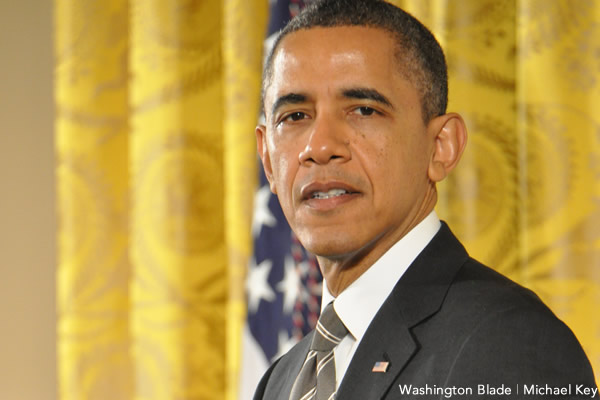
President Obama spoke about the Prop 8 brief on Friday. (Washington Blade photo by Michael Key)
President Obama suggested that the Supreme Court could take the arguments presented in his brief against California’s Proposition 8 as reasoning to overturn bans on same-sex marriage in other states.
In response to questioning from the Chicago Tribune’s Christi Parsons, Obama said his administration has articulated a position that if any state — not just California — has a law withholding rights from same-sex couples, there should be a compelling reason for it in order to withstand constitutional scrutiny.
“Now, the court may decide that if it doesn’t apply in this case, it probably can’t apply in any case,” Obama said. “There’s no good reason for it. If I were on the court, that would probably be the view that I’d put forward. But I’m not a judge, I’m the president. So the basic principle, though, is let’s treat everybody fairly and let’s treat everybody equally. And I think that the brief that’s been presented accurately reflects our views.”
Obama also maintained in his remarks that Solicitor General Donald Verrilli was addressing the issue of Prop 8 in his remarks because that is the question before the court.
“The Solicitor General in his institutional role going before the Supreme Court is obliged to answer the specific question before them.,” Obama said. “And the specific question presented before the court right now is whether Prop 8 and the California law is unconstitutional.”
Richard Socarides, a gay New York advocate who has called on Obama to participate in the Prop 8 lawsuit, said the brief itself coupled with Obama’s remarks demonstrate he’s in favor of marriage equality throughout the country.
“It’s clear from the brief and the president’s comments that he believes in equal marriage rights for every American no matter where you live,” Socarides said. “That’s our goal and his.”
Fred Sainz, vice president of communications at the Human Rights Campaign, said he doesn’t need to review Obama’s comments because the brief already presented an expansive view on marriage equality.
“I don’t need to interpret the president’s words,” Sainz said. “What matters is that the official position of the United States government is now that marriage discrimination is unconstitutional.”
The full transcript of the exchange follows:
CHICAGO TRIBUNE: Mr. President, your administration weighed in yesterday on the Proposition 8 case. A few months ago it looked like you might be averse to doing that, and I just wondered if you could talk a little bit about your deliberations and how your thinking evolved on that. Were there conversations that were important to you? Were there things that you read that influenced your thinking?
PRESIDENT OBAMA: As everybody here knows, last year, upon a long period of reflection, I concluded that we cannot discriminate against same-sex couples when it comes to marriage; that the basic principle that America is founded on — the idea that we’re all created equal — applies to everybody, regardless of sexual orientation, as well as race or gender or religion or ethnicity.
And I think that the same evolution that I’ve gone through is an evolution that the country as a whole has gone through. And I think it is a profoundly positive thing. So that when the Supreme Court essentially called the question by taking this case about California’s law, I didn’t feel like that was something that this administration could avoid. I felt it was important for us to articulate what I believe and what this administration stands for.
And although I do think that we’re seeing, on a state-by-state basis, progress being made — more and more states recognizing same-sex couples and giving them the opportunity to marry and maintain all the benefits of marriage that heterosexual couples do — when the Supreme Court asks, do you think that the California law, which doesn’t provide any rationale for discriminating against same-sex couples other than just the notion that, well, they’re same-sex couples, if the Supreme Court asks me or my Attorney General or Solicitor General, do we think that meets constitutional muster, I felt it was important for us to answer that question honestly — and the answer is no.
TRIBUNE: And given the fact that you do hold that position about gay marriage, I wonder if you thought about just — once you made the decision to weigh in, why not just argue that marriage is a right that should be available to all people of this country?
PRESIDENT OBAMA: Well, that’s an argument that I’ve made personally. The Solicitor General in his institutional role going before the Supreme Court is obliged to answer the specific question before them. And the specific question presented before the Court right now is whether Prop 8 and the California law is unconstitutional.
And what we’ve done is we’ve put forward a basic principle, which is — which applies to all equal protection cases. Whenever a particular group is being discriminated against, the Court asks the question, what’s the rationale for this — and it better be a good reason. And if you don’t have a good reason, we’re going to strike it down.
And what we’ve said is, is that same-sex couples are a group, a class that deserves heightened scrutiny, that the Supreme Court needs to ask the state why it’s doing it. And if the state doesn’t have a good reason, it should be struck down. That’s the core principle as applied to this case.
Now, the Court may decide that if it doesn’t apply in this case, it probably can’t apply in any case. There’s no good reason for it. If I were on the Court, that would probably be the view that I’d put forward. But I’m not a judge, I’m the President. So the basic principle, though, is let’s treat everybody fairly and let’s treat everybody equally. And I think that the brief that’s been presented accurately reflects our views.
Watch the video here (courtesy Think Progress)



New York
NYC lawmakers seek to repeal bathhouse ban
Current policy enacted in 1980s in response to AIDS crisis
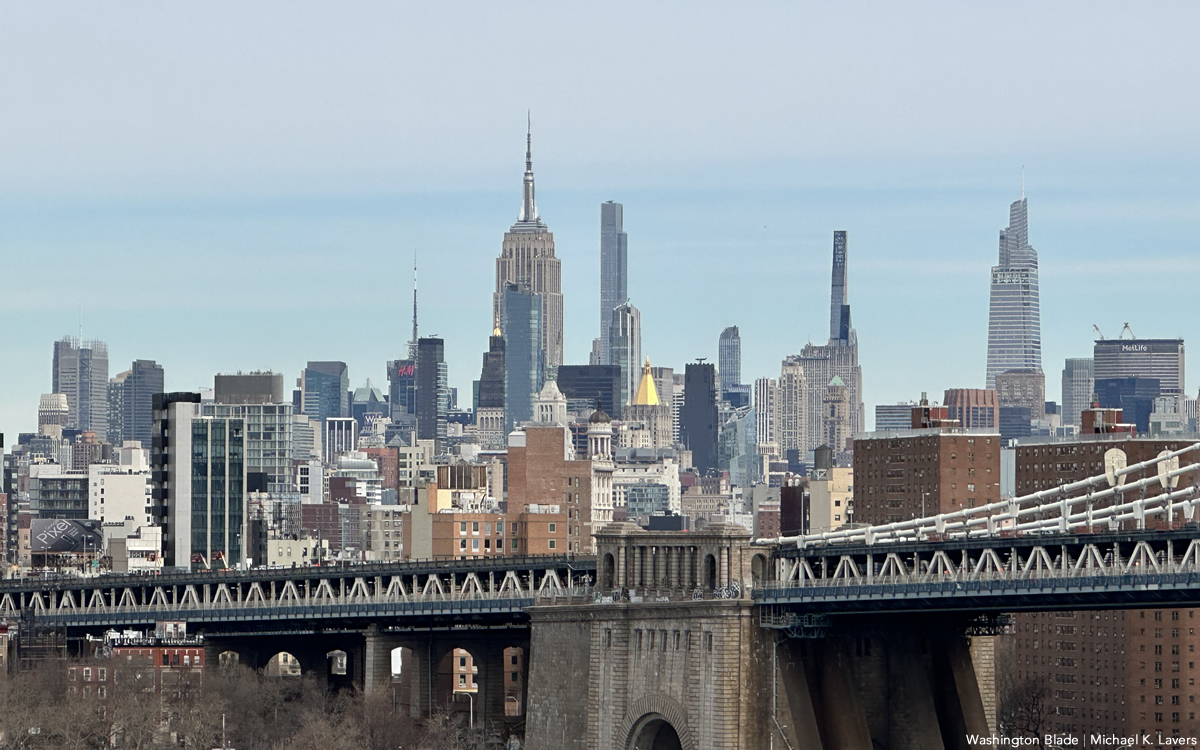
New York City lawmakers are pushing to repeal a decades-old prohibition on adult bathhouses, arguing the regulation was created during the height of the AIDS crisis and no longer reflects modern science or public health practices.
Erik Bottcher, the openly gay New York state senator who represents the 47th District that includes the Upper West Side, Chelsea, Hell’s Kitchen and portions of the West Village in Manhattan, is leading the charge to remove the decades-old ban. (Openly gay state Assemblymember Tony Simone has sponsored the repeal bill in the New York State Assembly.) Bottcher sat down with the Washington Blade to discuss why he is advocating for more bathhouses in New York City.
“This is simply about ensuring that our public health policy is in line with today’s science,” he told the Blade. “The prohibition on adult bathhouses was put into place in 1985 at the height of the the AIDS epidemic, when there was very little information, very little treatment options, few treatment options, and great deal of fear. Science has changed. Treatment has changed, and the laws need to change too.”
The proposed legislation would direct the New York State Department of Health to repeal the 1985 regulation and establish a new framework for regulating bathhouses.
“Municipalities around the country and all around the world allow for adult bathhouses. There’s no reason why New York City alone needs to maintain this outdated prohibition. Our bill orders the New York State Department of Health to strike the 1985 regulation and replace it with a regulated public health framework that’s grounded in science.”
Under the proposal, bathhouses would operate as licensed and regulated facilities subject to health and safety standards. Backers of the proposal say that framework could also give public health officials greater access to people who may otherwise be difficult to reach through traditional health care settings.
“What the Department of Health would do is work with public health experts and advocates to develop a regulatory framework that allows licensed regulated facilities to operate under clear health and safety standards — and under this — it would allow public health agencies to have greater opportunities to provide STI and HIV prevention resources, connect people to testing and treatment, conduct instructions, and address legitimate health concerns.”
Supporters of the repeal also argue banning bathhouses does not eliminate the sexual activity that takes place in them or elsewhere. Instead, they say, it pushes those activities into the shadows, where public health officials have fewer opportunities to provide life-saving services that include STI and HIV testing.
“This is also about a safer alternative than pushing activity into unregulated settings where there’s little opportunity for public health engagement because these activities are happening, but they’re happening in the shadows,” Bottcher continued. “We know that the best public health policy is to establish clear public safe public health guidelines that allow for public health intervention.”
Demetre Daskalakis, a physician and longtime HIV prevention advocate who has worked to create sexual healthcare opportunities in bathhouses, also worked with Bottcher on the proposal.
Daskalakis was a high level Centers for Disease Control and Prevention employee until 2025, when he left federal health landscape after the Trump-Vance administration ousted then-CDC Director Susan Monarez. There he worked as director of the National Center for Immunization and Respiratory Diseases and was director of the Division of HIV Prevention at the National Center for HIV/AIDS, Viral Hepatitis, STD, and TB Prevention.
Daskalakis explained his experience has shown him the potential for these spaces to become points of contact for people who do not regularly access traditional health care.
“I’ve seen what happens when you push sex into the underground,” he said. “From my perspective, this is a great opportunity to be able to reach people who really will not come to normal clinical care and won’t go to normal routine places for testing or screening.”
“As a public health person, I look at it as a great opportunity,” added Daskalakis. “If there’s like regulation of those venues, and if there’s like a prevention plan that sort of sprouts in those places with really solid public health and clinical partners, I think it’s a great opportunity for public health good.”
Daskalakis said a regulated bathhouse could offer more than HIV and STI testing, potentially creating spaces where people could access prevention medications and other health services.
“The bottom line is if there is a good relationship between the government and the venues, we can develop spaces in the venues to actually deliver services,” he said. “It’s not just infectious disease services — I mean yes, you can do HIV testing, STI testing. You can provide doxypep and pre-exposure prophylaxis for people who are HIV negative and at risk for HIV.
“As an example, at Callen-Lorde Community Health Center (in New York City), where I’m the chief medical officer, we developed a prevention pack in a very low threshold way. We gave people enough doxypep and prep to get through Pride. You can also have Narcan and other things to reduce the risk of overdose.”
Daskalakis said that approach reflects what public health should be striving for: meeting the community where they are.
“If you have this sort of relationship with the government that’s not antagonistic, and the government, as New York is one to do, provides some regulatory oversight to these venues, I think what you’re going to have is a place that supports LGBTQ culture — which also which does include sexuality, and also creates a platform to be able to do like very solid prevention work.”
The public health landscape surrounding HIV has changed dramatically since the bathhouse regulation was adopted, Daskalakis said, pointing to advances in treatment and prevention.
“The bottom line is that HIV treatment and prevention have really converged. If you are someone living with HIV and you’re on HIV medicines and your viral load is undetectable, you don’t transmit HIV. That’s called undetectable is equal to untransmittable, or U = U. People who are on prep also have very low risk of acquiring HIV, and so you know the world is very different,” he said.
“Back in the 80s, when there was no way to impact transmission of HIV because we didn’t have effective ways to prevent it — or didn’t know very much about it at that point. It’s a very different world where we know a lot about HIV and have a lot of tools to be able to prevent transmission. Same with STIs,” added Daskalakis. “If you create a holistic strategy for prevention that is sex positive and aligned to these venues, you’re going to prevent HIV and STIs. Period.”
For supporters of the legislation, that public health argument is central to the effort to repeal the ban. Bottcher also sees the proposal as a way to restore LGBTQ community spaces at a time when many queer venues have disappeared and social interaction increasingly takes place online.
“In this era of social isolation created by social media and streaming services, people are desperate for third spaces,” Bottcher said. “Places for people to come together in person, to be together in person. That’s what this would help provide.”
Daskalakis echoed Bottcher’s point that bathhouses could transform from underground, tabooed spaces into venues that combine sexual health services with broader LGBTQ culture.
“When you make them illegal, they become seedy and dark. When you make them something that is allowed, they actually then become sites that may have sex on premises but also support other sorts of cultural things, and in a universe where people are trying to make LGBT folks seem invisible, creating a safe space for them is exactly what we need right now.”
That community-space argument is also tied to health disparities, Bottcher said, arguing that greater access to health education and prevention services could help people who are less likely to seek care through traditional medical settings.
“Creating opportunities for in-person public health education, prevention, treatment that will help improve health outcomes when you push people into less safe settings without any opportunities for education, prevention tools, or treatment. That’s when we see these disparities, these health disparities grow. So it’s very important that we be laser focused on opportunities to address these disparities and reduce them.”
He continued, explaining the proposed change is ultimately about updating public health policy as medical science evolves, just as other practices are updated when new information comes out.
“This is a matter of an outdated public health regulation and the government has a responsibility to continually revisit its public health regulation and ensure that they’re in line with modern day science,” Bottcher said. “Science and healthcare are continually evolving, and the HIV/AIDS prevention and treatment landscape has changed tremendously in the last few years. Our public health regulations need to keep pace with science.”
For LGBTQ New Yorkers who lived through the AIDS crisis, however, changing the policy could carry a different meaning.
Bottcher says the experiences of those who lived through the epidemic — one that killed nearly 300,000 gay men since the 1980s — should inform how any new system is implemented, rather than being dismissed.
“These are in order to help prevent the spread of HIV and AIDS and other STIs,” Bottcher said. “We have to bring people engaging in these activities out of the shadows and into safe settings that provide the opportunity for public health entities to engage with education, treatment, prevention — that’s what this would do.”
Daskalakis said those concerns should be approached through what he described as trauma-informed care.
“My response is that of trauma-informed care,” Daskalakis said. “We have totally been through it, but we need to sort of move past the trauma and realize that the science has changed. I’s not it’s not the ’80s anymore, but we definitely need to look at those folks who have gone through the experience (of the HIV/AIDS crisis) to make sure that what we’re building, from a public health perspective, are effective programs.”
“There’s a great opportunity to learn from folks with experience rather than to alienate them,” he added.
Bottcher also pointed out this policy revision and effort to bring regulations in line with modern science is not only happening in New York. Multiple other cities across the U.S. have moved away from bathhouse prohibitions.
“Minneapolis just passed their ordinance in June,” he said. “San Francisco, despite the fact that they repealed their prohibition some years ago, they are still working to change the policy … However, around the country, even in red states, they have bathhouses … and they haven’t presented a detriment to public health in any way.”
The proposed change could also revive a part of New York’s LGBTQ cultural history, Bottcher said.
“Bathhouses were a big part of gay culture for decades. We all know the legendary stories of Bette Midler and Barry Manilow performing at the Continental Baths. I envision a resurgence of bathhouse culture that includes things like live music, arts, and entertainment. So it’s exciting to think about.”
And if that resurgence happens, Bottcher already has a dream performer in mind to be the first to take the stage.
“Oh, that’s such a good question … Cher.”
Daskalakis picked a similarly essential female singer of gay culture that he’d like to see in the bathhouses of today.
“I feel like my list could be so long, but I think that would be a great place for Madonna.”
The debate over New York’s bathhouse regulation ultimately reflects a broader question about how public health policy should respond as science, medicine, and LGBTQ communities change.
For Bottcher, regulation, rather than prohibition, would give health officials more opportunities to provide prevention and treatment while allowing LGBTQ people to gather openly.
For Daskalakis, the central lesson from his extensive healthcare work in bathhouses is that pushing sexual activity underground will make public health outreach more difficult — the opposite of what the government and healthcare providers should be doing.
“The opportunity to create safe spaces means that we’ll have more opportunities to reach people, not just for public health, but for so many other things … The strategy of banning things that are natural really doesn’t tend to help you very much. It ends up creating misalignment between the community and policymakers.”
U.S. Military/Pentagon
Hegseth uses transphobic slur while campaigning for Iowa congressman
Defense Secretary was speaking in support of Republican Zach Nunn

Defense Secretary Pete Hegseth on Monday used an anti-transgender slur while campaigning for U.S. Rep. Zach Nunn (R-Iowa), drawing attention to the Trump-Vance administration’s ongoing efforts to restrict trans people from serving in the military.
“At the Department of War, we do training, not t***nies,” Hegseth said, according to the Iowa Capital Dispatch, which first reported the remarks.
Hegseth made the comment at JR’s SouthPork Ranch at the Iowa State Fair, where he joined Nunn for a rally. The remark came as Hegseth discussed his priorities for the military and argued that the department’s focus should be on military readiness rather than issues of race or gender.
In the same speech, Hegseth claimed that the military operates without regard to race or gender.
“Training, lethality, accountability, discipline, readiness — the bedrock of what it means to be an American warrior — is the only focus of our department,” Hegseth said. “Colorblind, gender-neutral, merit-based. That’s it.”
Hegseth’s remarks come as the Trump-Vance administration continues its efforts to restrict trans people from serving in the military.
Since President Donald Trump returned to the White House, his administration has moved to remove trans service members from the military while also taking steps to prevent trans people from joining.
Trump signed “Prioritizing Military Excellence and Readiness” in January 2025, which attempts to bars trans individuals from serving or enlisting in the U.S. military, citing “military readiness” as the reason, despite there being no factual basis for the ban. The policy has been challenged by LGBTQ advocates and military service members, who argue there is no evidence that trans service members undermine military readiness.
Earlier this year, Hegseth made headlines again over the administration’s contradictory approach to hormone therapy, as the military moved to restrict gender-affirming hormone treatment for trans service members while encouraging cisgender military members to receive hormone therapy for “low T,” or testosterone.
The administration’s policy has faced a series of legal challenges from trans service members and advocacy groups.
In June, a federal appeals court panel ruled the administration could not discharge the trans service members who brought one of the lawsuits challenging the ban while their case continues, providing a moment of relief amid the administration’s ongoing efforts to restrict trans military service. The Trump-Vance administration has asked the U.S. Supreme Court to review that ruling and, in the meantime, keep it from taking effect.
The Washington Blade reached out to the Pentagon for comment on Hegseth’s use of the slur, but the department did not push back on his choice of words.
“We have nothing further to add beyond the secretary’s remarks,” the statement read.
Illinois
Chicago’s LGBTQ+ youth: Why their zip code still matters
South and West side residents face longer commutes to access affirming services
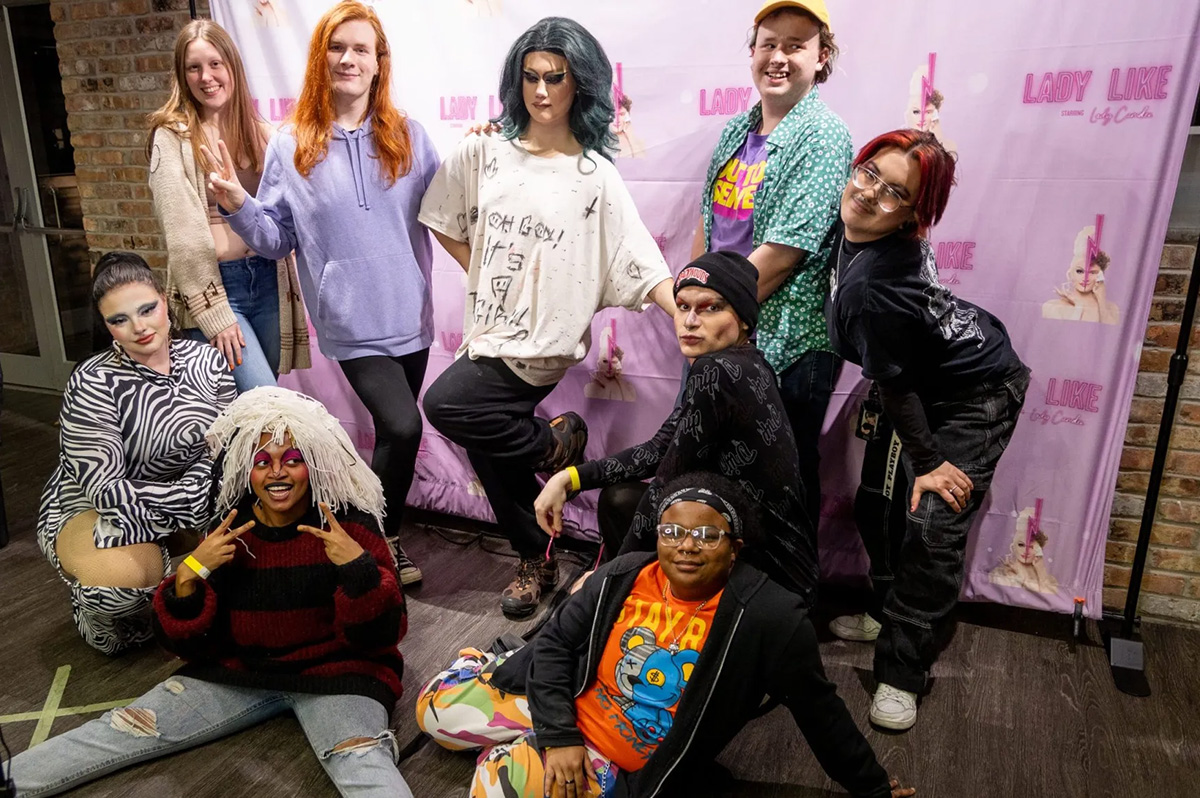
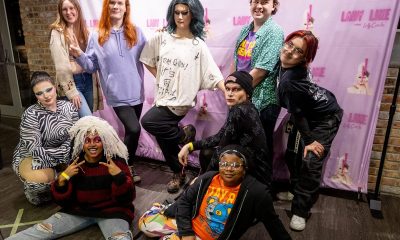
On Chicago’s West Side, the ballroom scene doubles as a lifeline for LGBTQ+ youth.
Every week, teens are drawn into TaskForce Prevention & Community Services for its popular Vogue School. Once there, they then have access to a variety of resources like housing support, a food pantry, fresh produce, and mental health services.
For many, it’s the only affirming environment in their neighborhood.
“We’re located here in Austin, and there isn’t really any other LGBTQ+ youth program like us on the West Side,” said Reyna Ortiz, program director at the nonprofit. “It’s special because young people don’t have to go Downtown or to the North side to feel like they belong here.”
Ortiz’s perspective underscores a long-standing reality that access to LGBTQ+ youth resources often depends on your zip code.
The city’s largest LGBTQ+ institutions have a prominence on the North Side, which is home to LGBTQ+ enclaves like Northalsted and Andersonville. This can leave queer youth on the South and West sides having to face longer commutes and other barriers when trying to access affirming services.
And when queer youth don’t have these kinds of resources nearby, it can create gaps that shape their health, education and economic futures. But North Side-based institutions—as well as smaller LGBTQ+ orgs on the South and West sides and some citywide organizations—are working to fill these gaps.
Two of Chicago’s largest LGBTQ+ organizations, the Center on Halsted and Howard Brown Health’s Broadway Youth Center, are both situated on the North Side.
At Center on Halsted, 3656 N. Halsted St., youth and family programming spans drop-in spaces, leadership and mentoring opportunities and support groups for LGBTQ+ youth. statewide LGBTQ+ hotline provides additional access for young people beyond its Lakeview base.
CEO Joli Robinson said the Center has been intentional about expanding youth programming beyond the North Side through partnerships with other LGBTQ+ organizations and by introducing programs to its South Side location, the Center on Cottage Grove, 6323 S. Cottage Grove Ave.
“A week or so ago, we started our first drop-in space at the Center on Cottage Grove, which has been a priority for us over the past year and a half that I’ve been with the organization,” Robinson said. “We also partner with organizations like Chicago House and Life is Work, … and work to strengthen relationships with the GSAs in schools and PFLAG organizations that exist on the South and West sides.”
These kinds of collaborations are crucial to reaching LGBTQ+ youth in all neighborhoods of Chicago, Robinson said.
“These are organizations that they may already have a strong relationship with, and by deepening our partnerships with them, we’re leveraging the expertise of people who are in these neighborhoods to make sure we’re working in collaboration,” Robinson said.
The Broadway Youth Center, 1023 W. Irving Park Road, serves LGBTQ+ youth ages 12 to 24, particularly those experiencing homelessness or housing instability. It provides integrated medical and mental health care, sexual and reproductive health services, case management and mental wellness support.
The Broadway Youth Center’s drop-in space also offers meals, clothing, showers and other essentials, while cultural programming like art and dance provides additional affirming outets.
Both organizations state their programs are open to youth citywide and emphasize outreach through hotlines, housing services and broader support networks.
Still, their physical bases on the North Side mean that young people in other parts of the city often face barriers to access them.
“And we don’t want transportation to be a barrier for individuals,” Robinson said. “We don’t want location to be a barrier for individuals to participate in some of our programming, so it really is incumbent upon us to be very strategic and think creatively about how we engage the full city.”
TaskForce is among the organizations working to fill these gaps.
Based in Austin on the West Side, the nonprofit offers youth services that are culturally specific, including housing support, food access, and sexual health testing.
Equally as important is TaskForce’s Vogue School, which uses voguing and ballroom culture to strengthen community and encourage self expression.
“Ballroom is important because it’s the one place where they can showcase their talents, where they can showcase who they are without any type of restrictions, without any type of judgment,” Ortiz said. “Ballroom and vogue are how our kids see themselves celebrated. It’s culture, it’s community, and it’s also leadership development.”
Ortiz said TaskForce also provides a steady presence in a neighborhood where resources are limited.
“We are consistent, we are here, we are present and we are open,” Ortiz said.
TaskForce is also home to PrEP 4 Teens, a citywide program focused on HIV prevention and sexual health among youth. While it’s open to teens across Chicago, staff said they are especially focused on reaching those on the South and West Sides who often face the steepest barriers to access.
“We’re looking to collaborate more with agencies, both in the south and west side of Chicago,” said program lead David Gauna. “We know those are the young people who need us most.”
That focus reflects the larger imbalance in the city.
“It’s about equitable access,” said Jim Pickett, one of the program’s organizers. “And so there’s a real lack of equity throughout Chicago, and we could certainly have a much more equitable distribution of opportunities.”
PrEP4Teens was shaped by youth themselves, Gauna added.
“Young people created this,” Gauna said. “They decided the colors, the imagery, the language. They said, ‘We don’t want this to be medical. We want this to be something fun. We want this to be engaging.’”
That youth-driven design is what makes it resonate, said Skai Underwood, who also runs PrEP4Teens.
“We try to meet youth where they are, and culture is part of that,” Underwood said.
Schools can also play a part in filling these gaps on the South and West sides.
“I think that there’s a great opportunity for schools to be like the glue that brings everything together,” said Julio Flores, program director for the Alliance, which promotes school safety for LGBTQ+ youth through advocacy, education, youth programming and research.
For some students, he said, school-based GSAs are the only affirming space they have.
“A GSA can be the only affirming space a young person has,” Flores said.
And those spaces can change a student’s trajectory, he added.
“When young people can lead a GSA, they’re not just building community, they’re building the skills they’ll use in college, in jobs and in life,” Flores said.
The gaps in geography don’t just shape whether young queer people can find community. They also shape whether they’re set up to succeed.
At TaskForce, Ortiz said success often begins with visibility. Young people who first came in for the Vogue School or drop-in services have gone on to train as medical assistants and phlebotomists.
“Some of our youth that frequent the Vogue School start to volunteer. Then we hire and train them, and now they’re building careers,” Ortiz said.
For youth involved with PrEP 4 Teens, growth is just as tangible.
Gauna said teens were engaged in a program that empowered them to build the look, feel and voice of a PrEP awareness campaign. By the end of the cohort, youth who had once been too shy to speak were leading workshops, presenting artwork and giving speeches.
“They started off super shy… and by the end they were showcasing what this program had done for them — not just to take charge of their sexual health, but to feel a lot more confident in themselves,” Gauna said.
Pickett tied those individual transformations back to the bigger picture.
“So many queer young people of color don’t necessarily have many safe spaces throughout the day in their lives,” he said. “Providing these opportunities to engage with other young people and develop their skills and have fun and be fully who they are is so empowering. It sets them up for success.”
Robinson of Center on Halsted said the link between geography and opportunity often comes down to whether young people have their most immediate needs met close to home. Without food, shelter or a safe place to connect, long-term success could remain out of reach.
“For people to really have the safety and security they need to think about economic development or to be provided with a stronger footing and foundation to focus on maybe college or career, they need to have some of their most basic needs met,” Robinson said.
This article was originally published by the Windy City Times and is part of a national initiative exploring how geography, policy, and local conditions influence access to opportunity. Find more stories at economicopportunitylab.com/

Two awesome, affordable rides

Proposed Indian foreign funding law overhaul could further pressure LGBTQ groups

Why we need to protect ‘sacrilegious’ art

New GALA show about WWII spy full of conflict, intrigue

Exploring Renée Richards’s life through lens of a trans author

Anne Arundel schools updates gender identity regulation following Trump administration threats

Chicago’s LGBTQ+ youth: Why their zip code still matters

I respect AOC, even though I often disagree with her

Black Educated Lesbians: A movement rooted in community

Hegseth uses transphobic slur while campaigning for Iowa congressman
-

 Maryland5 days ago
Anne Arundel schools updates gender identity regulation following Trump administration threats
-
Illinois4 days ago
Chicago’s LGBTQ+ youth: Why their zip code still matters
-
Opinions4 days ago
I respect AOC, even though I often disagree with her
-
Opinions4 days ago
Black Educated Lesbians: A movement rooted in community