World
New Iran government leaves country’s LGBTQ community hopeless
Ebrahim Raisi involved with 1988 execution of political prisoners
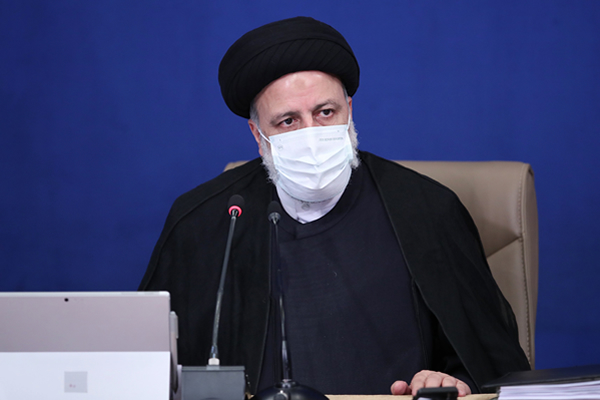
Ebrahim Raisi took over the presidency of Iran and promised to be a “true defender of human rights,” but the Iranian LGBTQ community is not hopeful.
Iran, a country where LGBTQ youth face legal challenges such as prosecution, sometimes to the extent of death sentences, is seeing a rise of new ultra far-right leaders.
Raisi is accused being involved in the 1988 execution of thousands of political prisoners in Tehran, but his human rights abuses are not limited to political prisoners. During Raisi’s tenure as “head of the judiciary,” blanket immunity was given to the Iranian officials and security forces responsible for the killing of hundreds of innocent men, women and children. This kind of bizarre record of human rights abuse by Raisi is also reflected in the hopelessness of the Iranian LGBTQ community.
“I did not even vote for the new president,” said Sher (changed name), an Iranian woman who secretly identifies as bisexual. “I do not care anymore because I know he is the same as his predecessor or even worse.”
In June, a poll conducted by the Six Colors Organization suggested that 90 percent of eligible voters living outside Iran had intended not to vote for Raisi. Many LGBTQ youth did not participate in voting to protest against the Raisi.
“Iran is governed based on sharia law, so it doesn’t matter who is the president or supreme leader or a parliamentarian, as long as the country is governed on Islamic laws — LGBTQI+ youth are being sentenced to death,” said Arsham Parsi, an Iranian LGBTQ activist living in exile in Canada and executive director of International Railroad for Queer Refugees. “Raisi is kind of extreme, more than others. He was also involved in the killing of other people at the beginning of the revolution, so he is a scary figure, especially for LGBTQs, because he can force the Islamic state agenda.”
Parsi told Washington Blade that he is not very hopeful about the Islamic Republic of Iran. He said that Iranian politicians do not care about anything but their power and money. Parsi does not believe that LGBTQ people will have any rights under this regime.
President Biden in February issued a memorandum on Advancing the Human Rights of Lesbian, Gay, Bisexual, Transgender, Queer and Intersex Persons Around the World.
Biden, in the major foreign policy speech, highlighted the promotion of LGBTQ rights. Although the U.S. does not maintain an embassy in Iran, the Swiss embassy works as the protecting power of the U.S. in Iran. But during Pride month, the Swiss embassy did not fly Pride flags outside of its building.
The U.S. State Department maintained that American embassies and consulates developed individual plans during Pride Month to both celebrate LGBTQ people and raise awareness of violence, human rights abuses and discrimination targeting LGBTQ people globally, including appropriate exterior displays. The State Department did not comment on “why there was no Pride flag flying outside the Swiss embassy during the pride month to spread awareness.”
“The continuous engagement of Switzerland for the promotion of human rights, including LGBTQ rights, takes place independently of displaying specific symbols, such as the Pride flag,” said Pierre-Alain Eltschinger, a spokesperson for the Swiss Department of Foreign Affairs. “Switzerland chooses its engagement strategy and instruments in a way that allows it to best fulfill, the general objective to promote human rights, based on the specific context.”
The Swiss president, in a message to Raisi, also congratulated him on his victory.
The Swiss Department of Foreign Affairs did not comment to the Blade on the president’s congratulations, but maintained that the Swiss government is aware of the challenges faced by members of the LGBTQ community in Iran.
“Switzerland maintains relations with the governments of all states, including the Iranian government. These high-level political contacts form the basis of an open dialogue in which we regularly address the human rights situation in Iran,” said Eltschinger. “We believe that maintaining an in-depth dialogue with Iran is the best way to achieve improvements that benefit the LGBTQ community. Switzerland will continue to address this and other human rights issues with the Iranian authorities, including at the highest level.”
A European Union official in a statement said that the EU takes action globally to prevent and denounce all forms of discrimination against LGBTQ persons, including homophobic, biphobic and transphobic violence while promoting their access to equal opportunities in all spheres of life. During the interview, the officials avoided the brazen human rights violation by Raisi and did not comment on Iran specifically.
“We have consistently asserted our strong opposition toward any abuse, harassment, violence and stigma targeting LGBTQI+ persons around the world, and we continue to have serious concerns over the Iranian regime’s treatment of LGBTQI+ persons,” said a State Department spokesperson in a statement. “We urge the new government in Tehran to ensure LGBTQI+ persons are treated fairly and with full respect for their dignity and human rights.”
While speaking with Blade, Alex Vatanka, Iran program director of Middle East Institute, also expressed hopelessness on the future of the LGBTQ community in Iran under the new presidency of Raisi. He said that Raisi did not say anything progressive on this subject matter.
“The group of people coming in with Ebrahim Raisi are the least likely to engage in any kind of real and meaningful dialogue about the LGBTQI+ community in Iran,” said Vatanka. “Mr. Raisi and his supporters believe that they know best, the way of life that they have chosen for themselves — is really the only way, and instead of trying to seek an opponent and have a dialogue, they would rather force their will, on the society.”
For years, the U.S. and the EU have raised the issue, but there hasn’t been anyone in the central government in Iran with whom to have a serious dialogue. The Iranian government considers this as interference in their internal matter. Although the hope remains bleak under this regime, the LGBTQ community is still trying to show their protest against the discriminatory laws — sometimes by not participating in the election or leaving blank votes.
Mohit Kumar is a freelance reporter who has covered different stories that include the 2020 election in the U.S. and women’s rights issues. He has also covered NASA, ESA (the European Space Agency), the
Canadian Space Agency and loves to help people. Mohit is on Twitter at @MohitKopinion and can be reached at [email protected].





Turkey
Activists protest outside Turkish Embassy in D.C.
Dozens detained during anti-LGBTQ ‘My Family Is Safe’ campaign raids
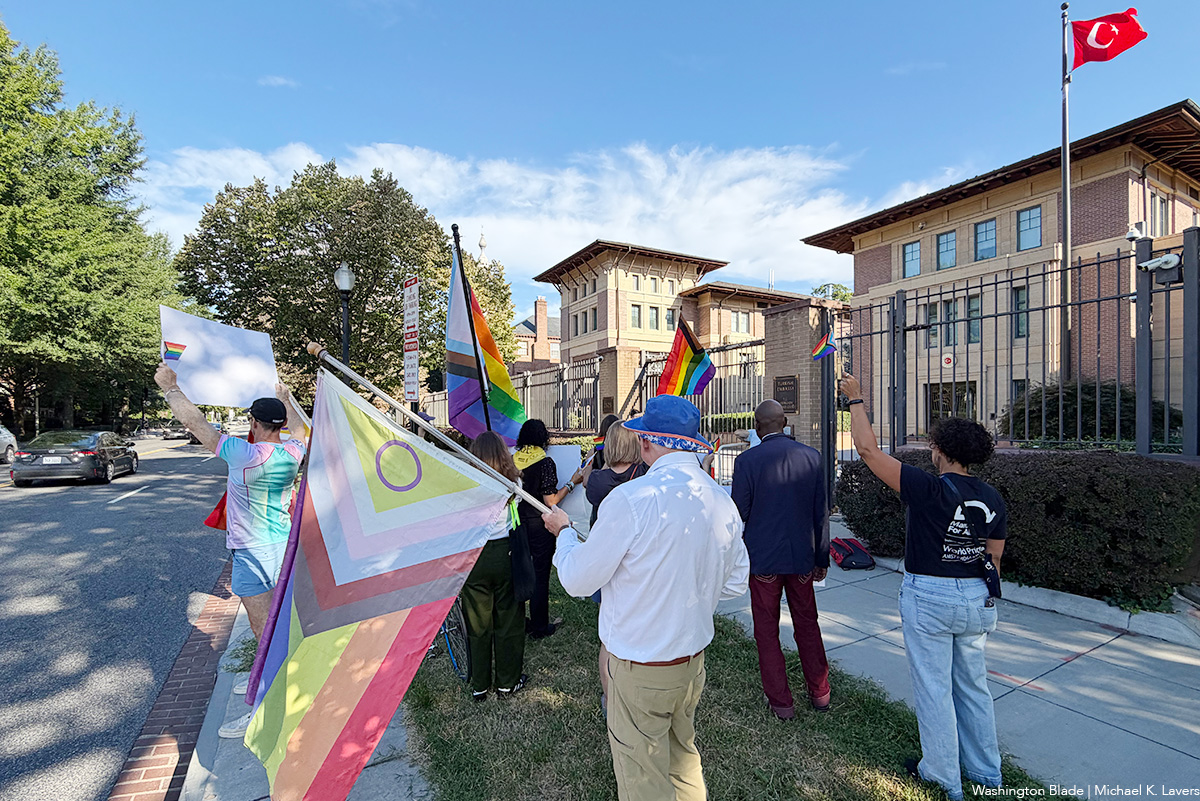
A group of activists on Friday gathered in front of the Turkish Embassy in D.C. to protest the country’s anti-LGBTQ crackdown.
The protest — which the Council for Global Equality, Amnesty International USA, Outright International, and Health GAP organized — took place less than a week after Turkish authorities detained dozens of people during raids that targeted the country’s LGBTQ community and advocacy groups and HIV/AIDS service organizations.
Authorities in Istanbul on Sept. 15 detained more than 150 people who gathered outside a courthouse to protest the raids that are part of the government’s “My Family Is Safe” campaign. Journalists are among those who were taken into custody.
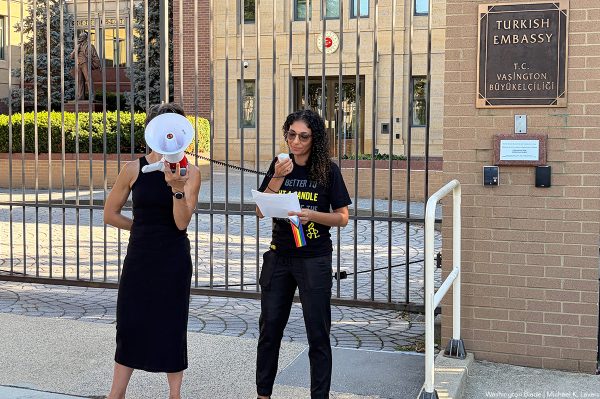
“This crackdown is not making families safer,” said Amnesty International USA Executive Director Nadia Daar, speaking in front of the Turkish Embassy.
Council for Global Equality Managing Director Keifer Buckingham stressed that “homosexuality is not a crime in Turkey.” Health GAP Executive Director Asia Russell and Outright International Senior Director of Law, Policy, and Research Neela Ghoshal also spoke.
View on Threads
Activists in Madrid and in other cities around the world held similar protests on Friday.
Turkey
More than 150 people detained outside Istanbul courthouse
Protesters gathered after raids targeted Turkey’s LGBTQ community
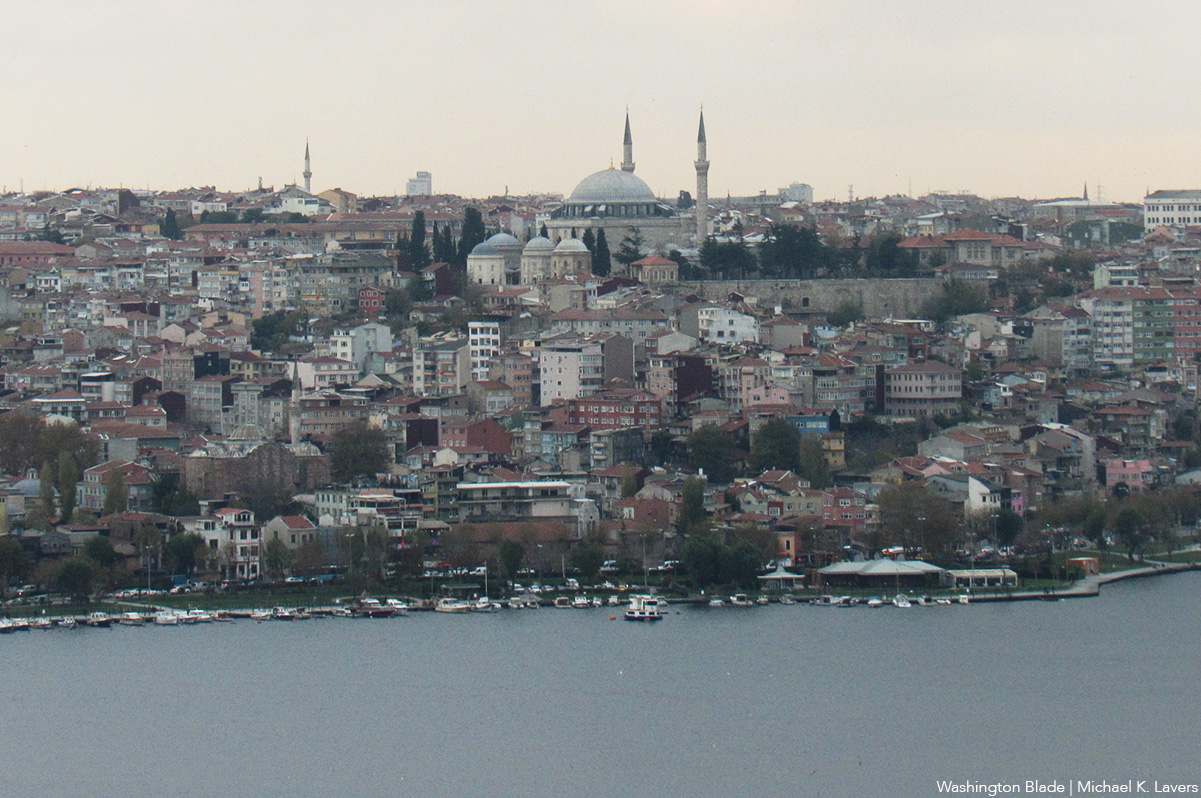
Turkish authorities on Tuesday detained more than 150 people who gathered outside an Istanbul courthouse to protest raids that targeted the country’s LGBTQ community.
CNN reported the protesters had planned to speak with reporters outside the city’s Caglayan courthouse, but authorities prevented them from doing so.
Turkish authorities over the weekend detained dozens of people in Istanbul and in other cities during raids that were part of the government’s “My Family is Safe” campaign.
A statement from a group of Turkish advocacy groups the Washington Blade received on Tuesday notes “at least 112 people have been detained in connection with the operations.” The organizations said 43 of those taken into custody are “LGBTI+ rights defenders,” and “at least” 62 of those detained “have been arrested, while judicial proceedings remain ongoing in Istanbul.”
“Among those arrested, at least 16 are LGBTI+ activists or individuals connected to LGBTI+ associations, including founders and members of association bodies,” reads the statement. “Per press statements by the prosecutor’s offices, dissolution cases will also be launched against associations.”
“The majority of those arrested are trans women who are charged with prostitution-related offences,” it adds. “While authorities have framed the operations as part of investigations into alleged crimes such as obscenity, prostitution and child exploitation, human rights defenders and civil society organizations have raised serious concerns regarding the use of criminal law mechanisms and public morality narratives to target legitimate LGBTI+ rights activities. Civil society views the ‘My Family is Safe’ narrative as a smokescreen to distract the public from deep economic crises and actual domestic violence, weaponizing moral panic to scapegoat LGBTI+ rights defenders, who have long been targeted by the government.”
The raids have sparked outrage among LGBTQ activists in Europe and elsewhere around the world.
The Congressional Equality Caucus and U.S. Rep. Carlos Giménez (R-Fla.) are among those who have publicly condemned them in the U.S. The Council for Global Equality on Friday is scheduled to hold a rally in support of Turkey’s LGBTQ community in front of the Turkish Embassy in Northwest D.C.
Indonesia
Indonesia’s top Muslim clerical body proposes criminalizing LGBTQ people, advocacy
Proposal underscores increased pressure against community
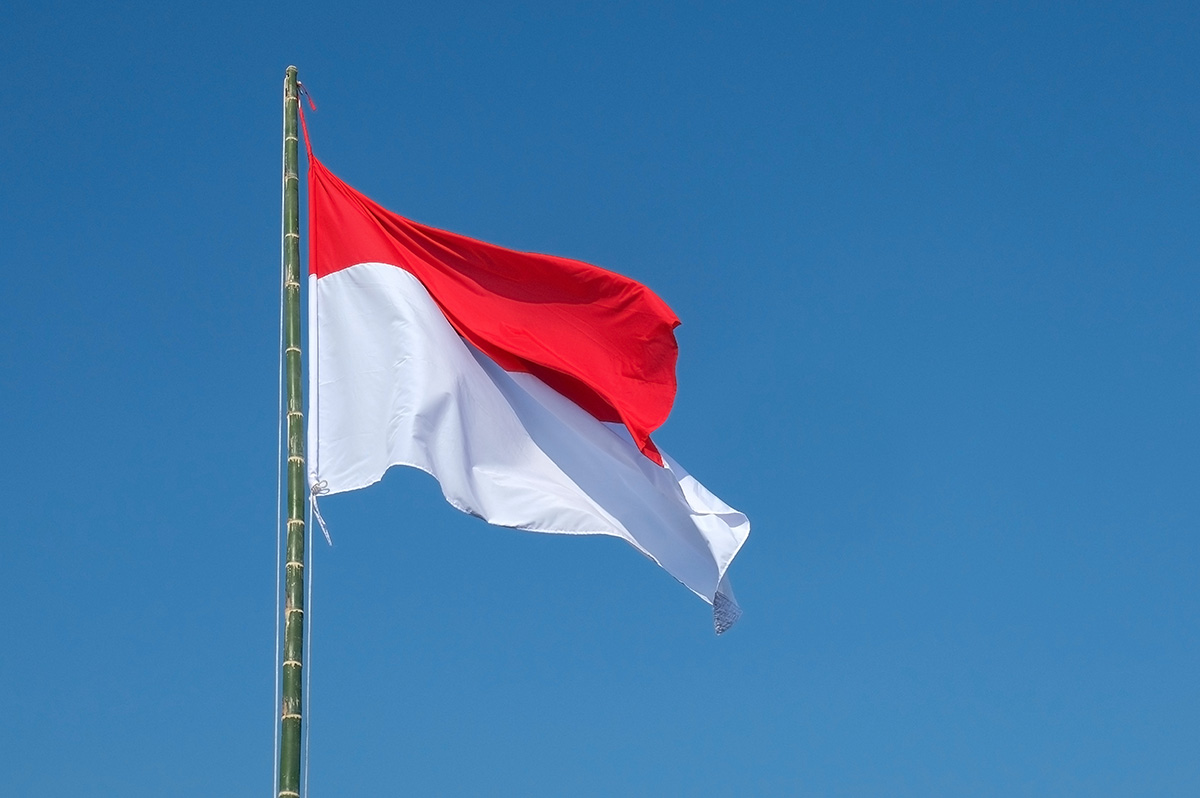
Indonesia’s top Muslim clerical body has proposed replacing the term “LGBT” with “LGSP,” grouping lesbian and gay people with sodomy and sexual abuse, as it prepares a proposed law that would criminalize conduct and advocacy it consideres prohibited.
Asrorun Niam Sholeh, head of the Indonesian Ulema Council’s Fatwa Commission, announced the proposal in Jakarta in late July, saying the council was preparing an academic paper and draft bill to submit to the government and MPs
The council in August also warned men against wearing women’s clothing during Independence Day festivities, despite a long-standing tradition in some Indonesian communities of men dressing in dresses and hijabs to play football as part of the annual celebrations. In a statement issued Aug. 7, the Fatwa Commission said such cross-dressing was “haram,” or forbidden under Islamic law, and linked the practice to what it described as a covert campaign by the “Lesbian, Gay, Sodomy and Obscenity (or LGSP) movement.
Indonesia on Aug. 17 marks its 1945 declaration of independence from the Netherlands with flag ceremonies, neighborhood gatherings, and a lively tradition of community competitions known as “lomba tujuhbelasan.” Children and adults take part in games ranging from sack races and cracker-eating contests to tug-of-war and “panjat pinang” — teams climb a greased pole to reach prizes at the top. Some communities also hold football matches in sarongs or “daster,” a loose-fitting house dress traditionally associated with women, turning the celebrations into an occasion for communal play and laughter.
The pressure extends beyond religious authorities.
In a report published in July, Human Rights Watch said attacks against LGBTQ university students had escalated during June’s Pride Month, while at least 10 public universities had recently adopted discriminatory regulations and curbed student media coverage and social media discussions about gender and sexual diversity. The rights group said the measures undermine freedom of expression and academic freedom.
Reacting to Pride Month celebrations, the Ulema Council called for “sexual deviation” to carry criminal penalties heavier than those for adultery and said it was preparing a draft law to criminalize LGBTQ conduct and campaigning.
President Prabowo Subianto in October 2025 signed Presidential Regulation No. 111 of 2025, which sets Indonesia’s General National Defense Policy for 2025–2029 and classifies the spread of LGBTQ culture as a non-military threat to the state. The provision places it among other perceived threats that include terrorism, radicalism, separatism, and the spread of prohibited ideologies.
The regulation drew public attention in July after Indonesian media reported on the provision, prompting Amnesty International Indonesia Executive Director Usman Hamid to warn that it could institutionalize discrimination against LGBTQ people.
“Amnesty International Indonesia unequivocally condemns these attacks and intimidation by both state and non-state actors based on perceived sexual orientation or gender identity,” said Amnesty International Indonesia. “We urgently call upon the Indonesian government to repeal this regulation and uphold its constitutional mandates and the international human rights treaties it has ratified.”
Indonesia on Jan. 2 began enforcing a new national criminal code, replacing the Dutch-era penal code that had governed the country for more than eight decades.
MPs had approved the 345-page code in December 2022 after years of debate and public protests over provisions concerning morality, religion, and individual rights. Among its new provisions is Article 411, which makes sexual intercourse outside marriage a criminal offense punishable by up to one year in prison.
Article 412 makes living together as husband and wife outside a legally recognized marriage punishable by up to six months in prison. The offenses can be prosecuted only after a complaint by a spouse, parent or child, but rights groups have warned that the provisions can disproportionately affect same-sex couples, whose relationships are not legally recognized in Indonesia.
Purba Widnyana, chairman of GAYa Nusantara, an Indonesian LGBTQ rights organization, told the Washington Blade that the situation for LGBTQ people in Indonesia has become increasingly worrying.
Widnyana told the Blade that the concern extends beyond increasing violence, pointing to stronger anti-LGBTQ sentiment in public spaces, on social media and within educational institutions, as well as in politics, including Presidential Regulation No. 111 of 2025.
“The impact is not always in the form of physical violence. Many LGBT+ people, especially trans women, that mostly work in entertainment or other informal jobs, beginning to lose job opportunities because they are considered to pose a ‘risk’ to the event organizers,” Widnyana said. “There are also concerns that the rising stigma and fear could deter people from accessing health services, including HIV test and STI, due to the fear that their identity or sexual orientation might be revealed.”
Widnyana said the changing environment has placed an additional burden on LGBTQ organizations; making spaces for gatherings, educational activities, and public information campaigns increasingly sensitive.
“We are constantly in alert mode,” he said, adding that since the previous wave of anti-LGBTQ sentiment in 2016, organizations have developed security and risk-mitigation plans before holding events. Previously, he said, the primary concerns were physical attacks, raids and threats that could force venues to cancel events. Now, organizations also have to account for online attacks, including WhatsApp hijacking and social media account hacking, as well as the possibility of an event or organization being targeted after going viral.
“It’s been limiting our movements,” he said.
Asked about the proposed LGSP framework and its decision to replace the term LGBTQ with a classification combining sexual orientation with sexual conduct, Widnyana said the council was conflating fundamentally different concepts.
“I really don’t know where to begin. They are definitely confused by mixing identities, in this case sexual orientation, with sexual behavior and actions that are understood as violations or offenses, that are sodomy and sexual indecencies,” he said.
Widnyana said the change should not be viewed as merely a change in terminology.
“The change shifts how Indonesians understand or perceive LGBT+ issues, moving from identities, rights and existence to behavior, morality, and criminality,” he told the Blade. “We also see it in the context of narrative that has been for so long evolving that frames LGBT+ as the ‘product of the West’ or ‘Western propaganda’,” he said. “In this framework, LGSP can be interpreted as their effort in rejecting how LGBT+ people define themselves and changing it with a category that is defined by those who oppose the existence of LGBT+ people.”
Widnyana also pointed to Indonesia’s long history of diverse gender identities and expressions, citing traditions such as the “bissu,” “calalai,” “calabai,” and “waria,” as well as artistic traditions in which men perform female characters. He cautioned against imposing modern LGBTQ categories on those traditions, but said gender and sexual diversity are not foreign to Indonesian history.
Widnyana said his main concern was the lack of clarity around terms such as “campaigning,” “promoting,” and “spreading LGBT+ culture,” which he said could be interpreted broadly enough to affect legitimate work in education, health care, human rights, and community services. He cited HIV and sexual health information, legal assistance for victims of violence, discrimination research, training on sexual orientation, gender identity and expression, and sex characteristics, and academic discussion as examples. Widnyana also questioned whether a gay man publicly saying he is gay and demanding to live safely, or a transgender woman speaking about discrimination she has experienced, could be deemed “campaigning” or “spreading LGBT+ culture.” Such legislation, he warned, could turn existing social stigma into a tool for systematically limiting the lives, expression, services and LGBTQ organizations.
“For me, the situation is becoming more difficult. And I think we need to look beyond just what the law says. Because sometimes, when we talk about Indonesia, people say, ‘Well, being LGBTQ+ is not generally criminalized under the national criminal law,’” said Arisdo, outreach representative of Pelangi Nusantara, an LGBTQ community group in Indonesia advocating for love, equality, and the right to live with dignity. “technically, that’s an important distinction. But that’s not really what people on the ground are experiencing. What we’re seeing is more pressure. More harassment. More public shaming. More people being targeted simply because they are perceived to be LGBTQ+.”
Arisdo told the Blade that transgender women are facing escalating violence, citing Pelangi Nusantara’s documentation of 10 attacks in Bogor between March and July 2026 involving 45 victim-survivors. He said the emergence of “Boti Hunter” groups was particularly alarming, reflecting a shift from anti-LGBTQ rhetoric toward actively targeting people. He added that fear of being outed or attacked prevents many victims from reporting violence, while doxxing and online harassment are increasingly forcing LGBTQ organizations to limit their visibility.

White House press pool pushes back after Trump bars three outlets

PHOTOS: Shenandoah Valley Pride

Long-time DignityUSA executive director announces retirement

PHOTOS: Walk and 5K to End HIV

PHOTOS: Wanda Alston Foundation Fall Reception

Gun reform is an LGBTQ rights issue

All the queer things to watch this fall

Parties, dinners, concerts and more on tap for fall nightlife

Jeremy Moss looks to bring LGBTQ advocacy from Lansing to Capitol Hill