Congress
EXCLUSIVE: Sen. Blumenthal defends Kids Online Safety Act
Blackburn comment on ‘trans influence’ raises alarms
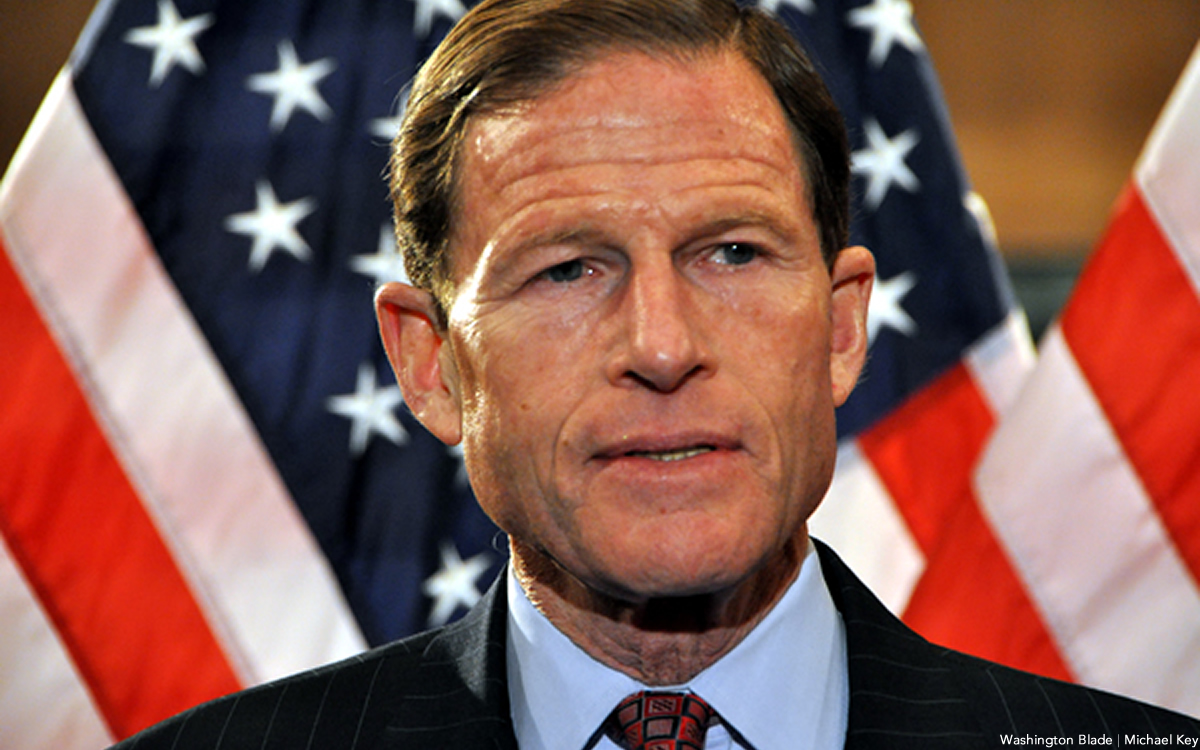
Responding to criticism from some in the LGBTQ community about the Kids Online Safety Act, U.S. Sen. Richard Blumenthal (D-Conn.) defended the legislation and reiterated his strong support for queer youth.
“I would never put my name on any bill that targets or disparages or harms the trans or LGBTQ community,” Blumenthal told the Washington Blade on Friday.
“There have been a lot of eyes” on the Kids Online Safety Act, he said. “A lot of very smart and careful people have reviewed its language, and they and I have worked to make it as rigorous and tight as possible.”
The proposed legislation, introduced by Blumenthal and Republican U.S. Sen. Marsha Blackburn (Tenn.), would address harms experienced by children and their families at the hands of dominant social media and tech platform companies. It enjoys broad bipartisan support in the Senate.
Critics took issue with previous iterations of the bill, however, raising alarms that conservative state attorneys general tasked with enforcing its provisions might treat positive or tonally neutral LGBTQ content as harmful to children under the statute.
A coalition of organizations issued a letter last year warning Congress that “online services would face substantial pressure to over-moderate,” at a time in which “books with LGBTQ+ themes are being banned” and “people providing healthcare to trans children are being falsely accused of ‘grooming.'”
Blumenthal told the Blade changes to the 2023 version in areas including the duty of care, which were made in consultation with a bevy of LGBTQ groups and individual advocates, have changed these organizations’ positions on the legislation.
“We have tightened the statute – tightened and clarified the statute – as much as we can to try to make it as rigorous as possible to avoid both the misuse and potential chilling effect,” the senator said.
He also highlighted some reasons for the urgent need for passage.
“The real devastating harms done to children by the bullying,” along with toxic content promoting eating disorders and suicide, “largely as a result of black-box algorithms, is the kind of evil that I have fought throughout my career,” he said.
The senator has fought for accountability from these companies for decades, combatting child predation on Myspace and Facebook as attorney general of Connecticut in the early aughts and, in Congress, championing antitrust reforms targeting Big Tech that have come to the fore in recent years.
He has also been a staunch pro-equality ally for the LGBTQ community, earning a perfect 100 on the Congressional Scorecard from the Human Rights Campaign, America’s largest LGBTQ advocacy group.
“I care deeply about that community as is evidenced by a lifetime of work in this area, as attorney general and now as the U.S. senator,” he said.
“The Kids Online Safety Act is designed to give children and their parents tools to protect themselves,” Blumenthal said, “and also to impose accountability on those companies that are profiteering; achieve more transparency about those algorithms; and give parents reporting mechanisms and other means, in effect, to take back control and [also for] children to take back control.”
The proposed bill would require covered platforms to “take reasonable measures” to “prevent and mitigate” harms to youth such as “anxiety, depression, eating disorders, substance use disorders, and suicidal behaviors,” along with “patterns of use that indicate or encourage addiction-like behaviors” and “physical violence, online bullying, and harassment of the minor.”
LGBTQ youth are affected by these challenges and harms, too, and in many cases, disproportionately.
“Take bullying, for example,” Blumenthal told the Blade. No longer relegated to the school yard, this behavior follows victims home, he said, adding, “the addictive quality of social media is so powerful that it can be all consuming.”
During an interview Thursday on the Rated LGBT Radio program, attorney Laura Marquez-Garrett noted how LGBTQ youth will turn to social media platforms searching for affirmation about their sexual orientation or gender identity only to find “this really harmful experience that is causing, in many cases, depression, anxiety, suicidal thoughts.”
Marquez-Garrett, a litigator who left her law practice in 2020 to join the Social Media Law Center, explained the Kids Online Safety Act includes a carve-out, “added in the last couple months, which says that a covered platform has no duty to prevent or preclude any minor under 17 from deliberately and independently searching for or specifically requesting content.”
Still, concerns persisted after Blackburn noted, in March, efforts toward “protecting minor children from the transgender [sic] in this culture and that influence” before talking about the Kids Online Safety Act.
Her legislative director later clarified that, “KOSA will not — nor was it designed to — target or censor any individual or community.”
Addressing these matters, Blumenthal told the Blade, “whatever anyone including Senator Blackburn may say about their personal beliefs, I know what the bill does and that’s what’s important here.”
“My goal,” he said, is to remedy the problems caused by social media and online platforms, problems that in too many cases are fatal for young people, while avoiding “any of the unintended consequences” because “it’s not enough to have good motives.”
Blumenthal said that while “my colleagues on the Republican side and I may differ in certain beliefs about a wide variety of issues” and “Senator Blackburn and I vote together a small minority of times, where we’re united, we try to work together.”
“And we’re united on preventing the harms that are so egregiously crippling and killing,” he added.
So, Blumenthal said, “looking at it substantively, putting aside who’s for it and who’s against it, I think on the merits, it holds up. The merits and the substance and the actual words of the proposed statute really refute those arguments that the tech companies have sought to make.”
Asked whether he believes the dominant tech platforms and social media companies might be behind efforts to sow doubt and distrust with respect to the Kids Online Safety Act among LGBTQ and other communities, the senator noted, “they have no compunction about distorting or misrepresenting the facts and trying to twist and deceive about specific provisions of legislation.”
“They resort to any and every means,” he said, “And they will try to exploit communities that may be susceptible to their misrepresentation.”
Additionally, Blumenthal said, the “tech and social media companies have – I don’t know how to put it politely – but they’ve essentially tried to ignore the important changes that we have made” including “the narrowing of the duty of care provisions” and “the broadening of support services.”




Congress
House blocks effort to codify transgender servicemember ban into law
Lawmakers approved two anti-trans NDAA amendments

The U.S. House of Representatives on Tuesday rejected an amendment to the National Defense Authorization Act that would have codified a ban transgender servicemembers in the military.
The bipartisan vote was 212-217.
The NDAA is for the 2027 fiscal year and sets policies for the Defense Department programs and activities and the national security programs of the Department of Energy.
U.S. Rep. Lauren Boebert (R-Colo.) proposed the amendment on July 21. It stated that all personnel are required to serve in accordance with their biological sex, citing military readiness and discipline.
Human Rights Campaign Senior Director of Government Affairs Jennifer Pike Bailey stated that she is grateful for the bipartisan vote that rejected President Donald Trump and Defense Secretary Pete Hegseth’s “dangerous and discriminatory policy that has kicked brave transgender servicemembers out of the military and weakened our national security.”
“Everyone who meets the same rigorous standards should be able to serve their country. We should honor that patriotism, particularly in this moment where we are witnessing brave servicemembers making the ultimate sacrifice for our country, instead of ending their careers and politicizing their existence. We’re grateful that a permanent extension of this ban failed, and we will keep fighting to reverse this senseless policy,” Bailey said.
Mark Takano, chair of the Congressional Equality Caucus, stated that he and his members put in countless hours of work to kill the amendment.
“When Americans know they or their families are going to be targeted by or not supported by the military, that leads them to avoid signing up to serve or staying in the service — making it harder to keep the ranks of the armed services full and our nation safe. My colleagues in the Equality Caucus and I will continue working to prevent these attacks on our servicemembers and their families from becoming law,” Takano said.
According to the Congressional Equality Caucus, two other bills could potentially be passed that would also target the transgender community, both of which were proposed by U.S. Rep. Nancy Mace (R-S.C.).
The first was a bill that would have prohibited gender-related medical care under TRICARE and to prevent TRICARE from covering certain gender-related medical procedures and treatments, which was approved in a vote of 219-208.
The second was a bill that would have prohibited male participation in female sports at DoDEA schools. DoDEA schools are Department of Defense Dependents Schools, which is a network of primary and secondary schools.
The amendment was approved in a vote of 221-203.
Congress
Lindsey Graham has passed away. Do LGBTQ people have a right to celebrate his death?
SC senator opposed marriage equality, despite speculation over sexual orientation
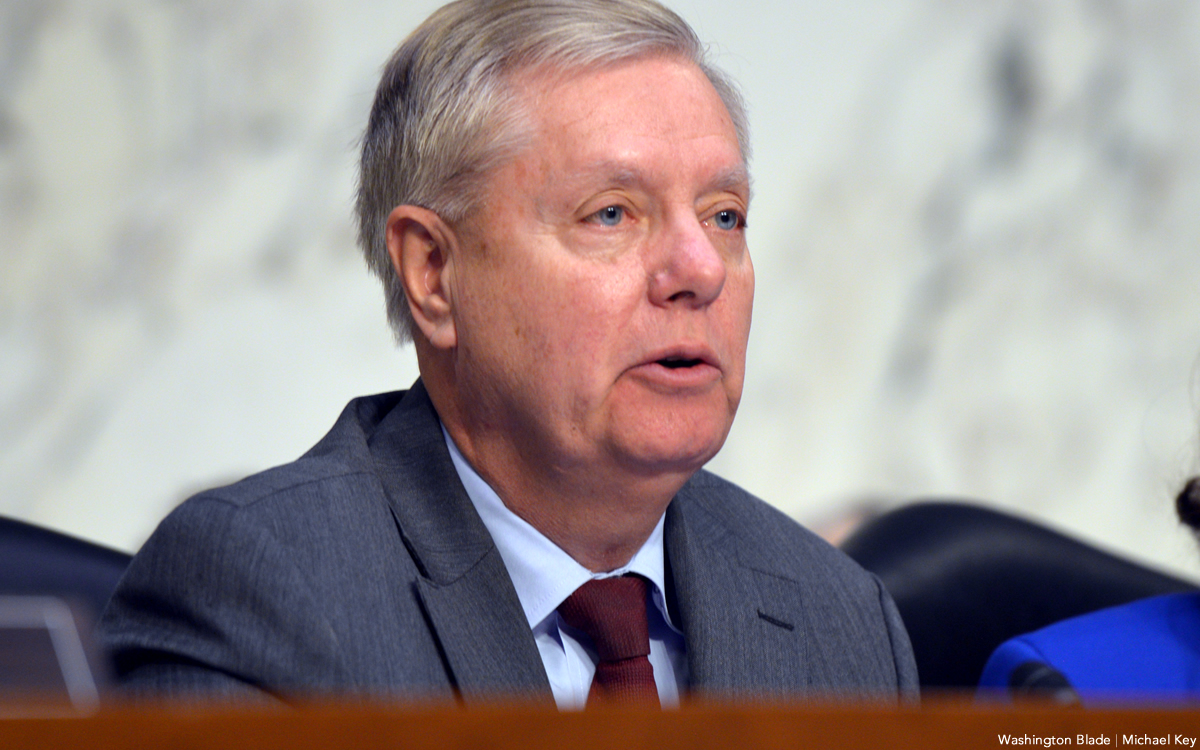
Uncloseted Media published this article on July 16.
By SPENCER MACNAUGHTON | On Sunday, the office of Lindsey Graham reported that the Republican senator and Trump ally from South Carolina died “from a brief and sudden illness.” The office said that the preliminary cause of death was a rupture of his aorta due to a hardening of his arteries.
Since then, many folks in the LGBTQ community, including a large number of Uncloseted followers, have — for better or worse — celebrated the senator’s death. When we posted the news on our Instagram page on Sunday, our followers commented:
- “Maybe he rest in hell”—this one got 194 likes.
- “She made sure to wait until Pride was over.”
- “And just like that the world is a better place.”
These responses are fueled by allegations that the senator lived as a closeted gay man while supporting policies that would roll back LGBTQ rights. In 2006, he voted in support of a constitutional amendment that would have restricted marriage to only being between one man and one woman. After gay marriage became legal across the U.S. in 2015, he said “I am a proud defender of traditional marriage.” And in 2022, he told CNN he would oppose the Respect for Marriage Act and later reiterated that states should decide the issue of marriage.
Outside the Washington rumor mill, there wasn’t much evidence that Graham could be gay until 2020, when adult video performer Sean Harding wrote on Twitter that “There is a homophobic republican senator who is no better than Trump who keeps passing legislation that is damaging to the lgbt and minority communities. Every sex worker I know has been hired by this man. Wondering if enough of us spoke out if that could get him out of office?”
Harding followed up with another post, writing “If you’d be willing to stand with me against LG please let me know,” and, “So far I have two individuals who would be willing to go public and support my claims. Anyone else?”
A few days later, another anonymous sex worker came forward and made similar allegations.
But after that, there was silence, with some believing these sex workers were slapped with non-disclosure agreements (NDAs). And while at least one lawyer took to Twitter saying that he’d “be more than happy to read the NDAs and look for loopholes. For free!” nobody else came forward.
That is until earlier this week, when author Jesse James Rose posted to her Instagram that Graham had paid her for sex work prior to her gender transition. Rose wrote that “Most of you know him as the homophobic senator from South Carolina but to me he will always be the man who paid a twinky pre-transition college student a fat stack of cash to do unspeakable things to him in a hotel room while he wore red lingerie.”
This dynamic has created a complicated question for LGBTQ people: Is it appropriate to posthumously celebrate the death of a man who railed against our community and used his position of power to make our lives less equitable and less safe? Is it even more fair to criticize him if he was living a secret queer life?
Or should we go high and give his track record on LGBTQ issues a positive spin now that he’s no longer with us?
In a time where social media feels like a breeding ground for angertainment, I’ll admit that the immediacy of the response to his death at first felt intense.
At the same time, I knew I didn’t want to send thoughts or prayers to a man who tried to rip my rights away.
If the alleged NDAs that Graham handed his sex workers were legitimate, they likely evaporated after his death. So now really may be the first time people can speak their truth and offer an accurate window into the absurd hypocrisy between Graham’s public and private life.
For that, I think it’s fair game to speak candidly about the story he may have worked hard to muzzle while he was here.
Congress
Political drama in Angie Craig’s Minn. Senate race heats up
Lesbian lawmaker running to succeed retiring U.S. Sen. Tina Smith

After an historic and expensive July 4th fireworks display capped Donald Trump’s self-indulgent commemoration of America’s 250th birthday, voters are now watching state races explode into political pyrotechnics as Democrats fight to win majorities in Congress and Republicans plan to keep buying power.
With the midterm elections just over three months away and several primary races still undecided, most pundits predict the decline in Trump’s approval ratings will result in Democrats winning the House, if infighting doesn’t turn off voters.
Democrats’ dream of taking the U.S. Senate, however, turned into a nightmare with the scandalous Graham Platner debacle in must-win Maine. Energized party leaders hope to put on a master class in democracy as they pick a new candidate before July 27.
The hike to Senate victory is still steep. Republicans have a 53-47 advantage — meaning Democrats must win eight of 11 competitive races, including defending seats currently held in Minnesota, Michigan, New Hampshire, and Georgia, for a net gain of four seats.
LGBTQ people intent on reversing Project 2025’s prolific erasure might focus on lesbian U.S. Rep. Angie Craig’s race in Minnesota.
With the retirement of Democratic U.S. Sen. Tina Smith, The Cook Political Report’s out guru Amy Walter labeled the open seat “likely” Democrat but with only a +3-point advantage.
New York Times Polling data reporter Alex Lemonides notes that “Trump lost Minnesota by four percentage points in 2024, and Minnesotans have not sent a Republican to the Senate since the 2002 midterms, so a Republican win in the general election would buck the trend.”
But this whole election cycle is about bucking trends. With so many Democratic Socialists defeating establishment candidates, “socialist” is no longer a slur, forcing Trump to switch to the old Cold War charge of Communist!
In Minnesota, U.S. Sen. Bernie Sanders (I-Vt.)-backed candidate Lt. Gov. Peggy Flanagan is out-polling Craig, a more centrist Democrat who flipped a battleground House seat in 2018. Their primary is on Aug. 11.
Republicans are salivating over challenging Flanagan for her administrative role in the scandal that forced Gov. Tim Walz to forgo a third term and deal with widespread fraud in social programs.
Former NBC’s Sunday Night Football sideline reporter and current political podcaster Michele Tafoya has a built-in “bro” audience. The announcement of her Republican candidacy was featured on ESPN.com.
“As Minnesota’s senator, I will clean up the system, fighting corruption, ending the fraud, and protecting your tax dollars,” Tafoya said. “I will protect what’s fair and safe, standing with our law enforcement officers, deporting dangerous criminals, and keeping female sports for female athletes.”
Craig responded quickly. “Trump’s hand-picked candidate just jumped in the race for U.S. Senate,” she said on social media. “Minnesota needs a Senator who will stand up and fight for our state – and we know it won’t be MAGA Michele.”
Craig tells LGBTQ+ Freedom Fighters that she has been happy to represent Minnesota’s Second Congressional District in the U.S. House of Representatives since 2019. Now she wants to represent the entire state as a U.S. senator.
“The state of Minnesota has been so good to me and my family,” says Craig, who chose to move to the state because it would accept her family.
Craig grew up in a mobile home park in Arkansas, one of three children of a single mother. She worked her way through the University of Memphis, earning a degree in journalism, and became a reporter with the Memphis Commercial Appeal.
She has a long history of fighting for LGBTQ rights, including her own. In the late 1990s, while living in Tennessee, Craig and her then-partner, Debra Langston, adopted their first son, Joshua. Under Tennessee law at the time, only one of them could be recognized as an adoptive parent; Craig was listed as Langston’s roommate.
The birth mother wanted the couple to have Joshua, but her parents intervened, seeking to adopt him. The courts had to decide if Langston and Craig were “fit” parents. One appellate court judge objected to the boy being raised by “open, practicing lesbians,” but his two colleagues disagreed, and Langston and Craig won the precedent-setting case in 2000, albeit with lots of caveats.
“The issue in this case is not whether the members of this court approve the homosexual lifestyle or the adoption of children by homosexuals, but rather whether the adoption of this child by this prospective parent is in the child’s best interest. As in any adoption case, the determinative issue was and remains what is in the child’s best interest,” wrote Judge Alan E. Highers in his opinion concurring with the majority in ruling In re: ADOPTION OF M.J.S. in the Tennessee Court of Appeals.
By then, Craig was working in corporate communications for Smith & Nephew, a multinational maker of medical equipment, and the couple had another son, Jacob, born to Craig through alternative insemination. She and her family moved to London, where the company was based, in the early 2000s. They returned to the U.S. in 2005; Craig went to work for another medical equipment company, St. Jude Medical, in the suburbs of Minneapolis. She later said it was the least lucrative job offer she had, but she took it because she knew the area was welcoming to LGBTQ people.
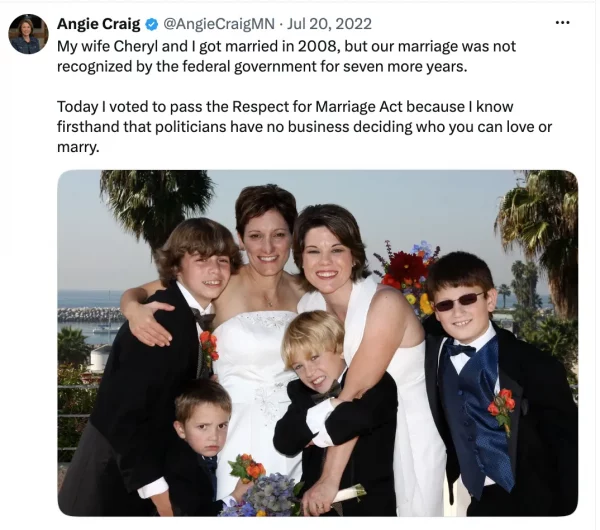
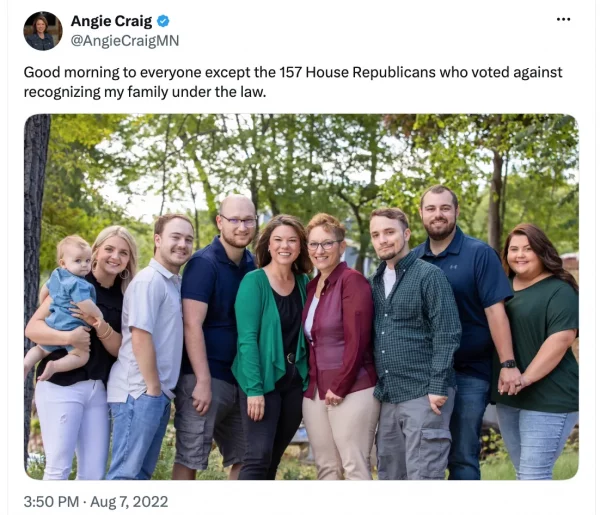
Craig and Langston separated in 2006, and Craig married Cheryl Greene in California in 2008. They have four sons and three grandsons, with a fourth on the way. Greene is a former middle school teacher still involved with youth programming.
Craig worked for LGBTQ equality within her company and for statewide marriage equality in Minnesota. She also fought against an anti-marriage equality constitutional amendment in 2012, which voters rejected. The state legislature passed a marriage equality bill the following year that Gov. Mark Dayton signed into law.
In 2016, when she ran for Congress in Minnesota’s 2nd District, a Republican stronghold for more than a decade, she told the Twin Cities Pioneer Press that the fight for custody of Joshua gave her strength.
“Whether I win or lose on Election Day, I know that that won’t be the hardest thing or the biggest challenge that I’ve ever faced,” said Craig, then 44. “When you get up every day and wonder, ‘Am I going to (still) have my child the next day?’ you get pretty good at being focused on the big picture.”
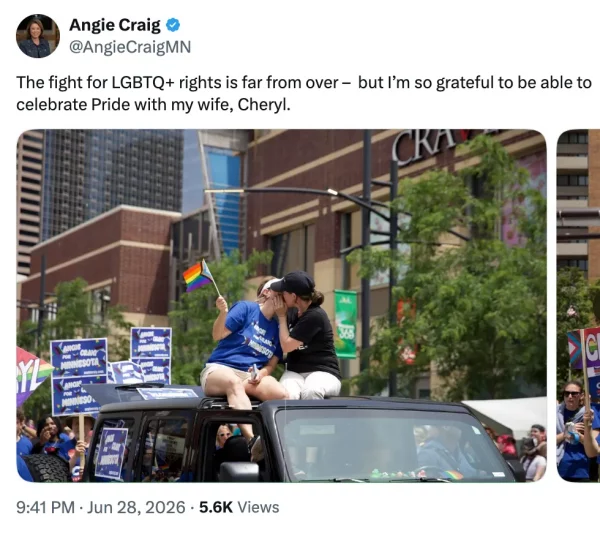
“I’ve always talked about my family openly” on the campaign trail and in office, Craig, co-chair of the Congressional Equality Caucus, tells LGBTQ+ Freedom Fighters. Often at events in her district and around the state, she’ll meet someone who mentions they have an LGBTQ family member, she notes. She finds that if she listens to constituents and addresses what’s important to them, her identity isn’t an issue.
What Craig has addressed for constituents includes health care costs, such as capping the out-of-pocket cost of insulin and limiting overall out-of-pocket drug costs for people on Medicare. These came from a bill introduced by Craig and became provisions of the Inflation Reduction Act, signed into law by President Joe Biden in 2022. She also wants a public option for health insurance, an increased child tax credit, and she introduced a bill to eliminate federal taxes on Social Security benefits.
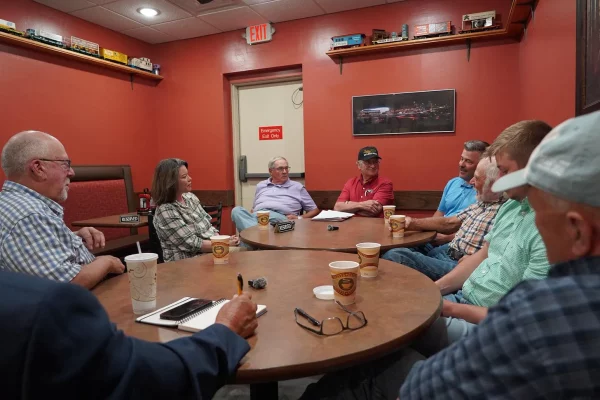
In a June 19 SurveyUSA poll, Minnesotans say their single most important issue is inflation (39%) and cost of living, followed by health care, immigration, gas prices, and the war in Iran.
But immigration may soon jump to the front as more information leaks out about U.S. Immigration and Customs Enforcement agents shooting and killing Lorenzo Salgado Araujo during a traffic stop in Houston on Tuesday morning, July 9. Homeland Security says the father, with no criminal record, driving to work, ignored verbal instructions and tried to ram their vehicle. ICE shot him in self-defense — the same excuse ICE used on Jan. 7, 2026, when an ICE agent killed nonviolent protester Renee Good. In both instances, video footage proved ICE lied.
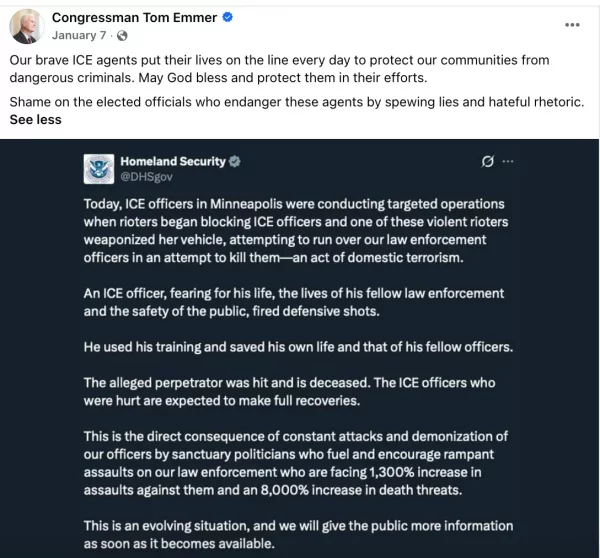
Also caught on tape was Craig’s angry confrontation with Republican Majority Whip Tom Emmer (R-Minn.) on the House floor the day Good was killed after Emmer supported ICE on social media. The story and her response went viral.
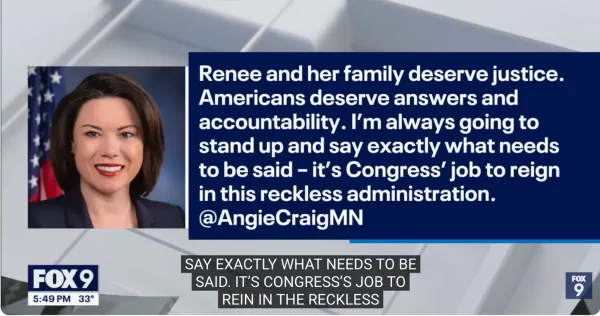
But Craig continues to be criticized for voting for the Laken Riley Act, named for a woman who was killed by an undocumented immigrant. It allows for undocumented immigrants to be detained or deported if they are simply accused of crimes, even nonviolent ones. Critics say she has never apologized — but she has.
In a commentary for The Minnesota Star Tribune in May, Craig wrote, in part:
“The text of the bill did not include the word deportation. I made the difficult decision to vote for it. Democrats like Sens. Mark Kelly and Ruben Gallego, Raphael Warnock and Jon Ossoff — leaders I deeply respect — all came to the same conclusion.
But as I stood side by side with protesters on the streets of Minneapolis and opposite dozens of armed Immigration and Customs Enforcement agents at the Whipple Federal Building after Renee Good’s killing — and again after the killing of Alex Pretti — I couldn’t help but question whether I made the right call last year … It’s also become clear that supporting any bill that gives ICE new authority in this administration was the wrong decision. And I regret my vote.”
“What happened under Operation Metro Surge was horrific,” Craig tells LGBTQ+ Freedom Fighters. The U.S. can secure its borders in a humane fashion while providing a path to citizenship for undocumented people, those brought here as children, and others, she adds.
On LGBTQ rights, Craig says the Equality Act has been a huge priority of hers in the House and would remain so in the Senate.
Since 2019, Craig has introduced the John Lewis Every Child Deserves a Family Act that “would ban discrimination based on sexual orientation, gender identity, religion or marital status in those programs, prohibit the use of federal funds for so-called ‘conversion therapy’ and create a resource center for LGBTQ+ foster and adoptive youth within the Department of Health and Human Services’ Administration for Children and Families,” according to a press release.
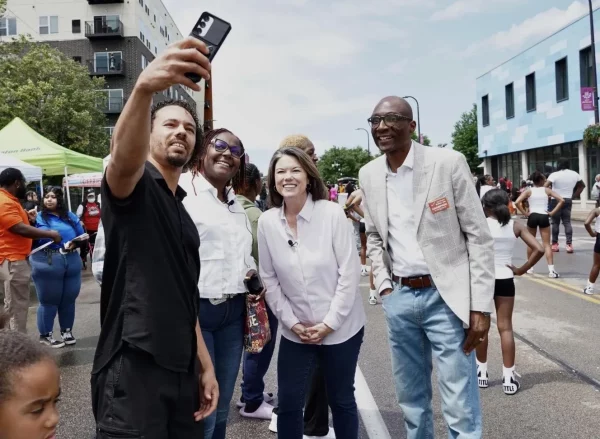
Another priority is passage of the John R. Lewis Voting Rights Advancement Act, named for the late civil rights activist and longtime congressman. “I was lucky enough to serve with John Lewis,” she says.
Additionally, Craig supports campaign finance reform. The recent U.S. Supreme Court ruling that further loosened restrictions was “just another blow to our democracy,” she says. She supports limits on Supreme Court terms.
On foreign policy, she condemns Trump’s war of choice in Iran. “The administration has had zero strategic objectives,” she says, adding that the war has caused “tremendous economic damage,” such as the spike in gas prices.
And though Craig supports a two-state solution to the ongoing Israel-Palestinian conflict, with Palestinians having their own state, her campaign does not accept direct donations from AIPAC’s political action committee — the pro-Israel group held fundraisers for her before her Senate announcement — another point exploited by primary opponent Flanagan.
On gender-affirming care for transgender youth, Craig says politicians should not interfere with decisions made by young people and their parents. Regarding trans girls and women in sports, she says the matter is best handled locally — and that local conversations can foster understanding.
But Craig has had a strong public reaction to federal transphobia. After that, then-U.S. Reps. Tulsi Gabbard (D-Hawaii) and Markwayne Mullin (R-Okla.) introduced the Protect Women’s Sports Act in December 2020. Craig released the following statement:
“As a lesbian woman, I am no stranger to prejudice and intolerance — but this legislation is beyond the pale. Plain and simple, the Protect Women’s Sports Act is transphobic — and this type of discrimination has no place in the halls of Congress. Especially at a time when the transgender community is suffering from a tragic rise in suicide rates and experiencing a surge of transphobic violence, such a bigoted and appalling effort is simply unacceptable. Queer and transgender women must stand together in the face of intolerance — and I am proud to do so today by emphatically denouncing this narrow-minded and hateful legislation, which is harmful not only to transgender women but to the LGBTQ community at-large.”
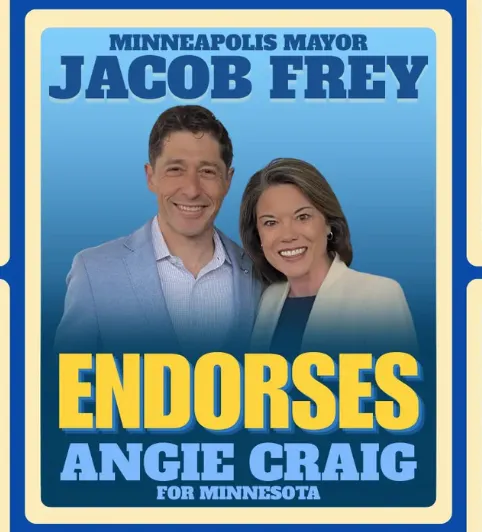
Craig has been endorsed by prominent LGBTQ groups, including the LGBTQ+ Victory Fund, the Human Rights Campaign PAC, Equality PAC, and LPAC. She has also been endorsed by Minneapolis Mayor Jacob Frey and St. Paul Mayor Kaohly Her, plus many nationally known political figures, such as former Transportation Secretary Pete Buttigieg, U.S. Sen. Tammy Baldwin (D-Wis.), House Speaker Emerita Nancy Pelosi (D-Calif.), and House Democratic Leader Hakeem Jeffries (D-N.Y.).
Flanagan has the endorsement of Smith and her predecessor, Al Franken, Minnesota Attorney General Keith Ellison, and, from outside the state, U.S. Sen. Elizabeth Warren (D-Mass.) and Sanders, among others. U.S. Sen. Amy Klobuchar of Minnesota and the state’s governor, Tim Walz, so far haven’t made endorsements.
“I’m ready on day one” to serve in the Senate, says Craig, noting her four terms in the House, her substantial career before going into politics, and her two votes to impeach Trump. “If we can take the House and Senate, we can put a cap on this administration.”
This is a cross-post from Karen Ocamb’s LGBTQ+ Freedom Fighters Substack.

Russian LGBTQ rights group to shut down

PHOTOS: Nellie’s Drag Brunch

Remembering Barbara ‘Boo’ Price, a pioneering force in women’s music

‘Maddie’s Secret’ defies campy expectations

Bros + romance + fantasy = ‘Bromantasy.’

Supreme Court ruled Boy Scouts could exclude James Dale. Now he says that same rule protects LGBTQ scouts from Trump

Beloved pastor, AIDS activist Rainey Cheeks dies at 74

Live music drag cabaret set for Shaw’s Tavern

Comings & Goings

Calendar: August 14-20
-

 Pentagon5 days ago
Supreme Court ruled Boy Scouts could exclude James Dale. Now he says that same rule protects LGBTQ scouts from Trump
-

 Obituary4 days ago
Beloved pastor, AIDS activist Rainey Cheeks dies at 74
-
Out & About4 days ago
Live music drag cabaret set for Shaw’s Tavern
-
District of Columbia4 days ago
Comings & Goings