District of Columbia
Whitman-Walker celebrates opening of new Max Robinson Center
Mayor, city officials call facility major benefit for Southeast D.C.
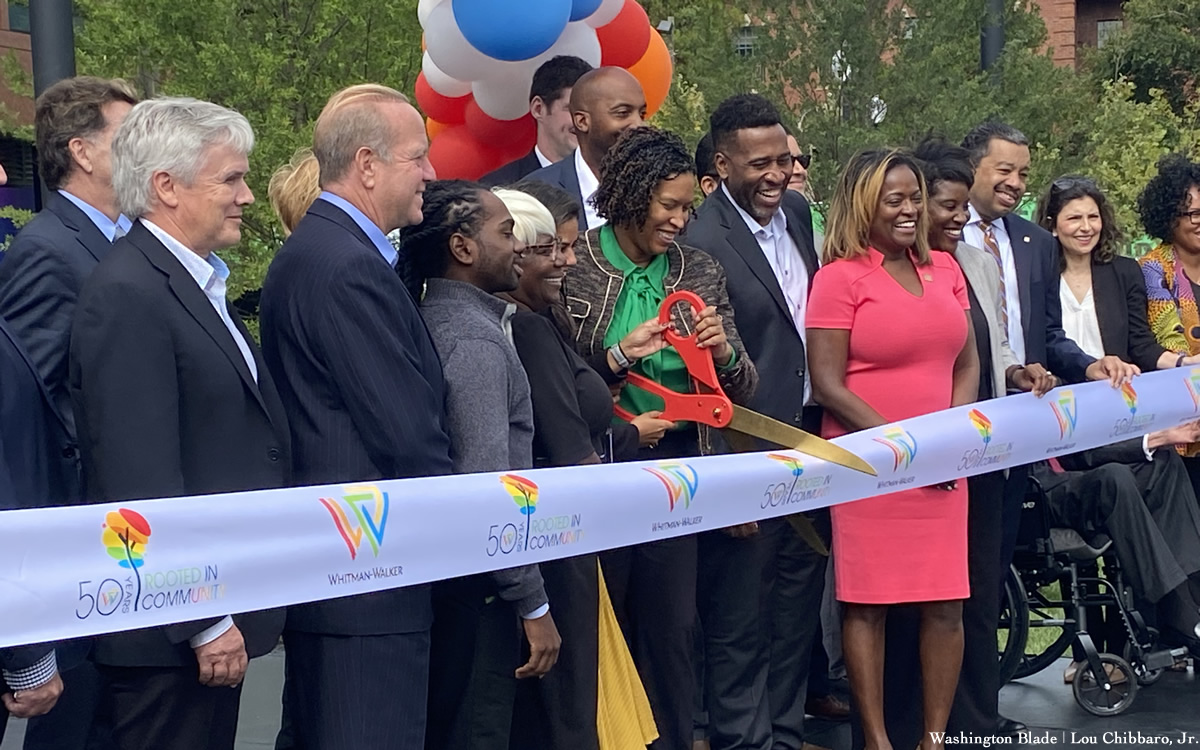
D.C. Mayor Muriel Bowser, joined by city officials and leaders of Whitman-Walker Health, cut a ceremonial ribbon on Monday to mark the official opening of Whitman-Walker’s new Max Robinson Center at the city’s St. Elizabeth’s East campus in Southeast D.C.
The six-story healthcare and research facility will enable Whitman-Walker to expand its wide range of services to the community, with a focus on Ward 7 and Ward 8 residents, officials said. Those services, which began when the facility opened its doors on Aug. 14, include primary, dental, and HIV care, behavioral health services, substance use counseling, and a pharmacy, according to a Whitman-Walker statement.
“Today, we’re opening a bigger Max Robinson Center, and in two years we’ll be opening a new hospital on this same campus – and together, these two facilities are going to change the way we deliver healthcare in D.C.,” Bowser told the crowd of about 200 that turned out for the event held in a courtyard next to the newly opened building.
“We’re incredibly grateful that Whitman-Walker is part of the legacy that we’re building on the St. Elizabeths East campus,” the mayor said. “This campus represents our commitment to Ward 8 and our community to a stronger, healthier, and equitable D.C.”
Whitman-Walker and city officials noted that the new building replaces the longtime LGBTQ supportive health care organization’s original Max Robinson Center that opened in 1993 on Martin Luther King Boulevard in Anacostia about a mile away from the new facility. The center was named in honor of award-winning TV news journalist Max Robinson who became the first African American to serve as co-anchor of a network news program at ABC News in 1978. Robinson died of complications associated with HIV/AIDS in 1988.
Bowser and others who spoke at the event praised Whitman-Walker for providing high quality healthcare through its Max Robinson center for underserved communities in city neighborhoods east of the Anacostia River.
The opening of the new Max Robinson Center comes on Whitman-Walker’s 50th year since its founding in 1973 as an LGBTQ community health clinic in a church basement in Georgetown, Whitman-Walker CEO Naseema Shafi noted at the ribbon cutting event.
“We are thrilled to unveil this once-in-a-lifetime healthcare and research expansion during our 50th anniversary year,” Shafi said. “Our new healthcare home will significantly improve access to excellent healthcare for all residents,” she said.
Among other things, the new facility will allow Whitman-Walker to serve an additional 10,000 patients per year more than it was able to serve at the original Max Robinson Center, a statement released by Whitman-Walker says. An important part of its services will include mental health and behavioral services, officials said.
There are more than 40 exam rooms, eight dental suites, six group therapy rooms and a psychotherapy suite in the new facility, the officials said in the statement.
The statement says the new building will also serve as headquarters for the Whitman-Walker Institute, an arm of the healthcare organization that for many years has conducted HIV related research. It says the new facility will allow Whitman-Walker to expand its research “from 19 to over 60 clinical trials, including innovations in cancer research and continued progress toward finding a cure for HIV.”
Others who attended or spoke at the event included D.C. Council members Christina Henderson (I-At-Large), Trayon White (D-Ward 8), and Vincent Gray (D-Ward 7); Japer Bowles, director of the Mayor’s Office of LGBTQ Affairs; Latrena Owens, executive director of St. Elizabeths East Development; and Debrah Wells, a Whitman-Walker patient who said the substance use treatment and counseling she received at the Max Robinson Center “saved my life.”
Also speaking were Louis Dubin, managing partner of Redbrick development company, which led the development of the building project; and Jim Davis, president of Davis Construction, the company that built the new facility. Both pointed out that they worked with banks and other lenders along with financial support from the city that made the financing of the new Max Robinson Center possible.
Whitman-Walker CEO Shafi told the Washington Blade after the ribbon cutting event that while Whitman-Walker has expanded its services to include the wider community in the years since its founding as an LGBTQ clinic, its commitment to serving the healthcare needs of the LGBTQ community continues in all its facilities, including the new Max Robinson Center.
“What’s interesting about Whitman-Walker of today — when we started in 1973, we were started by community for community, and we were responding to the needs at that time particularly of the LGBTQ community,” she said. “So, now we’ve continued to take care of people, we will continue to do so,” she added.
“And this new site in Congress Heights gives us the opportunity to take care of even more community members, parts of the LGBTQ community and the greater Washington region,” she said, noting that Whitman-Walker currently has about 2,500 transgender or gender expansive people in care, and 3,500 people with HIV in care.



The Comings & Goings column is about sharing the professional successes of our community. We want to recognize those landing new jobs, new clients for their business, joining boards of organizations and other achievements. Please share your successes with us at [email protected].
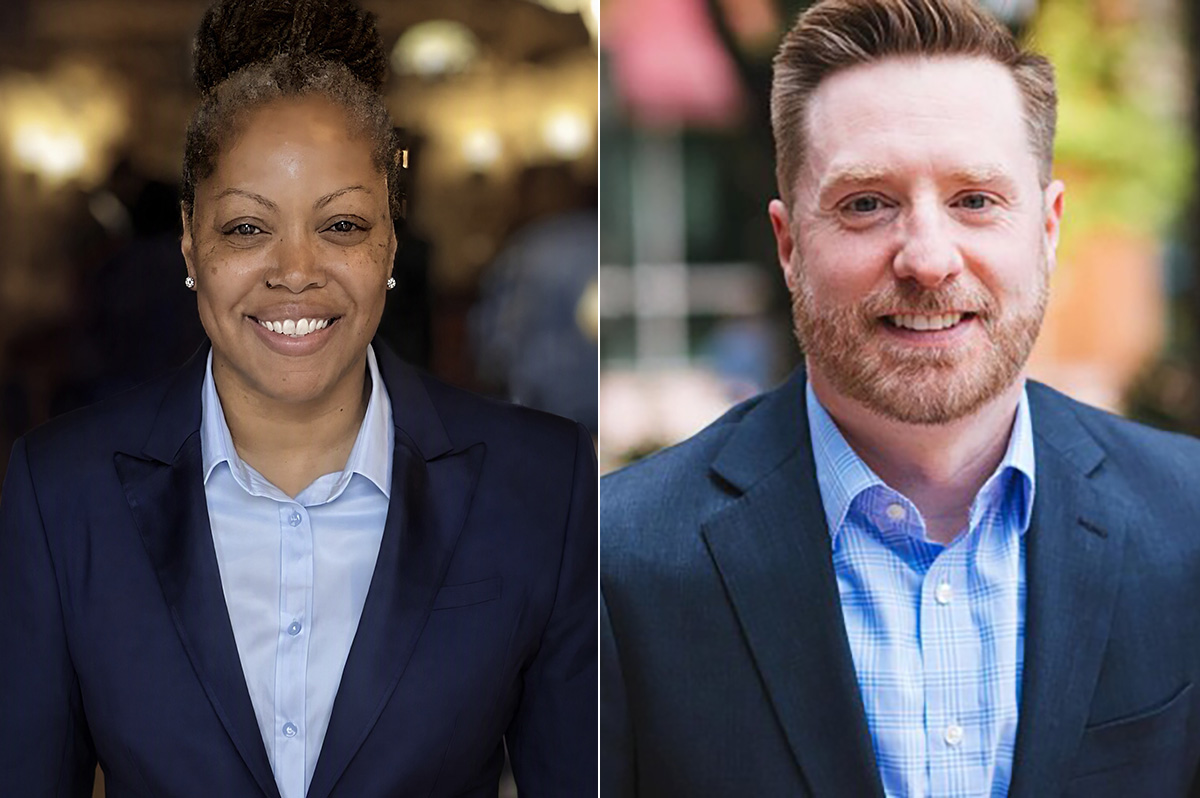
Congratulations to Carla Lester, LICSW on her new position as Chief Program Officer with SMYAL. Upon accepting the position she said, “SMYAL deeply aligns with my passion for honoring, protecting, and upholding the rights of all individuals, particularly LGBTQ+ youth and others who have been historically underserved, to belong to communities that affirm their identities, treat them with dignity and respect, and support their well-being. At this point in my career, I was ready to transition to an organization whose mission more closely reflected my values and was rooted in the community. SMYAL offered the opportunity to serve both an organization and a population whose mission not only resonates deeply with me but also intersects with my own multiple identities.”
Lester is a healthcare and human services executive with more than 20 years of experience in behavioral health, federal and state health insurance programs, housing, health care, education, and community-based services. She has held senior roles at Carelon Behavioral Health, Pathways to Housing and N Street Village, leading clinical programs, Housing First initiatives, homeless outreach, trauma-informed services, and integrated case management.
She earned master’s degrees in Social Work and Divinity, and maintains active clinical social work licenses in D.C. and Maryland.
Congratulations also to Tad Czyzewski on his new position as Chief Development Officer at SMYAL. On accepting the position, he said, “While I’ve spent much of my nonprofit career in the arts, the current social and political environments made me want to apply my skills and passion more directly toward supporting and strengthening our community. SMYAL and this role felt like the right place to do that.”
Czyzewski brings more than two decades of experience in nonprofit leadership and strategy, fundraising, and business development. Prior to joining SMYAL, he served for eight years as executive director of The Choral Arts Society of Washington, where he led fundraising, financial management, and community engagement. During his tenure, he helped raise more than $15 million in contributed revenue. He guided the organization through a major rebrand and the COVID-19 pandemic.
Prior to that Czyzewski served as Business and Development Director for Washington Revels, and held leadership and advisory roles with Chorus America, the DC Commission on the Arts and Humanities, and the National Endowment for the Arts. He began his career in the corporate sector, including at Capital One, where his work in product development and marketing contributed to new financial products and more than $2 billion in deposits.
Czyzewski is a lifelong musician, has performed professionally as a classical singer, including with the Washington National Opera and the National Symphony Orchestra.
District of Columbia
Gay ANC commissioner sues D.C. over police ‘failure’ to pay reward money
Lawsuit says information led to conviction in murder, armed robbery cases

Gay D.C. Advisory Neighborhood Commissioner Tom Donohue on Aug. 11 filed a lawsuit in D.C. Superior Court charging that D.C. police acted improperly and violated a local law by not paying him $30,000 in reward money for his role in helping police identify and arrest — and obtain the subsequent conviction — of one man charged with murder and another man charged with armed robbery in separate cases.
Although the lawsuit alleges improper action by D.C. police in carrying out the city’s Crime Solvers reward program, it names as defendants the District of Columbia and the Office of the Attorney General for D.C., which, among other things, defends the city against lawsuits.
Donohue, who is a member of the city’s ANC Rainbow Caucus consisting of LGBTQ elected ANC members, held a news conference outside the D.C. Superior Court building on Aug. 11 to talk about the lawsuit before entering the courthouse to officially file it.
The lawsuit states that Donohue “provided key video evidence that led to the arrest and conviction” of a man initially charged with first degree murder for allegedly running over a bicyclist with his car after the two got into an argument.
The lawsuit states that police had offered a $25,000 reward for information leading to the arrest and conviction of the defendant in that case, but police “arbitrarily slashed the payment to $5,000 without prior notice or policy justification.”
Court records show that D.C. resident Eric Beasley was charged with first degree murder for killing David Farewell, 45, by hitting him with his car on Sept. 4, 2020, on the 2100 block of Young Street, S.E. The records show the evidence for the case was based in large part on video camera footage of the incident obtained by police. Donohoe has said he provided that video camera evidence.
The records show that during Beasley’s October 2023 trial a jury was unable to reach the required unanimous verdict, and the judge declared a mistrial.
According to the records, Beasley later agreed to an offer by prosecutors to plead guilty to a lesser charge of involuntary manslaughter and was sentenced in September 2024 to eight years in prison, a development that angered the victim’s family members who called it a “slap on the wrist,” according to a Fox 5 News report.
Donohue’s lawsuit says the second case in which he provided police with pivotal information involved a series of armed robberies known as the Fairlawn Serial Armed Robbery Spree that occurred in the Fairlawn neighborhood in Southeast D.C. in 2023 near where Donohue lives.
The lawsuit says evidence consisting of video surveillance footage provided by Donohue to police enabled police to determine they initially wrongfully arrested an 18-year-old male for the robberies. “Using Plaintiff’s security video, MPD identified, arrested, and convicted the actual robber, David Crocker, who was sentenced to 18 years in federal prison,” the lawsuit states.
It says one of the detectives investigating the case recommended a $10,000 reward for Donohue’s help in the case based on the police Crime Solvers reward program. The detective’s recommendation was approved by then-Assistant D.C. Police Chief Kyle Ramey on Aug. 4, 2025, according to the lawsuit.
But it adds, “Nevertheless, MPD improperly withheld payment.”
When contacted by the Washington Blade for comment on Donohue’s lawsuit allegations, a D.C. police spokesperson said “MPD does not comment on pending or ongoing litigation.”
Gabriel Shoglow-Rubenstein, who serves as press secretary for the D.C. Office of the Attorney General, which will be defending the city against the Donohue lawsuit, said he would look into obtaining a possible comment but said the office has a similar longstanding policy of not commenting on pending litigation.
“This action arises from the District of Columbia Metropolitan Police Department’s arbitrary, bad-faith, and legally unsupportable failure to honor its public reward promises and administrative obligations to Plaintiff,” the lawsuit states.
It says the MPD violated the city’s Freedom of Information Act or FOIA law by not responding to Donohue’s request for information and documents related to the decision not to pay him the full reward money.
“MPD’s reduction of Plaintiff’s homicide reward from $25,000 to $5,000, and its withholding of his approved $10,00 robbery reward, were undertaken completely devoid of written standards, making such decisions inherently arbitrary, capricious, and an abuse of administrative discretion,” it says.
It calls for Donohue to be awarded $30,000 in compensatory damages consisting of the $20,000 “unpaid balance” for the homicide case reward and $10,000 for the robbery case reward. It also calls for reimbursement for “reasonable” litigation costs and attorney’s fees. Donohue told the Washington Blade that at this time he is representing himself without an attorney.
Donohue told the Blade that the refusal by D.C. police to pay him the full reward money also limited his plans to donate some of that money to the family of murder victim David Farewell to help pay for a burial stone. He said that due to the family’s limited resources Farewell is buried in an unmarked grave
District of Columbia
D.C.’s Mary’s House For Older Adults names new executive director
Charlene Leach to succeed Imani Woody as leader of LGBTQ-supportive seniors home
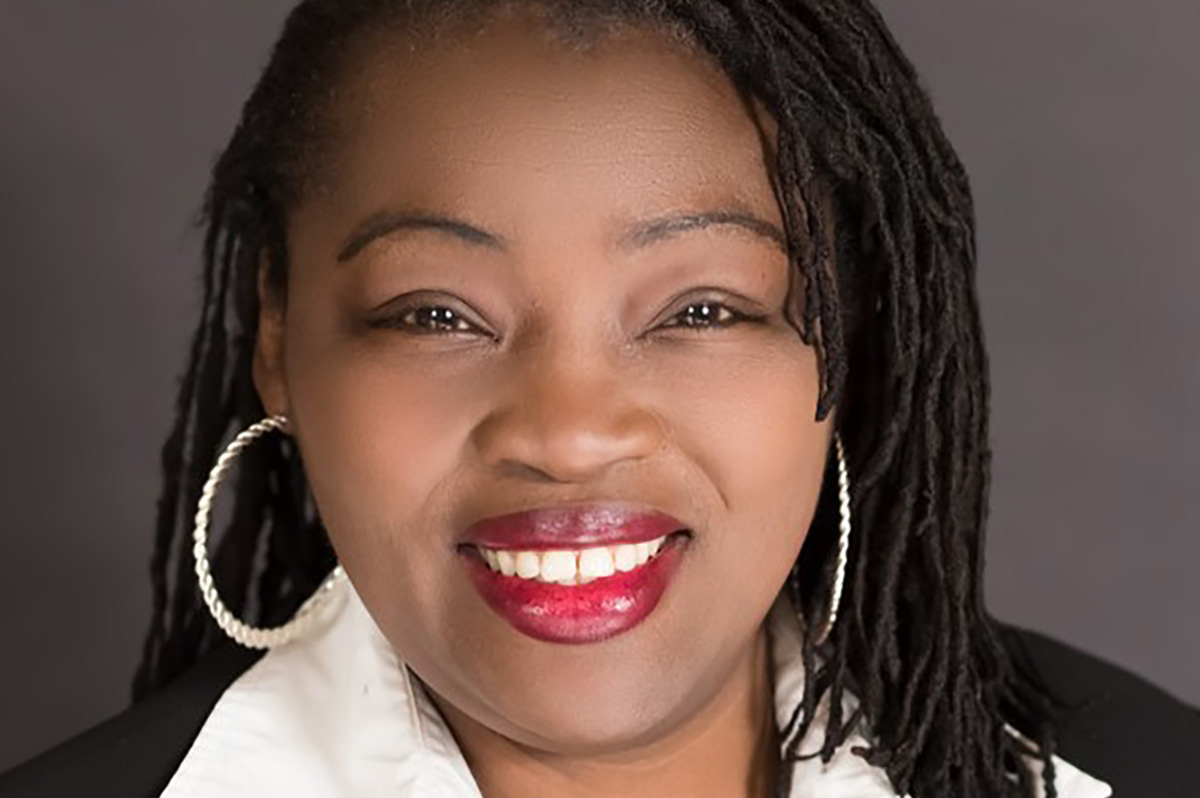
The board of directors of Mary’s House for Older Adults, the D.C.-based home dedicated to providing affordable housing for LGBTQ seniors, has announced it has named longtime nonprofit organization leader A. Charlene Leach as its new executive director.
Leach, who is now serving in the executive director’s position, is succeeding Dr. Imani Woody, the Mary’s House founding president and CEO, who announced her retirement from her official leadership role at Mary’s House on July 7.
Woody, who holds a PhD in Human Services, is credited with playing the lead role over many years in arranging both city and private funding needed to construct and operate the Mary’s House three-story building located at 401 Anacostia Road, S.E., in the city’s Fort DuPont neighborhood.
“With over three decades of nonprofit experience and 15 years serving as an executive director, Charlene brings a wealth of knowledge in organizational leadership, program development, and community engagement,” the Mary’s House board says in a statement.
“Her proven track record of building impactful programs and leading mission-driven organizations makes her uniquely suited to guide Mary’s House into its next phase of growth,” the statement continues. “Charlene is deeply aligned with the mission of Mary’s House and is committed to advancing its work to provide safe, inclusive housing and supportive services for LGBTQ+ older adults,” it says. “Under her leadership, the organization will continue to expand its impact while remaining grounded in the values that define our community.”
Leach’s LinkedIn page shows she has most recently served since 2022 as executive director of the African American AIDS Task Force in Minneapolis. Prior to that, it shows she served as executive director of the Fredericksburg Area Health and Support Services organization in Fredericksburg, Va., and before that as director of development for the D.C.-Baltimore area Women’s Collective.
Her LinkedIn page says she has been involved with Mary’s House as a volunteer and grant writer since 2016.
The newly built and enlarged Mary’s House, which opened in March 2025, with a grand opening ceremony held in May 2025 attended by D.C. Mayor Muriel Bowser, includes 15 single-occupancy residential apartments and more than 5,000 square feet of shared communal living space.
An earlier statement released by the Mary’s House board announcing Woody’s retirement said Woody would continue to be involved with the organization as a member of the board. The earlier statement and board’s more recent statement on July 29 announcing Leach’s appointment as executive director did not say whether the board plans to name someone else as president and CEO, the title that Woody held before her retirement. But the latest statement says Leach will be running Mary’s House’s day-to-day operations as Woody did.

Madonna nominated for 11 MTV VMAs

White House targets gender-affirming care funding, states fight back

Winsome Earle-Sears ‘Life and Marriage Tour’ to include Northern Va. stops

Russian LGBTQ rights group to shut down