Virginia
Miyares joins efforts to fight Title IX changes
Republican Va. AG part of multi-state effort
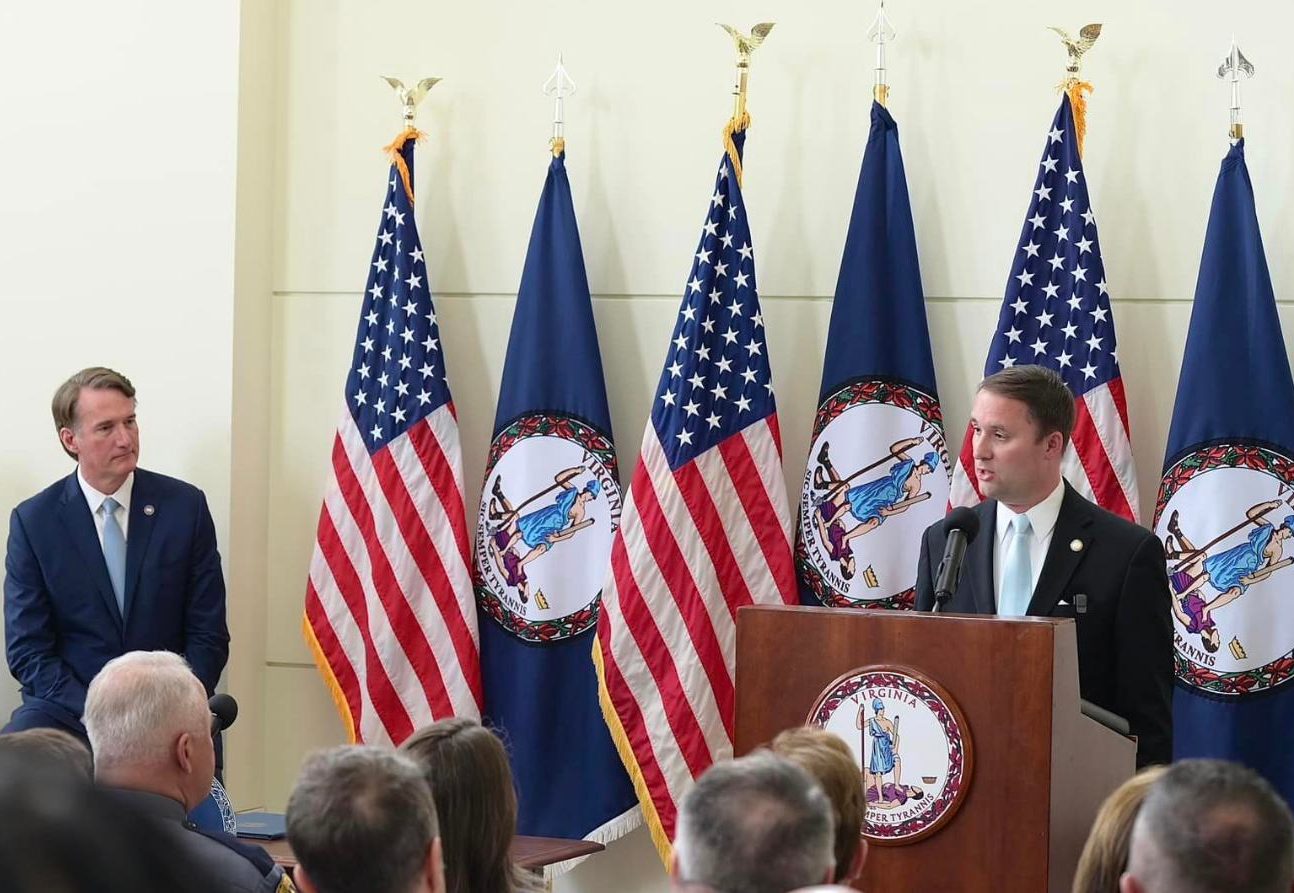

BY NATHANIEL CLINE | Virginia Attorney General Jason Miyares has joined a multi-state effort to stop new Title IX rules from going into effect.
The list of new rules designed to protect victims of campus sexual assaults and the rights of LGBTQ students has come under attack by Republican attorneys general in several states.
Miyares called the changes a “dangerous overhaul” of Title IX, and said the new rules would negatively impact students, families and schools in the commonwealth. The ruling also comes after Gov. Glenn Youngkin’s administration overhauled the commonwealth’s transgender student policies.
“The Biden administration’s unlawful rule would jeopardize half a century of landmark protections for women, forcing the administration’s social agenda onto the states by holding federal funding hostage,” Miyares said in a statement. “They are avoiding Congress and the constitutional process because they know it will not pass. We cannot roll back Title IX in the name of false equity.”

Attorney generals from Tennessee, Indiana, Kentucky, Ohio, and West Virginia have also signed onto the suit, which was filed in Tennessee. Separate lawsuits have been filed in other states, including Louisiana and Texas.
Title IX, which has undergone several transformations based on the political party in office, was created to address women’s rights and prohibits any federally funded school or education program from discriminating against any student based on sex since it was established in 1972.
The Department of Education said some differences compared to the previous version developed under the Trump administration, include protections against all sex-based harassment and discrimination, prohibits schools from sharing personal information, and supports students and families.
Narissa Rahaman, executive director for Equality Virginia, said in a statement that the rule prevents opponents from weakening “crucial” civil rights protections including for LGBTQ students by ensuring that pregnant and parenting students have a right to equal education opportunities, protecting student survivors and guaranteeing the rights of LGBTQ students to come to school as themselves without fear of harassment or discrimination.
“Students across races, places, and genders prove every day that they can do great things, especially when there are strong Title IX protections in place, which is why the Biden administration’s updates to the Title IX rules are essential to ensure every student can thrive at school,” said Rahaman.
The new rule is slated to take effect on Aug. 1 and will apply to complaints of alleged conduct that occurs on or after that date, according to the Department of Education.
Protections
While the ruling protects students and employees from all sex-based harassment and discrimination, it will also impact LGBTQ students and employees, including providing complete protection from sex-based harassment, and prohibiting schools from sharing personal information.
Schools must act “promptly and effectively” to protect and treat all students and staff who make complaints “equitably.” Schools must also provide support measures to complainants and respondents, and act to end any sex discrimination in their programs and prevent any recurrence.
The rule further clarifies the definition of “sex-based harassment,” which means to treat someone unfairly because of their gender; and the scope of sex discrimination, including schools’ obligations not to discriminate based on sex stereotypes, sex characteristics, pregnancy or related conditions, sexual orientation, and gender identity.
The federal agency said the changes will empower and support students and families by requiring schools to disclose their nondiscrimination policies and procedures to all students, employees, and other participants in their education programs so that students and families understand their rights.
The final rule also protects against retaliation for students, employees, and others who exercise their Title IX rights, and supports the rights of parents and guardians to act on behalf of their elementary school and secondary school children.
The rule also protects student privacy by prohibiting schools from disclosing personally identifiable information with limited exceptions, which is something the Youngkin administration has opposed.
Advocates say one of the rights students should have is the power to decide who finds out about their transgender status, to protect them from being bullied or harassed.
Virginia policies
In 2021, the first model policies for trans students were designed under former Gov. Ralph Northam to provide school officials guidance on the treatment of trans and nonbinary students and to protect the privacy and rights of these students.
However, some schools declined to adopt the model policies, and the state law that led to them lacked enforcement incentives or penalties.
The current policies adopted by the Youngkin administration were revised to require parental approval for any changes to students’ “names, nicknames, and/or pronouns,” direct schools to keep parents “informed about their children’s well-being” and require that student participation in activities and athletics and use of bathrooms be based on sex, “except to the extent that federal law otherwise requires.”
Virginia schools have also not fully adopted the newly revised policies, and state law has not changed since the policies were overhauled in 2023.
The Virginia Department of Education faces two lawsuits over the policies adopted by the Youngkin administration.
“All Virginia students, including our transgender and nonbinary students deserve to feel safe and welcomed at schools,” said Wyatt Rolla, a senior trans rights attorney with the ACLU of Virginia. “Accessing restrooms, locker rooms and other facilities that are necessary when you are at school learning is a key part of our schools being inclusive of those transgender [and] non binary students that are part of our community.”
Athletics not included
The provisions under the new Title IX rule did not mention anything about requiring schools to allow trans students to play on teams that align with their gender identity. Virginia has taken its own shot at banning trans athletes from competing in sports through legislation.
In February, the Youngkin administration attempted to challenge the Virginia High School League’s policy on transgender athletes, the Daily Progress reported.
The proposed policy would have matched with the administration’s current policies that students should be placed on teams based on their biological sex rather than their gender identity.
The Virginia High School League, which oversees interscholastic athletic competition for Virginia’s public high schools, allows for trans athletes to participate on teams that match their gender identity, but under certain conditions.
Simultaneously, lawmakers in the Virginia General Assembly controlled by Democrats killed bills, including Senate Bill 68, during the previous session that would have essentially banned transgender students from competing in sports.
State Sen. Tammy Brankley Mulchi (R-Mecklenburg), who carried Senate Bill 723, said students like her 6-year-old granddaughter should have a choice to play with their own gender during a Feb. 1 Senate Education subcommittee hearing.
Mulchi’s bill would have required schools and colleges to have separate sports for boys and girls based on their biological sex. Any dispute would require a note from a doctor.
“If she [my granddaughter] wants to play an all-girl sport, I want her to play against girls that were born girls and not play against someone that is much stronger than her or can hurt her and take away her chances of a scholarship,” Mulchi said.
However, state Sen. Stella Pekarsky (D-Fairfax) argued during the February hearing that whether students are competing with their respective biological sex or not “children of all ages, sexes have different builds and strengths and no children are alike on the same team.”
******************************************************************************************

Nathaniel is an award-winning journalist who’s been covering news across the country since 2007, including politics at the Loudoun Times-Mirror and the Northern Neck News in Virginia as well as sports for the Plain Dealer in Cleveland, Ohio. He has also hosted podcasts, worked as a television analyst for Spectrum Sports, and appeared as a panelist for conferences and educational programs. A graduate of Bowie State University, Nathaniel grew up in Hawaii and the United Kingdom as a military brat.
******************************************************************************************
The preceding article was previously published by the Virginia Mercury and is republished with permission.
Nonprofit. Nonpartisan. No paywalls. Fair and tough reporting on the policy and politics that affect all of us is more important than ever. The Mercury brings you coverage of the commonwealth’s biggest issues from a team of veteran Virginia journalists.
We’re part of States Newsroom, the nation’s largest state-focused nonprofit news organization.




Virginia
Virginia Anti-Violence Project struggles to fill federal funding gaps
Group has lost 54 percent of funding since 2020
A loss of federal funding has threatened to adversely impact the Virginia Anti-Violence Project’s work in the state.
The group’s mission is to assist LGBTQ and BIPOC (Black, Indigenous and people of color) victims of domestic, sexual, interpersonal, and state violence with direct support, education, and advocacy. The VAVP seeks to build a future where LGBTQ and BIPOC individuals can live freely without a sense for worry about violence.
“Virginia Anti-Violence Project helps to close the distance between services existing and LGBTQIA+ survivors actually being able to reach safety, stable housing, and support that they can trust,” VAVP Executive Director Ebony Clark told the Washington Blade on Tuesday. “Our mission is to provide direct services and advocacy to LGBTQ+ survivors across Virginia.”
Clark said obtaining state and federal funds has become increasingly difficult.
“One of the reasons that we can talk about is politics and how you know queer diverse, queer communities are targets when it comes to politics, and so that may be a reason why the funding is decreasing in in very niche areas, but overall, state funding, federal funding has been lost or significantly reduced when it comes to culturally specific marginalized populations,” Clark said. “The bigger picture is that funding that was purposed for diversity, equity, inclusion, marginalized populations, or you know culturally competent programming, those funds have been strategically reduced or eliminated on state and federal levels overall.”
Even more so with the current Trump-Vance administration.
Data shows federal funding for one “major federal victim-services funding stream in” Virginia has dropped 54 percent over the last six years: from $25.1 million in fiscal year 2020 to $11.6 million in fiscal year 2026.
Clark noted some federal funding has been denied due to VAVP’s DEI policies — it has had to “water down” their language. These cuts have forced VAVP to limit housing and economic support, which has resulted in fewer resources for its clients.
The organization has set up a goal for receiving between $250,000-$300,000 a year that would allow it to operate — and focus on client housing.
“Housing is fundamental to safety,” Clark told the Blade. “If you know leaving violence puts someone on the street or forces them back to the person harming them, that means the crisis isn’t over. So there needs to be other prevention strategies and reactive strategies in place to be able to prevent further violence from folks.”
VAVP has set up a link for anyone who is interested in making a donation. It is here.
The VAVP website is also accepting donations.
Virginia
Winsome Earle-Sears ‘Life and Marriage Tour’ to include Northern Va. stops
Voters to consider marriage equality, reproductive rights referenda in November
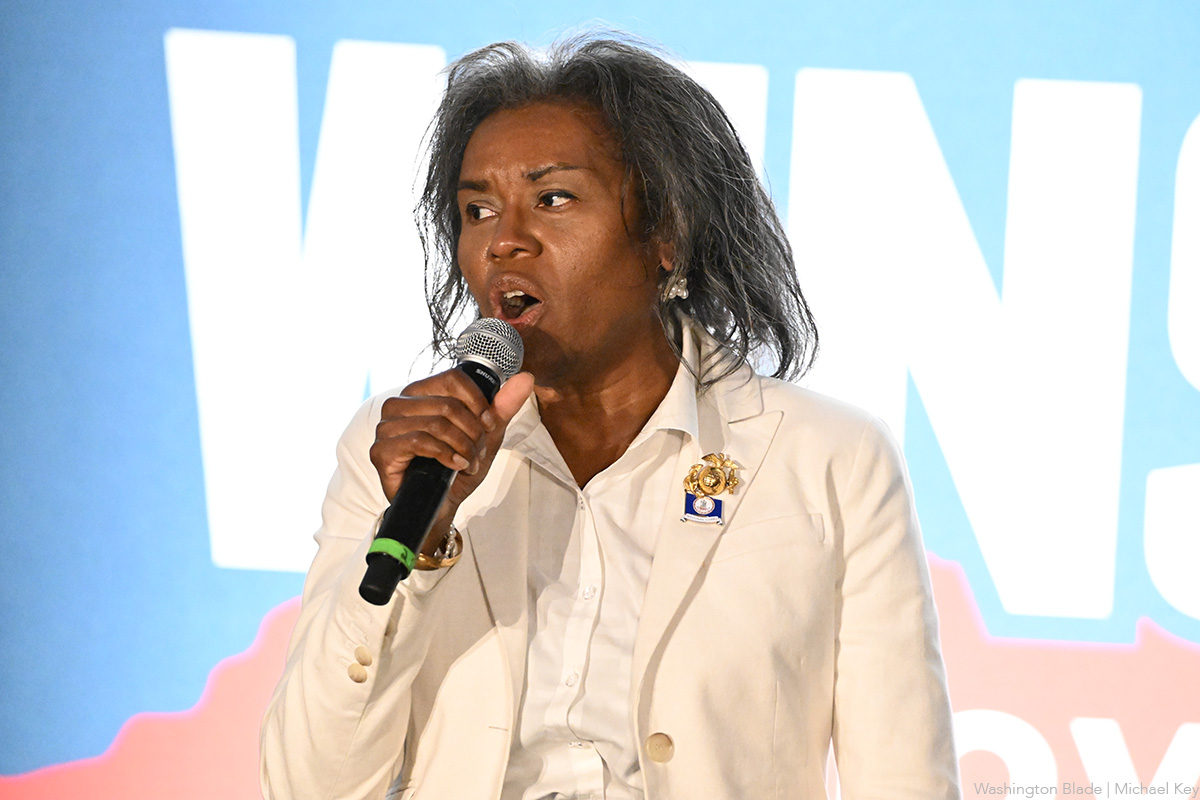
Former Virginia Lt. Gov. Winsome Earle-Sears has announced her campaign against efforts to enshrine marriage equality and reproductive rights in the state constitution will make several stops in Northern Virginia.
Her “Life and Marriage Tour” will include stops in Manassas, Winchester, and Harrisonburg. Earle-Sears said the “Life and Marriage Tour” will also travel to Virginia Beach, Lynchburg, Roanoke, Charlottesville, and other cities across Virginia “throughout September and October.”
The announcement did not include specific dates.
“Virginia, you’ve been asking where the Life and Marriage Tour is headed — here’s a look at our current tour locations,” she said on X on Tuesday. “We’ll be traveling across the commonwealth throughout September and October, and we’re still building the journey.”
Current Gov. Abigail Spanberger, a Democrat, last November defeated Earle-Sears, a Republican, in the race to succeed Republican Glenn Youngkin.
Voters in 2006 approved the Marshall-Newman Amendment, which defined marriage in Virginia as between a man and a woman.
Same-sex couples have been able to legally marry in Virginia since 2014. Youngkin a decade later signed a bill that codified marriage equality in state law.
Two successive legislatures must approve a proposed constitutional amendment before it can go to the ballot.
Spanberger signed bills that finalized the marriage equality and reproductive rights referenda’s language.
The referenda will take place on Nov. 3.
Virginia
Doug Ollivant to face Eugene Vindman in Va. 7th Congressional District
Republican defeated challengers in Tuesday’s primary
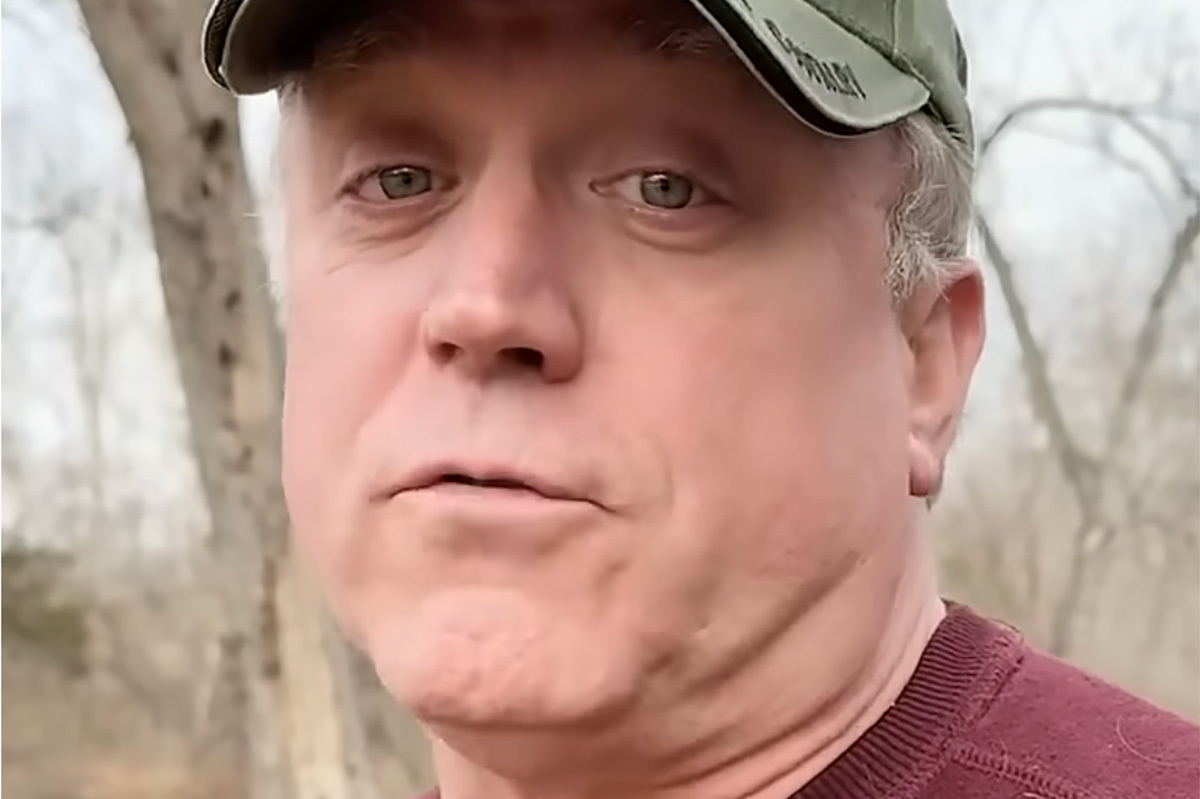
Republican Doug Ollivant will face off against incumbent U.S. Rep. Eugene Vindman (D-Va.) in Virginia’s 7th Congressional District.
Ollivant defeated his Republican opponents in Tuesday’s primary. Vindman ran unopposed.
Vindman in 2024 ran to succeed then-Congresswoman Abigail Spanberger in the U.S. House of Representatives after she ran for governor. Spanberger succeeded Republican Gov. Glenn Youngkin in 2025.
U.S. Sen. Mark Warner (D-Va.) on Tuesday easily won his primary. All other Democratic incumbent members of Congress from Northern Virginia also won their respective primaries.

United States Conference on HIV/AIDS grapples with federal budget cuts

For lesbian victims of domestic violence, competent care is scare

UN human rights chief sounds alarm over ‘comprehensive onslaught’ against LGBTQ rights

White House press pool pushes back after Trump bars three outlets

PHOTOS: Shenandoah Valley Pride

Jeremy Moss looks to bring LGBTQ advocacy from Lansing to Capitol Hill

Queer mega stars coming to D.C. this fall

Republican challenger misgenders McBride during forum, forced to leave

Activists protest outside Turkish Embassy in D.C.

A roundup of fall events not to be missed
-

 Congress5 days ago
Jeremy Moss looks to bring LGBTQ advocacy from Lansing to Capitol Hill
-
Music & Concerts4 days ago
Queer mega stars coming to D.C. this fall
-
Delaware4 days ago
Republican challenger misgenders McBride during forum, forced to leave
-
Turkey4 days ago
Activists protest outside Turkish Embassy in D.C.