Politics
HRC’s Brandon Wolf reflects on Trump’s victory, path ahead for LGBTQ movement
He joined the Blade for a conversation on Rated LGBT Radio

Human Rights Campaign National Press Secretary Brandon Wolf and Washington Blade White House reporter Christopher Kane spoke with Rated LGBT Radio on Thursday, following Donald Trump’s victory over Vice President Kamala Harris.
They covered subjects ranging from the impact of anti-trans advertising by the former president’s campaign and other Republican candidates in down-ballot races to the future of the Democratic Party and what lies ahead for organizations in the LGBTQ movement.
Prior to joining HRC, Wolf served as press secretary for Equality Florida. A survivor of the 2016 Pulse nightclub shooting in Orlando, he is recognized for his work in LGBTQ advocacy, public speaking and media appearances, and his critically acclaimed 2023 memoir “A Place for Us.”
The conversation has been edited for length and clarity.
MODERATOR: What is the mood at HRC and what are leaders and staff saying?
BRANDON WOLF: Like millions of people, the folks at HRC are heartbroken. I know I can speak for myself in saying that I am most heartbroken for those who have had their humanity questioned for years by Donald Trump and the MAGA movement. I’m most heartbroken for those who have been in the crosshairs, who have seen their freedoms and rights stripped away in state after state, in places like Texas and Tennessee and Florida. I’m heartbroken for the families who have been terrorized by their political leaders for years because of the kind of environment that people like Donald Trump have created, and I’m heartbroken for all the people who aren’t sure what happens next, the people who’ve listened to Donald Trump’s words, who’ve seen the ads that he’s run, who’ve read through Project 2025 and are deeply concerned about what happens next for themselves and their families.
This is a really challenging time, and the obstacles we’re facing are incredibly difficult, but we’ve also been here before as a community. I think about our ancestors a lot. I think about when we were being beaten and brutally assaulted by police officers, we fought back at Stonewall, and birthed a movement when people were dying by the 1,000s of AIDS and leaders refused to acknowledge that pain and suffering. We fought back, we formed Act Up, and we brought ourselves to this moment in time where we have the opportunity to potentially end that epidemic in our lifetime. We have been in incredibly challenging circumstances before, and at every one of those moments, we’ve locked arms with each other. We’ve chosen to get through it together. We dared ourselves to imagine what’s possible when we finally overcome those hurdles, and at every one of those moments, we have been successful. We’ve made progress happen. So, I’m heartbroken by the results of the election, but I’m certainly not feeling broken today.
MODERATOR: What are you hearing from LGBTQ groups you’ve spoken with in terms of their reaction to the election?
CHRISTOPHER KANE: The remarks that we just heard from Brandon actually echo what I heard earlier from Kierra Johnson, who’s the president of the LGBTQ Task Force and Task Force Action Fund. She was saying how we have this rich history as a community of activism, and how brave our forebears have been and how many of our brothers and sisters lost their lives defending our rights.
Something that I think these advocacy groups will be thinking about is what the next administration might cost [them], in terms of their access to levers of power. To what extent is the Trump administration going to work with these groups? And that means kind of a change in strategy, because the focus becomes, you know, political organizing and a lot of the other work that’s so important that these groups are engaged in, right? You know, whether it’s going out into the field and helping people get, in our community, get exactly what they need, Whether it’s providing legal resources for folks, in light of what we’re going to see in terms of regulatory and legal changes over the next administration. So there’s just so much work to be done.
[Note: Johnson told the Blade that Task Force and the other movement groups had been “doing scenario planning for months” to prepare for all possible outcomes, and together are already “moving to implement different strategies in the communities that we’re working in.”]
MODERATOR: It seems the Trump campaign sought to divide the community between LGB people on one side and trans and nonbinary communities on the other. VP-elect J.D. Vance saying, for example, that the ‘normal gay guy’ vote would break in their favor.
WOLF: First, I’m loath to let J.D. Vance tell anybody what normal is supposed to be. But the truth is, the data does not bear out that they won any significant part of the LGBTQ+ community. Exit polls show that people in the community backed Harris over Donald Trump by a 70 point margin, 84 to 14. That margin is second only to Black women in support of Vice President Harris. So, the LGBTQ+ community continues to be a very reliable part of the Democratic coalition, and I think that is because of a couple of things: Number one, we understand what’s at stake. We understand what we have to lose in these elections. We understand what we’re up against in Donald Trump. And number two, in Kamala Harris and [her VP pick, Minnesota Gov.] Tim Walz, we had real champions for our community — career-long champions who were doing the work of equality even before that was, maybe, politically advantageous or easy for them to do. It was Kamala Harris who was performing some of the first same-sex marriages in California when the country was having a debate over whether or not we should be able to get married at all. It was Tim Walz who, in the late ’90s, as a football coach, was the sponsor of the Gay-Straight Alliance club at his high school.
So, I think you saw that drive turnout in the LGBTQ+ community. That number expands when you get into some of these highly competitive battleground states. In Arizona, equality voters, who are people who prioritize LGBTQ+ equality when deciding who to vote for, equality voters backed Democratic candidates by a 92 to seven margin. So, again, we’re talking about a community that understands what’s at stake, and really showed up in this election cycle.
The other thing I want to address is, you’re talking about the MAGA agenda of driving people apart from each other. This is the old playbook. This is the right-wing playbook that they use every single time. And it’s because the MAGA agenda is not one that is designed to bring people together. MAGA candidates and campaigns don’t have a vision for our country. They don’t fundamentally believe in a multi-racial, multi-generational democracy, and so the only thing they have to offer the American people is division, chaos and hate. They pit neighbors against each other. They turn one community against another. They dare us to build higher walls and taller fences, because so long as we’re fighting with each other, we won’t find the time or the resources to organize against them collectively. And so that is what they have to offer us, this agenda of chaos, division, and hate, and that is what they’ve been trying throughout the election cycle, instead of offering policy proposals to help people address the cost of housing or groceries, instead of offering offering real comprehensive conversations on immigration reform, for instance, they serve up hate and xenophobia and transphobia and general bigotry. So, I think we have to be wary of falling into that same trap.
We’re going to spend years dissecting the election and figuring out how to build a winning coalition moving forward, but I can tell you that scapegoating trans people in this moment is not going to help us build the path forward. I think at HRC, I can speak for us that you know our job is to be in community with those other organizations. We’ve already been having conversations throughout the election cycle with our progressive partners, people in the labor space, people in the immigrant rights space, people in the civil rights space, the voting rights space, certainly the reproductive freedom space and others. We have to keep those conversations going. We have to make sure that we’re building a plan and a strategy that organizes communities across issue areas, and ultimately, we’re going to have to be united. We have to be a united front in defense of democracy and freedom and our basic civil liberties.
KANE: As Brandon said, first of all, the exit polls show that this strategy of dividing communities didn’t work, and it should come as no surprise, because [Brandon is] exactly right — that’s not how to win. We’re much stronger together.
It’s only been, what, less than 48 hours, right, since the election was called? We still have to collect a lot of information, and there’s plenty of time for reflection and recrimination and everything else to figure out exactly what happened here. To the extent possible. But I think one thing worth probing is whether the spend by Republicans on anti-trans advertising had any effect. And I think that’s something that’s perhaps worth looking into and maybe examining what would be the best way to respond to those anti-trans commercials. Should the campaign have done more to address it directly? Should they have pivoted to an economic message and said, you know, Republicans want to focus on [going after trans people] at the expense of improving materially the lives of the American people? You know, there are a lot of directions you could take that, but I think it’s worth revisiting in the future when we have more information.
MODERATOR: At Equality Florida, you fought against the extreme anti-LGBTQ laws passed under Gov. Ron DeSantis (R). How should the community prepare for or respond to those policies if or when they are introduced at the federal level after Trump takes office?
WOLF: Project 2025 is horrifying, but it’s not all that surprising if you’ve been living its beta test for years, and people in places like Florida and Texas and Tennessee have indeed been living this beta test of Project 2025. I think the next steps come in phases in my mind. And I would say, we start with community. We have to take care of our people. I’ve been at several of these inflection points when bad legislation is passing and leaders are trafficking in dehumanizing language, and the first thing we do is is reach out to people and ask what they need. I know that that’s what we’re going to be doing at HRC. We’ve got some plans in place to be with community, gathering information, listening, hearing what folks need. We’ve already put out a number of mental health resources that people can get access to. So, in these really difficult moments, we have to start with community. I’ve been in some really dark moments in my life, and in those moments, I didn’t know that the next day was worth living for, but it was community that reminded me I had to get up and fight every single day. We’re going to need that community right now more than ever.
The second thing I would say is we have the same rights today as we did when polls closed on Tuesday. In fact, we have the same congressional makeup today as we did when polls close on Tuesday. And there’s work to be done so long as we have control over the White House [and] a pro-equality majority in the Senate. There are things that we can do. I know that we’re having conversations internally with the administration to see where we can safeguard and shore up people’s access to freedoms and rights. We’ve got to do that work during the lame duck session.
And finally, I think we have work to do once Donald Trump is inaugurated. We’re going to have to work with Congress to try to blunt some of the attacks that will come through the legislative branch. We’re going to have to work with governors and state legislatures to try to safeguard people’s freedoms and protections on the state level. And we’re going to have to work with our foundation, our educational programs, to change the culture, to humanize people. So often we can get lost in the political rancor. People become talking points. It’s our job to put human faces and stories behind the policies that we’re debating, and we’re going to have to do that — whether it’s, you know, in classrooms, talking to young people about the kind of future they want for themselves and their peers, or whether it’s workplaces, challenging companies to make their values more than just a dusty poster on a wall, but living, breathing values that make people’s lives fundamentally better. So, it’s going to take a whole of organization, a whole-of-community approach, to resist Donald Trump, but I don’t want us to skip past the part where we we take care of each other first for a second.
MODERATOR: Reactions to Delaware State Sen. Sarah McBride’s victory in her race for the state’s at-large seat in the U.S. House, which distinguishes her as the first transgender candidate elected to Congress?
WOLF: You’re spot on when you’re talking about the power that Sarah has, and I don’t want to lose that. You know, Tuesday was a rough night in the presidential, and certainly did not go the way we wanted it to in other races, but we can’t lose sight of the historic wins that we got either. Sarah McBride’s victory is groundbreaking for people. There are trans kids out there who are wondering whether or not this country loves them, who will look up and see Sarah McBride’s face on a television screen and believe that they can be whoever they want to be. That really matters. When we say representation matters, that’s what representation really looks like.
And when you’re talking about the story that Sarah tells just by walking the halls or or giving speeches from the floor, don’t forget that Sarah did not just win this race for Congress. She dominated in the primary field because of her record of service. She cleared that field very early on. Adnd then in the general election, she garnered the highest support among any other Democrat running in Delaware, except for one, the insurance commissioner. We’re going to have to dissect how that happened. But, you know, we’re talking about Sarah McBride getting more votes, you know, than folks running for governor and for Senate. So Sarah is a gravitational pull right now in Delaware politics, she is a groundbreaking win for the community, and it matters that she got there by being an incredibly talented champion for her constituents.
And so, to answer your question, yes, we have to tell the story of why Sarah McBride’s race is historic, why her serving is groundbreaking. And we have to tell the story of how Sarah got there, that she got there by doing really good, hard, work. By connecting with her constituents. By delivering results for people every single day. That’s what it looks like to be successful. And when we tell those full, rich stories of all that people are, that’s when we see them as human, right?
I think we can do such a better job in the media and in digital social media spaces [of] telling the rich fullness of people’s lives. I want to hear the stories of the trans business owners. The trans parents. I want to hear the story of the trans woman who just graduated from law school. I want to hear those rich, full stories, and that’s how we chart a new path.
KANE: I agree with everything Brandon said. You know, I’ll add that when I interviewed President Biden at the end of September, one of the things we talked about was Sarah McBride. And he said something, I wish I had the exact words in front of me, but it was something like, ‘Sarah’s going to be, I pray to God, a member of Congress.’ And I think he understood and understands and was communicating just the unbelievable power of having a transgender woman serving in the United States Congress, and everything that that means.
And it’s not, of course, just that she’s elected and is serving there, but it’s the work that she’s going to be doing when she gets there. And, you know, Sarah is the real deal. She’s so widely respected and for her work, I mean, as a state senator in Delaware, she was very effective in securing a bill that provided paid family leave for people in Delaware. So, she’s just been very effective, and, again, very widely respected.
MODERATOR: The Trump-Vance administration will bring an influx of insiders — lobbyists, staffers, attorneys, advisers — to Washington. When contending with new policies concerning LGBTQ rights, how critical will it be to work with those folks, and what does that look like?
KANE: I just had a conversation with a senior employee at a federal government agency, and I was asking her about what the transition process looks like. I’ve never covered a presidential transition, but the process is more or less consistent and tends to work in the same way each time. You have folks that are eager to make their ins and make inroads at various agencies, and they have their eye on various jobs.
And then there’s a lot of, I think especially with this crowd, frankly, a lot of people knifing each other. There are warring factions. Also so that’s something that we need to understand, like within the Republican Party and even within Trump’s closest group of aides, there was conflict. A lot of conflict. So, ultimately, yes, of course, like it comes down to the people that are really effectuating these policies and and also the question, of course, of how effective they can be, especially where there’s a lot of dysfunction. And I think we can probably expect to see — as much as we’ve been promised that this administration is going to be a lot smoother, and he knows what he’s doing this time — I think based on the reporting about how his campaign went, that we can expect a lot of dysfunction.
WOLF: I will cosign that and say, you know, one of the things that people warned about Trump’s Project 2025 plan all along was this idea of purging the federal government and replacing dedicated career public servants with Trump acolytes. And what that would mean for those levers of power, right? You think about people like Stephen Miller and Steve Bannon and the devastating impact they had the first time, you can just imagine a federal, you know, government full of people like Stephen Miller and Steve Bannon, with very few people there to act as a check and a balance.
Your second point is so important to me, Chris, which is about dysfunction. When you put unqualified, incompetent people in important positions, then systems and structures break down, right? You’re talking about putting Elon Musk in charge of anything — I’m not sure he knows how government works, and it concerns me that he would be overseeing large government agencies that have complicated functions that impact people’s daily lives. You’re talking about some of these other people that just have no background in public administration. They don’t know how these agencies are supposed to function, and you’re putting them in positions because they’re a pal or they’re a yes man. That’s incredibly dangerous, that the federal government plays a critical role in people’s everyday lives, and putting incompetent people in these positions could do real damage.
KANE: And it’s even hard when they put people in there that are really competent, because — this is part of the conversation I was having earlier today — it’s even hard for the most qualified people, because it is such a short timeframe to learn everything about the way the institution is run, whether it’s the Justice Department, State Department, or whatever. [New appointees and officials have to learn] everything from where the bathrooms are and how many employees are there to, you know, what are the active investigations that the outgoing administration is going to put in your hands? So you can imagine that having somebody in there that doesn’t know what they’re doing. I mean, you can imagine, right?
MODERATOR: How are LGBTQ movement organizations looking at the threat posed by Trump’s appointment of more judges on the federal bench?
WOLF: We’ve seen the devastating impact, not just on the Supreme Court level, but across the judiciary of Trump stacking the court system with his acolytes and, again, sometimes it is incompetence. We saw that with the judge down in Florida, where she just didn’t really know the basic functions of the job, and clearly had been put there to help influence cases in a direction that someone like Donald Trump might like.
And then, you know, you look at some things that are maybe more sinister, which is this bench of candidates that organizations like the Heritage Foundation and the Alliance Defending Freedom have groomed for these positions to use their roles as judges to reshape the United States of America legally and culturally. We saw the impact of that, obviously, most infamously with the Dobbs v. Jackson decision that overturned Roe v Wade. There, you had these candidates who had been hand picked and groomed through the system, through the right wing system, who got up there, lied to the Senate committee, said that Roe v Wade was decided precedent, that there would be no reason to go back on that kind of precedent. Yet [they were confirmed and seated] and immediately [went] after Roe v Wade protections and precedent.
We’re in a very precarious position with a President Donald Trump and a Senate majority who could further stack the judiciary. And then you look at the threat on the Supreme Court. There’s a very real possibility that he could, you know, harass one or two justices into leaving and replace them with 40-year-old candidates that have been groomed and hand picked and cement a conservative majority on the Supreme Court for a very long time to come. So I think that’s why people named, in the beginning, the threat that Trump posed to the courts. That’s why it was a part of people’s pitch during the election cycle. And we’re up against some real challenges with him nominating judges.
KANE: I’m nodding in agreement. Kevin Jennings, the CEO of Lambda Legal, made the point recently that if she serves as long as Ruth Bader Ginsburg did, [Trump-appointed] Justice Amy Coney Barrett would leave the court in, I think he said, 2049. We’re talking like generational impact in terms of the rightward shift of the judiciary that we’re going to see in the next administration.
The [incoming] Trump administration is expected to be able to appoint, I believe, roughly as many judges as the Biden administration did, and as many as the [first] Trump administration did. I believe the first Trump administration also perhaps set a record — or, if not, came close — in the number of judges on the federal bench that they appointed. So we’re about to see massive, massive changes throughout the country. And, you know, it really matters who these judges are. They’re deciding things that affect our everyday lives for people across the United States.
MODERATOR: How are the LGBTQ movement organizations thinking about the makeup of the federal judiciary in the context of their legal strategy following Trump’s inauguration?
WOLF: I don’t want to get ahead of our legal team on what potential litigation tactics might look like, but I will say they know the law really well. They’re very savvy about understanding the ways in which discriminatory policies violate the law. They’re really good at helping to tell that story in courtrooms across the country, and every case is very different. So it is likely that there will be a lot of strategizing in the months and years to come.
MODERATOR: Over the past few years, a number of Democratic governors have made refuge for trans people who live in other (redder) states that have anti-trans laws and healthcare restrictions on the books. This week, many of those same governors pledged to resist a number of the incoming administration’s proposed policies. Where does that leave LGBTQ folks?
WOLF: We can’t deny that that’s happening to people, that they have been forced from their homes. I know plenty of people that I love and care about a lot who have made the really difficult decision to leave their homes. There was a trans woman that I used to work with in Florida who. through tears, called me one day and said, ‘if you see a GoFundMe on my Facebook page, it’s so that I can save enough to rent a U-Haul, put all my stuff in it, and I’ll just drive until I find somewhere that’s safer.’ Those kinds of stories are heartbreaking, and they’re already happening around this country. Trans people are made into refugees in their own states.
And I also think we can’t lose sight of the fact that some people just can’t do that, right? It’s too complicated for them to move. Maybe they’re taking care of a family member, or they have kids that are enrolled in school, or they can’t afford it. Maybe they’re in a home that their families had for generations, and they don’t want to leave it behind. People deserve to be treated with dignity and respect they deserve to have their humanity respected in their home. That’s what I get so passionate about, is that people should not be forced — in order to get the basics, the fundamental freedoms that they deserve simply on the basis of being a human being.
It’s going to be our job to, one. help to expand protections [for trans people that were passed in some blue states]. Minnesota is a great example. Under Governor Walz’s leadership, they’ve become a refuge for people who are seeking health care access. It’s going to be our job to help support those states and expand their footprint to give people as many options as possible, and it’s going to be our job to help get resources and support to people who are in states where they are facing the highest hurdles.
MODERATOR: Trump has promised to disband the U.S. Department of Education. He and his allies support anti-LGBTQ curriculum restrictions, book bans, etc. What are your concerns with the incoming administration’s approach to education?
WOLF: Project 2025 is a 900+-page manifesto of terrifying things, and this might be one of the most terrifying among them, which is the complete dismantling of our public education system. Just for reference for folks, as a society, we’ve decided that education K through 12 is a right, and that everyone should be able to have access to it, because it helps us build a better society together, that young people deserve to be able to go to school to get an education so they can go out and be the thriving adults they deserve to be.
The MAGA agenda stands in opposition to that idea that everyone should have access to education in that way, and it is in part because education poses a threat to the MAGA agenda. The more people know about who we are as a country and who we’ve been, the more they ask questions about who we want to be in the future. The more access they have to different kinds of communities and different lived experiences. The more compassionate they are to those lived experiences.
And MAGA can’t have that. Their agenda, again, is built on division and chaos and hate, and so they work to dismantle the education system. They work to influence young people by destroying their access to one of their most fundamental rights in this country. Dismantling the Department of Education would be disastrous for people, and I want people to maybe consider what it would mean for folks in everyday life. Schools are not just a place to learn, they’re a place where young people are for long periods of the day. Everything that they interact with while they’re at school impacts who they grow up to be. And families rely on schools to keep their kids safe, to make sure their kids are treated with dignity and respect, to make sure they get a good education. So disrupting the education system in this country would be absolutely devastating for families all over the place, and especially so for LGBTQ+ young people, many of whom don’t have a safe space outside of the classroom where they spend so many hours of the day.
MODERATOR: What is your advice for LGBTQ people, including young queer and trans people, who are worried?
KANE: As a journalist, I am poorly positioned to answer such a question, especially relative to someone in the advocacy or political organizing space, or someone with experience in social work and mental health. It’s not an easy question. I would encourage folks to look out for their personal welfare and the welfare of their families and friends, to lean on other people, and to avail themselves of the resources provided by LGBTQ movement groups like HRC.
WOLF: Especially for trans and non binary folks, things feel really daunting, for good reason. As someone who’s been on the front lines in Florida before and has seen these things firsthand, the first thing I would recommend is feel all the feelings. I have routines on days where I’m feeling all the feelings. Everybody has their routine, but you have to allow yourself to feel it. Sometimes the temptation is to bury yourself in work or to become numb to it, or try to tell yourself that your feelings aren’t valid or that you’re overreacting, but you have to feel all the feelings.
And the second thing is what Chris said, which is to lean on people around you. As I mentioned, I’ve been through some pretty dark times in my own journey, and on the days where I wasn’t sure that tomorrow was worth waking up for, it was the little things. It was somebody offering a shoulder to cry on. It was the woman at Publix who offered a hug even though she didn’t know what I was going through. It was the woman at the bank who offered me a tissue when I couldn’t stop crying. It was the person at a vigil who wrapped their arms around me and told me that I was loved exactly as I am. It was that sense of community that reminded me that every day is worth getting up and fighting for. We’re going to need that community in this moment. So feel all the feels. And then, as Chris said, lean into each other, do everything you can to care for each other. We’ve been through dark times. We’re in dark times again. And we’ve gotten through them before, but only together.





White House
Trump-appointed judge restores White House TV pool access
Judge called in to question president’s justification of the ban

A federal judge ordered the White House to restore West Wing press credentials to three news organizations after President Donald Trump attempted to bar their access for unfavorable reporting.
Early Thursday morning, Trump-appointed U.S. District Judge Timothy Kelly granted a temporary restraining order brought by POLITICO, CNN, and MS NOW as part of a joint lawsuit. The lawsuit cites the imperative role of a “free press” and ordered the 78 journalists’ credentials returned to the three outlets for at least the next two weeks as litigation plays out.
In the eight-page ruling, the judge goes over a slew of laws that Trump may have violated in banning the three media groups — from stepping on their First Amendment rights to a free press to the Fifth Amendment right to due process.
The judge also questioned Trump’s justification for removing the outlets, originally saying it was a matter of national security.
“The court is skeptical — at least on this record — that defendants’ interest in safeguarding national security is the actual motivation for, or is even advanced by, the revocation of plaintiffs’ hard passes,” Kelly wrote in an 8-page ruling issued just before 1 a.m. ET.
“Nothing in the record that predates this suit suggests that the revocation of plaintiffs’ hard passes was motivated by national security concerns. Certainly, that is not what President Trump said when he announced that he was ‘banning’ plaintiffs from the White House — instead, he focused on the alleged lack of truthfulness and negativity of plaintiffs’ reporting,” the judge added.
The Washington Blade reached out to the White House press office asking if the administration would file an appeal to keep the journalists out of the West Wing but did not hear back before publication time.
White House
White House press pool pushes back after Trump bars three outlets
As President Trump refuses entry to outlets he deems unreasonable, lawsuits have been filed to regain access to the West Wing
Past the first checkpoint to get into the White House, multiple carts filled with camera equipment sat along a fence. Wagons loaded with tripods, cables, mics, and cameras sat just past where they normally would be working at full power. Today, they were turned off and packed away.
Last week, President Donald Trump decided to bar CNN, MS NOW and POLITICO from the White House following reporting he considers “FAKE NEWS.”
Trump, in a post on Truth Social on Monday morning, described his move as “instituting an assault on the FAKE NEWS,” which he said has “grown like Cancer in our beloved United States of America.”
“It is corrupt, purposeful, pervasive, fully coordinated, and totally out of control,” he wrote on the social media site he owns. “It is a threat to our National Security, and must be stopped, NOW!”
As a result, all of the major television networks that comprise the television press pool — ABC, CBS, NBC, CNN, and Fox News — suspended their White House TV pool coverage. They decided to no longer send camera crews to cover President Donald Trump’s events.
“The public has a vital interest in receiving accurate, independent information about its government,” the five White House TV pool networks said in a joint statement Monday. “No administration should restrict a news organization because it objects to its reporting.”
POLITICO, CNN and MS NOW filed a lawsuit Monday to immediately restore access for their reporters, who had their credentials confiscated by the Secret Service.
In the White House, there was a noticeable shift in the atmosphere. The Washington Blade is the only LGBTQ news outlet that is part of the White House Press Pool, and was acting as the primary print pooler as the situation unfolded on Monday.
Whispers about who might be kicked from the press pool next could be heard both in the press area of the West Wing, as well as outside the part of the White House dedicated to filming the president’s office. The area where TV stations normally film their live shots of the White House while reporting looked less busy than a normal Monday — especially as the president made his way to New York City ahead of the UN General Assembly meeting this week.

CNN’s outdoor filming area, which is staffed nearly at all times, sat dark with a green cover over the space that normally houses its cameras and political reporters like Kaitlan Collins.
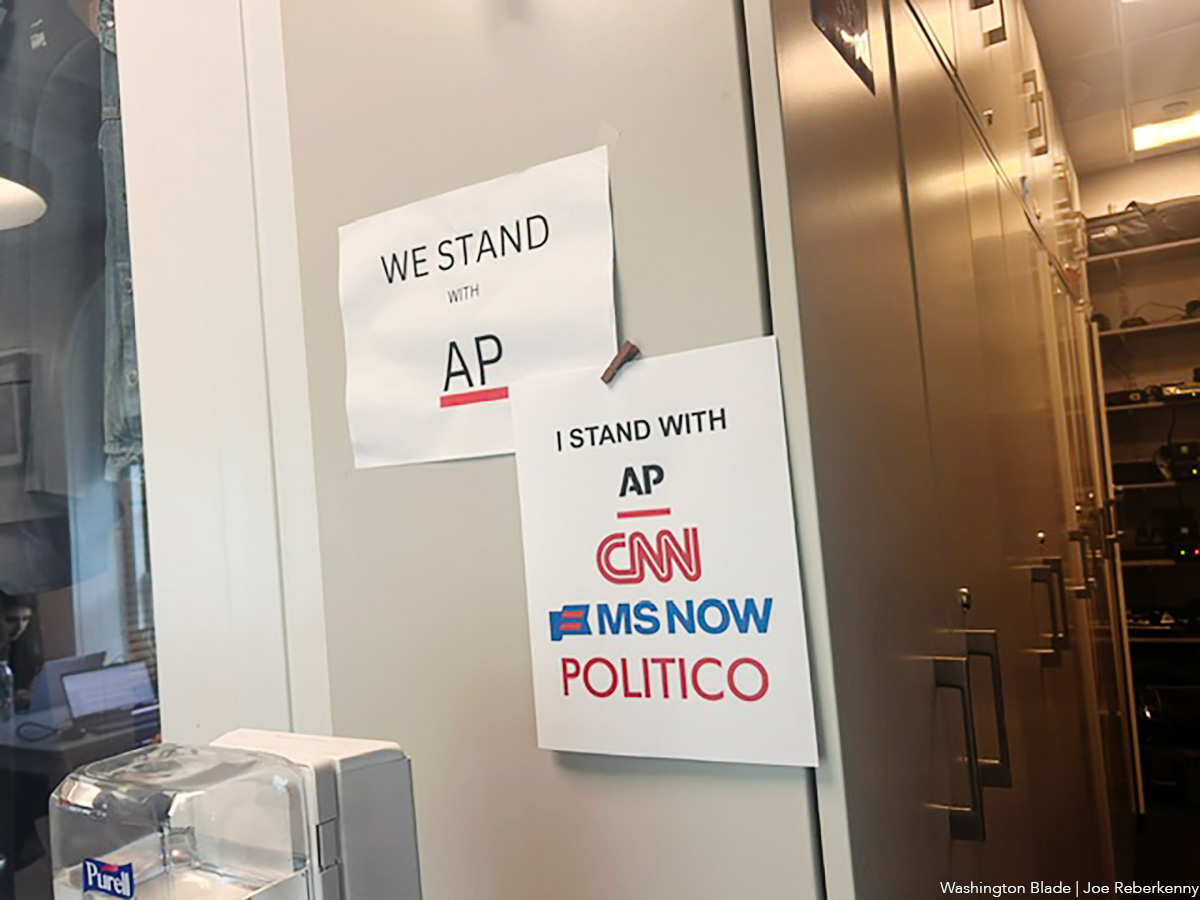
There were small signs of solidarity from other outlets in the press office. A sign that has hung outside one of the news offices in the West Wing was updated. It originally read, “WE STAND WITH AP” following President Trump’s first attempt at removing a news outlet he deemed unfavorable. It now includes “I STAND WITH AP CNN MSNOW POLITICO.”
The change could also be felt as the press pool attempted to cover the president.
There was a ribbon cutting in honor of the $6 million helipad installed at Trump’s behest — which had nearly no audio as a result of fewer microphones in the space following the outlets’ removal on Monday afternoon, and partly because of the loud sound of Marine One.
Vice President JD Vance defended Trump when asked about the changes to TV access at the White House, standing with the president despite this likely being a violation of the First Amendment’s guarantee of a free and fair press.
“He’s not banning media outlets. What he’s doing is saying we’re not going to give you special access to the White House if you engage in what is effectively propaganda,” Vance said, alleging that 92% of the stories from CNN, MS NOW and Politico about Trump are “negative.”
“That’s not representative of the American people. It’s not representative of public opinion,” Vance said.
He pushed back on the notion that this is a hindrance on free speech — claiming access to the president through White House visitation is a privilege — a privilege that in this administration, at least until courts weigh in, could change the landscape of the American media system.
“It’s about basic fairness. They can still report. They still have the access to free speech. They’re just not going to get an office in the White House anymore,” Vance said.
Jacqui Heinrich, the White House Correspondents Association President condemned the president’s actions in restricting media access in a statement sent to WHCA members on Saturday.
“Today’s action revoking access for journalists from CNN, POLITICO, and MSNOW violates the First Amendment. The implications extend beyond these organizations: a standard used to exclude one news outlet because of its coverage could be applied to any outlet in the future.
“The American people, through a free and independent press, must be able to scrutinize those elected to power, regardless of whether government officials view it favorably. That’s why courts have repeatedly held that once the White House provides access to journalists, it cannot deny that access arbitrarily or based on the content of their reporting. The WHCA calls on the administration to immediately restore our colleagues’ access.”
Congress
Jeremy Moss looks to bring LGBTQ advocacy from Lansing to Capitol Hill
Congressional candidate would represent Detroit suburbs if elected
With fall comes swapping out T-shirts for sweaters, raking leaves and, of course, elections. The summer’s primaries have narrowed the playing field in a slew of races, but the big ones — the actual races for seats in federal and local elections — are still to come.
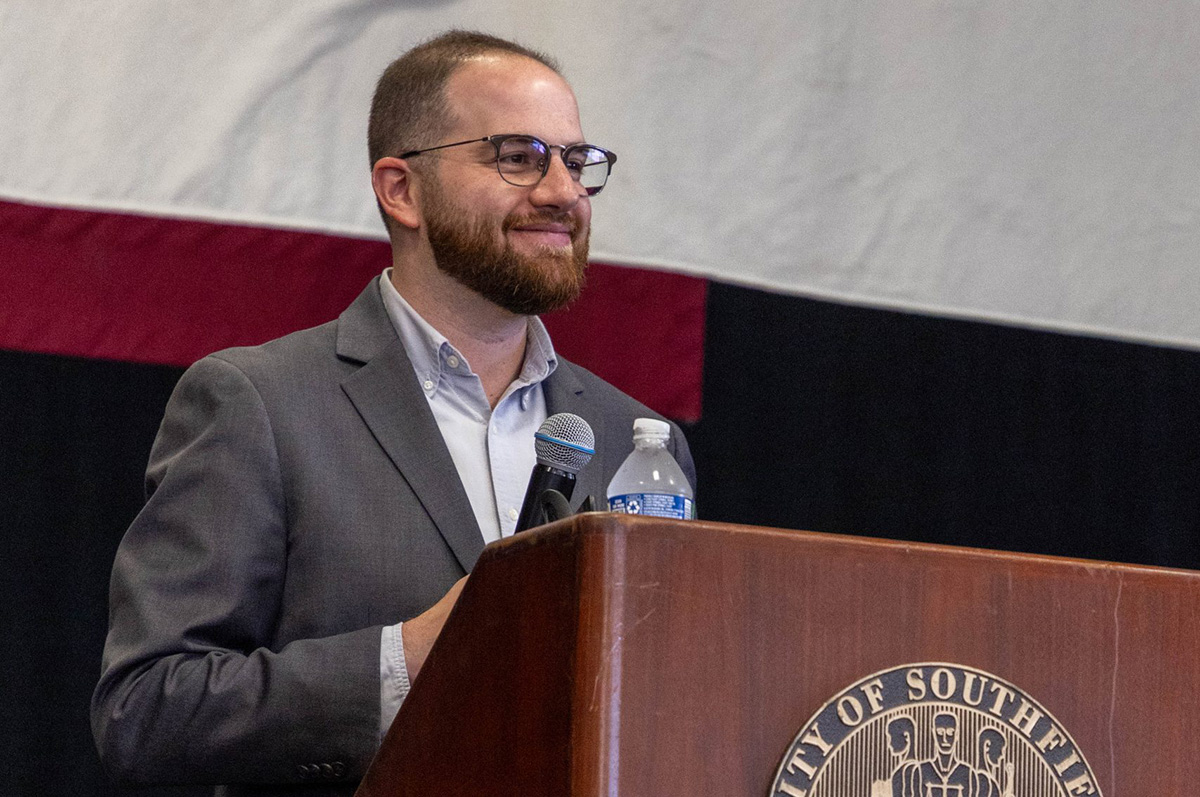
Jeremy Moss is one of those people running for a congressional seat in Michigan. Despite his young age, Moss has quickly learned the ropes of politics in the state, already serving terms in the Great Lakes State’s House of Representatives and Senate.
Moss sat down with the Washington Blade to discuss his history in Michigan politics, his experience as an openly LGBTQ legislator and his vision for a better America as he looks toward Congress.
He currently represents Michigan’s 7th Senate District, but now he is setting his sights beyond Lansing toward Capitol Hill to represent Michigan’s 11th Congressional District, which includes Detroit’s northern suburbs.
Moss earned his bachelor’s degree in journalism from Michigan State University, where just a few years later he made history as the first openly gay person elected to the Michigan Senate and the first to serve as its president pro tempore.
His political experience stretches across multiple offices.
Moss worked in the offices of Southfield Mayor Brenda Lawrence, who also served in the U.S. House of Representatives, and State Rep. Paul Condino.
Moss, at age 25, was elected to the Southfield City Council in 2011, becoming the youngest member elected in the body’s history. He then switched over to the state legislature, representing Michigan’s 35th House of Representatives District in the Michigan House of Representatives from 2014-2018, becoming the second openly gay member elected to the Michigan legislature.
He then moved from Michigan’s House to its Senate in 2018, elected to represent the 11th Michigan Senate District and becoming the Assistant Democratic Leader. Moss started his second term in the Michigan Senate in 2023, this time representing District 7.
He currently has a long list of priorities listed on his campaign website, many of which have become standard for Democrats running across the country, with a particular focus on minimizing — and cleaning up — issues that the Republican-controlled federal government has created under President Donald Trump.
Those goals include lowering healthcare costs, tackling the cost of living crisis, holding U.S. Immigration and Customs Enforcement accountable and fixing the broken immigration system, restoring national voting rights, protecting rights — with a particular focus on abortion access and LGBTQ rights — combating corruption in politics, preventing gun violence and strengthening gun safety, empowering Michigan workers, and preserving the environment.
Why Moss is running for Congress
When asked why he wants to run for Congress, Moss pointed to his lengthy resume in state leadership, with a clear voice arguing that if he can do it in Lansing, he can get it done in Washington.
“I’ve served 12 years in the legislature and have ascended into leadership as president pro tem of the Senate,” Moss explained to the Blade. “We flipped our state legislative chamber to a Democratic majority for the first time in 40 years in 2022, and we passed some big, generational-changing, consequential Democratic wins that had languished for a generation, but had improved people’s lives in our state.
“We’ve passed the first gun safety laws in a generation that are saving lives. We protected the right to vote amidst attacks from Donald Trump and other conspiracies. We pushed forward and finally put LGBTQ rights in our state civil rights law. We provided free school meals and lunches for all public school children in the state of Michigan.
“The problems from Washington, D.C., aren’t getting less severe over time,” he continued. “They’re getting more severe. So this district unexpectedly opened up due to a series of retirements and it was just a great opportunity for me to continue to advocate for big change that we’ve already achieved here in the state legislature.”
“I’m a product of this district. I grew up here. I’ve represented a bulk of the district already in the state legislature, and I knew that I was going to earn grassroots support to be able to wage this campaign. We sought it out, we earned it, including some premier endorsements from Gov. (Gretchen) Whitmer, among many others, and were highly successful in the primary because we were in tune to the needs of this district.”
Moss has been endorsed by a slew of Democratic leaders and organizations, including, as he pointed out, by Whitmer.
Other endorsements include former Gov. Jim Blanchard, Secretary of State Jocelyn Benson, Attorney General Dana Nessel, the Equality PAC, the Human Rights Campaign, the Unity Fund, and the LGBTQ+ Victory Fund.
His political identity and the Democratic Party
Moss described himself as being “on the liberal end of the spectrum,” but argued that the Democratic Party’s internal divisions should not be the central focus.
“I’m certainly on the liberal end of the spectrum, but I don’t even think it necessarily has to be this progressive versus establishment fight that we’ve seen play out,” Moss said when asked about various elements of in-party disagreements. “It has to be between action and, and inaction, fighters versus folders.”
He said that distinction between action and inaction is central to how he would approach Washington.
“At this moment, I think we need to demonstrate that we are ready to take on Donald Trump and MAGA chaos with boldness and effectiveness. I’ve been saying all along our campaign trail, we can no longer be the party that shows up to the knife fight carrying a pie chart, and so I think we have to be showing that we have spine and we have punch, and we’re really ready to be tough fighters for, for Michiganders and the American people.”
“We can’t walk on eggshells anymore. We can’t pull our punches,” he added. “We can’t fear that we’re offending someone, you know, one way or another with how we act. People are expecting a bold party to take on MAGA, and I think that’s exactly what the Democratic Party needs.”
Becoming an LGBTQ legislator
Moss also reminisced with the Blade about his first run for elected office — at a time when Michigan had no openly LGBTQ members serving in the state legislature — and how that experience became deeply connected to his identity and his approach to LGBTQ politics.
In 2014, Michigan was in the pre-marriage equality era, and the state had no openly LGBTQ members serving in the legislature.
“12 years ago in 2014 — this was pre-marriage, the pre-marriage equality era — we had zero people from our community serving in the legislature, and still they were talking about us.
“The big topic then in Michigan was whether or not to expand our civil rights law to include LGBTQ protections, so that people from our community would no longer face discrimination in housing and employment. And they were talking about us regardless of whether or not we were at the table.”
Moss eventually helped lead the effort to expand Michigan’s civil rights protections to include LGBTQ people, a measure that passed with bipartisan support.
He said his experience as an openly gay lawmaker allowed him to make the case for LGBTQ protections in terms that extended beyond LGBTQ issues.
“One thing I definitely aligned with Gov. Whitmer at the time was making the case that discrimination was not only morally wrong, but it was bad for business,” he said. “By not having these protections for our LGBTQ neighbors and family members and friends and community members, we were actually holding back our economy. We were essentially allowing people to be kicked out of Michigan as consumers and workers, because of who they are and how they identified.”
That led to various efforts — including committee hearings and meetings with advocates, businesses and the public — that helped make Michigan what the Movement Advancement Project deems the 16th most LGBTQ-friendly state, solidly above other states due to its robust LGBTQ-related legislation.
“I wanted to meet everybody where they were, including those who may have not been involved with or engaged with the LGBTQ community as legislators, but understood that we couldn’t sustain the economic impact of discriminating against our community,” Moss said. “And as I’ve said all along, discrimination is bad for business. That’s something I think helped broaden the vote and earn some bipartisan support for it.”
Representation and LGBTQ youth
For Moss, the importance of LGBTQ representation also comes from his own experience growing up.
“I think about when I was younger, when I was 18 years old. It was in 2004, and, you know, there are certain things that really shaped me in that time … Michigan had a ballot proposal that passed to have the strictest language banning marriage equality in our state constitution. We didn’t even allow civil unions in that language in our constitution to exist, and there were scandal-plagued LGBTQ politicians.”
“It was the same year that Jim McGreevey was forced to resign as he came out,” he said. “So it really was a signal to me that, you know, you don’t have a future. Not just you don’t have a future in politics; you might not even have a future. Period, and it was pretty defining for me.”
Despite those fears, Moss continued to pursue public office.
“And you can’t be what you can’t see, and so to be able to break the barriers at the state level and at this congressional level, I think is a signal to anybody who is struggling with wondering where their place is?”
“I think that visibility is incredibly important, and it’s something that I needed when I was much younger, and it’s something that I’ve been honored to be able to provide for the, for the next generation of emerging leaders.”
His LGBTQ priorities in Congress
When asked what LGBTQ issues he would prioritize in Congress, Moss emphasized the importance of growing the number of LGBTQ lawmakers while also expanding federal nondiscrimination protections.
“To have a caucus in the legislature has made all the difference because you can, you know, run these issues across the field. You can have somebody take on marriage. You can have somebody take on trans rights. You can have somebody take on LGBTQ youth. You can have somebody take on discrimination protections.”
He sees much of the work he wants to get done on Capitol Hill as a direct follow-up to his work in Lansing — most importantly, the passage of the Equality Act. The legislation has been debated in some form for more than 50 years at the federal level, with the goal of protecting LGBTQ people from discrimination under federal law.
“I think the Equality Act is incredibly important. That’s kind of the, the counterpart to what we’ve done in the state legislature, ensuring discrimination protections for the LGBTQ community,” he said.
“I think housing and, and workplace discrimination is, is everything, you know, to protect our community so that they can have a safe place to call home and earn a living … That’s incredibly important across the board. And I would really want to take a leading role in telling the story of how we were able to do it in Michigan after 50 years since this act was first written — and finally finished the job federally to ensure their federal protections in, in, in, in employment and housing.”
LGBTQ political organizations and Congress
Moss said the LGBTQ political organizations that have supported his political career from its early stages have helped him along the way.
“Obviously, I’ve been affiliated with Victory Fund since I first ran for office, and they were early endorsers, but Equality PAC, which is the political arm of the LGBTQ caucus in Congress, has been an incredible part of my support system. From day one they helped me out.
“I’ve been getting to know a lot of the members of Congress who are LGBTQ, really over the last year of this campaign. So I’m eager to join them. I’m eager to be one of the players on the field here to be able to advocate and advance our issues.”
Voting rights
Voting rights are another major focus for Moss, an issue he said dates back to his experience during the 2004 campaign over marriage equality.
“Something I’m very passionate about is voting rights, and it really does go back to that 2004 campaign where it was very evident that elections can determine your future.
“Elections can determine what rights you do have and don’t have, and so I’ve been very laser focused on increasing access to the ballot box, making sure our democracy remains whole and accessible.”
He explained how Trump’s recent attacks on voting legitimacy and mail-in voting have only made his desire to help that much stronger.
“We went through a real trial of that in 2020 with, with Michigan’s presidential election, with Donald Trump and Rudy Giuliani — as he jetted into Michigan and tried to overturn our valid and accurate election results. We were kind of the spotlight of the nation in that stop this deal movement that led to Jan. 6.”
That, according to Moss, spurred direct action on his end.
“I took the helm as chair of the Senate Elections Committee, and we wrote the law to implement pieces of that ballot proposal, including drafting the law that implemented nine days of early voting here in Michigan, increased access to absentee ballot. We further secured our canvassing and certifications so that nobody could jet in with an alternative slate of electors and send them to Congress on Jan. 6.”
“So I’ve been on the front lines in Michigan on defending our election systems and strengthening protections for both voters to access the ballot box and protections against those who want to overturn our election results.”
Those issues are still present today, he explained.
“He’s pushing for suppressive tactics like the Save Act. The Supreme Court has eroded the federal Voting Rights Act,” Moss said. “I want to really get into Congress as an election expert, we have a Michigan story to tell. I wrote a lot of that story, and, and I think the most urgent thing that we could pass is the John Lewis Voting Rights Act to make sure that there’s no pocket of discrimination anywhere in our country, and that people have the ability to exercise their constitutionally guaranteed right to vote.”
What he would do differently in Washington
Moss also shared that he believes Democrats should communicate differently in Washington, with an emphasis on getting things done.
“Yeah, again, we’ve, we’ve seen politics evolve in this Trump era, and I think that Democrats need to communicate differently.
“He talks so brazenly, and how proud he is that he’s renamed the Gulf of Mexico or Lake Ontario. I put that in the stupid category.
“He’s also done things in the harmful category that he boasts about, like cutting Medicaid and cutting SNAP. And of course, he’s doing things in the dangerous category, but proud of it, like trying to overturn our elections or suppressing the vote.
“What we’re doing is both popular and good for people, whether it’s growing our economy from the middle class outward, whether it’s lowering costs, whether it’s making healthcare more affordable, whether it’s strengthening the core functions of our democracy, we have to be talking about it with the same gusto and confidence that MAGA talks about their agenda.
“I think this is a party that needs more spine and more punch, and really meet this moment because I think that’s what people are looking for, and that’s really what I think a new generation will bring into this next Congress.”

Charles Bowers, former owner of Baltimore gay bar the Hippo, dies

Being a female firefighter comes with unique risks, and rewards

Writing a play about Lincoln leads down a rabbit hole to a closet

Trump-appointed judge restores White House TV pool access