The White House
White House ends protections for trans students in multiple school districts
Cape Henlopen School District in Delaware among administration’s targets

The Department of Education has terminated agreements with five school districts and a college aimed at protecting the rights of transgender students, backtracking requirements made in prior administrations, according to the Associated Press.
Allowing the reversal of these federal obligations removes formerly mandatory measures, including faculty training on responding to a student’s preferred name and pronouns, and policies allowing trans children to use bathrooms that align with their gender identity.
This policy change is a major shift from past democratic-led administrations, and will impact Delaware Valley School District in Pennsylvania, Sacramento City Unified School District in California, Cape Henlopen School District in Delaware, Fife School District in Washington, and La Mesa-Spring Valley School District, as well as Taft College in California.
Delaware Valley School District received notice from the Trump-Vance administration in February and has since voted to roll back anti-discrimination protections. Other schools, like Sacramento City Unified School District, said the change in minimum protections a district must offer will not affect their policies because it “remains committed to the support of our LGBTQ+ students and staff.”
This is part of a wider wave of anti-trans actions taken by the Trump-Vance administration. This White House has penalized schools attempting to accommodate students’ gender identity, filed lawsuits in California and Minnesota over state policies allowing trans students to participate in interscholastic sports, and opened civil rights investigations into multiple schools and universities over their policies on trans students.
Kimberly Richey, the Department of Education’s Assistant Secretary for Civil Rights, said the action underscored the administration’s efforts to prevent trans students from participating in girls’ and women’s sports teams and accessing shared locker rooms.
“Today, the Trump administration is removing the unnecessary and unlawful burdens that prior administrations imposed on schools in its relentless pursuit of a radical transgender agenda,” she said in a written statement.
According to the AP, this is just one instance of the administration rescinding civil rights protections in education. Last year, the Department of Education terminated two agreements: one involving the removal of books from a school library in Georgia, and another addressing harsh discipline and unequal education opportunities for Native students in the Rapid City Area School District in South Dakota.
Shiwali Patel, the senior director of education justice at the National Women’s Law Center, issued a statement in response to the removal of protections for trans students, saying the rollback will negatively impact all students — not just trans ones.
“There is absolutely no basis for what the Department of Education is doing, and it is unimaginably cruel. Title IX exists to ensure that students are protected from discrimination and treated with dignity so that they can learn and thrive in our schools,” Patel said. “It’s what students, families, lawmakers, and advocates fought for when Title IX was passed decades ago. But the Trump administration’s Department of Education has spent its limited resources to strip Title IX of that very purpose.”
She continued, highlighting the issues that will arise from the agreement removals in schools.
“Real complaints of discrimination and sexual assault are going unanswered by the Department of Education while conservative lawmakers continue to escalate their attacks on a small minority of students,” the nationally recognized Title IX expert and advocacy leader for gender-based harassment added. “Parents, teachers, and students need the Department to focus on addressing real harms on campuses instead of rolling back policies that keep all students safe.”
The schools that had their agreements terminated vary, but stem from the same issue: treating trans students with the same protections from harassment as their cisgender peers.
In 2023, Taft College, a community college in California’s Central Valley, became one of the few schools to settle a case with the Department of Education’s Civil Rights Office after a student accused faculty of discrimination, including refusing to use the student’s preferred pronouns. The college agreed to faculty training on Title IX protections and revised its policies to clarify that refusing to use a person’s preferred name and pronoun can constitute harassment.
The now-canceled agreement with Sacramento City Unified School District stemmed from a 2022 complaint brought by a student after a teacher refused to use the student’s preferred pronouns and/or refused to allow the male-identifying student to work in a boys’ group for a class activity. The 2024 resolution agreement had mandated training for employees on civil rights law, sexual harassment, and how to handle formal complaints.
Under a settlement the Delaware Valley School District reached with the Obama-Biden administration, the district was required to permit students to use bathrooms aligned with their gender identity. In February, the Trump-Vance administration sent the district a letter rescinding the settlement and requiring the rollback of antidiscrimination protections for trans students. The school board voted in late March to change its policies accordingly.
This move is part of a broader pattern of anti-trans actions from the White House since Trump returned to office.
In addition to restricting protections in federally funded education spaces, the administration has attempted to end trans girls’ and women’s participation in sports competitions and has sued states that have not complied. It has also blocked trans and nonbinary people from choosing sex markers on passports and attempted to stop those under 19 from receiving gender-affirming medical care.



The White House
White House targets gender-affirming care funding, states fight back
Attorneys general from Md. and elsewhere are fighting directives
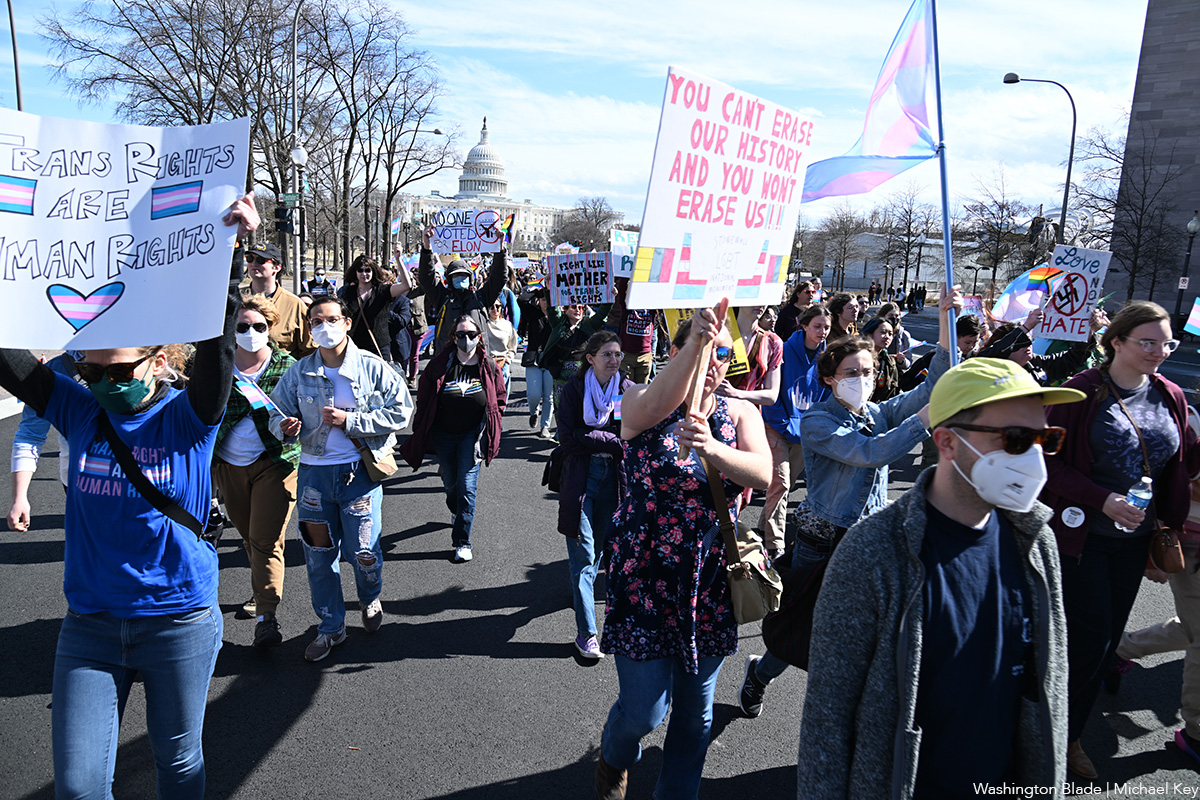
The Centers for Medicare and Medicaid Services announced last week that federal funding could no longer be used to pay for gender-affirming care through Medicaid or the Children’s Health Insurance Program.
The rule prohibits federal Medicaid dollars from covering puberty blockers, hormone therapy, and rare instances of surgery for enrollees under the age of 18 in the Medicaid program and under the age of 19 in CHIP. It does not prohibit coverage of counseling or psychotherapy as part of gender-affirming care.
The decision to restrict what healthcare is covered by federal dollars is part of a longer, more aggressive stance the Trump-Vance administration is taking toward LGBTQ healthcare.
Since taking the White House back for his second term, Trump has signed three executive orders that directly target transgender Americans. They include Executive Order 14168, “Defending Women From Gender Ideology Extremism and Restoring Biological Truth to the Federal Government” that requires the federal government to recognize only a person’s sex at birth, not their gender identity; Executive Order 14183, “Prioritizing Military Excellence and Readiness,” which attempts to remove transgender service members from the military and prevent them from enrolling; and an executive order that helped spur this change by restricting gender-affirming care.
The administration’s choice to villainize gender-affirming care, despite it being considered a best medical practice recommended by nearly every major medical group for gender dysphoria or gender incongruence, including the American Medical Association, American Academy of Pediatrics, and American Psychological Association, comes as KFF, a source for health policy research and polling data, estimates about 130,000 young trans people with Medicaid or CHIP coverage could be impacted by the policy.
“Today, we are ending federal taxpayer funding for sex-rejecting procedures on children,” U.S. Department of Health and Human Services Secretary Robert F. Kennedy, Jr., said last week when announcing the change. “These interventions carry serious risks and can cause irreversible harm. The federal government will no longer use Medicaid and CHIP dollars to fund procedures that fail to meet the evidentiary standard our children deserve.”
“Children deserve our protection, not experimental interventions that pose serious risks and convey no proven benefits,” said CMS Administrator Mehmet Oz. “By cutting off federal funds for these sex-rejecting procedures, we’re following the science, saving taxpayer dollars, and, most importantly, protecting children from potentially irreversible harm so they can truly flourish.”
The administration’s push is having a chilling effect on state healthcare legislation — more states now prohibit gender-affirming care than ever before. States with gender-affirming care restrictions jumped from four in 2023 to 27 states today.
The funding change has been met with fierce pushback from LGBTQ advocates, health experts, and government officials across the country before the rule goes into effect.
Some of the first actions against this policy began in July 2025.
Twenty-one states have attempted to restrict this effort in some fashion from going through as the White House intends. They include Arizona, California, Colorado, Connecticut, Delaware, Illinois, Maryland, Massachusetts, Maine, Michigan, Minnesota, Nevada, New Mexico, New Jersey, New York, Oregon, Rhode Island, Vermont, Washington, and Wisconsin, as well as Pennsylvania Gov. Josh Shapiro on behalf of his state.
The coalition of attorneys general filed lawsuits challenging nine separate provisions of the final rule, arguing that they would make it harder for consumers to get coverage through the ACA, increase costs for states, and weaken key ACA protections.
The U.S. District Court for the District of Massachusetts on Aug. 15 struck down a key provision of a Trump-Vance administration final rule that would have excluded coverage of certain types of gender-affirming care as essential health benefits under the Affordable Care Act. Essential health benefits are subject to the ACA’s financial protections, including limits on out-of-pocket costs.
“Everyone deserves access to health coverage,” said California Attorney General Rob Bonta. “The Trump administration tried to exclude gender-affirming care from qualifying as an essential health benefit. We fought back, and the court’s ruling means this care can — and in many states must — qualify for the ACA’s financial protections, ensuring transgender people have an equal opportunity to benefit from the ACA.”
“The Trump administration tried to make essential care unaffordable for transgender Marylanders by stripping it out of the ACA’s cost protections,” said Maryland Attorney General Anthony Brown. “We fought to keep that care covered, and we won. My Office will always defend Marylanders’ right to the care they need.”
The final rule at issue — the “Marketplace Integrity and Affordability” rule — was proposed by the Trump-Vance administration in March 2025, purportedly to “curb ACA enrollment fraud” and reduce federal spending on subsidies that help consumers afford ACA coverage. Among other changes, the rule would have removed certain types of gender-affirming care from the ACA’s 10 essential health benefit categories.
“This president would rather target young people than lower costs or expand access to health care. It is reprehensible that our federal government is intent on hurting and isolating the adolescents it is supposed to protect. I will use every tool at my disposal to fight this proposal and protect transgender Americans and their families,” said New York Attorney General Letitia James in December after the policy was announced.
In addition to state government resistance to the change, multiple LGBTQ advocates have committed to protecting the right to healthcare for LGBTQ children.
Rocky Mountain Equality CEO Mardi Moore affirmed those in Colorado would continue to help people most at risk if the change goes through.
“First, to the families impacted by this news: you will not be cut off immediately. The rule takes effect Oct. 13, 2026, and providers can continue to bill Medicaid and CHIP for youth already receiving gender-affirming care for up to six months after that. Rocky Mountain Equality is here, and we can help you understand your options to continue your child’s care.
“This is discrimination dressed up as rule-making. Government healthcare policy should expand what people can access, not strip away care that families and doctors have already determined is medically necessary,” Moore added. “We’ve seen this pattern before with other kinds of essential care, and it rarely stops with just one restriction. Any effort to ban or limit care opens the door for more restrictions on more kinds of care.”
The Human Rights Campaign, the largest LGBTQ lobbying group in the U.S., issued multiple statements following the announcement, and has filed a similar lawsuit against the federal government for prohibiting gender-affirming care to federal employees using federal health plans.
HRC President Kelley Robinson said taking a hard stance against what the administration is presenting as a win for the American people that will ultimately restrict healthcare options for thousands of Americans.
“Every young person is entitled to the health care that they, their parents, and their medical providers agree that they need, without politicians interfering with these important and highly personal decisions. And yet, rather than working to make healthcare more affordable and accessible, the Trump administration continues to obsess over the healthcare needs of trans youth, this time by cutting off health insurance coverage for those who rely on Medicaid and CHIP to access that care,” Robinson said. “The Trump administration is terrorizing trans youth and their families with these kinds of actions, and it has to stop.”
The White House
HRC files class action over federal ban on gender-affirming care coverage
Lawsuit filed Monday challenges White House effort to restrict care

The Human Rights Campaign Foundation, the nonprofit sister organization to the largest LGBTQ human rights lobbying and advocacy organization in the U.S., along with law firms Correia & Puth and Cohen Milstein Sellers & Toll, filed a class action lawsuit against the government as it attempts to restrict gender-affirming healthcare for federal employees.
The suit, filed on Monday, alleges that the Office of Personnel Management, run by Trump appointee Scott Kupor, is discriminating against LGBTQ federal employees (and their families and retired employees) by prohibiting health insurance coverage for gender-affirming care under the Federal Employees Health Benefits and Postal Service Health Benefits plans. There are five plaintiffs named in the complaint, but it extends to others who have those healthcare plans.
The document asserts that OPM’s prohibition on coverage for “gender transition” care in the FEHB and PSHB programs violates Title VII, the federal law that prohibits discrimination based on sex, race, color, religion, or national origin.
The policy, which was implemented on Jan. 1 following the 2025 issuing of Program Carrier Letter, mandated that insurance providers in these programs deny any coverage for gender-affirming care. In February, HRC filed a federal complaint with OPM over the change in healthcare policy, which was ultimately passed to the Equal Employment Opportunity Commission for review. That complaint is now an officially filed class action lawsuit in the U.S. District Court for the District of Columbia.
Research from the Williams Institute at UCLA Law, a think tank that collects data and conducts research on issues related to sexual orientation and gender identity, indicates that this policy denying gender-affirming care will impact healthcare access for at least 39,400 current and former federal employees and their dependents.
Human Rights Campaign President Kelley Robinson released a statement following the lawsuit’s filing.
“Our message to the Trump administration is simple: we’ll see you in court,” said Robinson. “Healthcare access should never be weaponized to advance discrimination — and the denial of coverage for critical healthcare based simply on who you are blatantly violates the rights of all of us.”
Gender-affirming care has been under constant attack by the Trump-Vance administration since its return to the White House, despite the practice being considered as extensively evidence-based but also supported by nearly every major medical organization. This type of care is provided to all people—not just transgender people—and includes things such as social affirmation, including using correct names and pronouns and wearing clothing that matches a person’s gender identity; mental health support, such as counseling to reduce depression and anxiety; and, in some cases, medical interventions such as reversible puberty blockers or hormone therapy when deemed medically appropriate.
“Federal employees have been through the wringer with the Trump administration,” said Cathy Harris, partner at Correia & Puth. “We draw the line at blatant discrimination to deny healthcare to our nation’s dedicated civil servants.”
“This odious policy is the latest example of the Trump administration’s obsession with targeting transgender people, using shameful and cruel tactics to threaten their employment, their health, and the well-being of themselves and their families,” Robinson added. “OPM’s actions will not go unchallenged, and we’ll continue to fight so that federal employees and their families receive the dignity they deserve.”
This is not the first time the White House has directly attacked gender-affirming care.
In January 2025, the administration issued Executive Order 14187, titled “Protecting Children from Chemical and Surgical Mutilation.” The order directs federal agencies to restrict gender-affirming medical care — including puberty blockers, hormone therapy, and surgeries — for individuals under the age of 19.
For more information on how to get involved with the lawsuit, visit hrc.org.
The White House
White House counterterrorism strategy targets ‘anti-American, radically pro-transgender’ groups
Administration released document last week

The White House released the “United States Counterterrorism Strategy” last week, introducing enforcement priorities that include references to people with “extreme transgender ideologies.”
The document is the first executive branch counterterrorism strategy released since former President Joe Biden’s 2021 “National Strategy for Countering Domestic Terrorism,” which largely focused on threats tied to domestic extremism and the Jan. 6 Capitol attack. The Trump-Vance administration’s new strategy instead centers heavily on cartels, Islamist organizations, and what it describes as “violent left-wing extremists.”
The report identifies three primary categories of terror threats facing the U.S.: “Narcoterrorists and Transnational Gangs,” “Legacy Islamist Terrorists,” and “Violent Left-Wing Extremists, including Anarchists and Anti-Fascists.” The strategy repeatedly frames those groups as existential threats to the U.S. and outlines a more aggressive, militarized counterterrorism posture.
The introduction to the report closes with a warning from President Donald Trump referencing counterterrorism operations carried out during his second administration: “We will find you and we will kill you.”
In the section outlining the administration’s counterterrorism priorities, the document argues that federal intelligence, and law enforcement agencies under prior administrations focused on the wrong threats while overlooking violence committed by left-wing extremists. The strategy specifically references transgender ideology while discussing political violence.
“As real threats were ignored or underplayed, Americans have witnessed the politically motivated killings of Christians and conservatives committed by violent left-wing extremists, including the assassination of Charlie Kirk by a radical who espoused extreme transgender ideologies.”
Claims tying a trans person to Kirk’s killing have been disputed, however, and multiple news outlets later retracted or corrected early reports that identified the shooter as trans.
The report later expands on that argument, saying the administration will prioritize targeting “violent secular political groups” it describes as anti-American and “radically pro-transgender.”
“In addition to cartels and Islamist terror groups, our national CT activities will also prioritize the rapid identification and neutralization of violent secular political groups whose ideology is anti-American, radically pro-transgender, and anarchist.”
The rhetoric mirrors claims frequently made by Trump allies and conservative commentators linking trans people and left-wing activism to political violence. However, data compiled by researchers and organizations tracking mass shootings does not support the idea that trans people are responsible for a significant share of such attacks.
Factcheck.org says rhetoric from Trump and several far-right political pundits contradicts available data, noting that the percentage of mass shootings committed by trans people is “exceedingly small.”
Despite the lack of evidence supporting generalized claims about trans people, the president’s son Donald Trump, Jr., told Fox News in September 2025 that he could not “name a mass shooting in the last year or two in America that wasn’t committed by, you know, a transgender lunatic.”
Factcheck.org also found that even if cases involving shooters with unclear gender identities were included in statistics about trans mass shooters, the number would still account for only a fraction of a percent.
Mark Bryant, founding executive director of the Gun Violence Archive, said the number of trans mass shooters could be as high as eight, but would still account for less than 0.1 percent of mass shootings over the last 12 years, according to GVA data. He added that the figure would remain below 0.2 percent even when examining incidents from 2018 to the present.
Beyond domestic extremism, the strategy frames the administration’s broader counterterrorism agenda through the lens of “America First” foreign policy and renewed U.S. dominance in the Western Hemisphere. The report repeatedly references the Monroe Doctrine, the nearly 200-year-old policy warning European powers against interference in the Americas.
“After years of neglect, the United States will reassert and enforce the Monroe Doctrine to restore American preeminence in the Western Hemisphere, and to protect our homeland” Trump said in the report.
The document also breaks down counterterrorism priorities by region, including the Middle East, where it argues the U.S. is “no longer as dependent” on the region because of increased domestic energy production.
“Our growing domestic energy production means the Middle East is no longer as central to America’s stability, yet threats from this region remain, and our counterterrorism goals continue to be specific and rooted in realistic threat analysis.”
The statement comes amid rising gas prices tied in part to instability surrounding the war involving Iran, with fuel costs reaching some of their highest levels since 2022. According to AAA, the national average price for gasoline climbed to $4.52 per gallon as the national average rose “$.25 for a second straight week.“

NYC lawmakers seek to repeal bathhouse ban

Black Educated Lesbians: A movement rooted in community

Hegseth uses transphobic slur while campaigning for Iowa congressman

What ‘Queer Eye for the Straight Guy’ can still teach us

I respect AOC, even though I often disagree with her

‘Maddie’s Secret’ defies campy expectations

PHOTOS: Nellie’s Drag Brunch

Remembering Barbara ‘Boo’ Price, a pioneering force in women’s music

White House targets gender-affirming care funding, states fight back