
National
HRC affirms 'Don't Ask' repeal for 2010
The Human Rights Campaign is affirming its commitment to repealing “Don’t Ask, Don’t Tell” this year as part of its legislative agenda in Congress.
HRC President Joe Solmonese outlined during a Feb. 27 fundraising dinner speech in Raleigh, N.C., expectations for the passage of pro-LGBT federal legislation in Congress, including the repeal of the 1993 barring open service in the U.S. military.
In a DC Agenda interview following the event, David Smith, HRC’s vice president of programs, elaborated on the remarks that Solmonese gave during the dinner.
Smith restated HRC’s commitment to seeing this year the enactment of domestic partner benefits for federal workers, domestic partner tax relief and the Early Treatment for HIV Act, as well as repeal of “Don’t Ask, Don’t Tell.” He also cautioned against reading too much into the Solmonese’s remarks and said HRC is working on other tasks beyond what Solmonese mentioned.
DC Agenda: Joe said during the dinner that “Don’t Ask, Don’t Tell” would be brought to an end this year. What is your plan for making that happen?
David Smith: Well, Chris, we’ve been talking about that for months, and there’s been a lot of public dialogue on a path to repeal “Don’t Ask, Don’t Tell.” There are obviously a number of options on the table. Somebody just reminded me you have our campaign, so you are well aware of how we hope to move forward on that. (Editor’s note: See “Questions surround Lieberman’s ‘Don’t Ask’ repeal bill”)
Agenda: But what leads you to believe you can accomplish “Don’t Ask, Don’t Tell” repeal this year?
Smith: We’ve been saying that for months — that this is year for it to be repealed and we’re mobilizing our campaign to accomplish just that.
Agenda: What has the White House been saying on this issue? Does the White House want repeal this year or does it want to wait until the Pentagon review is finished?
Smith: The White House has publicly said that they’re following this process that was set up with [Defense Secretary Robert] Gates and [Chairman of Joint of Chiefs of Staff Adm. Michael] Mullen — and that’s precisely what they’re doing is — following the process that was outlined at the Senate Armed Services Committee however many weeks ago that was now.
Agenda: What will happen if repeal doesn’t happen this year?
Smith: We fully expect repeal to happen this year. That’s what we’re working towards.
Agenda: What about two items Joe mentioned that were in the House version of the health care reform: the domestic partner tax penalty elimination and the Early Treatment for HIV Act? They’re not in the president’s proposed legislation. Do you plan to have those provisions moving forward as part of the health care package?
Smith: As far as I understand, the plan right now is that he put forward some broad outlines in terms of how the Senate bill can reconcile with the House bill. And every particular wasn’t included in those policy proposals, so it is still our hope that DP tax and ETHA will be included in whatever fix is — whatever they come up with to reconcile those two bills.
Agenda: How do you see the process going to move forward with health care reform?
Smith: Well, Chris, every reporter in this city, whether they work for DC Agenda or the New York Times is trying to figure out exactly how the process is going to work. They are still figuring it out, or if not still figuring it out, they’re not being open about how it moves forward.
I’ve read many different things, and they certainly are not talking to a whole bunch of people about it. But one version is the House passes the Senate bill, and the Senate introduces a reconciliation bill that fixes the Senate in accordance to what the House wants. There’s many different ways that this could all shake out. But it is still our hope that DP tax relief and ETHA will be included in whatever final resolution there is.
Agenda: And you’re expecting that to happen this year?
Smith: Yes.
Agenda: What about the Domestic Partnership Benefits & Obligations Act? What do you see as the path for that legislation now?
Smith: Well, as you well know, it’s been passed out of both committees in both the House and Senate in various committees of jurisdiction. It is probably our most ripest piece of legislation in terms of how many times it has had a hearing and markup, so again it is our ripest piece of legislation and indications are that it will happen this year.
Agenda: And you’re expecting it to happen this year?
Smith: Yes.
Agenda: I know there was an issue with how Sen. Joseph Lieberman wanted the U.S. Office of Personnel Management to provide information it would offset the costs of that legislation within the existing budget. Do you know if that issue has yet been resolved?
Smith: I don’t believe it has, but I still think they are definitely looking for an offset and we have every reason to believe that they’re going to find it.
Agenda: Do you have any expectations for a timeline on when we can see floor votes on this legislation in either the House or the Senate?
Smith: No. I mean, I think the rest of the [congressional] calendar is completely up in the air this year.
Agenda: Joe mentioned four things that were part of the calender this year. Why wasn’t [the Employment Non-Discrimination Act] included among these four?
Smith: Joe spoke about ENDA in those remarks. It was one speech in one part of the country. It’s not going to be — one speech is not reflective of what we’re working on.
Clearly, there’s a very good possibility there could be movement on ENDA in the House. As you reported, there are issues with the Senate. We’re all, as a coalition, [we] are continuing to work through those issues. And you come to work every day trying to pass legislation, and ENDA is one of our top priorities. And each and every day we’re fighting for it, and you keep pressing until these things happen.
Agenda: But do you think there is as strong a possibility of passing ENDA as the other four things we just talked about?
Smith: Again, I think there are issues in the Senate, which I think are challenges, and we’re working through those challenges with our colleagues and our coalition.
Agenda: Another thing that wasn’t mentioned in Joe’s speech was the Uniting American Families Act. Do you think attaching as part of comprehensive immigration reform can lead to passage of UAFA this year?
Smith: We continue to press to get UAFA into the process. UAFA is one our priorities, and we continue to work on that as well.
Again, Chris, I want to stress, one speech is not going cover every single issue that we’re working on. You should be aware of that. So one speech does not an entire agenda make.
We’re continuing to work on repealing [the Defense of Marriage Act], UAFA, domestic partner benefits for federal employees. There’s a list of efforts that we’re working towards and each one is in various stages of the process.


Federal Government
Treasury Department has a gay secretary but LGBTQ staff are under siege
Agency reverses course on LGBTQ inclusion under out Secretary Scott Bessent

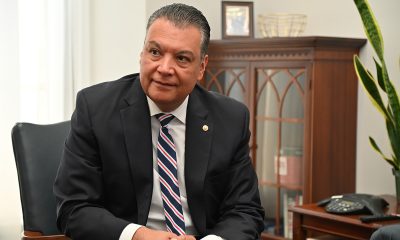
A former Treasury Department employee who led the agency’s LGBTQ employee resource group says the removal of sexual orientation and gender identity (SOGI) from its discrimination complaint forms was merely a formalization of existing policy shifts that had already taken hold following the second inauguration of President Donald Trump and his appointment of Scott Bessent — who is gay — to lead the agency.
Christen Boas Hayes, who served on the policy team at Treasury’s Financial Crimes Enforcement Network (FinCEN) from 2020 until March of this year, told the Washington Blade during a phone interview last week that the agency had already stopped processing internal Equal Employment Opportunity (EEO) complaints on the basis of anti-LGBTQ discrimination.
“So the way that the forms are changing is a procedural recognition of something that’s already happening,” said Hayes. “Internally, from speaking to two EEO staff members, the changes are already taking place from an EEO perspective on what kind of cases will be found to have the basis for a complaint.”
The move, they said, comes amid the deterioration of support structures for LGBTQ workers at the agency since the administration’s early rollout of anti-LGBTQ executive orders, which led to “a trickle down effect of how each agency implements those and on what timeline,” decisions “typically made by the assistant secretary of management’s office and then implemented by the appropriate offices.”
At the end of June, a group of U.S. House Democrats including several out LGBTQ members raised alarms after a Federal Register notice disclosed Treasury’s plans to revise its complaint procedures. Through the agency’s Office of Civil Rights and EEO, the agency would eliminate SOGI as protected categories on the forms used by employees to initiate claims of workplace discrimination.
But Hayes’s account reveals that the paperwork change followed months of internal practice, pursuant to a wave of layoffs targeting DEI personnel and a chilling effect on LGBTQ organizing, including through ERGs.
Hayes joined Treasury’s FinCEN in 2020 as the agency transitioned into the Biden-Harris administration, working primarily on cryptocurrency regulation and emerging technologies until they accepted a “deferred resignation” offer, which was extended to civil servants this year amid drastic staffing cuts.
“It was two things,” Hayes said. “One was the fact that the policy work that I was very excited about doing was going to change in nature significantly. The second part was that the environment for LGBTQ staff members was increasingly negative after the release of the executive orders,” especially for trans and nonbinary or gender diverse employees.
“At the same time,” Hayes added, “having been on the job for four years, I also knew this year was the year that I would leave Treasury. I was a good candidate for [deferred resignation], because I was already planning on leaving, but the pressures that emerged following the change in administration really pushed me to accelerate that timeline.”
Some ERGs die by formal edict, others by a thousand cuts
Hayes became involved with the Treasury LGBTQ ERG shortly after joining the agency in 2020, when they reached out to the group’s then-president — “who also recently took the deferred resignation.”
“She said that because of the pressure that ERGs had faced under the first Trump administration, the group was rebuilding, and I became the president of the group pretty quickly,” Hayes said. “Those pressures have increased in the second Trump administration.”
One of the previous ERG board members had left the agency after encountering what Hayes described as “explicitly transphobic” treatment from supervisors during his gender transition. “His supervisors denied him a promotion,” and, “importantly, he did not have faith in the EEO complaint process” to see the issues with discrimination resolved, Hayes said. “And so he decided to just leave, which was, of course, such a loss for Treasury and our Employee Resource Group and all of our employees at Treasury.”
The umbrella LGBTQ ERG that Hayes led included hundreds of members across the agency, they said, and was complemented by smaller ERGs at sub-agencies like the IRS and FinCEN — several of which, Hayes said, were explicitly told to cease operations under the new administration.
Hayes did not receive any formal directive to shutter Treasury’s ERG, but described an “implicit” messaging campaign meant to shut down the group’s activities without issuing anything in writing.
“The suggestion was to stop emailing about anything related to the employee resource group, to have meetings outside of work hours, to meet off of Treasury’s campus, and things like that,” they said. “So obviously that contributes to essentially not existing functionally. Because whereas we could have previously emailed our members comfortably to announce a happy hour or a training or something like that, now they have to text each other personally to gather, which essentially makes it a defunct group.”
Internal directories scrubbed, gender-neutral restrooms removed
Hayes said the dismantling of DEI staff began almost immediately after the executive orders. Employees whose position descriptions included the terms “diversity, equity, and inclusion” were “on the chopping block,” they said. “That may differ from more statutorily mandated positions in the OMWI office or the EEO office.”
With those staff gone, so went the infrastructure that enabled ERG programming and community-building. “The people that made our employee resource group events possible were DEI staff that were fired. And so, it created an immediate chilling effect on our employee resource group, and it also, of course, put fear into a lot of our members’ hearts over whether or not we would be able to continue gathering as a community or supporting employees in a more practical way going forward. And it was just, really — it was really sad.”
Hayes described efforts to erase the ERGs from internal communication channels and databases. “They also took our information off internal websites so nobody could find us as lawyers went through the agency’s internal systems to scrub DEI language and programs,” they said.
Within a week, Hayes said, the administration had removed gender-neutral restrooms from Main Treasury, removed third-gender markers from internal databases and forms, and made it more difficult for employees with nonbinary IDs to access government buildings.
“[They] made it challenging for people with X gender markers on identification documents to access Treasury or the White House by not recognizing their gender marker on the TWAVES and WAVES forms.”
LGBTQ staff lack support and work amid a climate of isolation
The changes have left many LGBTQ staff feeling vulnerable — not only because of diminished workplace inclusion, but due to concerns about job security amid the administration’s reductions in force (RIFs).
“Plenty of people are feeling very stressed, not only about retaining their jobs because of the layoffs and pending questions around RIFs, but then also wondering if they will be included in RIF lists because they’re being penalized somehow for being out at work,” Hayes said. “People wonder if their name will be given, not because they’re in a tranche of billets being laid off, but because of their gender identity or sexual orientation.”
In the absence of functional ERGs, Hayes said, LGBTQ employees have been cut off from even informal networks of support.
“Employees [are] feeling like it’s harder to find members of their own community because there’s no email anymore to ask when the next event is or to ask about navigating healthcare or other questions,” they said. “If there is no ERG to go to to ask for support for their specific issue, that contributes to isolation, which contributes to a worse work environment.”
Hayes said they had not interacted directly with Secretary Bessent, but they and others observed a shift from the previous administration. “It is stark to see that our first ‘out’ secretary did not host a Pride event this year,” they said. “For the last three years we’ve flown the rainbow Pride flag above Treasury during Pride. And it was such a celebration among staff and Secretary Yellen and the executive secretary’s office were super supportive.”
“Employees notice changes like that,” they added. “Things like the fact that the Secretary’s official bio says ‘spouse’ instead of ‘husband.’ It makes employees wonder if they too should be fearful of being their full selves at work.”
The Blade contacted the Treasury Department with a request for comment outlining Hayes’s allegations, including the removal of inclusive infrastructure, the discouragement of ERG activity, the pre-formalization of EEO policy changes, and the targeting of DEI personnel. As of publication, the agency has not responded.
U.S. Supreme Court
Supreme Court to consider bans on trans athletes in school sports
27 states have passed laws limiting participation in athletics programs
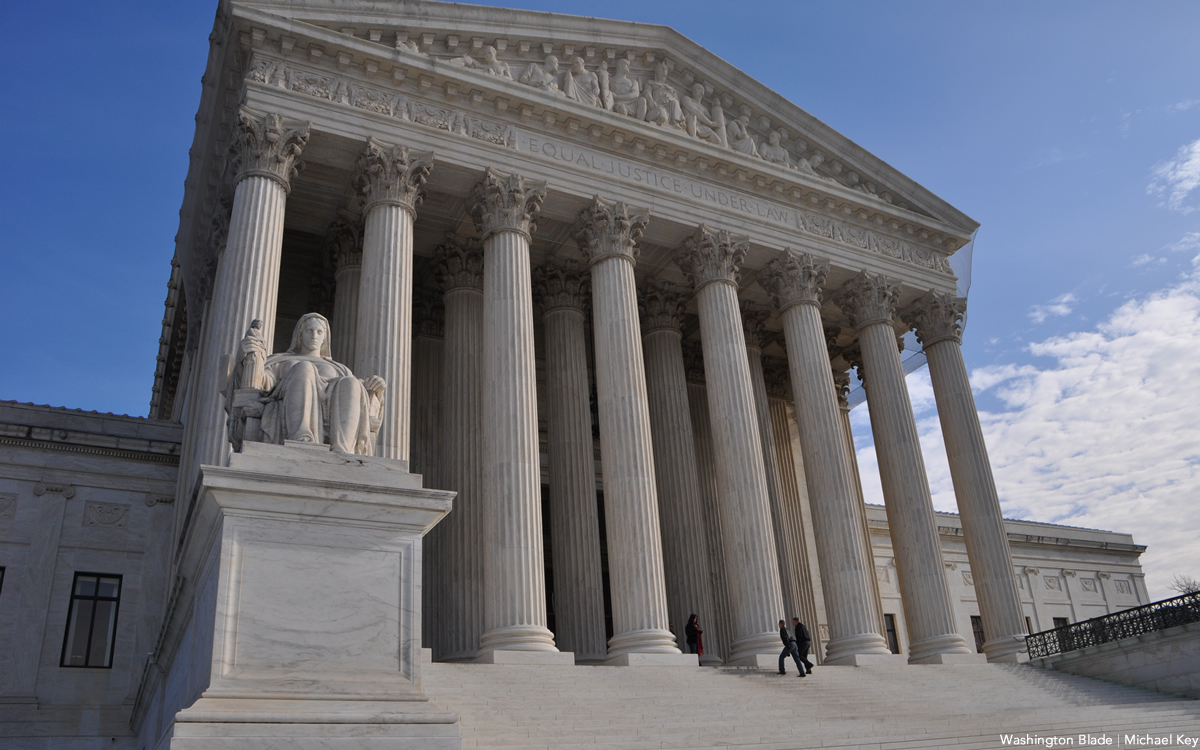
The U.S. Supreme Court on Thursday agreed to hear two cases involving transgender youth challenging bans prohibiting them from participating in school sports.
In Little v. Hecox, plaintiffs represented by the ACLU, Legal Voice, and the law firm Cooley are challenging Idaho’s 2020 ban, which requires sex testing to adjudicate questions of an athlete’s eligibility.
The 9th U.S. Circuit Court of Appeals described the process in a 2023 decision halting the policy’s enforcement pending an outcome in the litigation. The “sex dispute verification process, whereby any individual can ‘dispute’ the sex of any female student athlete in the state of Idaho,” the court wrote, would “require her to undergo intrusive medical procedures to verify her sex, including gynecological exams.”
In West Virginia v. B.P.J., Lambda Legal, the ACLU, the ACLU of West Virginia, and Cooley are representing a trans middle school student challenging the Mountain State’s 2021 ban on trans athletes.
The plaintiff was participating in cross country when the law was passed, taking puberty blockers that would have significantly reduced the chances that she could have a physiological advantage over cisgender peers.
“Like any other educational program, school athletic programs should be accessible for everyone regardless of their sex or transgender status,” said Joshua Block, senior counsel for the ACLU’s LGBTQ and HIV Project. “Trans kids play sports for the same reasons their peers do — to learn perseverance, dedication, teamwork, and to simply have fun with their friends,” Block said.
He added, “Categorically excluding kids from school sports just because they are transgender will only make our schools less safe and more hurtful places for all youth. We believe the lower courts were right to block these discriminatory laws, and we will continue to defend the freedom of all kids to play.”
“Our client just wants to play sports with her friends and peers,” said Lambda Legal Senior Counsel Tara Borelli. “Everyone understands the value of participating in team athletics, for fitness, leadership, socialization, and myriad other benefits.”
Borelli continued, “The U.S. Court of Appeals for the Fourth Circuit last April issued a thoughtful and thorough ruling allowing B.P.J. to continue participating in track events. That well-reasoned decision should stand the test of time, and we stand ready to defend it.”
Shortly after taking control of both legislative chambers, Republican members of Congress tried — unsuccessfully — to pass a national ban like those now enforced in 27 states since 2020.
Federal Government
UPenn erases Lia Thomas’s records as part of settlement with White House
University agreed to ban trans women from women’s sports teams

In a settlement with the Trump-Vance administration announced on Tuesday, the University of Pennsylvania will ban transgender athletes from competing and erase swimming records set by transgender former student Lia Thomas.
The U.S. Department of Education’s Office for Civil Rights found the university in violation of Title IX, the federal rights law barring sex based discrimination in educational institutions, by “permitting males to compete in women’s intercollegiate athletics and to occupy women-only intimate facilities.”
The statement issued by University of Pennsylvania President J. Larry Jameson highlighted how the law’s interpretation was changed substantially under President Donald Trump’s second term.
“The Department of Education OCR investigated the participation of one transgender athlete on the women’s swimming team three years ago, during the 2021-2022 swim season,” he wrote. “At that time, Penn was in compliance with NCAA eligibility rules and Title IX as then interpreted.”
Jameson continued, “Penn has always followed — and continues to follow — Title IX and the applicable policy of the NCAA regarding transgender athletes. NCAA eligibility rules changed in February 2025 with Executive Orders 14168 and 14201 and Penn will continue to adhere to these new rules.”
Writing that “we acknowledge that some student-athletes were disadvantaged by these rules” in place while Thomas was allowed to compete, the university president added, “We recognize this and will apologize to those who experienced a competitive disadvantage or experienced anxiety because of the policies in effect at the time.”
“Today’s resolution agreement with UPenn is yet another example of the Trump effect in action,” Education Secretary Linda McMahon said in a statement. “Thanks to the leadership of President Trump, UPenn has agreed both to apologize for its past Title IX violations and to ensure that women’s sports are protected at the university for future generations of female athletes.”
Under former President Joe Biden, the department’s Office of Civil Rights sought to protect against anti-LGBTQ discrimination in education, bringing investigations and enforcement actions in cases where school officials might, for example, require trans students to use restrooms and facilities consistent with their birth sex or fail to respond to peer harassment over their gender identity.
Much of the legal reasoning behind the Biden-Harris administration’s positions extended from the 2020 U.S. Supreme Court case Bostock v. Clayton County, which found that sex-based discrimination includes that which is based on sexual orientation or gender identity under Title VII rules covering employment practices.
The Trump-Vance administration last week put the state of California on notice that its trans athlete policies were, or once were, in violation of Title IX, which comes amid the ongoing battle with Maine over the same issue.

Gay ANC member announces candidacy for Ward 1 D.C. Council seat

ICYMI: ‘Overcompensating’ a surprisingly sweet queer treat

Democrats need to stop the self-immolation

Spanish women detail abuses suffered in Franco-era institutions

PHOTOS: Independence Day Weekend in Rehoboth

Treasury Department has a gay secretary but LGBTQ staff are under siege

Defying trends, new LGBTQ center opens in rural Winchester, Va.

Gay GOP group hosts Ernst, 3 House members — all of whom oppose Equality Act

USAID’s demise: America’s global betrayal of trust with LGBTQ people

D.C. police seek public’s help in July 5 murder of trans woman
-
 Federal Government2 days ago
Treasury Department has a gay secretary but LGBTQ staff are under siege
-
 Virginia3 days ago
Defying trends, new LGBTQ center opens in rural Winchester, Va.
-
 District of Columbia2 days ago
Gay GOP group hosts Ernst, 3 House members — all of whom oppose Equality Act
-
 Opinions4 days ago
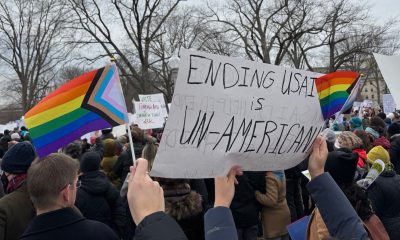
USAID’s demise: America’s global betrayal of trust with LGBTQ people