Health
YEAR IN REVIEW: ‘story of the year’ countdown
Gay suicides capture national attention along with elections and Prop 8

The story of the year was repeal of “Don’t Ask, Don’t Tell,” but there were many other big stories that kept us busy this year. Here are the rest of the top 10. Compiled by Blade staff writers Lou Chibbaro Jr. and Chris Johnson.
#2 Youth suicides lead to “It Gets Better” Campaign
A rash of suicides committed by gay youths throughout the country this year prompted the “It Gets Better” campaign in which prominent U.S. officials and LGBT leaders advise teens struggling with their sexual orientation that their lives will improve.
Four gay youths took their lives in September, reportedly after they had been bullied because of their sexual orientation. Among those who committed suicide was Tyler Clementi, an 18-year-old Rutgers University freshman who leaped off the George Washington Bridge connecting New York and New Jersey.
In response to the suicides, Dan Savage, a gay Seattle, Wash.-based activist, founded the “It Gets Better” project, an online video channel in which U.S. officials and LGBT leaders urge youth to look to a brighter future. President Obama was among the officials to appear in a video.
#3 Democrats get clobbered in midterms
Democrats this year sustained heavy losses in the mid-term elections and lost control of the U.S. House to Republicans, which will likely kill LGBT rights advances in Congress for at least two years.
Republicans claimed 63 seats in a result that will lead to the ascent of Rep. John Boehner (R-Ohio), who scored a “0” in the Human Rights Campaign’s most recent congressional scorecard, as House speaker. Democrats retained control of the U.S. Senate, but will have a reduced majority of 53 seats.
Still, the LGBT community enjoyed one bright spot in the election through the win of David Cicilline, a gay mayor of Providence, R.I., to the House. Upon the start of the 112th Congress in January, Cicilline will become the fourth sitting openly gay member of Congress.
#4 Proposition 8 court battle
California’s Proposition 8, the ballot measure that amended the state’s constitution to halt gay marriage, has been a non-stop battle in the court of law — and the court of public opinion — since it passed in 2008.
A federal lawsuit seeking to overturn the ban, led by famed attorneys Ted Olson and David Boies, advanced in August, when U.S. District Court Judge Vaughn Walker ruled Prop 8 unconstitutional.
But rather than allowing gay couples to resume marrying in California, Walker issued a stay on his ruling pending the outcome of inevitable appeals. While California state leaders, including Gov. Arnold Schwarzenegger, refused to defend the law, the “Yes on 8” campaign challenged the ruling as expected.
A three-judge panel of the 9th Circuit U.S. Court of Appeals heard arguments in the appeal on Dec. 6, in which supporters of the ban argued that gay marriage “will make children prematurely preoccupied with issues of sexuality.” The appeals panel is expected to issue its decision in 2011.
#5 CDC: 1 in 5 gay men has HIV in cities
Nineteen percent of men who have sex with men in a study of 21 U.S. cities was found to be infected with HIV and nearly half did not know they were infected, according to a report released this year by the U.S. Centers for Disease Control and Prevention.
“This study’s message is clear: HIV exacts a devastating toll on men who have sex with men in America’s major cities, and yet far too many of those who are infected don’t know it,” said Kevin Fenton, director of the CDC’s National Center for HIV/AIDS, Viral Hepatitis, STD, and TB Prevention.
The report, published in September, shows that among the men who have sex with men, or MSM, participating in the 21-city study, young MSM and MSM of color were least likely to know their HIV status.
#6 Three more countries legalize same-sex marriage
Portugal, Iceland and Argentina became the latest three countries to legalize same-sex marriage in 2010, with Iceland becoming the world’s first nation to do so with an openly gay head of state in office.
Lesbian Johanna Sigurdardottir, who became Iceland’s prime minister in 2009, faced virtually no opposition when she and her Social Democratic Party introduced a same-sex marriage bill into the island nation’s parliament. According to Reuters News Service, the legislation passed by a vote of 49-0.
The situation was far different in Argentina, where the Catholic Church raised strong objections to a same-sex marriage proposal backed by the majority-Catholic nation’s president, Cristina Fernandez. But church opposition failed to sway public opinion and a majority of lawmakers.
The action by the three countries brought the total number of nations where same-sex marriage is legal to ten. The other nations are Canada, Netherlands, Belgium, Spain, South Africa, Norway, and Sweden.
#7 Lesbian mayor takes office in Houston
Lesbian Annise Parker was inaugurated as mayor of Houston in January, becoming the first openly gay person elected mayor of a U.S. city with a population greater than 1 million.
Parker became Houston’s first out gay elected official in 1997 when she won election to the City Council. She held her Council post until she won election in 2003 as the city’s controller. She came in first place in her November 2009 bid for mayor but didn’t receive enough votes to avoid a run-off election, which she won in December 2009.
In one of her first actions as mayor, Parker issued an executive order extending non-discrimination protections for city government workers to cover transgender employees.
#8 ‘Kill the Gays’ bill in Uganda draws attention
LGBT and human rights activists across the globe voiced opposition and outrage over a bill introduced into the Parliament of Uganda that calls for strengthening the country’s criminal law against homosexuality to include the death penalty or life imprisonment.
The proposed law, introduced by Ugandan Parliament member David Bahati, who has ties to fundamentalist Christian groups in the U.S., drew opposition from the U.S. State Department and members of the U.S. Congress.
Bahati has said he would not seek a vote on his bill until after the country’s February 2011 elections.
#9 Gay service member held in WikiLeaks scandal
A 22-year-old gay U.S. service member emerged in August as the prime suspect in the investigation of leaked classified documents and videos to WikiLeaks, the controversial whistle-blowing website that has rocked U.S. intelligence agencies.
Army Pfc. Bradley Manning has been held since August in solitary confinement at a brig in the U.S. Marine base in Quantico, Va., while military and civilian authorities continue their investigation into the leaks.
In an instant message conversation with a friend, Manning reportedly said he was responsible for leaking a classified video showing a U.S. Apache helicopter strike in Bagdad that resulted in civilian deaths. Manning, who had been stationed in Iraq as an intelligence analyst, also reportedly claimed to access to 240,000 classified U.S. diplomatic cables that would reveal the inner workings of U.S. embassies worldwide.
#10 Mass. judge rules DOMA unconstitutional
A U.S. District Court judge in Massachusetts ruled in July that the federal Defense of Marriage Act, or DOMA, is unconstitutional because it violates the right of same-sex married couples to equal protection under the law.
DOMA defines marriage under federal law as a union only between a man and a woman and bars same-sex unions from access to all federal marriage-related benefits such as Social Security pensions for married spouses.
Gay rights attorneys said the ruling by Judge Joseph Tauro was an important first step in the quest to either persuade Congress to repeal DOMA or to have it struck down by the courts. The Obama administration, to the disappointment of gay activists, announced it would appeal Tauro’s decision to a federal appeals court.





Health
CMS moves to expand HIV-positive organ transplants
HIV/AIDS activists welcome potential development

The Centers for Medicare and Medicaid Services is pushing forward a proposed rule that would make it not only easier for people with HIV in need to get organ transplants from HIV-positive donors, but also make it a priority where there was often a barrier.
The Washington Blade sat down with people familiar with this topic — from former heads of the Centers for Disease Control and Prevention, to HIV activists and to the first HIV-positive person to donate an organ — about what this proposed change could mean.
HIV is a virus that attacks the body’s immune system, particularly targeting the body’s T-cells, which makes it harder to fight off infection and disease. If left untreated, HIV can become AIDS. Without treatment, AIDS can lead to death within a few months or years. The virus is spread through direct contact with bodily fluids — often through sex, unclean needles, or from mother to baby during pregnancy.
According to HIV.gov, a website managed by the U.S. Department of Health and Human Services, approximately 1.2 million people in the U.S. were living with HIV in 2022. Of those 1.2 million, 13 percent don’t know they have it.
The virus disproportionately impacts men who have sex with men and people of color.
The CDC’s statistics show men are most affected, making up almost 80 percent of diagnoses, with gay and bisexual men accounting for the majority. Racial disparities also are present — Black people make up 38 percent of diagnoses. The World Health Organization estimates that around 44.1 million people have died from AIDS-related illnesses globally as of 2024.
Since the virus was first detected 45 years ago, scientists have been working on ways to treat and prevent its spread. In 1987, the first breakthrough in fighting HIV came as the U.S. approved the first HIV medication, AZT — marking the beginning of antiretroviral therapy. This medicine — and later descendants of it, like today’s widely prescribed Biktarvy — stop the HIV virus from reproducing and allow the body to keep its T-cells.
Then in 2012, another big step toward minimizing the scope of the potentially fatal disease came as the CDC approved the first HIV prevention medication, Truvada, more commonly known as PrEP. As of 2024, nearly 600,000 people in the U.S. are using PrEP, according to AIDSVu, which uses data from Gilead Sciences (manufacturers of Truvada and Biktarvy) and is compiled by researchers at the Rollins School of Public Health at Emory University.
The following year, in 2013, the HIV Organ Policy Equity (HOPE) Act was signed into law, enabling the use of organs from HIV-positive donors for transplants into HIV-positive recipients, overturning a 1988 ban.
There are an estimated 123,000 people waiting for organ transplants in the U.S. The number of HIV-positive people on that list is estimated to be smaller, harder to precisely quantify, but they are still in dire need.
A study from the New England Journal of Medicine, published in 2024, analyzed the outcomes of 198 kidney transplantations to people with HIV at 26 medical centers across the U.S. from 2018 to 2021.
Results from the study showed that for kidney transplants performed using organs from 99 donors with HIV and 99 without HIV, one-year survival rates for HIV-positive recipients were nearly identical (94 percent and 95 percent, respectively). Three-year survival rates were also similar (85 percent and 87 percent). Organ rejection rates were also numerically on par after three years (21 percent and 24 percent). Other measures for surgical outcomes, including the number of side effects that occurred, were also roughly the same for both groups.
This shows that, overall, HIV-positive-to-HIV-positive transplants are nearly identical in outcome to transplants between HIV-negative donors and recipients.
Where we are now
Now in 2026, CMS is pushing past the clinical trial testing phase it has been in, making HIV-positive-to-HIV-positive organ transplants more widespread and more accessible.
Adrian Shanker, the former deputy assistant secretary for health policy and senior advisor on LGBTQ health equity at HHS, explained to the Blade that the HOPE Act was a step in the right direction, but this policy change from CMS will expand the ability to help HIV-positive patients in need.
“The original HOPE Act asked for scientific research,” Shanker explained. “There were 10 years of clinical trials. The Biden administration promulgated a rule that removed clinical trial requirements for kidney and liver transplants between people living with HIV. This proposed rule is further implementation on the CMS side with the organ procurement organizations to ensure they’re carrying out the stated intent of the HOPE Act law. It’s building on consensus that has existed through multiple administrations.”
The proposed change would go into effect on July 1, and, according to Shanker, would help everyone in need of an organ — not just HIV-positive people.
“People living with HIV, their ability to receive organs from other people living with HIV in a more streamlined way means that the overall organ waitlist is sped up as well,” he added. “So it benefits everyone on the waitlist.”
Shanker, who was also a member of the Presidential Advisory Council on HIV/AIDS, spoke about how this is a rare moment of bipartisanship.
“There’s no secret that the Trump administration has been quite adversarial to LGBTQI plus health, and to the health of people living with HIV/HIV prevention resources as well … From destabilizing PEPFAR to shutting down one of the primary implementation partners, which is USAID, to firing almost the entire staff of the Office of Infectious Disease and HIV Policy at HHS … But what this is is a glimmer of hope that we can have bipartisan solutions that improve quality of life for people living with HIV.”
Harold Phillips, the CEO of NMAC, a national HIV/AIDS organization that pushes policy education and public engagement to end the HIV epidemic, and an HIV-positive American, sees this as a huge gain for the HIV-positive community.
“For a number of years, we were excluded from that pool of potential donors,” Phillips said. “Many people living with HIV were excluded from being able to get organ transplants. So this opens up that door. This is a positive step forward that will help save lives.”
That “open door,” Phillips said, does more than just provide life-saving organs to people in the most need. It provides a sense of being able to support their community.
“I remember when I was no longer able to check that box on my driver’s license,” Phillips recalled during his interview with the Blade. “I remember what that meant — that my organs might not be able to save a life. The potential that now they could is really exciting for me.”
“To think about people living with HIV donating their organs to other people living with HIV and helping extend their health and well-being — that’s an exciting moment in our history. It reinforces that HIV is not a death sentence anymore.”
Human Rights Campaign Senior Public Policy Advocate Matt Rose also sat down with the Blade to explain the realities of HIV-positive people in the U.S. right now who are looking for a transplant.
“If you’re HIV positive and on the waitlist for an organ right now, your chance of getting one is slim to nil,” Rose said. “This at least gives you a real shot.”
He went on to explain that while the HOPE Act started to move in the right direction, it hasn’t done enough for HIV-positive people in dire need.
“This bill [HOPE] was supposed to fix that — and it never really has. But every administration, we keep chipping away at the next hurdle,” he said. “This latest move will drastically expand the ability for someone who is HIV positive to donate an organ.”
That slow chipping away, in addition to the non-stop trials being done to prove the efficacy and ability for HIV-positive people’s bodies to accept organ donation, is part of the broader push to normalize this practice and remove outdated restrictions.
Shanker elaborated, explaining all that time was necessary to figure out the efficacy of HIV-positive-to-HIV-positive organ transplants but now that the data has been collected — its time to expand the availability.
“There were over a decade of clinical trials between the original HOPE Act law being signed by President Obama and our rule being promulgated at the end of the Biden administration. It was to allow those clinical trials to run their course,” Shanker said.
Nina Martinez is the first HIV-positive person to donate an organ to another person with HIV.
She explained that the stigma and lack of understanding from the general public is another hurdle that those working to improve the quality of life for people living with HIV have to deal with.
“People don’t generally understand that treatment works,” Martinez said, who became the first person to undergo HIV-positive organ donation in 2019. “When you have access to antiretroviral therapy, it lowers the virus in your bloodstream to levels so low that lab tests can’t detect it. Clinically, that correlates to good health and an inability to transmit HIV sexually. I was healthy enough to pass the same evaluation as any other living donor without HIV.”
She continued explaining:
“Just by having a diagnosis of HIV, they’re labeling donors as medically complex, and that’s not accurate. Every donor with HIV has to pass the same evaluation as donors without HIV,” she said. “If someone passes that evaluation and still isn’t allowed to donate, that’s discrimination. If a patient is willing to accept that organ and you block it because of preconceived notions, you’re denying someone care based on disability. That runs counter to basic fairness.”
When asked about her decision to become a donor and what message she hopes it sends, Martinez emphasized that the choice should remain personal.
“I didn’t undertake this endeavor to say that people with HIV should donate. This is a community that’s been through a lot and has contributed to science — we have served. But for people who wanted a way to leave a legacy, and that is what I wanted, they should be supported in that. There shouldn’t be arcane scientific perceptions and myths getting in the way of that.”
National Donor Day, which raises awareness of organ donation, is on Feb. 14. To become an organ donor, visit registerme.org.
Health
CVS Health agrees to cover new HIV prevention drug
‘Groundbreaking’ PrEP medication taken by injection once every six months

CVS Health, the nation’s second largest pharmacy benefit manager company that plays a key role in deciding which drugs are covered by health insurance policies, has belatedly agreed to cover the new highly acclaimed HIV prevention drug yeztugo.
The U.S. Food and Drug Administration approved the use of yeztugo as an HIV prevention or “PrEP” medication in June 2025 as the first such drug to be taken by injection just once every six months. AIDS activists hailed the drug as a major breakthrough in the longstanding effort to end the HIV epidemic.
“We are pleased that CVS Health has finally decided to cover this groundbreaking new PrEP mediation,” said Carl Schmid, executive director of the HIV+ Hepatitis Policy Institute.
“Four months ago, 63 HIV organizations joined us in sending a letter to CVS’s president urging them to reconsider their refusal to cover Yeztugo and reminding them of their legal obligation to cover PrEP and describe the important benefits the drug would bring to preventing HIV in the U.S.,” Schmid said in a statement.
He noted that CVS Health now joins other leading pharmacy benefit manager companies and insurers in covering yeztugo. Gilead Sciences, the pharmaceutical company that developed and manufactures yeztugo, has said 85 percent of all people with health insurance in the U.S. now have coverage for the drug, according to Schmid.
“However, coverage does not automatically translate into access and usage,” Schmid said in his statement. “Too many people are being forced to pay copays while other payers, including employers, are failing to cover all forms of PrEP,” he said.
According to Schmid, the HIV+ Hepatitis Policy Institute is joining other HIV advocacy organizations in urging federal and state government officials to engage in “aggressive enforcement of PrEP insurance coverage requirements and sustained funding of state, local, and community HIV prevention programs.”
Health
Choose U ambassadors share lived experiences with HIV, personal reflections, and insights
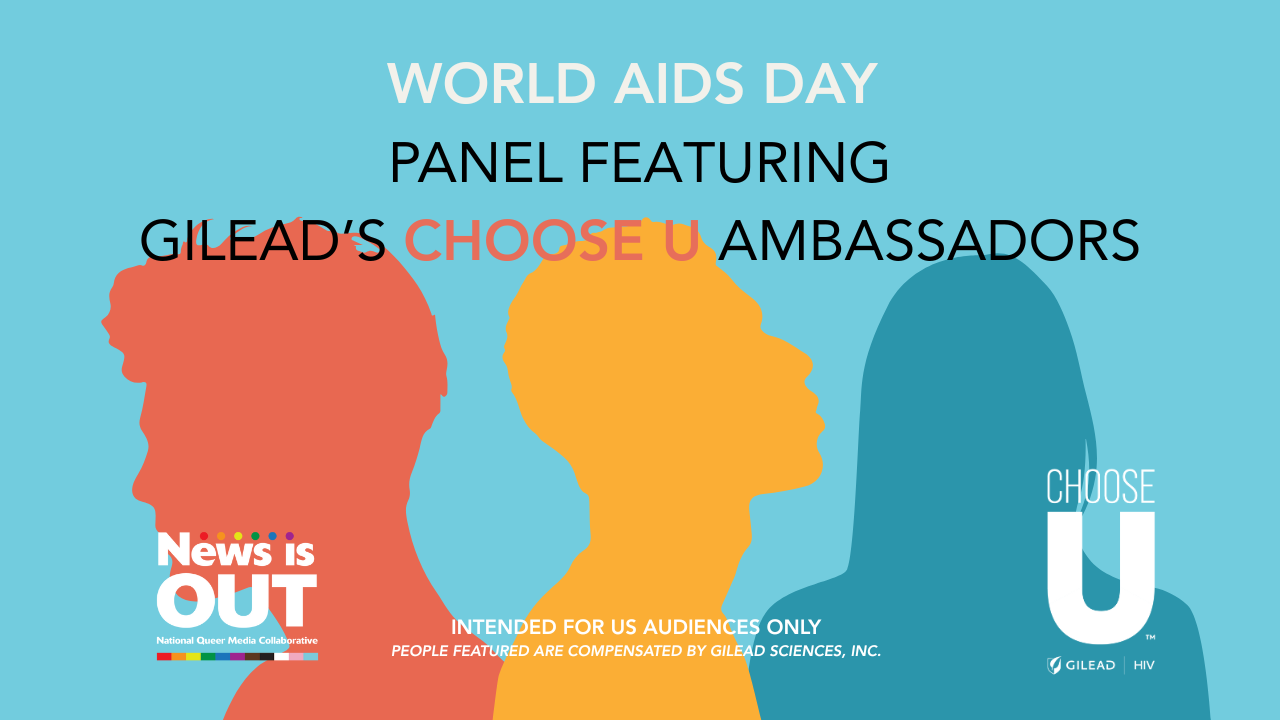
The Choose U World AIDS Day panel brought together three longtime advocates living with HIV to talk about care, stigma, and what living with HIV over the long-term means to them. The conversation featured Jahlove Serrano, Joyce Belton, and Andrew Nichols, who have each lived with HIV for more than 20 years. News is Out hosted the event in partnership with Gilead Sciences.
“Co-created with community representatives from around the world, Choose U is comprised of inspiring examples of how the outlook for aging with HIV has dramatically changed,” Gilead shared in the recent launch of the program. “By focusing on the real-world experiences of people in different circumstances, Choose U spotlights individuals prioritizing starting and staying on HIV treatment, self-care, and overall strategies to help them lead healthier lives.”
The Choose U ambassadors opened with a clear message: Lived experience drives understanding.
Each panelist talked through the decisions, relationships, and periods of uncertainty that shaped their HIV care. They also described their approaches to HIV treatment and adherence, including the importance of staying on treatment to help lower the risk of HIV drug resistance. They reflected on the shifts they have seen in HIV treatment over the decades, the value of honest conversations with providers, and how staying engaged in care and on HIV treatment helped them lead longer, healthier lives.
The panel discussed U=U, which stands for “Undetectable equals Untransmittable.” Undetectable means there is so little virus in the blood that a lab test can’t measure it. Research shows that taking HIV treatment as prescribed, and getting to and staying undetectable, prevents HIV from spreading through sex.
The panelists also spoke about the emotional side of living with HIV over the long-term and the stigma they have faced. Joyce described a personal moment when her pastor visited her in the hospital and how that experience began her work educating her church community about HIV.
Jahlove talked about how his biological family reacted to his diagnosis. “When I disclosed my status, they told me that I put a shame on the family,” said Jahlove. When he shared his status with his peers, they responded with support, which gave him a sense of empowerment.
Andrew, a professional therapist, described how he has experienced stigma in dating and in his workplace, and why he turns to therapy for guidance. “Therapy has really helped me rebuild my confidence and realize my self-worth has to come from me,” said Andrew. “Then after that, I can help with the greater community.”
The panel closed with a message for others living with HIV: They encouraged viewers to start and stay engaged in HIV treatment and care, ask questions, and rely on supportive networks. Their stories show how starting and staying on treatment over the long-term, community, and affirmation can shape well-being.
A recording of the full 30-minute event is now available on YouTube, which you can access here.

Justicia reconoce delito de odio en caso de bullying en Instituto Nacional Mejía de Ecuador

Radical reframing highlights the ‘Wuthering’ highs and lows of a classic

4th Circuit rules against discharged service members with HIV

PHOTOS: Clash

Gay Treasury Secretary’s silence on LGBTQ issues shows he is scum

Magic is happening for Round House’s out stage manager

‘Heated Rivalry’ fandom exposes LGBTQ divide in Baltimore

Home is where the heart is

Deon Jones speaks about D.C. Department of Corrections bias lawsuit settlement

European Parliament resolution backs ‘full recognition of trans women as women’
-

 Theater5 days ago
Magic is happening for Round House’s out stage manager
-
Baltimore3 days ago
‘Heated Rivalry’ fandom exposes LGBTQ divide in Baltimore
-
Real Estate3 days ago
Home is where the heart is
-
District of Columbia3 days ago
Deon Jones speaks about D.C. Department of Corrections bias lawsuit settlement