National
Legacy of 9/11
10 years later, assessing impact of attacks on rights of same-sex couples
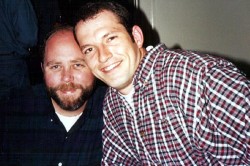
Mark Bingham, pictured here with partner Paul Holm, helped prevent United Flight 93 from reaching D.C. Those passengers are widely credited with saving the U.S. Capitol or White House on Sept. 11, 2001. (Blade file photo)
Ross Levi, executive director of New York’s LGBT advocacy group Empire State Pride Agenda, worked in the group’s lower Manhattan office in a different staff position at the time of the Sept. 11, 2001 terrorist attack on the World Trade Center.
In what he describes as the first horrifying hours following the crash of two hijacked jetliners into both World Trade Center towers, causing them to collapse, Levi said the ESPA staff joined other New Yorkers in helping survivors and victims any way they could.
“We opened the doors to our offices, which were on 12th Street at the time, to people as they were fleeing the World Trade Center site and coming downtown,” he said. “Many of them came right by our offices and so people were coming in just to use the bathroom and get some water and make phone calls,” he said.
“And in that way we were just a member of the New York family that had to go through this horrible event,” Levi said.
But Levi and other LGBT activists observing the Sept. 11 events as they unfolded said they quickly discovered within a week of the attacks that same-sex partners of those killed, injured or missing in the World Trade Center collapse faced additional hurdles in obtaining government and private sector assistance.
He said ESPA first became aware that same-sex partner survivors were being treated differently when the city and private relief agencies like the Red Cross set up an emergency station on a pier along New York’s Hudson River where people could go to find a family member missing and as yet unaccounted for in the World Trade Center carnage.
“Literally [gay] people had to go there, turn around, go back home and get some paperwork that spouses didn’t have to get to prove a relationship existed,” Levi said. “You were nervous and scared and sad and then you had to go through that. And worse, other people turned them away, even with the paperwork, saying sorry you’re not a family according to our guidelines.”
Activists reflecting on the Sept. 11 tragedy this week said New York City and New York State officials quickly recognized the inequities faced by same-sex partner survivors and took steps to change polices and laws to correct the situation. The changes began to take place, activists, said, following news media reports of the loss of individual LGBT people at the World Trade Center and at the Pentagon just outside Washington, which was hit by a third hijacked plane.
“It had such an impact because the loss was about death and relationships,” said Jennifer Pizer, senior counsel for Lambda Legal, an LGBT litigation group, in a 2006 interview with the Blade at the time of the 5th anniversary of the Sept. 11 attacks.
“The grief and loss was the same between heterosexual and same-sex couples, and a perception of this seemed to come through to much of the public,” Pizer said.
Among the victims widely reported on by the media was Mark Bingham, a gay public relations executive and avid rugby player from San Francisco, who was one of the passengers on United Airlines Flight 93, which crashed into the countryside in Pennsylvania.
Bingham’s mother said she spoke to him by cell phone after his hijacked plane was believed to be heading toward Washington, D.C. for another terrorist attack. She said she believes her son was part of a small group of passengers believed to have attempted to wrestle control of the plane from the hijackers.
Authorities have speculated that passengers such as Bingham and others most likely intervened to prevent the hijackers from crashing the jetliner into a building in Washington, such as the Capitol or the White House.
Bingham was among the 9/11 victims portrayed in the Hollywood film “United 93.”
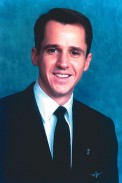
American Airlines pilot David Charlebois, who was gay, served as co-pilot onboard American Airlines Flight 77 when terrorists hijacked it and crashed it into the Pentagon. (Blade file photo)
Another of the victims widely reported in the media was American Airlines pilot David Charlebois, who was gay and an active member of the National Gay Pilots Association. Charlebois was serving as first officer, or co-pilot, onboard American Airlines Flight 77 when terrorists hijacked the Boeing 757 jetliner and crashed it into the Pentagon.
All of its crew and passengers perished along with dozens of Pentagon employees working in the part of the building struck by the plane.
Charlebois’ surviving partner of 14 years, Tom Hay, was treated with respect and honor by American Airlines’ top brass and colleagues when more than a dozen uniformed company pilots and flight attendants attended Charlebois’ funeral mass at St. Matthews Cathedral in downtown D.C.
“It was a time when all Americans did come together with a single, united focus,” said David Smith, vice president of programs for the Human Rights Campaign and the national LGBT advocacy group’s media spokesperson at the time of the Sept. 11 attacks.
“And there were extraordinary acts of kindness and recognition that this is an issue that needs to be dealt with, i.e., our families need to be protected,” Smith said. “But it also really brought into stark reality how the lack of recognition of our families causes real pain and at times almost insurmountable challenges that families that are protected by law through marriage don’t have to experience.”
Levi said ESPA was pleased when, in response to requests by LGBT advocacy groups and media reports, then GOP Gov. George Pataki issued an executive order in October 2001 that included surviving partners of gay and lesbian victims of the World Trade Center attacks in receiving full spousal benefits from the state’s Crime Victims Board.
“The order marks the first official step taken by any level of government in the nation to address the inequities faced by gay and lesbian survivors of the terrorist attacks in obtaining benefits,” ESPA said in a statement at the time.
The New York State Legislature soon followed suit by passing three separate bills that included same-sex partner survivors in various state benefits to be allocated to 9/11 survivors and their families. One provided state worker’s compensation benefits to domestic partners of 9/11 victims.
Another bill approved by the legislature enabled same-sex partners and their children to be eligible for a newly created World Trade Center Memorial Scholarship Program. A third bill passed by the legislature called on the federal government to include same-sex partners in federal relief programs for 9/11 survivors.
A short time later, the Red Cross responded to requests by ESPA, HRC, Lambda Legal and other LGBT groups by opening up its disaster relief programs to same-sex partner survivors. Activists called the action historic and noted it resulted in badly needed relief for LGBT victims of Hurricane Katrina, which struck New Orleans and the Gulf Coast several years later.
On the federal level, President George W. Bush and Republican members of Congress joined Democrats in approving a massive, $7 billion Sept. 11 Victim Compensation Fund. Officials said the program was aimed at providing a viable alternative to thousands of individual wrongful death lawsuits that likely would have emerged against airline companies and the company that operated the World Trade Center if such a fund were not created.
But LGBT advocacy groups once again discovered that the relief funds would likely be out of reach for surviving same-sex partners of 9/11 victims. Among other things, the fund’s administrator, attorney Kenneth Feinberg, who had worked for the late U.S. Sen. Edward Kennedy (D-Mass.), said rules for who is eligible for receiving as much as $1.3 million in compensation payments would have to be linked to state probate laws and rules.
At the time, no state probate law recognized same-sex relationships, even if they were made legal on the local level by a city or county domestic partnership ordinance.
ESPA, HRC, Lambda Legal and other advocacy groups said they worked hard to lobby the U.S. Justice Department, which had jurisdiction over the compensation fund program, to take administrative steps to include same-sex couples survivors in the program.
At the time, Feinberg told the Blade that while he was concerned about the plight of surviving domestic partners of the Sept. 11 victims, it was not feasible to include specific domestic partner provisions in the relief fund’s regulations.
“If I get in the middle of that fight and try and trump local probate law in a particular case, I’ll be up to my neck in lawsuits,” he said. “I’m not saying they’re not entitled,” he said. “I’m not saying they are entitled.”
Smith of HRC said at least two of about 22 known LGBT partner survivors in the Sept. 11 attacks did receive compensation from the fund. Smith said the compensation payments came about, however, when surviving blood relatives chose not to challenge the same-sex partners’ application for the compensation.
In a separate development, HRC, ESPA, Lambda Legal and other LGBT advocacy groups created the September 11 Gay & Lesbian Family Fund to provide some relief to surviving partners who were ineligible for help from the federal relief fund program.
In a May 2006 announcement, ESPA said the known surviving partners of gay or lesbian victims of 9/11 had received nearly $17,315 each from the new Gay & Lesbian Family Fund. ESPA said at the time that the groups raised a total of $378,812 for the fund, with only $11,193, or 2.9 percent, being spent on administrative costs.
“The Family Fund was established in December [2001] to help offset the discrimination gay and lesbian partners faced in obtaining benefits automatically afforded to surviving spouses, including Social Security and Workers Compensation survivor benefits, and compensation under the Federal 9/11 Victims Compensation Fund,” the ESPA statement said.
“I don’t think there is one of us who were of remembering age who lives their life the same on Sept. 11 at 8 o’clock in the morning as we did at 10 o’clock in the morning on that day,” said Winnie Stachelberg, senior vice president for external affairs for the Center for American Progress, and who served as HRC’s political director in 2001.
“And my hope is it’s changed us to respect our diversity, to honor our humanity,” she said. “I don’t know if we’ve embraced those lessons but in this 10th year anniversary if we don’t remember that we need to honor our diversity and our humanity we will not have learned from the tragedy of Sept. 11.”
Another of the widely reported 9/11 victims was Father Mychal Judge, a gay Catholic priest and beloved New York Fire Department chaplain. Judge was killed when struck by falling debris next to the World Trade Center while he was performing last rites for a dying firefighter. His sexual orientation, while not widely known until after his death, was confirmed by New York Fire Commissioner Thomas Von Essen, who told New York magazine that Judge confided to him that he was both gay and celebate.
In 2002, Congress honored Judge by using his name for the landmark Mychal Judge Police and Fire Chaplains Public Safety Officers Benefit Act. The law marked the first time the federal government had extended an equal benefit for same-sex couples, in this case allowing domestic partners of public safety officers killed in the line of duty to obtain a federal death benefit.

The White House
SPJ calls for take down of Trump’s ‘media offenders’ website
White House launched online database on Monday
The Society for Professional Journalists has called out the White House for creating a website that targets individual journalists and news outlets that publish unfavorable coverage of the Trump-Vance administration.
In a letter to White House Press Secretary Karoline Leavitt on Monday, the SPJ — the nation’s most broad-based journalism organization, which works to protect the free practice of journalism with high ethical standards — asked the White House to take down its website singling out journalists for negative coverage of the administration.
“Journalists have a constitutionally protected and societally encouraged duty to hold power to account. They are not political opponents to be tracked, cataloged or punished,” the letter signed by SPJ National President Chris Vaccaro and SPJ Ethics Committee Chair Dan Axelrod.
“By publishing reporters’ names, outlets and specific stories, the White House is naming and shaming members of the press in a highly charged political and social environment. SPJ regards this as a form of online harassment that exposes journalists to potential threats and even violence.”
The website currently lists 23 outlets as “Media Offenders of the Week,” singling out national organizations like CBS News, the Boston Globe, and the Independent. The website says these particular organizations “misrepresents and exaggerates President Trump.”
The letter goes on to explain that there are more civil ways to disagree with published stories without singling out people for doing the only constitutionally protected job in the country.
“There are well-established ways of resolving disagreements over the fairness or accuracy of stories. The White House web page attacking so-called ‘media offenders’ ignores these principles and instead denigrates and attacks reporters.”
It also highlights how Trump often attacks women journalists in particular, noting that two weeks ago he told White House correspondent Catherine Lucey from Bloomberg News to be “quiet piggy” after she asked questions related to Trump’s relationship with sex offender Jeffery Epstein on Air Force One.
“Journalists, particularly women, already face an enormous amount of online harassment, and this can convert into physical violence. As you know, women journalists have also been publicly insulted by the president in recent weeks.”
The letter also explains that attacks like this on the legitimate press can cause tensions between journalists who attempt to hold those in power responsible and the public who consumes the rhetoric.
“This page, which categorizes reporting as ‘lies,’ ‘left-wing lunacy,’ and ‘malpractice,’ has a chilling effect on coverage. It undermines the healthy democratic relationship in which journalists hold power to account.”
The letter also draws a connection to how the Russian authoritarian dictatorship references media it dislikes, saying, “The president’s new ‘media offenders’ list mirrors a 2017 initiative by the Kremlin that labeled independent journalism as ‘fake news.’ The United States should not follow that example.”
“SPJ believes civility must be restored between the media and the Administration. Removing this page would be a vital first step toward lowering the temperature and reinforcing America’s commitment to free expression.”
The SPJ’s code of ethics, widely regarded as the ethical standard for good journalism, has four main pillars: Seek Truth and Report It, Minimize Harm, Act Independently, and Be Accountable and Transparent. The code was adopted in 1926 from the American Society of Newspaper Editors and has been revised multiple times since then, including in 1984, 1987, 1996, and most recently in 2014.
NLGJA, the The Association of LGBTQ+ Journalists is the journalist-led association that works within the news media to advance fair and accurate coverage of LGBTQ+ communities and issues, provided a statement to the Blade on the website and supports the SPJ’s public call for removing the website to restore faith in journalistic freedom in the U.S.
“We stand with SPJ in urging the Trump administration to remove its website targeting so-called “media offenders.” While NLGJA believes that media organizations should be held to the highest standards of accuracy and ethical reporting, this website does nothing to support a healthy press environment,” National Board President Ken Miguel told the Blade via email. “Instead, it undermines public trust in the free press, enables the harassment and targeting of journalists, and hinders their ability to cover the news fairly and accurately. Journalists must be able to do their work without fear of government retaliation.”
The White House has not responded to the Washington Blade’s request for comment on the letter.
National
Lawmakers warn of HIV crisis as federal support collapses
NMAC hosted Capitol Hill event on Wednesday
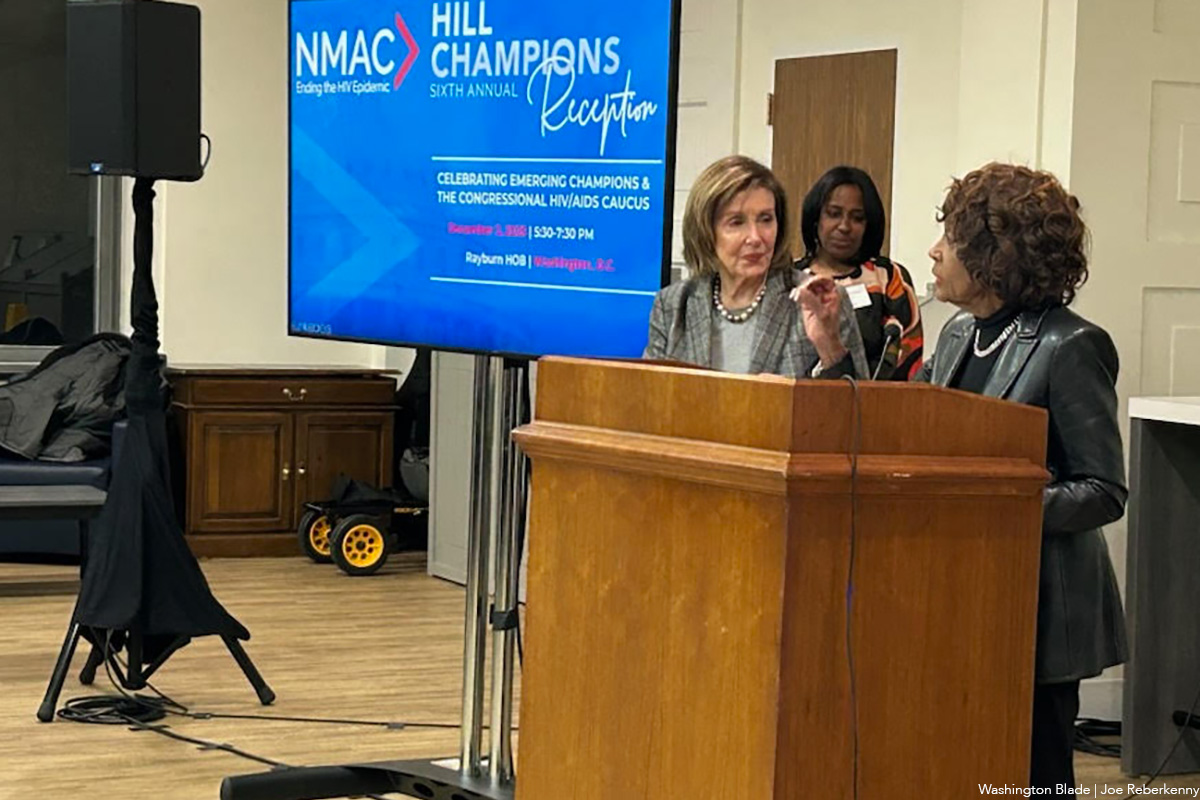
NMAC, formerly known as the National Minority AIDS Council, a nonprofit organization that works for health equity and racial justice to end the HIV epidemic, held its 6th annual Hill Champions reception on Wednesday in the Rayburn House Office Building to honor federal legislators who have worked to stop the spread of HIV/AIDS in the U.S. and around the world.
Currently there are an estimated 40.8 million people worldwide living with HIV, with about 1.2 million people in the U.S. with the disease. While there is no cure, there are highly effective treatments that can control the virus and allow people to live long, healthy lives called antiretroviral therapy that can reduce the amount of virus in the body to an undetectable level, which also prevents the spread of HIV to others.
This year, NMAC’s reception featured a slew of current policymakers who use their national platforms to push for expanding HIV funding in Congress. This year’s honorees were three congresswomen who are active voices for HIV/AIDS on the House floor: U.S. Reps. Jasmine Crockett (D-Texas), Sara Jacobs (D-Calif.), and Delia Ramirez (D-Ill.).
The awards presented to the representatives are named after three congressional icons who have dedicated their lives to ensuring the voices of the most marginalized are heard, seen, and helped.
Crockett received the John Lewis Good Trouble Award, Jacobs received the Barbara Lee Courage in HIV/Advocacy Award, and Ramirez received the Elijah Cummings Award for Minority Health Equity.
NMAC CEO Harold J. Phillips, the former director of the White House Office of National AIDS Policy under President Joe Biden, was one of the first to speak at the event. He congratulated the honorees, highlighted work accomplished this past year in the fight against HIV/AIDS, and outlined what lies ahead as the current president continues to slash funding for public health initiatives worldwide.
“Tonight, we gather to celebrate what’s possible when courage meets commitment, when leaders refuse to let politics stand in the way of saving lives, we’re in a critical moment. Political uncertainty threatens the very programs that have transformed HIV into a manageable condition, but a crisis creates an opportunity for collective action,” Phillips said. “For more than 40 years, the HIV movement has thrived because of bipartisan leadership, leaders who understood that public health transcends party lines. Now more than ever, we need advocates on the hill.”
He continued, spotlighting actions taken by the honorees for the HIV movement during a time when some of the highest officials in government refuse to acknowledge it.
“What unites these champions is their understanding that HIV advocacy is not political — it is moral. They show us what it looks like when leaders treat public health as a responsibility, not a bargaining chip.”
Jacobs and Ramirez attended in person, while Crockett, who was unable to be there, sent a video.
In her speech after receiving the Barbara Lee Courage in HIV/Advocacy Award, Jacobs emphasized that the policies and initiatives put forward through the HIV Caucus and public health organizations in the U.S. have global impact — particularly regarding PEPFAR. Jacobs has been a consistent champion for people living with HIV, military service rights, and protecting the U.S. Agency for International Development.
“PEPFAR has saved over 25 million lives, but cuts are already causing catastrophic setbacks,” Rep. Jacobs said, explaining that even with progress made due to PEPFAR funding, places like Malawi reaching the 95-95-95 goal (95 percent of all people with HIV knew their status, 95 percent of those diagnosed were on lifesaving antiretrovirals, and 95 percent of those on medication were unable to transmit HIV) will continue to suffer. “In Malawi, where services for LGBTQ people, sex workers, young women, and other marginalized groups have been eliminated, it’s no longer a question of if transmission rates will rise — but when. We cannot leave communities behind or allow preventable deaths because of political decisions made in Washington.”
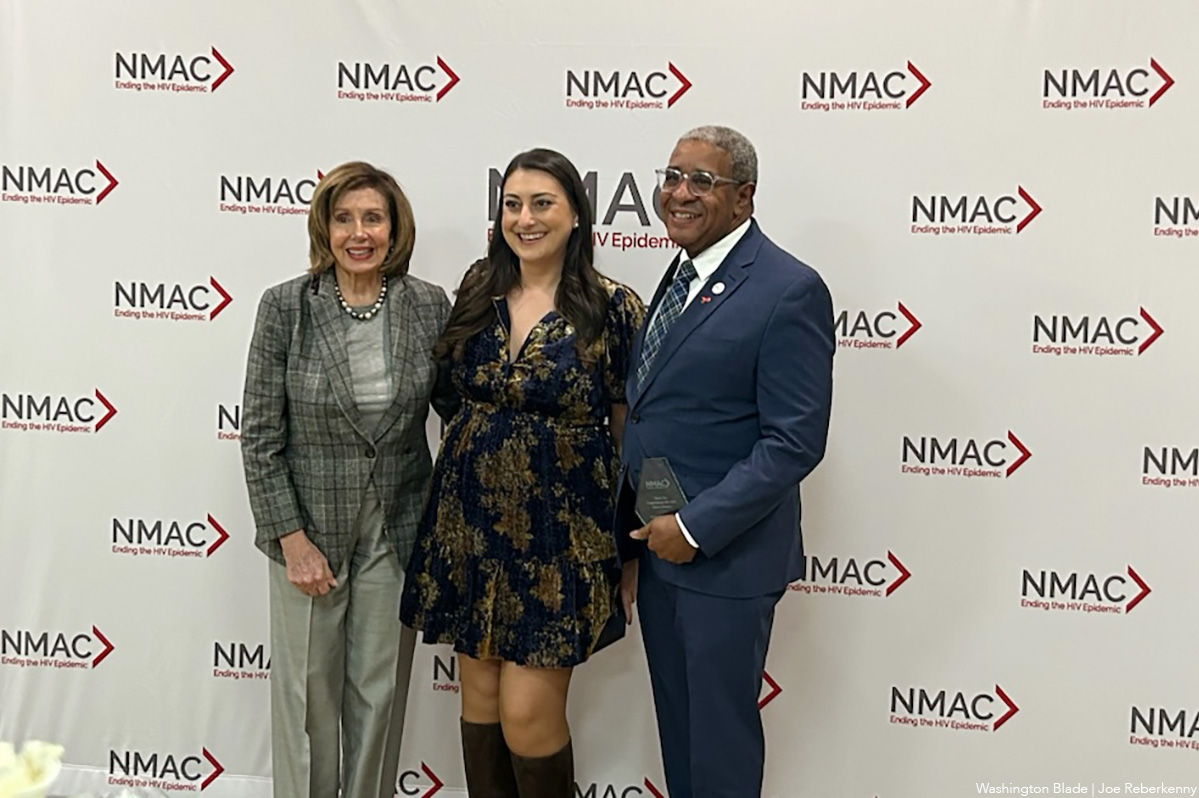
“I know that people of color, immigrants and trans people, have all been let down by our mainstream approach to HIV prevention and everything, I see seven barriers they face in accessing health care, the stigma surrounding disease and the lack of awareness from people in power,” the San Diego congresswoman said. “I want to say to those in that community, I will not let you fall through the cracks. I will not let you become another statistic, and I will keep working to make sure your voice is heard and that you can live a full and healthy life.”
Crockett, who addressed the crowd via video, emphasized her award’s namesake, explaining that the “good trouble” she gets into on the House floor and in committees can be deemed too much even by those in her own party, but that she remains committed to making HIV treatment accessible to all, regardless of background.
“To receive an award named after John Lewis is an honor all on its own. It means being bold, speaking up when others are scared to and standing firm when the truth makes people uncomfortable. And y’all know me — I don’t mind stirring a little trouble, especially when I am stirring trouble that is good trouble — but I never do it alone. I do it with the strength of the communities I represent. I do it with the stories of the folks who feel unheard. I do it for the people who depend on someone in those halls of Congress to fight for them. So this award isn’t just mine. It belongs to every advocate pushing for access to health care, every person navigating their own health journey, every organizer who refuses to give up.”
She continued, without directly calling out the White House, making allusions to pushing back against the recent emergence of budget cuts.
“I promise to keep fighting for funding, for research, for resources ,and for every community that needs a champion, because getting into good trouble isn’t just a phrase, it’s a calling, a calling we all share in this room,” Crockett said. “Thank you again for this honor, and thank you for your leadership, your fight and your refusal to back down. Now, let’s keep getting into that good trouble.”
Ramirez, who represents a part of Chicago, was previously in the Illinois House of Representatives, where she co-sponsored legislation to allow minors to access HIV and STI testing, prevention, and treatment without parental consent. She was also a chief co-sponsor in securing $10 million in state funding for this initiative in Illinois, and was the House chief co-sponsor for the “disrupting disparities for LGBTQ+ older adults and older adults living with HIV” initiative.
“I am clear more than ever that a commitment to ending the HIV and AIDS epidemic must continue to be our priority, and we must demonstrate that priority not through words, my friends, but through action — fighting for and protecting our neighbors, living with HIV or AIDS, including our LGBTQI plus neighbors,” Ramirez said. “It means showing up, telling our stories, celebrating each other and fighting side by side for that collective liberation, which only makes me more grateful for the people in this room.”
She also used the platform to criticize how some of Trump-Vance administration’s cuts to healthcare coverage funding were directed at underserved communities within the U.S. — namely undocumented immigrants like her parents.
“I want you to know that as members of Congress, we cannot go through day to day as business as usual, today is the time to demand that our siblings living with HIV and AIDS, no matter their sexual orientation, no matter their gender expression, no matter their zip code, their background or their citizenship status, that they get everything that they deserve, every Damn thing, so that they can live a healthy and thriving life.”
While the event was intended to celebrate the accomplishments of legislators, advocates, and supporters of the fight against HIV/AIDS, the tone of the night was noticeably more charged following the Trump-Vance administration’s refusal to acknowledge World AIDS Day — and the reported directive instructing federal employees not to comment about it on any channels, including social media and traditional media.
Speaker Emerita Nancy Pelosi (D-Calif.) made a surprise appearance, celebrating the three legislators while emphasizing the critical importance of supporting HIV/AIDS research now that the White House has refused to acknowledge it.
“It’s really important this year, because this is the first time in a very long time that we have had World AIDS Day when the president of the United States has said, we can’t really talk about it and we certainly should not observe it for two days. On Sunday and Monday in San Francisco, we did exactly that. We talked about it, and we observed it, and here we are talking about it here, because, as Congressman Crockett said, and we all know, we’re here to fight for funding. We’re fighting for research, prevention, and all of that, but we’re also here to fight against discrimination and stigma anybody wants to attach to this, and that starts with you in the White House,” Pelosi said. “We have a fight on our hands, because this isn’t over.. [to] make sure that any discussion of HIV ends up in the dust bin of history, an ancient malady when our children, grandchildren all grow up. ‘What was that?’ It was something that doesn’t exist anymore because of the goodness of others, because of the National Minority AIDS Council.”
Maxine Waters slams Trump
U.S. Rep. Maxine Waters (D-Calif.) also made an appearance and delivered an unfiltered, passionate speech praising NMAC’s efforts and calling out Trump for ending funding for HIV/AIDS worldwide while simultaneously accepting donations to rebuild the White House as he sees fit.
“I want to tell you when they asked, how was I doing when I came in, really, I was thinking about the president of the United States and what’s going on now, it’s so troubling. And I find myself not sleeping as well as I normally sleep. I find myself trying to believe that what I see is happening is absolutely happening,” Waters said. “Many of our people with HIV and AIDS are homeless, and they’re not being taken care of, and they’re going to die with the cuts that are being made. Unfortunately, we just got to say it.”
She continued, calling out Trump’s lack of focus on domestic issues like HIV/AIDS that directly impact American citizens, instead prioritizing issues unrelated to the public’s welfare.
“The fact that the president of the United States is killing people in international waters in Venezuela, not knowing whether or not they’re drug dealers or not, not caring, and I think about two people, two men hanging on the side of the boat who had escaped the bomb that hit, and they said, kill him, and they shot him down and killed it’s hard to live with this. It’s hard to understand how all of this is happening. And so Trump refused to commemorate World AIDS Day, and his State Department instructed employees and grantees to refrain from publicly promoting World AIDS Day through any communication channels, including social media, media engagements, speeches or other public facing messaging let’s just be an honorary Why would he be focused on us celebrating or working with World AIDS Day and helping people to understand that HIV and AIDS is still a big problem in this country, and we have to spend money. We have to do what it takes in order to provide the medicine and the health care that they need. Why would he just be against that? He’s already cutting the funds. But just go even further and say and don’t even promote World AIDS Day. It’s bothersome. Trump halted funds for PEPFAR, the President’s Emergency Plan for AIDS Relief, which was created under the leadership of former Congresswoman Barbara Lee, the co-founder of the Congressional HIV AIDS Caucus.”
“There’s a very rich man that paid attention to what was going on with HIV and AIDS, and that was Bill Gates. And I’d like to quote him and what he said. ‘We’re already seeing the tragic impact of reductions in aid, and we know the number of date deaths will continue to rise.’ Here in the United States, where Nancy and I just talked about the creation of Minority AIDS Initiative to address AIDS disparities, and where the initiative has grown from 156 million when we first started in 1999 to more than 400 million per year. Today, Donald Trump is waging an all out war on people living with HIV. Trump’s budget proposal completely eliminated HIV prevention funding at the Centers for Disease Control and Prevention, and he slashed the funds from Ryan White AIDS care and HIV research. We cannot allow, we cannot allow these devastating cuts to be implemented, and so we’re doing everything that we possibly can to fight Donald Trump on all of these issues. I want you to know that this attack on many of our friends who happened to come from other countries is just outrageous, and what he said about Somalia today just cannot be understood or accepted. And so for all of the nice people in the room, get mad, get angry. Do a little cursing. Tell people what you think about it, because if you’re too nice, nobody believes you. You got to kick a little butt. You got to make sure that they understand we’re in this fight and we’re not going to go away. I know he’s the president of the United States, but he shouldn’t be. He’s the president of the United States with a cabinet that knows nothing and cares nothing about anybody. I dare anybody to talk about minorities and want to know whether or not we’re qualified. Hell, they have the most unqualified people that you’ve ever witnessed in your life, anytime, anyplace, anywhere. We want to get rid of all of them dealing with this public policy, doing everything that we can, educating people. Don’t forget, you got to get them to vote.”
She spoke for 17 minutes, touching on many current events but repeatedly returning to the point that the president is supposed to represent the people — not his own interests.
“I came here to talk about AIDS, but I wasn’t going to let you go without talking about some other stuff too. And I’m going to leave you with saying, not only are we concerned and we’re upset about the kind of cuts that are made, whether we’re talking about health care, we’re talking about AIDS in particular, whether we’re talking about Section Eight, whether we’re talking about food stamps, this crazy man is destroying the White House — bulldozes the East Wing. Why would he do that? And why would he spend over $300 million to do that while he’s cutting all of these programs? Well, he’ll say it’s being donated. Well, get it donated to AIDS. You know what I’m saying. Why are you getting it donated? And then, last of all, which pisses me off, you. Definitely, and I just think it’s crazy and outrageous. He wants to take the John F. Kennedy Center and name it after Melania. What the hell?”
In a moment when federal silence grows louder, the advocates in that room offered a counterpoint — a reminder that community, courage, and persistence still drive the fight to end HIV.
Maine
Maine governor opens LGBTQ+ Victory Institute’s D.C. conference
Janet Mills successfully challenged White House’s anti-trans athlete executive order
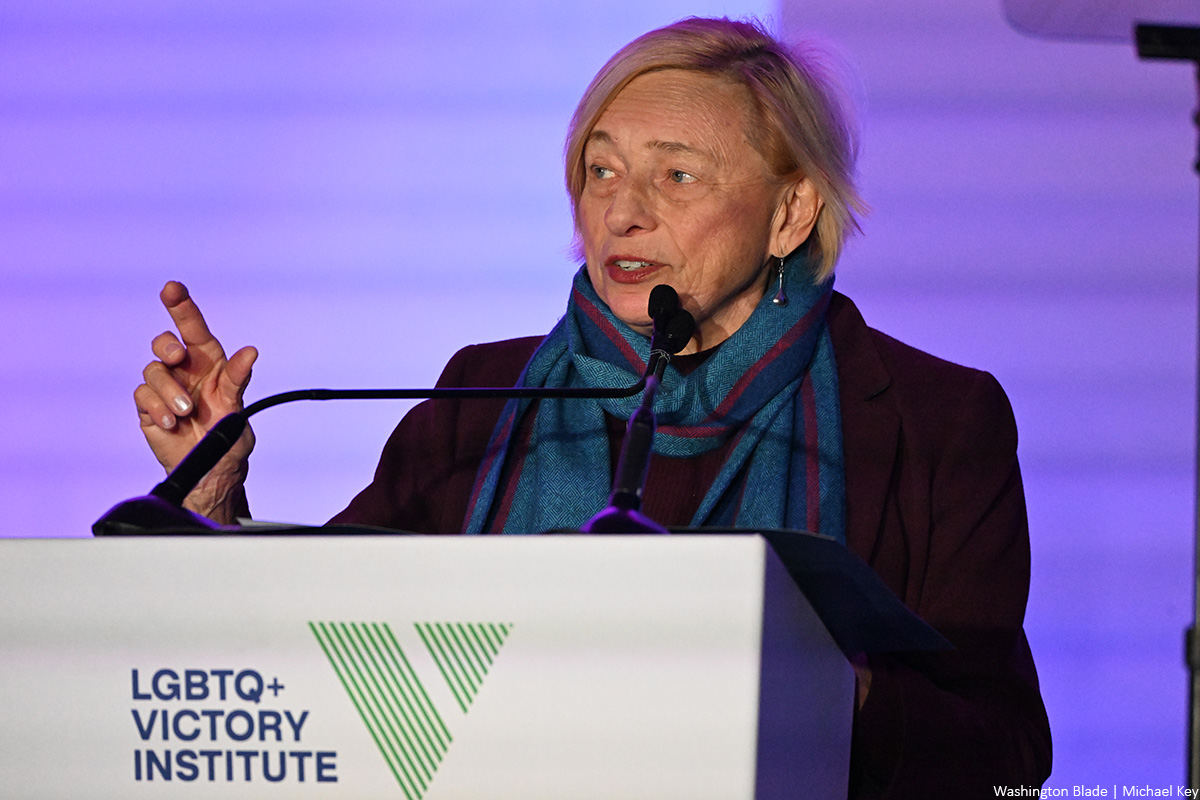
Maine Gov. Janet Mills on Thursday opened the LGBTQ+ Victory Institute’s annual International LGBTQ+ Leaders Conference in D.C.
Mills noted her February confrontation with President Donald Trump in the Oval Office over his executive order that bans transgender athletes from participating in school sports teams consistent with their gender identity.
Maine sued the Trump-Vance administration after it withheld federal funds to the state’s Department of Education. A federal judge ordered the White House to unfreeze the money.
“I speak as someone who, yeah, stood up to the president of the United States, to his face, when Donald Trump demanded that Maine violate our own laws to discriminate against transgender youth,” said Mills. “I told him I’d see him court. And guess what? We did see him in court and we won.”
Mills in October announced she is challenging incumbent U.S. Sen. Susan Collins (R-Maine).

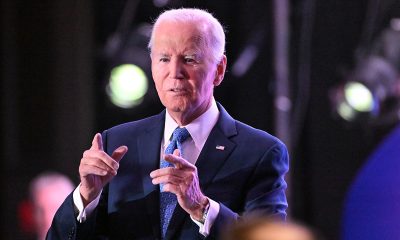
Biden honored at Victory Institute conference

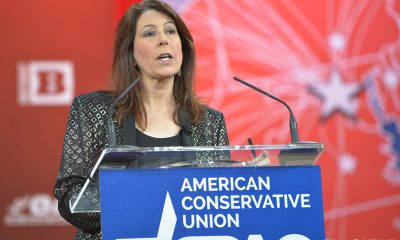
Tammy Bruce, Trump’s lesbian nominee for deputy UN ambassador. Just say no!

SPJ calls for take down of Trump’s ‘media offenders’ website

Team DC’s holiday party set for Dec. 8

Washington chorale kicks off Christmas with vibrant program

‘Lavender Scare 2.0’: inside the White House’s campaign against LGBTQ federal employees

HIV/AIDS activists block intersection near White House

Meet Mr. Christmas

Tokyo court upholds Japan’s same-sex marriage ban

Activists praise Mayor Bowser’s impact on city, LGBTQ community
-

 The White House2 days ago
‘Lavender Scare 2.0’: inside the White House’s campaign against LGBTQ federal employees
-
District of Columbia4 days ago
HIV/AIDS activists block intersection near White House
-
a&e features1 day ago
Meet Mr. Christmas
-
Japan3 days ago
Tokyo court upholds Japan’s same-sex marriage ban