National
72 lawmakers to Obama: Sign ENDA exec order
House members say directive would lay groundwork for bill’s passage
A group of 72 U.S. House members is calling on President Obama to take administrative action to institute federal non-discrimination protections for LGBT people in the workplace.
In a letter dated April 2, the lawmakers ask Obama to issue an executive order requiring companies doing business with the U.S. government to have non-discrimination policies inclusive of sexual orientation and gender identity.
“This order would extend important workplace protections to millions of Americans, while at the same time laying the groundwork for Congressional passage of the Employment Non-Discrimination Act (ENDA), a goal that we share with you,” the lawmakers write.
The executive order is similar in its goal to the Employment Non-Discrimination Act, legislation that would bar job bias. The directive has sometimes been referred to as the “ENDA” executive order, although the order would be more limited in scope because it only affects federal contractors.
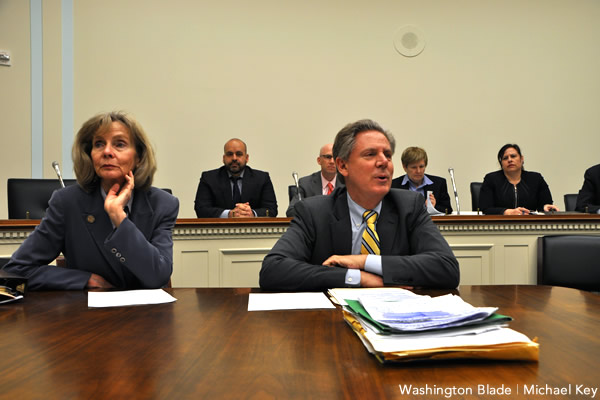
Reps. Lois Capps (D-Calif.) and Frank Pallone (D-N.J.) (Blade photo by Michael Key)
Reps. Frank Pallone (D-N.J.) drafted the letter and circulated it among House members. Rep. Lois Capps (D-Calif.) and retiring gay Rep. Barney Frank (D-Mass.) were two other original signers.
The letter recalls that President Johnson in 1965 issued Executive Order 11246, which similarly banned discrimination among federal contractors for workers based on color, religion, sex and national origin, and says this order “continues to stand as an important protection.”
“The opportunity to expand protections against workplace discrimination to members of the LGBT community is a critical step that you can take today, especially when data and research tell us that 43 percent of LGB people and 90 percent of transgender people have experienced workplace discrimination,” the lawmakers write.
Lawmakers also make the case for the executive order by citing data that the majority of the 25 largest federal contractors have already adopted these policies and polling shows a majority of American people support such action.
“The majority of the 50 largest corporations in America, for example, say that adopting inclusive workplace practices — such as adding sexual orientation and gender identity to corporate non-discrimination statements — helps attract the best talent, reduce employee turnover, and overall is a plus to their bottom lines,” the letter states.
The letter also notes that the military contractor DynCorp agreed to adopt an LGBT-inclusive non-discrimination policy after media reports were published about a straight employee who allegedly endured anti-gay harassment working there and an online petition demanding the company make the change received 50,000 signatures.
Multiple sources, speaking on condition of anonymity, have told the Blade the Labor and Justice Departments have cleared such a measure. The White House hasn’t said whether it will issue the executive order and didn’t immediately respond to a request to comment on the letter.
Tico Almeida, president of Freedom to Work and chief advocate of the executive order, commended Pallone and other House members for who signed their names in support of the executive order.
“Now that more than 110,000 people have signed the Freedom to Work online petition, more than 70 members of Congress have signed Mr. Pallone’s letter, and 73% of the American people have expressed support for this policy in recent polling, it is clear that ‘We Can’t Wait’ any longer for the president to sign the executive order adding LGBT workplace protections to millions of American jobs,” Almeida said.
Among the signers are the four openly gay members of Congress: Frank, Tammy Baldwin (D-Wis.), Jared Polis (D-Colo.) and David Cicilline (D-R.I.). The letter marks the first time that Frank, Baldwin and Cicilline have publicly articulated support for the directive.
In an interview with the Washington Blade shortly after he announced his retirement in November, Frank said the executive order is a “reasonable thing to keep pushing for.” Still, he said at the time the president’s authority has limits and racial discrimination is “embodied in the Constitution” unlike discrimination against LGBT people, so the president has more power to take action on issues related to race.
Polis said in an interview in March 2011 with the Washington Blade that he backs the idea of Obama issuing an executive order — making him the first public official to go on the record in support of the directive.
Other notable signers are Rep. George Miller (D-Calif.), the ranking Democrat on the House Education & the Workforce Committee, the House panel that has jurisdiction over ENDA. Another signer is Rep. Rob Andrews (D-N.J.), the ranking Democrat on the Subcommittee on Health, Employment, Labor & Pensions, the House subcommittee with jurisdiction over ENDA.
Other House who signed are Rep. Judy Chu (D-Calif.), chair of the Congressional Asian Pacific Caucus; as well as Reps. Raúl Grijalva (D-Ariz.) and Keith Ellison (D-Minn.), co-chairs of the Congressional Progressive Caucus. Rep. Chris Van Hollen (R-Md.) is also a signer.
But prominent members of House Democratic leadership aren’t among the signers. The names of both House Minority Leader Nancy Pelosi (D-Calif.) and House Minority Whip Steny Hoyer (D-Md.) aren’t on the letter.
Pelosi endorsed the executive order when asked about it by the Blade during a news conference in July. Drew Hammill, a Pelosi spokesperson, said the Democratic leader doesn’t typically sign group letters because of “longstanding custom since she has been in leadership.”
Still, Pelosi has penned her name to LGBT-relevant petitions before. She was among 69 lawmakers who signed a letter calling on the Obama administration to issue explicit guidance saying bi-national same-sex couples will be included in policies that aim to take low-priority cases out of the deportation pipeline. Pelosi was also among 133 House members who signed an amicus brief supporting litigation contesting the constitutionality of the Defense of Marriage Act.
Daniel Reilly, a Hoyer spokesperson, said Friday his boss is “reviewing the letter” and noted that Hoyer is an ENDA co-sponsor. Hoyer also signed the amicus brief against DOMA.
Another notable absence is Rep. Debbie Wasserman Schultz (D-Fla.), chair of the Democratic National Committee. Her office didn’t immediately respond to the Blade’s request for comment on the letter.
No Republicans signed the letter. It begins with a paragraph praising Obama — thanking him for his leadership on LGBT issues and saying his administration will be “long-remembered for its efforts to build an America that is fully inclusive of all people, regardless of their sexual orientation or gender identity” — which Republicans would likely find unpalatable.




Florida
Fla. Senate passes ‘Anti-Diversity’ bill that could repeal local LGBTQ protections
Bipartisan coalition urges Florida House to reject ‘extremism’ measure

The Florida Senate on March 4 voted 25-11 to approve an “Anti-Diversity in Local Government” bill that critics have called a sweeping and extreme measure that, among other things, could repeal local LGBTQ rights protections.
According to Equality Florida, a statewide LGBTQ advocacy organization, if approved by the Florida House of Representatives and signed by Republican Gov. Ron DeSantis, the bill “would ban, repeal, and defund any local government programming, policy, or activity that provides ‘preferential treatment or special benefits’ or is designed or implemented’ with respect to race, color, sex, ethnicity, sexual orientation, or gender identity.”
In a March 4 statement, Equality Florda added that the bill would also threaten city and county officials with removal from office “for activities vaguely labeled as DEI,” with only limited exceptions.
The Florida House was scheduled to vote on the bill on Monday, March 9, with opponents hopeful that a broad coalition of both Democratic and Republican lawmakers would secure enough votes to defeat the bill.
“Once again, Gov. DeSantis and Florida lawmakers are advancing one of the most sweeping and extreme bills in the country — this time threatening decades of local progress supporting diverse communities, including the LGBTQ community,” said Equality Florida Senior Political Director Joe Saunders. “This legislation is a sledgehammer aimed at cities and counties that recognize and address the diversity of the people they serve,” he said.
Among the LGBTQ organizations that could be adversely impacted by the bill is the highly acclaimed Stonewall National Museum, Archives and Library located in Fort Lauderdale.
Robert Kesten, the Stonewall organization’s president and CEO, told the Washington Blade the organization receives some funding from Broward County, in which Fort Lauderdale is located, and the city of Fort Lauderdale has provided support by purchasing tables at some of the museum’s fundraising events.
“Based on this legislation, hose things would be gone,” he said. “We also are based in a government building. So, we don’t know what potential side effects that could have.” He noted that the building in question is owned by Broward County and leased by Fort Lauderdale, with the bill’s vaguely worded provision making it unclear whether Stonewall would be forced to leave its building.
“It’s unknown, and we’re really in unchartered waters,” he said.
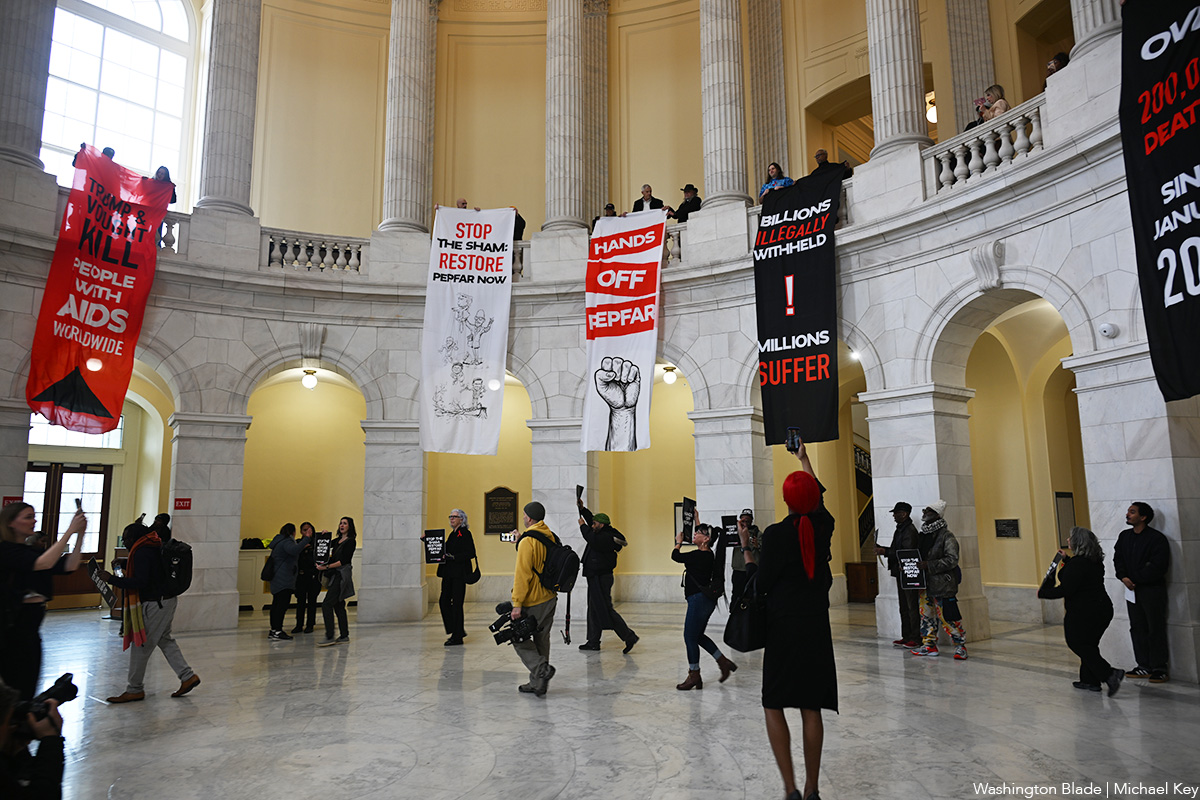
U.S. Capitol Police on Thursday arrested 13 HIV/AIDS activists in the Cannon House Office Building Rotunda.
The activists — members of Housing Works, Health GAP, and the Treatment Action Group — joined former PEPFAR staffers in demanding full funding of the program that President George W. Bush created in 2003. They chanted “AIDS cuts kill, PEPFAR now!” and unfurled banners from the Rotunda’s second floor that read “Trump and (Office of Management and Budget Director Russell) Vought kill people with AIDS worldwide,” “Over 200,000 deaths since January 2025,” and “Hands off PEPFAR” before their arrest.
(Washington Blade video by Michael K. Lavers)
This protest is the latest against the Trump-Vance administration’s HIV/AIDS policies since it took office.
Secretary of State Marco Rubio on Jan. 28, 2025, issued a waiver that allowed PEPFAR and other “life-saving humanitarian assistance” programs to continue to operate during a freeze on nearly all U.S. foreign aid spending. HIV/AIDS service providers around the world with whom the Washington Blade has spoken say PEPFAR cuts and the loss of funding from the U.S. Agency for International Development, which officially closed on July 1, 2025, has severely impacted their work.
The State Department last September announced PEPFAR will distribute lenacapavir in countries with high prevalence rates. Zambia is among the nations in which the breakthrough HIV prevention drug has arrived.
The New York Times last summer reported Vought “apportioned” only $2.9 billion of $6 billion that Congress set aside for PEPFAR for fiscal year 2025. (PEPFAR in the coming fiscal year will use funds allocated in fiscal year 2024.)
Bipartisan opposition in the U.S. Senate prompted the Trump-Vance administration last July withdraw a proposal to cut $400 million from PEPFAR’s budget. Vought on Aug. 29, 2025, said he would use a “pocket rescission” to cancel $4.9 billion for HIV/AIDS prevention and global health programs and other foreign aid assistance initiatives that Congress had already approved.
The White House in January announced an expansion of the global gag rule to ban U.S. foreign aid for groups that promote “gender ideology.” President Ronald Reagan in 1985 implemented the original regulation, also known as the “Mexico City” policy, which bans U.S. foreign aid for groups that support abortion and/or offer abortion-related services. The Council for Global Equality and other groups say the expanded rule will adversely impact HIV prevention efforts around the world.
A press release that Housing Works and Health GAP issued on Thursday notes more than $977 million “in appropriated PEPFAR funding for HIV prevention and treatment was unspent by the end of fiscal year (FY) 2025 — triple amount unspent at the end of FY 2024.”
“Activists predict this backlog will worsen rapidly in FY 2026 unless Congress immediately reasserts its Constitutionally-mandated oversight authority,” notes the press release.
The press release also indicates funding for the Centers for Disease Control and Prevention’s PEPFAR programs “will run out” by April 1 because “only 45 percent of their FY26 funding has been transferred from the State Department.
“Unless funding is transferred immediately, CDC’s global HIV programs across sub-Saharan Africa, Asia and the Caribbean will grind to a halt,” notes the press release.
The activists demanded Trump, Vought, Rubio, and Congress do the following:
- Activists are calling for full obligation of appropriated PEPFAR funds and rejection of growing political interference in global and domestic HIV programs
- Immediately release already-appropriated, unobligated PEPFAR funds
- Break the blackout on PEPFAR data, so Congress and people with HIV know how funding is being spent and can program based on data
- Activists are calling for full obligation of appropriated PEPFAR funds and rejection of growing political interference in global and domestic HIV programs.
“PEPFAR has saved more than 26 million lives and changed the trajectory of an epidemic,” said Housing Works CEO Charles King. “However, the Trump administration’s decision, over the objection of Republicans in Congress, to freeze PEPFAR funding has caused decades of progress to come undone and has been a death sentence for people with HIV relying on life-saving treatment. The U.S. must immediately restore PEPFAR funding and regain our standing in the global fight against HIV.”
King is among the activists who were arrested.
(Washington Blade video by Michael K. Lavers)
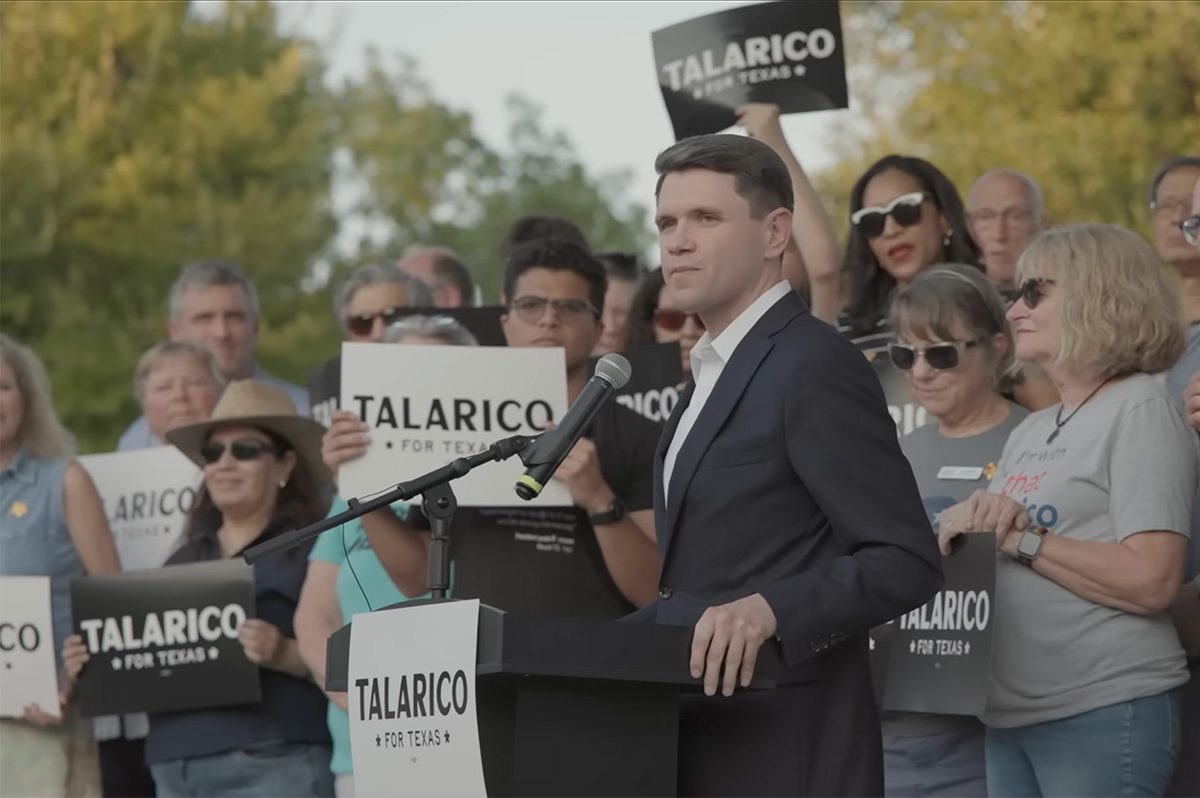
Texas state Rep. James Talarico won a hard-fought primary Tuesday to become the state’s Democratic nominee for U.S. Senate, defeating U.S. Rep. Jasmine Crockett in one of the year’s most closely watched and competitive Democratic contests.
Talarico, a Presbyterian seminarian and three-term lawmaker from Round Rock, was declared the winner by the Associated Press early Wednesday morning after a closely tracked vote count that drew national attention.
“Tonight, the people of our state gave this country a little bit of hope,” Talarico told the AP. “And a little bit of hope is a dangerous thing.”
With 52.8% of the vote to Crockett’s 45.9%, Talarico secured the nomination outright, avoiding a runoff and capping months of sharp contrasts between the two candidates over strategy, messaging, and how best to compete statewide in Texas. Democrats hope the competitive primary — and the relatively narrow margin — signals growing momentum in a state that has not elected a Democrat to the U.S. Senate since 1988.
Talarico has long expressed support for the LGBTQ community, a position he highlights prominently on his campaign website. Under the “Issues” section, he directly addresses assumptions that might arise from his faith and background as a seminarian in a deeply conservative state.
“My faith in Jesus leads me to reject Christian Nationalism and commit myself to the project of democracy,” his website reads. “Because that’s the promise of America: a democracy where every person and every family — regardless of religion, race, gender, sexual orientation, or any other difference between us — can truly be free and live up to their full potential.”
Crockett struck a conciliatory tone following her defeat, emphasizing party unity ahead of November.
“This morning I called James and congratulated him on becoming the Senate nominee,” Crockett told Politico. “Texas is primed to turn blue and we must remain united because this is bigger than any one person. This is about the future of all 30 million Texans and getting America back on track.”
Talarico also drew national attention earlier in the race when “Late Show” host Stephen Colbert said he was initially unable to air an interview with the state legislator due to potential FCC concerns involving CBS. The episode sparked a broader political debate.
Brendan Carr, chair of the Federal Communications Commission, appointed by President Donald Trump, told reporters the controversy was a “hoax,” though he also acknowledged Talarico’s ability to harness the moment to build support as an underdog candidate. The interview was later released online and garnered millions of views, boosting Talarico’s national profile.
In November, Talarico will face the winner of the Republican primary between incumbent Sen. John Cornyn and Texas Attorney General Ken Paxton, who have been locked in a bruising GOP contest. Rep. Wesley Hunt was also in the Republican primary field. The GOP race is expected to head to a May runoff.
In a joint statement, Senate Minority Leader Chuck Schumer and Democratic Senatorial Campaign Committee Chair Kirsten Gillibrand praised Talarico’s victory and framed him as a candidate capable of broad appeal.
“As an eighth-generation Texan, former middle school teacher, and Presbyterian seminarian, James will be a fighter for Texans from all walks of life and of all political stripes,” they said. “In November, Texans will elect a champion for working people: James Talarico.”

Liza Minnelli makes surprise appearance at GLAAD Media Awards

Fla. Senate passes ‘Anti-Diversity’ bill that could repeal local LGBTQ protections

Capital Pride must be transparent about sexual misconduct investigation

Ugandan activist named Charles F. Kettering Foundation fellow

13 HIV/AIDS activists arrested on Capitol Hill

Arlington LGBTQ bar Freddie’s celebrates 25th anniversary

Supreme Court deals blow to trans student privacy protections

D.C. Black Pride theme, performers announced at ‘Speakeasy’

Why innovation matters for Black health

Peter Thiel’s expanding power — and his overlap with Jeffrey Epstein
-

 Virginia4 days ago
Arlington LGBTQ bar Freddie’s celebrates 25th anniversary
-
National3 days ago
Supreme Court deals blow to trans student privacy protections
-
District of Columbia3 days ago
D.C. Black Pride theme, performers announced at ‘Speakeasy’
-
Opinions3 days ago
Why innovation matters for Black health