World
Jamaican gay rights advocate visits D.C.
J-FLAG Executive Director Dane Lewis attended mixer at Larry’s Lounge in Dupont Circle.
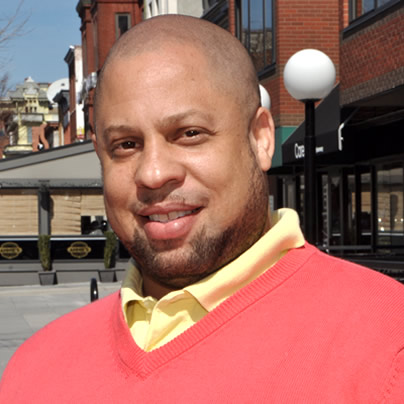
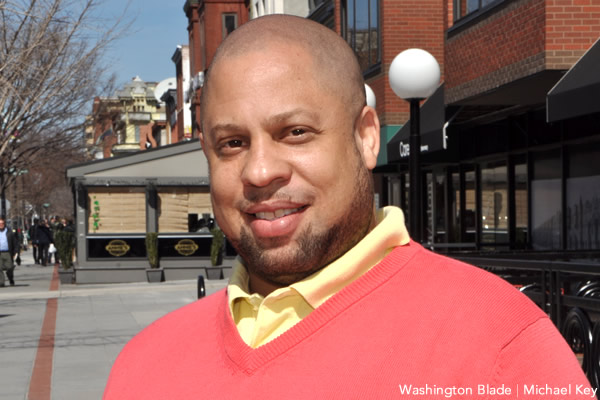
Dane Lewis (Washington Blade photo by Michael Key)
Dane Lewis, executive director of Jamaica Forum for Lesbians, All-Sexuals and Gays, was visiting a gay friend in Kingston, the country’s capital, on a Sunday night in the late 1990s when a group of men slashed three of his car’s tires.
A mob had already formed when he told his friends who were inside the house that they needed to leave. The men eventually stoned Lewis’ car — and a friend who was sitting in the backseat still has shards of glass in his arm after they broke a window.
“We took a girlfriend with us, which we thought would have been a good cover, but that clearly didn’t work,” Lewis told the Washington Blade on Sunday before he attended a D.C. Center-organized mixer at Larry’s Lounge in Dupont Circle. “The community already had an issue with the guy that we went to see and obviously reacted because he had friends that the others thought were gay coming to visit.”
Lewis, who has been with J-FLAG since Feb. 2008, spoke with the Blade roughly two months after he appeared in a public awareness campaign designed to promote greater acceptance of LGBT Jamaicans.
He said reaction to the “We Are Jamaicans” campaign has been “thankfully very positive,” but he has received some negative feedback. This includes a threatening note left on his car outside his Kingston home that read “Batty man for dead” or “Gay man should be murdered” in Jamaican slang.
“We are claiming space in a way that they think we really should keep our lives private and behind closed doors,” Lewis said. “That sadly has been just the way that LGBT people are expected to play to survive in a culture like ours. They would obviously find it offensive that people are being so comfortable with their orientation and the need to speak openly about their realities.”
J-FLAG has faced a number of challenges since its 1998 founding.
A man stabbed Brian Williamson, the organization’s co-founder, to death inside his Kingston home in 2004. Former J-FLAG executive director Gareth Henry sought asylum in Canada in 2008 after he received death threats.
A J-FLAG report said the organization knows of at least 30 gay men who have been murdered in Jamaica between 1997 and 2004. Authorities found honorary British consul John Terry strangled to death inside his home near Montego Bay in 2009 — they found a note left next to his body that referred to him as “batty boy.”
The State Department, Human Rights Watch and other groups have criticized the Jamaican government for not doing enough to curb anti-LGBT violence on the island. J-FLAG is among the organizations that have blasted Buju Banton, Elephant Man, Sizzla and other reggae and dancehall for lyrics they contend incite anti-gay violence.
In spite of these challenges, Lewis notes the country’s LGBT rights movement has seen some advances in recent years.
Jamaican singer Diana King came out as a lesbian last summer in a post to her Facebook page. Beenie Man in the same year apologized for his anti-gay song lyrics.
Prime Minister Portia Simpson said shortly before her Dec. 2011 election her government would review the country’s anti-sodomy law. It has yet to do so, but the Jamaica Supreme Court in June will hear a case that challenges the colonial-era statute on grounds it violates a constitutionally-guaranteed right to privacy.
“It will be a very interesting case to watch,” Lewis said. “It will give a better sense of where the courts are at in terms of protecting the rights of gay, lesbian, bisexual and transgender people.”
Lewis spoke with the Blade a day before Queen Elizabeth II signed a Commonwealth charter with an anti-discrimination statement that reportedly includes an implicit reference to gay men and lesbians. He said President Obama’s statements in support of LGBT rights and same-sex marriage have had a positive effect in Jamaica.
“What it has done has opened up a debate for us around the issue of rights and whether same-sex marriage needs to be on the table,” Lewis said.
Lewis remains optimistic this progress will continue in the years to come.
Health Minister Dr. Fenton Ferguson in December said lawmakers should repeal the country’s anti-sodomy law. A January sexuality symposium included LGBT-specific information, but a recent J-FLAG report found only 17 percent of Jamaicans tolerate gay men and lesbians.
A video showing a mob at a Jamaican university attacking a student whom they reportedly caught in a “compromising position” with another man in a bathroom went viral last November. The clip captures two security officers beating the man while the crowd calls him “batty boy.”
J-FLAG statistics note one third of Jamaicans feel the government has not done enough to protect their LGBT countrymen. Lewis said the Nov. 2012 incident and others like it help “generate the conversation” about gay and lesbian rights in the country.
“We need to capitalize on that energy and begin to have some public discourse,” he said.



Venezuela
AHF client in Venezuela welcomes Maduro’s ouster
‘This is truly something we’ve been waiting for’ for decades
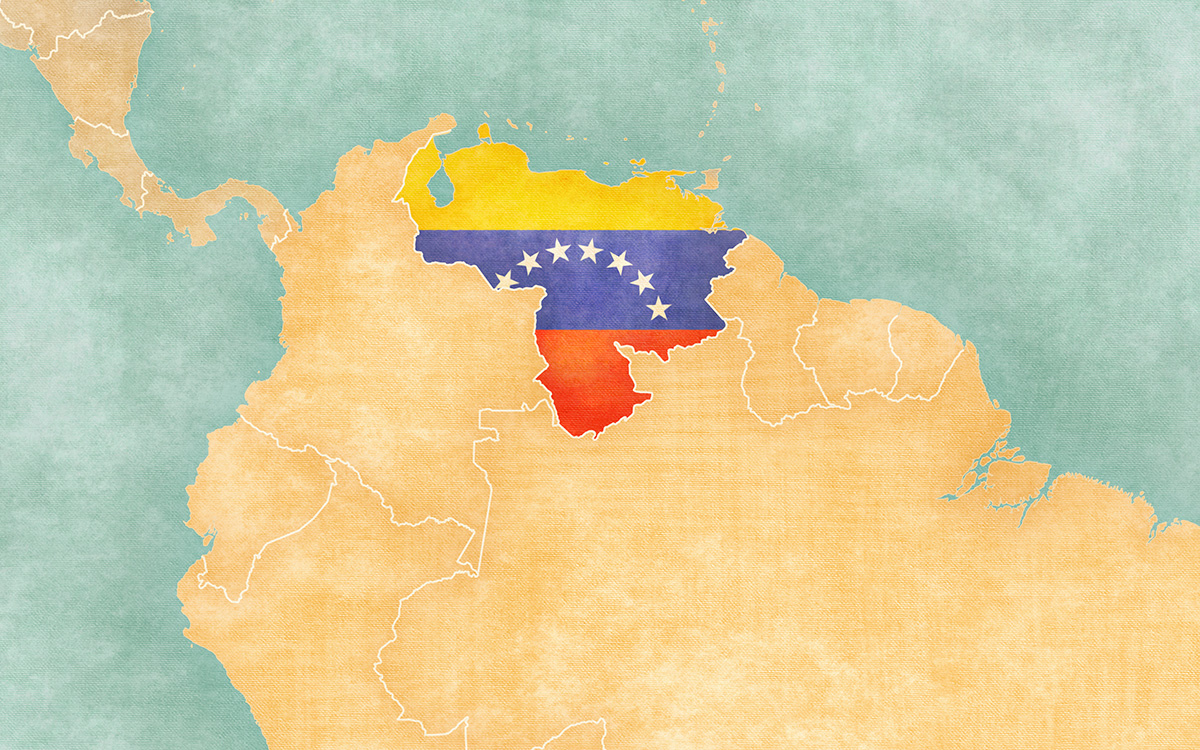
An AIDS Healthcare Foundation client who lives in Venezuela told the Washington Blade he welcomes the ouster of his country’s former president.
The client, who asked the Blade to remain anonymous, on Thursday said he felt “joy” when he heard the news that American forces seized Nicolás Maduro and his wife, Cilia Flores, at their home in Caracas, the Venezuelan capital, during an overnight operation on Jan. 3.
“This is truly something we’ve been waiting for for 26 or 27 years,” the AHF client told the Blade.
Hugo Chávez became Venezuela’s president in 1999. Maduro succeeded him in 2013 after he died.
“I’ve always been in opposition,” said the AHF client, who stressed he was speaking to the Blade in his personal capacity and not as an AHF representative. “I’ve never agreed with the government. When I heard the news, well, you can imagine.”
He added he has “high hopes that this country will truly change, which is what it needed.”
“This means getting rid of this regime, so that American and foreign companies can invest here and Venezuela can become what it used to be, the Venezuela of the past,” he said.
The AHF client lives near the Colombia-Venezuela border. He is among the hundreds of Venezuelans who receive care at AHF’s clinic in Cúcuta, a Colombian city near the Táchira River that marks the border between the two countries.
The Simón Bolívar Bridge on the Colombia-Venezuela border on May 14, 2019. (Washington Blade video by Michael K. Lavers)
The AHF client praised U.S. President Donald Trump and reiterated his support for the Jan. 3 operation.
“It was the only way that they could go,” he said.
The Venezuelan National Assembly on Jan. 4 swore in Delcy Rodríguez, who was Maduro’s vice president, as the country’s acting president. The AHF client with whom the Blade spoke said he is “very optimistic” about Venezuela’s future, even though the regime remains in power.
“With Maduro leaving, the regime has a certain air about it,” he said. “I think this will be a huge improvement for everyone.”
“We’re watching,” he added. “The actions that the United States government is going to implement regarding Venezuela give us hope that things will change.”
Colombia
Colombians protest against Trump after he threatened country’s president
Tens of thousands protested the US president in Bogotá
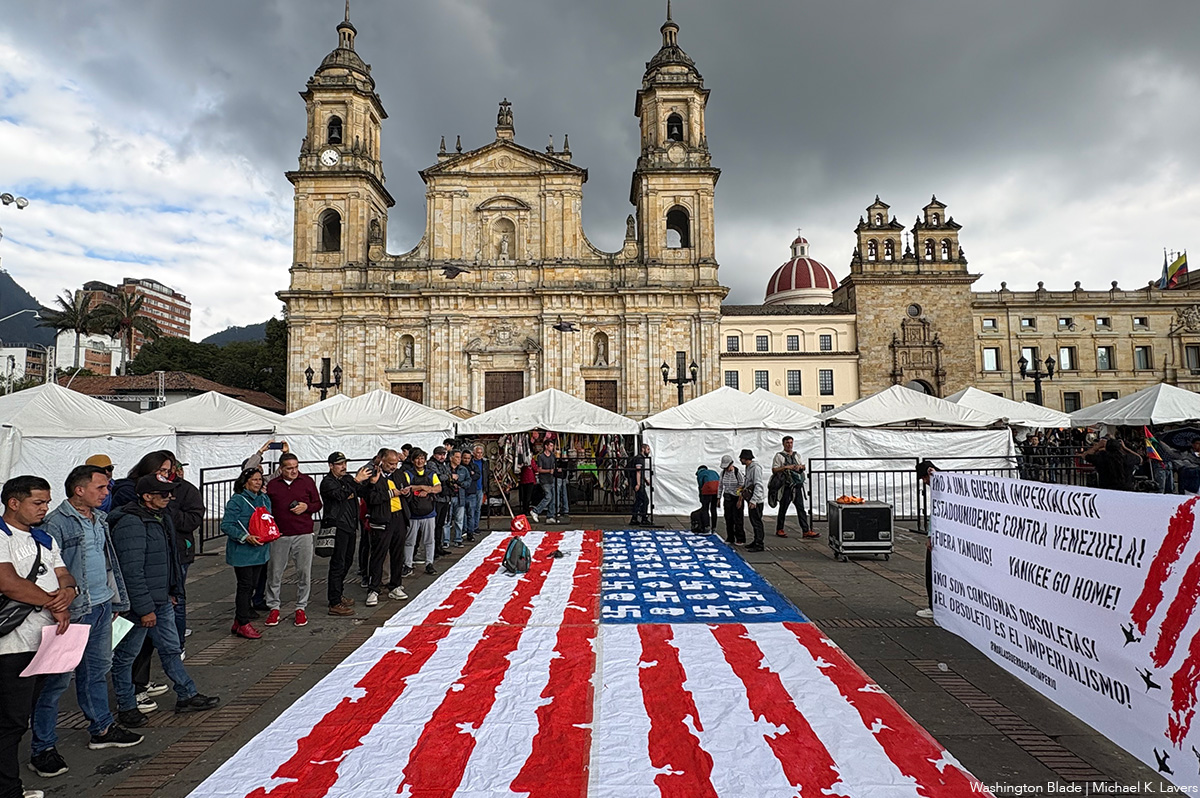
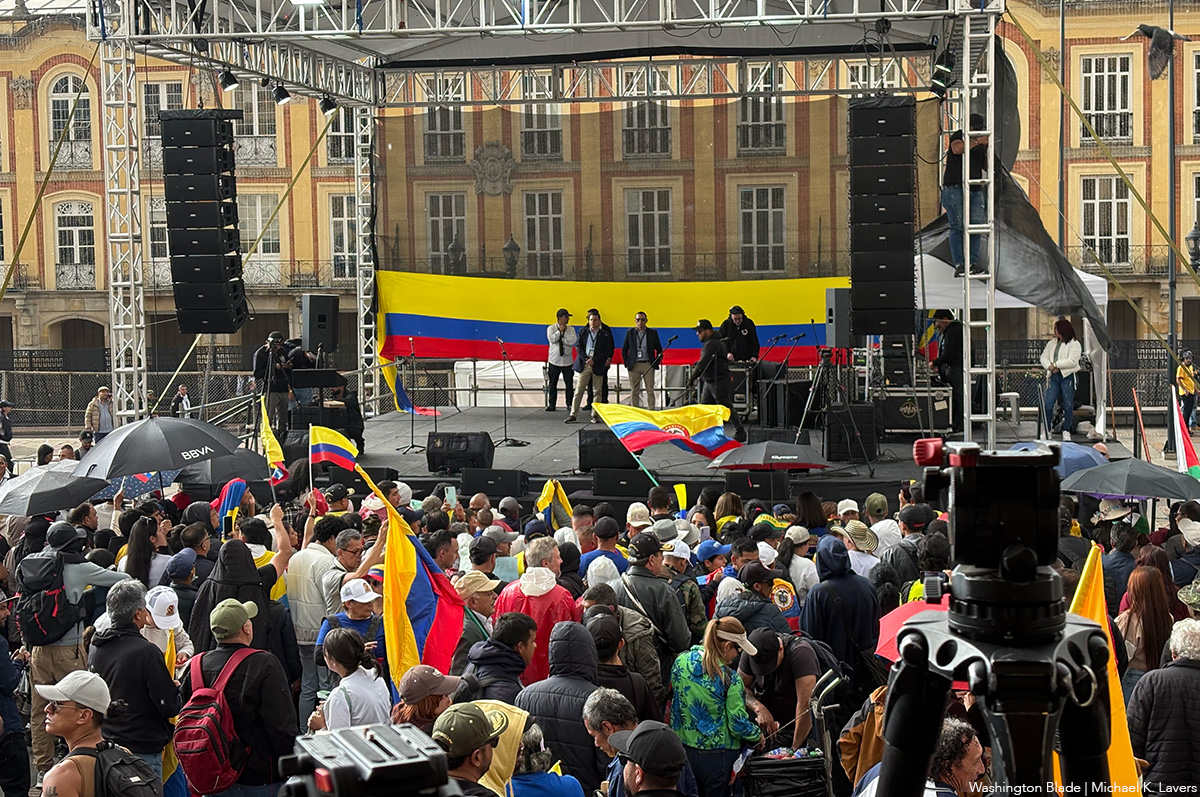
BOGOTÁ, Colombia — Tens of thousands of people on Wednesday gathered in the Colombian capital to protest against President Donald Trump after he threatened Colombian President Gustavo Petro.
The protesters who gathered in Plaza Bolívar in Bogotá held signs that read, among other things, “Yankees go home” and “Petro is not alone.” Petro is among those who spoke.
The Bogotá protest took place four days after American forces seized now former Venezuelan President Nicolás Maduro and his wife, Cilia Flores, at their home in Caracas, the Venezuelan capital, during an overnight operation.
The Venezuelan National Assembly on Sunday swore in Delcy Rodríguez, who was Maduro’s vice president, as the country’s acting president. Maduro and Flores on Monday pleaded not guilty to federal drug charges in New York.
Trump on Sunday suggested the U.S. will target Petro, a former Bogotá mayor and senator who was once a member of the M-19 guerrilla movement that disbanded in the 1990s. Claudia López, a former senator who would become the country’s first female and first lesbian president if she wins Colombia’s presidential election that will take place later this year, is among those who criticized Trump’s comments.
The Bogotá protest is among hundreds against Trump that took place across Colombia on Wednesday.
Petro on Wednesday night said he and Trump spoke on the phone. Trump in a Truth Social post confirmed he and his Colombian counterpart had spoken.
“It was a great honor to speak with the president of Colombia, Gustavo Petro, who called to explain the situation of drugs and other disagreements that we have had,” wrote Trump. “I appreciated his call and tone, and look forward to meeting him in the near future. Arrangements are being made between Secretary of State Marco Rubio and the foreign minister of Colombia. The meeting will take place in the White House in Washington, D.C.”
Colombia
Gay Venezuelan man who fled to Colombia uncertain about homeland’s future
Heberth Aguirre left Maracaibo in 2018

BOGOTÁ, Colombia — A gay Venezuelan man who has lived in Colombia since 2018 says he feels uncertain about his homeland’s future after the U.S. seized now former Venezuelan President Nicolás Maduro.
“On one hand I can feel happy, but on the other hand I feel very concerned,” Heberth Aguirre told the Washington Blade on Tuesday during an interview at a shopping mall in Bogotá, the Colombian capital.
Aguirre, 35, is from Maracaibo, Venezuela’s second-largest city that is the heart of the country’s oil industry.
He developed cultural and art initiatives for the Zulia State government.
“Little by little, I suddenly became involved in politics because, in a way, you had to be involved,” recalled Aguirre. “It was necessary to be involved because the regime often said so.”
“I basically felt like I was working for the citizens, but with this deeply ingrained rule we had to be on their side, on the side of the Maduro and (former President Hugo) Chávez regime,” he added.
Maduro in 2013 became Venezuela’s president after Chávez died.
“There are things I don’t support about the regime,” Aguirre told the Blade. “There are other things that were nice in theory, but it turned out that they didn’t work when we put them into practice.”
Aguirre noted the Maduro government implemented “a lot of laws.” He also said he and other LGBTQ Venezuelans didn’t “have any kind of guarantee for our lives in general.”
“That also exposed you in a way,” said Aguirre. “You felt somewhat protected by working with them (the government), but it wasn’t entirely true.”
Aguirre, 35, studied graphic design at the University of Zulia in Maracaibo. He said he eventually withdrew after soldiers, members of Venezuela’s Bolivarian National Guard, and police officers opened fire on students.
“That happened many times, to the point where I said I couldn’t keep risking my life,” Aguirre told the Blade. “It hurt me to see what was happening, and it hurt me to have lost my place at the university.”
Venezuela’s economic crisis and increased insecurity prompted Aguirre to leave the country in 2018. He entered Colombia at the Simón Bolívar Bridge near the city of Cúcuta in the country’s Norte de Santander Province.
“If you thought differently, they (the Venezuelan government) would come after you or make you disappear, and nobody would do anything about it,” said Aguirre in response to the Blade’s question about why he left Venezuela.
The Simón Bolívar Bridge on the Colombia-Venezuela border on May 14, 2019. (Washington Blade video by Michael K. Lavers)
Aguirre spoke with the Blade three days after American forces seized Maduro and his wife, Cilia Flores, at their home in Caracas, the Venezuelan capital, during an overnight operation.
The Venezuelan National Assembly on Sunday swore in Delcy Rodríguez, who was Maduro’s vice president, as the country’s acting president. Maduro and Flores on Monday pleaded not guilty to federal drug charges in New York.
President Donald Trump on Tuesday in a Truth Social post said Venezuela’s interim authorities “will be turning over between 30 and 50 million barrels of high quality, sanctioned oil, to the United States of America.”
“This oil will be sold at its market price, and that money will be controlled by me, as president of the United States of America, to ensure it is used to benefit the people of Venezuela and the United States,” wrote Trump.
Trump on Sunday suggested the U.S. will target Colombian President Gustavo Petro, a former Bogotá mayor and senator who was once a member of the M-19 guerrilla movement that disbanded in the 1990s.
Petro has urged Colombians to take to the streets on Wednesday and “defend national sovereignty.” Claudia López, a former senator who would become the country’s first female and first lesbian president if she wins Colombia’s presidential election that will take place later this year, is among those who criticized Trump’s comments.
“Let’s be clear: Trump doesn’t care about the humanitarian aspect,” said Aguirre when the Blade asked him about Trump. “We can’t portray him as Venezuela’s savior.”
Meanwhile, Aguirre said his relatives in Maracaibo remain afraid of what will happen in the wake of Maduro’s ouster.
“My family is honestly keeping quiet,” he said. “They don’t post anything online. They don’t go out to participate in marches or celebrations.”
“Imagine them being at the epicenter, in the eye of the hurricane,” added Aguirre. “They are right in the middle of all the problems, so it’s perfectly understandable that they don’t want to say anything.”
‘I never in my life thought I would have to emigrate’
Aguirre has built a new life in Bogotá.
He founded Mesa Distrital LGBTIQ+ de Jóvenes y Estudiantes, a group that works with migrants from Venezuela and other countries and internally placed Colombians, during the COVID-19 pandemic. Aguirre told the Blade he launched the group “with the need to contribute to the general population, not just in Colombia.”
Aguirre met his husband, an American from California, at a Bogotá church in December 2020 during a Christmas event that SDA Kinship Colombia, an LGBTQ group, organized. A Utah judge virtually officiated their wedding on July 12, 2024.
“I love Colombia, I love Bogotá,” said Aguirre. “I love everything I’ve experienced because I feel it has helped me grow.”
He once again stressed he does not know what a post-Maduro Venezuela will look like.
“As a Venezuelan, I experienced the wonders of that country,” said Aguirre. “I never in my life thought I would have to emigrate.”
The Colombian government’s Permiso por Protección Temporal program allows Aguirre and other Venezuelans who have sought refuge in Colombia to live in the country for up to 10 years. Aguirre reiterated his love for Colombia, but he told the Blade that he would like to return to Venezuela and help rebuild the country.
“I wish this would be over in five years, that we could return to our country, that we could go back and even return with more skills acquired abroad,” Aguirre told the Blade. “Many of us received training. Many of us studied a lot. We connected with organizations that formed networks, which enriched us as individuals and as professionals.”
“Returning would be wonderful,” he added. “What we’ve built abroad will almost certainly serve to enrich the country.”

Feminist fiction fans will love ‘Bog Queen’

A Shakespearean tragedy comes to life in exquisite ‘Hamnet’

Hundreds protest ICE killing of Renee Nicole Good in D.C.

Calendar: January 9-15

Support the Blade as mainstream media bend the knee for Trump

What to watch for in 2026: midterms, Supreme Court, and more

Blade travels to Colombia after U.S. forces seize Maduro in Venezuela

Tim Walz drops out of Minn. governor’s race

LGBTQ groups to join Spanberger inaugural parade

A reminder that Jan. 6 was ‘textbook terrorism’
-

 National4 days ago
What to watch for in 2026: midterms, Supreme Court, and more
-
Colombia5 days ago
Blade travels to Colombia after U.S. forces seize Maduro in Venezuela
-
Minnesota5 days ago
Tim Walz drops out of Minn. governor’s race
-
Virginia5 days ago
LGBTQ groups to join Spanberger inaugural parade