Politics
Leahy poised to help bi-national gay couples on Senate floor
‘Mini-DOMA repeal’ amendment was withdrawn during panel consideration
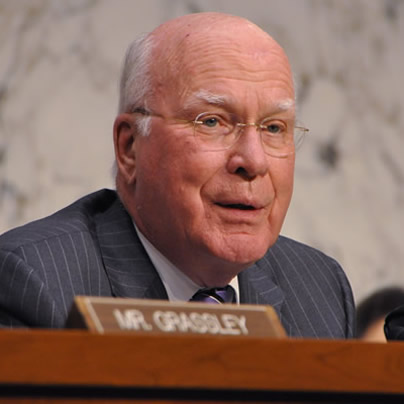
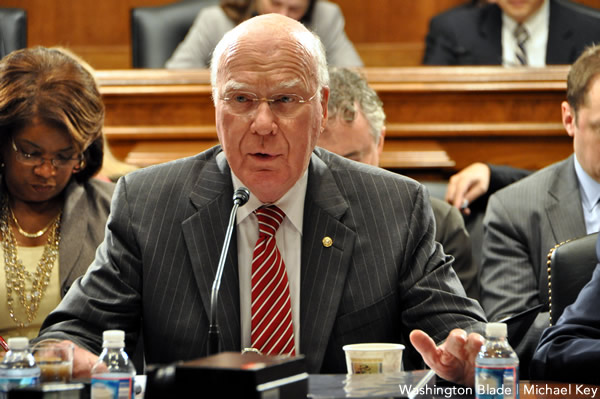
Sen. Patrick Leahy (D-Vt.) filed a floor amendment for bi-national gay couples. (Blade file photo by Michael Key)
The Senate Democrat who has championed legislation for bi-national same-sex couples has filed a floor amendment to ensure they can stay together in the United States without fear of separation.
Sen. Patrick Leahy (D-Vt.) announced on Tuesday he filed an amendment to comprehensive immigration reform along the lines of a carve-out to the Defense of Marriage Act that he proposed — and withdrew — when the Senate Judiciary Committee was considering the bill.
“Seeking equal protection under our laws for the LGBT community is the right thing to do,” Leahy said in a statement. “I withheld my anti-discrimination amendment during the Senate Judiciary Committee markup. As the entire Senate turns to debate the immigration bill, the fight for equality must go on.”
The amendment filed by Leahy, No. 1182, would repeal part of DOMA to enable married bi-national same-sex couples to apply for a visa through the marriage-based green-card application process.
It was one of two amendments that Leahy filed when immigration reform was before committee. The other amendment mirrored the Uniting American Families Act, which would allow gay Americans to sponsor their foreign “permanent partners” for residency in the United States.
Leahy withdrew the amendments from the committee — saying he was doing so with “a heavy heart” — after Republicans said they’d bolt from immigration reform if it were adopted and Democrats said they couldn’t bring themselves to vote for the amendment if it meant the larger bill would lose bipartisan support.
LGBT advocates, who expressed displeasure with the failure of the committee to include bi-national same-sex couples as part of immigration reform, had asked for a floor amendment when the bill came before the full Senate.
Steve Ralls, a spokesperson for Immigration Equality, praised Leahy and said the amendment would be “consistent with Sen. Leahy’s long-time commitment to LGBT binational families.”
“From the first introduction of UAFA more than a decade ago to his strong show of support during the Committee mark-up, he has always been at the forefront of the work to ensure our immigration system treats everyone fairly,” Ralls said. “If the Supreme Court doesn’t end this injustice, I have no doubt Senator Leahy can, and will. We will do everything we can to help him in that effort.”
Speaking on condition of anonymity, advocates said Leahy introduced the “mini-DOMA repeal” amendment — and not the one that more closely mirrored UAFA — because the former is more likely to reach the 60-vote threshold to end a filibuster on the Senate floor. Sen. Dianne Feinstein (D-Calif.), for example, voiced concerns last month about UAFA because she’s “not for just accepting affidavits.”
Lavi Soloway, a gay immigration attorney and co-founder of The DOMA Project, said the floor amendment filed by Leahy doesn’t change U.S. immigration code, but “simply removes the extrinsic barrier” caused by DOMA that prevents gay Americans from filing petitions for their spouses.
“The implication of Sen. Leahy’s focus on equality is the overarching message that our families are no different than any other American families comprised of citizens and non-citizens,” Soloway said. “We must have access to the same immigration law protections that ensure that no family is torn apart.”
Filing the amendment doesn’t necessarily mean Leahy will for certain offer the measure on the Senate floor. The U.S. Supreme Court may issue a ruling against DOMA as a result of pending litigation this month that would make offering the measure a moot point.
But Jessica Brady, a Leahy spokesperson, said she “can’t predict” whether offering the amendment would be dependent on a Supreme Court decision that upholds DOMA.
Fred Sainz, vice president of communications for the Human Rights Campaign, said determining whether the amendment has 60 votes for passage is difficult as the wait continues on the Supreme Court decision for DOMA.
“Your 60 vote question is unclear at this point and there’s a lot of moving parts to this amendment, like will the decision from SCOTUS come down first, like this Thursday,” Sainz said.






The White House
HRC files class action over federal ban on gender-affirming care coverage
Lawsuit filed Monday challenges White House effort to restrict care

The Human Rights Campaign Foundation, the nonprofit sister organization to the largest LGBTQ human rights lobbying and advocacy organization in the U.S., along with law firms Correia & Puth and Cohen Milstein Sellers & Toll, filed a class action lawsuit against the government as it attempts to restrict gender-affirming healthcare for federal employees.
The suit, filed on Monday, alleges that the Office of Personnel Management, run by Trump appointee Scott Kupor, is discriminating against LGBTQ federal employees (and their families and retired employees) by prohibiting health insurance coverage for gender-affirming care under the Federal Employees Health Benefits and Postal Service Health Benefits plans. There are five plaintiffs named in the complaint, but it extends to others who have those healthcare plans.
The document asserts that OPM’s prohibition on coverage for “gender transition” care in the FEHB and PSHB programs violates Title VII, the federal law that prohibits discrimination based on sex, race, color, religion, or national origin.
The policy, which was implemented on Jan. 1 following the 2025 issuing of Program Carrier Letter, mandated that insurance providers in these programs deny any coverage for gender-affirming care. In February, HRC filed a federal complaint with OPM over the change in healthcare policy, which was ultimately passed to the Equal Employment Opportunity Commission for review. That complaint is now an officially filed class action lawsuit in the U.S. District Court for the District of Columbia.
Research from the Williams Institute at UCLA Law, a think tank that collects data and conducts research on issues related to sexual orientation and gender identity, indicates that this policy denying gender-affirming care will impact healthcare access for at least 39,400 current and former federal employees and their dependents.
Human Rights Campaign President Kelley Robinson released a statement following the lawsuit’s filing.
“Our message to the Trump administration is simple: we’ll see you in court,” said Robinson. “Healthcare access should never be weaponized to advance discrimination — and the denial of coverage for critical healthcare based simply on who you are blatantly violates the rights of all of us.”
Gender-affirming care has been under constant attack by the Trump-Vance administration since its return to the White House, despite the practice being considered as extensively evidence-based but also supported by nearly every major medical organization. This type of care is provided to all people—not just transgender people—and includes things such as social affirmation, including using correct names and pronouns and wearing clothing that matches a person’s gender identity; mental health support, such as counseling to reduce depression and anxiety; and, in some cases, medical interventions such as reversible puberty blockers or hormone therapy when deemed medically appropriate.
“Federal employees have been through the wringer with the Trump administration,” said Cathy Harris, partner at Correia & Puth. “We draw the line at blatant discrimination to deny healthcare to our nation’s dedicated civil servants.”
“This odious policy is the latest example of the Trump administration’s obsession with targeting transgender people, using shameful and cruel tactics to threaten their employment, their health, and the well-being of themselves and their families,” Robinson added. “OPM’s actions will not go unchallenged, and we’ll continue to fight so that federal employees and their families receive the dignity they deserve.”
This is not the first time the White House has directly attacked gender-affirming care.
In January 2025, the administration issued Executive Order 14187, titled “Protecting Children from Chemical and Surgical Mutilation.” The order directs federal agencies to restrict gender-affirming medical care — including puberty blockers, hormone therapy, and surgeries — for individuals under the age of 19.
For more information on how to get involved with the lawsuit, visit hrc.org.
Politics
Buttigieg indicates he may run for president in 2028
Former Transportation Secretary was in Biden-Harris administration’s Cabinet

Former Transportation Secretary Pete Buttigieg told a podcaster he is considering throwing his hat in the ring for president once again.
“I don’t know,” Buttigieg told Steven Bartlett, the British host of The Diary of a CEO, the most popular top business and tech podcast on Spotify, which aired Monday. “I think I’m more inclined than not, but there’s so much we don’t know.”
“There’s so much I don’t even know about what’s going to happen this year, let alone … what we need to know later,” he added.
Buttigieg is no stranger to running for the Oval Office.
In 2019, the former South Bend, Ind., mayor was a serious contender in the Democratic primary for the 2020 presidential election but ultimately ended his campaign and endorsed Joe Biden.
In May, an Emerson College Polling survey found Buttigieg at the top of the list of potential presidential contenders, leading California Gov. Gavin Newsom, New York Congresswoman Alexandria Ocasio-Cortez, former Vice President Kamala Harris, and others.
In addition to discussing his future in federal politics, Buttigieg also discussed President Donald Trump’s handling of the Iran war — which reached its 5-month mark two weeks ago — the changing landscape of U.S. jobs due to the rise of artificial intelligence, and the growing national debt, all issues he could face if he ultimately returns to the White House.
Following his 2020 presidential campaign, Buttigieg gained prominence within the Democratic Party, eventually leading to his confirmation as Transportation Secretary. In February 2021, he became the first openly gay Cabinet member to be confirmed by the U.S. Senate.
In addition to his experience as an elected official, the 44-year-old served as a Navy intelligence officer in the reserves from 2009-2017, including a seven-month deployment to Afghanistan in 2014. Buttigieg came out as gay in 2015 and later married his husband, Chasten Glezman, in 2018. The couple now has two children: twins.
Buttigieg also has an extensive educational background.
He graduated from Harvard University with a bachelor’s degree in history and literature and later became a Rhodes Scholar, attending the University of Oxford, where he earned a bachelor’s degree in philosophy, politics, and economics.
This is not the first time Buttigieg has made headlines this year.
In June, he went public about being falsely accused of posing a threat to his children’s safety. An anonymous police report claimed he was a danger to his 4-year-old twins and was not allowed to be with them until after police interviews were conducted.
The police report was later determined to be false. The Washington Blade reached out to the Michigan State Police to ask what course of action, if any, would be taken against the woman who filed the false report, but the agency did not answer the question.
The Blade reached out to Buttigieg’s team for comment on his potential 2028 presidential bid, but did not hear back before publication.
Congress
House blocks effort to codify transgender servicemember ban into law
Lawmakers approved two anti-trans NDAA amendments

The U.S. House of Representatives on Tuesday rejected an amendment to the National Defense Authorization Act that would have codified a ban transgender servicemembers in the military.
The bipartisan vote was 212-217.
The NDAA is for the 2027 fiscal year and sets policies for the Defense Department programs and activities and the national security programs of the Department of Energy.
U.S. Rep. Lauren Boebert (R-Colo.) proposed the amendment on July 21. It stated that all personnel are required to serve in accordance with their biological sex, citing military readiness and discipline.
Human Rights Campaign Senior Director of Government Affairs Jennifer Pike Bailey stated that she is grateful for the bipartisan vote that rejected President Donald Trump and Defense Secretary Pete Hegseth’s “dangerous and discriminatory policy that has kicked brave transgender servicemembers out of the military and weakened our national security.”
“Everyone who meets the same rigorous standards should be able to serve their country. We should honor that patriotism, particularly in this moment where we are witnessing brave servicemembers making the ultimate sacrifice for our country, instead of ending their careers and politicizing their existence. We’re grateful that a permanent extension of this ban failed, and we will keep fighting to reverse this senseless policy,” Bailey said.
Mark Takano, chair of the Congressional Equality Caucus, stated that he and his members put in countless hours of work to kill the amendment.
“When Americans know they or their families are going to be targeted by or not supported by the military, that leads them to avoid signing up to serve or staying in the service — making it harder to keep the ranks of the armed services full and our nation safe. My colleagues in the Equality Caucus and I will continue working to prevent these attacks on our servicemembers and their families from becoming law,” Takano said.
According to the Congressional Equality Caucus, two other bills could potentially be passed that would also target the transgender community, both of which were proposed by U.S. Rep. Nancy Mace (R-S.C.).
The first was a bill that would have prohibited gender-related medical care under TRICARE and to prevent TRICARE from covering certain gender-related medical procedures and treatments, which was approved in a vote of 219-208.
The second was a bill that would have prohibited male participation in female sports at DoDEA schools. DoDEA schools are Department of Defense Dependents Schools, which is a network of primary and secondary schools.
The amendment was approved in a vote of 221-203.

Gay ANC commissioner sues D.C. over police ‘failure’ to pay reward money

New LGBTQ visitor center slated for Wilmington, Del.

Jason DePuy on coping with homophobia in ‘Big Brother’ house

2 former NBA players launch cheap anti-trans stunt to exploit WNBA rules

Same-sex couples challenges India income tax law

HRC condemns DoE removal of LGBTQ bullying data from federal survey

Dutch PM: More needs to be done to defend trans rights

New book chronicles gay man’s life in hippie commune

PHOTOS: Daddy Issues at Kiki