Delaware
Carper’s retirement opens historic possibilities in Delaware
Blunt Rochester likely to run for Senate; McBride could become first out trans member of Congress
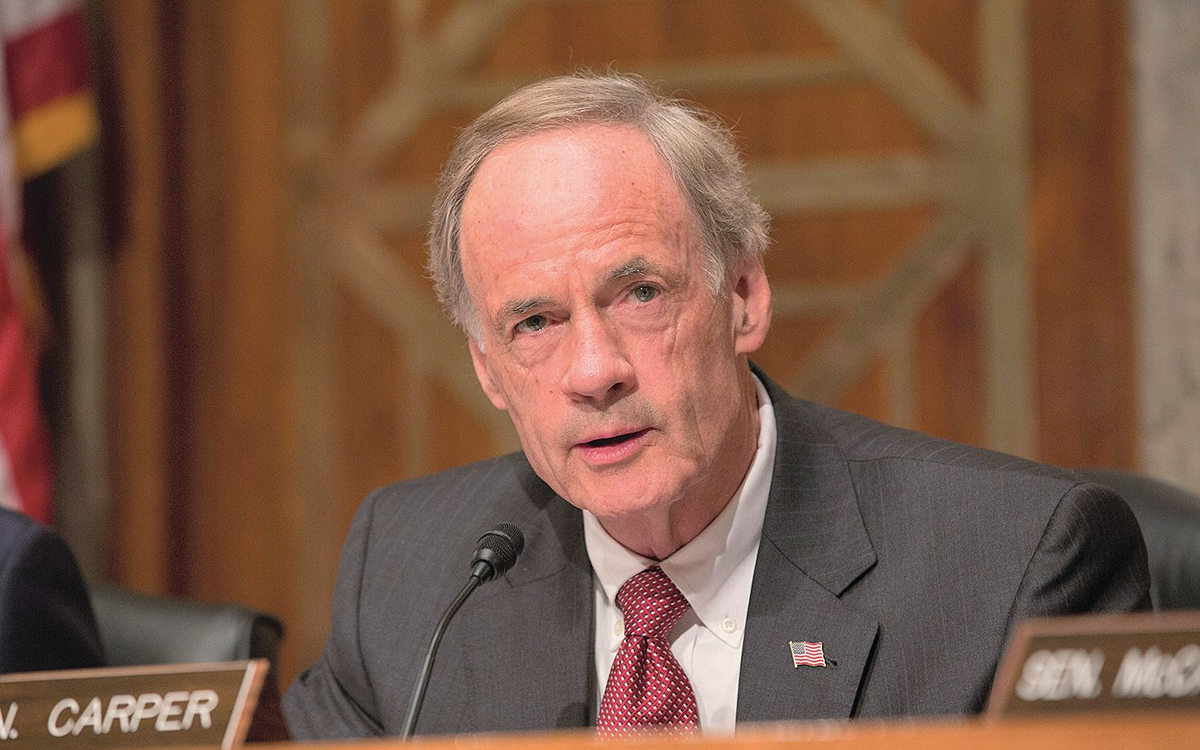
As Delaware governor, he signed a bill that defined marriage as being between a man and a woman in 1996. Now, 27 years later, the Human Rights Campaign gives Sen. Tom Carper a perfect score on LGBTQ issues in Congress.
That man, who turned from opponent of marriage equality to LGBTQ rights supporter, announced his retirement last week. Unlike other Senate races across the country, though, there is little doubt who will succeed him.
He endorsed Delaware’s lone representative in the House, Lisa Blunt Rochester, as his successor in a news conference last week.
“I spoke with her this morning, I said, ‘You’ve been patient, waiting for me to get out of the way, and I’m going to get out of the way, and I hope you run, and I hope you’ll let me support you in that mission,’” he said with a laugh. “And she said, ‘Yes I will let you support me.’ And so I’m going to.’”
Carper plans to serve out the remainder of his term, which ends in 2024. He serves as chair of the Senate’s Environment and Public Works Committee. Previously, he was chair of the Homeland Security Committee. He served as Delaware’s governor from 1993-2001 and represented Delaware in the House.
The Human Rights Campaign has given Blunt Rochester a perfect score in the last two congresses, and an almost perfect one in the 2017-2018 congress based on her voting record on LGBTQ issues. It did not respond to a phone call and two emails to spokespeople but praised her and Carper in 2018.
“Every time they take the train down to Washington, Senator Carper and Congresswoman Blunt Rochester carry with them the hopes of all Delawareans,” the organization wrote in a press release. “With the LGBTQ community under attack by the Trump-Pence administration, Senator Carper and Congresswoman Blunt Rochester have tirelessly fought to defend our progress and advance equality for LGBTQ people both in Delaware and around the nation.”
Blunt Rochester would be the first Black person and first woman to represent Delaware in the Senate. She has close ties to Delaware’s LGBTQ community and a record as a strong ally. She has served as keynote speaker at the Washington Blade’s annual Summer Kickoff Party in Rehoboth Beach three times, thrilling the LGBTQ crowd with her passionate support for equality.
She said she is “interested” in running, but neither she nor her spokesperson reached last week would say any more.
“I don’t have a bad thing to say about her,” said longtime LGBTQ activist and Delaware lawyer Mark Purpura. It was responsible of Carper to retire, he added.
Assuming she runs as expected, that would leave Blunt Rochester’s seat in the House open. Sarah McBride, the first openly transgender state senator in the U.S., could fill that seat. A source familiar with her thinking said she will “100%” run for Rochester’s seat.
That would make her the first openly transgender member of Congress. Her run would be a “great opportunity” to showcase the Delaware Democratic Party’s diversity,” Purpura said.
Peter Schott, secretary of the Delaware Stonewall PAC, agreed, noting that McBride is very popular and can raise a lot of money.
McBride, who did not respond to an email and two calls to her office, is one of five openly LGBTQ lawmakers in the Delaware Legislature, a record number for the state.
“I think Sarah is absolutely wonderful,” said colleague Eric Morrison, a gay man who represents parts of Newark and other communities in his 27th district in the Delaware House. “I wish her well.”




Delaware
Republican challenger misgenders McBride during forum, forced to leave
Jewish Federation of Delaware hosted event on Thursday
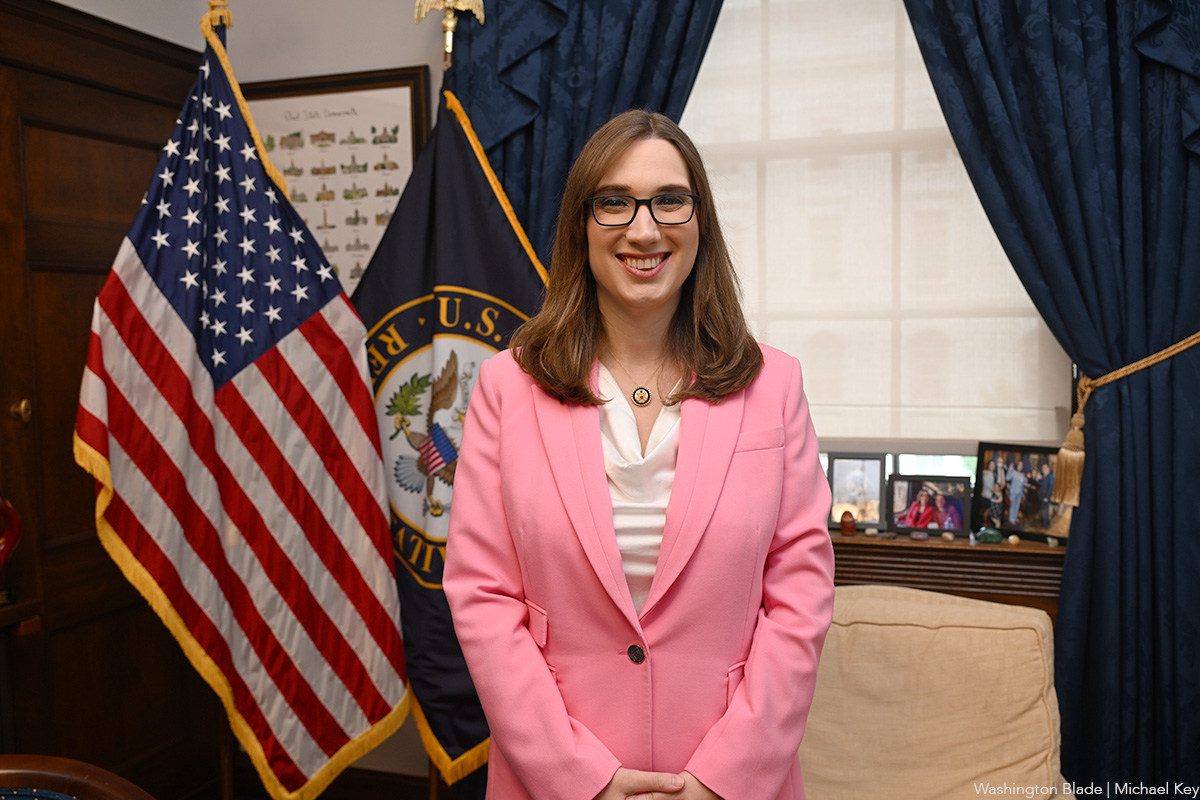
Republican “Dr. Joe” Arminio, the Republican nominee for the First State’s at-large U.S. House of Representatives seat, attempted to misgender the the country’s first and only transgender member of Congress while at a forum on Thursday.
This story was first broken by WDEL out of Wilmington, Del.
Arminio used the terms “his” and later “gentleman” when referring to U.S. Rep. Sarah McBride (D-Del.) during his time on the mic before he was asked to leave the forum, hosted by the Jewish Federation of Delaware at the Siegel Jewish Community Center in Talleyville on Thursday night.
At that point, the crowd of about 100 people largely started booing Arminio, who then finished, “I would like to show respect to the speaker, that would be nice.”
The first time Republican US House candidate “Dr. Joe” Arminio referred to Rep. Sarah McBride (D) as a man during Thursday’s debate at the Siegel Jewish Community Center in Talleyville. He was warned for his comment. #netde https://t.co/j4EaMOL84W
— Sean Greene (@SeanGreeneWDEL) September 18, 2026
Moderator Ken Grant waited until Arminio was finished, then said, “this is your final warning, if you fail to show respect to anyone else on this stage, you’ll be asked to leave.”
During the answer to his next question at the forum, Arminio responded to what he called an “error.”
“I committed an error before, and I do acknowledge it,” Arminio said. “It’s not the first error I’ve made in this campaign, or at any point in my future life.”
Despite the apology and acknowledgement that he had committed what was, at the very least, a social taboo, he did it again 12 minutes later.
While talking about rising healthcare costs being a “catastrophe,” Arminio pointed to U.S. Sen. Chris Coons (D-Del.) and McBride.
“The reason it is is because gentlemen like the two up here with me in the Democratic Party, and the Republican Party … ” Arminio said.
Despite his direct attacks on McBride’s gender identity, she responded to the situation with grace, attempting to intervene to allow Arminio to still have a chance to speak despite not heeding the moderator’s warnings.
“I don’t want this gentleman to not have the ability … ,” McBride began.
However, Republican Senate candidate Michael Katz interrupted her shortly before Arminio was removed from the forum, which was meant to inform the Delaware electorate on the candidates’ issues.
Katz had his opening statement next and directly condemned Arminio’s comments.
“I would like to apologize to everybody here and everybody else on this stage. As a physician, I believe in our common humanity and respect for each other. I feel that pain over those comments, and my apologies.”
Following the forum, Katz called for Arminio to exit the race via social media.
“Those who seek to represent Delaware must demonstrate integrity, judgment, decency, and respect — even toward people with whom they profoundly disagree,” Katz’s post read on Facebook. “For these reasons, I am calling on Joseph Arminio to withdraw his candidacy for the United States House of Representatives.”
This is not the first time McBride has been the victim of misgendering.
In 2025, House Foreign Affairs Committee Chair Rep. Keith Self (R-Texas) introduced the sole representative from Delaware as “Mr. McBride” during a meeting.
This is also not the first time McBride has faced vitriol from the other side of the aisle — both in terms of personal and legislative attacks on her trans identity.
In 2025, the House voted to ban trans girls and women from playing school sports with other girls, while U.S. Rep. Nancy Mace (R-S.C.) pushed for legislation barring trans women from using women’s bathrooms.
House Speaker Mike Johnson (R-La.) instituted a similar rule barring McBride — and all other trans women — from women’s restrooms on Capitol Hill.
McBride has also been a vocal opponent of Executive Order 14168, “Defending Women from Gender Ideology Extremism and Restoring Biological Truth to the Federal Government,” signed by President Donald Trump on his first day in office. The directive prohibits the federal government from recognizing the gender identity of trans people.
She has criticized Executive Order 14183, “Prioritizing Military Excellence and Readiness,” which would ban trans service members from serving in the Armed Forces. The directive is still being challenged in the courts to determine its constitutional legitimacy, but it has been allowed to remain in effect as the judicial system considers its legality.
The Washington Blade sat down with McBride in May to reflect on a tense year for LGBTQ politics, where she, in typical McBride fashion, answered questions about the hate she has received.
“Our politics are too often defined by hate,” McBride told the Blade. “I’m glad Delaware and Delawareans are showing that a different kind of politics is possible.”
Delaware
Gay man sues Delaware AG for not prosecuting partner in domestic violence case
Also accuses Univ. of Delaware of failing to discipline Ph.D. student named as attacker
Tymothy ‘Ty’ Moyer, a gay former resident of Wilmington, Del., earlier this year filed a lawsuit in federal court charging Delaware Attorney General Kathleen ‘Kathy’ Jennings, one of her deputies, and a state-employed victims advocate with conspiring to deny him “equal protection” under the law because he is African American by declining to prosecute his then domestic partner after the partner’s arrest on Feb. 3, 2024, for assaulting and seriously injuring him, causing a “permanent traumatic brain injury.”
The lawsuit also names as defendants the University of Delaware and one of its officials for allegedly failing to sufficiently discipline Michael Uzu, Moyer’s former partner and alleged attacker, who at the time was a graduate student seeking a Ph.D. in chemistry.
According to the lawsuit, following his arrest on an assault charge, the university conducted an investigation of Uzu and found he violated the university’s policy of student conduct by engaging in domestic violence, but issued a deferred suspension until December 2025, allowing him to continue his studies. Moyer has said the university acted improperly by not expelling Uzu from its Ph.D. program because of the seriousness of the assault.
The lawsuit identifies Uzu, 33, as a citizen of Nigeria with a U.S. student visa. Uzu identifies himself on his LinkedIn page as a chemist who was conducting research for the Delaware-based chemical company Chemours while studying advanced chemistry at the University of Delaware. His LinkedIn page says he received his Ph.D. in 2026.
Moyer, 30, who identifies himself in his lawsuit as African American and a lifelong U.S. citizen, provided the Washington Blade with a statement describing the details of his allegations against Uzu.
“On the late evening of February 2 through the morning of the 3rd, in 2024, I ended the relationship and asked Michel ‘Mike’ Uzu to leave my apartment in Wilmington, Delaware,” his statement says. “I was ending the relationship after months of escalating mistreatment,” the statement says, adding that Uzu refused to leave his apartment and started a confrontation.
“Uzu attacked me,” the statement continues. “He struck me repeatedly with his fists, with my own cell phone, and with a titanium lacrosse stick that he picked up from inside the apartment and used to strike me on the head. I suffered severe facial trauma, swelling, bodily bruising, and required surgical staples to close the lacerations on the top of my skull.”
The statement adds, “During the assault, Uzu told me he would kill me if I told anyone. Outside the apartment building, Uzu picked up a large rock and positioned himself to strike me with it before a bystander intervened.” It says Moyer was then transported to the emergency room of a nearby hospital.
Moyer’s lawsuit says Uzu was arrested by Wilmington police, indicted by a grand jury, and arraigned on felony and misdemeanor assault charges.
In response to an email request from the Blade for comment, Uzu emailed a statement on Sept. 15 denying all of Moyer’s allegations, saying it was he who told Moyer he wanted to end their relationship and it was Moyer who assaulted him.
“He would get drunk and use drugs and pick up fights with me and apologize when he became normal,” Uzu says in his statement. “So, I packed up my things and decided to depart from him,” he said, adding, “The night preceding the day I was moving out he attacked me while I was sleeping, kicked me in the stomach and injured me in my arms, jaw and neck while I was sleeping, that turned into a fight as I was defending myself.”
He said he called the police and before the police arrived Moyer “self-inflicted injury on himself and framed it on me.”
Moyer couldn’t immediately be reached for a response to Uzu’s allegations. But his friend, journalist Scott Davis, who has followed the case and examined the police report and court documents, said none of Uzu’s allegations could be confirmed by police, who arrived on the scene and prepared a report. Among other things, Davis said the investigation conducted by the University of Delaware found Uzu never provided any documentation that he was injured.
Davis said Moyer, who is about 5 feet 7 inches tall and weighs about 160 pounds compared to Uzu, who is over six feet tall and weighed over 200 pounds, was the one found to be suffering serious injuries, with no injuries reported for Uzu.
Moyer’s earlier statement to the Blade says that In September 2024, on the day of his birthday, the lead prosecutor in the case, Deputy Attorney General Claudia Debonte, called him to inform him she was dropping the case. The lawsuit states that the reason given for dropping the case was insufficient evidence based on Uzu’s claim that he acted in self-defense.
“The University’s hearing officer explicitly rejected Uzu’s self-defense claims as ‘inconsistent and unreliable’ and found that Uzu’s account contained ‘multiple irreconcilable inconsistencies’ and ‘material omissions,’” Moyer’s lawsuit states.
Moyer’s lawsuit says the university’s investigative findings and the police report at the time Uzu was arrested, along with a partial video Moyer took with his phone showing Uzu attacking him with the lacrosse stick, clearly provide sufficient evidence for a full prosecution.
Moyer has said the assault left him with permanent brain damage that impaired his vision, forcing him to resign from his career as a financial compliance associate with the BlackRock asset management company.
In response to a request by the Blade for comment on why the Delaware Attorney General’s office, with the approval of Attorney General Jennings, declined to prosecute Uzu for assault, Matt Marshall, a spokesperson for Jennings, sent the Blade a statement.
“While I can’t characterize specific evidence or statements made to police, the State’s analysis included, but was not limited to, the investigation’s finding that the Defendant had a credible claim of self-defense,” according to Marshall’s statement.
“This kind of dynamic is fairly common in domestic violence cases, no less so in same-sex cases,” he said. “A case being unviable at trial does not mean a victim has not been harmed, that we don’t believe them, or even necessarily that a Defendant is innocent,” Marshall’s statement says. “It only means that criminal guilt could not be proven at trial.”
Among other things, he noted that prosecutors must be able to convince a jury that a defendant is guilty beyond a reasonable doubt. In this case, he said, his office did not believe they could overcome “every reasonable doubt, which would include a Defendant’s argument that they acted in self-defense.”
Jennings, a Democrat, who easily won her primary race for re-election to a third four-year term on Tuesday, has a longstanding record of support on LGBTQ rights and progressive causes. She was challenged by two opponents in the Sept. 15, 2026, Delaware Democratic primary. One of the opponents, civil rights attorney Dwayne Bensing, is gay and would have become the nation’s first openly gay state attorney general had he prevailed in the race.
In response to a request from the Blade for comment on Moyer’s lawsuit allegations, Bensing said in a statement that when the Attorney General’s office declines to prosecute a case where an arrest was made it should maintain the public trust by being “transparent” about its decision-making process.
“As Attorney General, I will commit to reviewing how domestic partner violence cases are handled across the state to ensure that prosecutorial decisions are made consistently, transparently, and free from administrative oversight failures,” he said.
Moyer’s lawsuit, which was filed in the U.S. District Court for the District of Delaware on April 16, 2026, calls for a jury trial and requests that the court issue a judgment against each of the defendants, “jointly and severally” finding that they “conspired to deprive Plaintiff of the equal protection of the laws in violation of 42 U.S. Code 1985 (3).”
It calls for compensatory damages and punitive damages against each defendant “in an amount to be determined at trial, including damages for lost wages, medical expenses, legal fees, emotional distress, and pain and suffering.”
Moyer said he is currently representing himself without an attorney.
In an Aug. 28, 2026, “Report and Recommendation,” Magistrate Judge Laura D. Hatcher, who was presiding over the lawsuit case, issued a recommendation that the case be dismissed without prejudice on grounds that Moyer’s complaint “fails to state a claim upon which relief can be granted” based on existing federal law.
Hatcher also recommended that Moyer be “granted leave to amend his complaint within thirty (30) days of the District Court’s adoption of this Report and Recommendation.”
Moyer told the Blade District Judge Gregory B. Williams accepted the recommendation and granted him permission to amend and revise his complaint.
“An amended complaint addressing the Court’s guidance will be filed within the timeframe the Court has provided,” Moyer said. “The Court identified areas where the complaint needed further development, and that development is underway,” he said.
Moyer’s friend, journalist and commentator Davis, said he has conducted research into domestic violence cases in Delaware and reported in articles and commentaries that Delaware is one of the states with the highest rates of domestic violence cases that are not prosecuted.
“In fiscal year 2024, Delaware law enforcement made 5,064 domestic violence arrests,” Davis wrote in a November 2025 commentary entitled, “Was Ty Moyer Too Black and Gay for Delaware AG Kathy Jennings to Prosecute His Attacker?” He added, “Yet Jennings’ office prosecuted only 1,184 cases – a mere 23 percent,” Davis wrote, adding that, “More than three-quarters of domestic violence perpetrators faced no prosecution despite being arrested.”
Davis told the Blade that Jennings’s decision not to prosecute Uzu has raised concerns that she based that decision on political bias. He points out that Jennings has publicly aligned herself with national immigration advocacy efforts, including joining lawsuits against the Trump administration’s immigration policies and its funding freezes against universities, including the University of Delaware.
Davis said Uzu’s academic ties to the University of Delaware and the chemical company Chemours, which Davis says is “politically influential” with its headquarters in Wilmington, has led some to believe that Jennings’s refusal to prosecute Uzu was politically motivated, aimed at preserving her image as a defender of immigrants rather than pursuing justice for a domestic violence victim.
Jennings’s supporters dispute those claims, saying she bases her decisions on whom to prosecute on the available evidence.
As if all that were not enough, Davis said he contacted the U.S. Department of Homeland Security in September 2025 to find out if their strict policy of investigating and deporting immigrants found to have violated U.S. laws, including engaging in violent behavior, might apply to Michael Uzu, who was charged with assault and is in the U.S. on a visa status. Davis said the DHS did not respond to his inquiry.
Delaware
Michael Smith could make history as Delaware’s first LGBTQ treasurer
Promises to defend state from Trump administration

With experience as an economist, legislative staffer, and nonprofit director, Michael Smith is looking to protect Delaware from the Trump administration and become Delaware’s first openly LGBTQ treasurer.
With a master’s degree in economics from the University of Alabama, Smith has worked as an economist at Secretariat Economist and Cornerstone Research. He previously interned at the Progressive Policy Institute.
“I think my work in economic and financial analysis has given me a lot of experience and know-how about what the treasurer role can and should be,” said Smith.
Smith also worked in the Delaware House Democratic Caucus in Dover, working with state representatives to improve the quality of life of Delawareans.
“I got to see where the rubber meets the road and how we can have policies that positively affect everyday working Delawareans.” said Smith.
In 2024, Smith narrowly lost a race to represent District 21 by 30 votes. He said that this loss gave him the itch to make a positive impact on the community.
Smith also founded and directed Powering Our Future, a nonprofit that promoted clean energy infrastructure throughout New Castle County.
“We helped people across Delaware reduce their energy bills and specifically try to encourage energy efficiency and electrification,” said Smith.
According to Smith, affordability is the biggest issue to voters, especially with the rising cost of utility bills.
“Everyone is worried about the affordability crisis. The cost of living is just incredibly high.”
“I’ve been knocking on doors for months now, and every time I hear people say: ‘My utility bill has gone up 75 percent. My property taxes are going through the roof. I can’t afford health care. I can’t afford to save for my children’s college or my own retirement.’”
“The treasurer cannot solve all those problems. But what we can do is we can help people save for them and their family’s future,” said Smith.
Smith talked about his goal to increase awareness around Delaware EARNS, a state sponsored Roth IRA geared toward people who don’t have access to a traditional employer-sponsored retirement plan.
“There’s roughly 150,000 Delawareans who could take advantage of it,” said Smith. “These are people who are the backbone of Delaware’s economy, whether they are working for small businesses, certain nonprofits, or working the gig economy,” said Smith.
Smith said that many people working for companies such as Doordash and Lyft are not saving for the future but that they could be doing so in a tax-advantaged way through Delaware EARNS.
“I think there’s some work that needs to be done to make a clear on-ramp for the self-employed and for those gig workers to get enrolled,” said Smith.
“Right now, we just passed our 10,000th account, which is fantastic, but there’s a lot of room left to grow.”
Smith also spoke of his plans to build on the Aspire 529 College Savings Plan, a project that helps traditionally underserved students finance their college education in ways that traditional 529 plans don’t.
Smith said that Delaware needs a treasurer who will work to protect the first state from the Trump administration, and he says is ready to step up to the plate.
“I think we need someone who’s willing to speak out and try to work with state treasurers, comptrollers, and other elected officials across the country to push back over the next two years.”
“We have a president in Washington, D.C., who is working with his Republican cronies in Congress to attack blue states like ours and threaten our federal funding.”
“I think that the best form of resistance is resilience,” said Smith.

Smith identifies as pansexual, having come out 10 years ago in college. He said that he is proud of the representation Delaware already has, from Rep. Sarah McBride to Travis McDermott, the mayor of Newark.
“I would love to partner with our attorney general, our governor, and our General Assembly to defend our LGBTQ+ citizens and residents as much as possible,” said Smith.
“I’d be honored to be Delaware’s first openly LGBTQ+ treasurer,” said Smith.
Mike Ramone, the Republican nominee for treasurer, has described Delaware as being in a ‘financial crisis.’The Blade asked Smith to respond to Ramone’s statement.
“I would disagree with Mike Ramone. I think Delaware is in a very strong financial shape, with the caveat of our state employee health benefits, which needs to be more well funded.”
Michael Smith will face Ted Lauzen and Mike Miller on the ballot for the Sept. 15 primary.
(Editor’s note: An earlier version of this story reported that Smith worked as an economist at the Progressive Policy Institute. He actually worked as an intern there while in college. The Blade regrets the error.)

Annapolis Pride arrives this weekend

Calendar: October 2-8

Renee Good’s family files two federal lawsuits

House Democrats urge White House to confront Turkish government over anti-LGBTQ crackdown

988 restores crisis services for LGBTQ youth

HRC National Dinner 2026: A night of music, activism, LGBTQ history

Lesbian Bar Project co-founder: purity politics could destroy our remaining spaces

529 openly LGBTQ candidates running in Brazilian election

HRC report: LGBTQ students face ‘far greater challenges’ in non-supportive states

Meet the LGBTQ candidates running for U.S. House, Senate
-

 LGBTQ Non-Profit Organizations5 days ago
HRC National Dinner 2026: A night of music, activism, LGBTQ history
-
Bars & Parties5 days ago
Lesbian Bar Project co-founder: purity politics could destroy our remaining spaces
-
Brazil5 days ago
529 openly LGBTQ candidates running in Brazilian election
-
National5 days ago
HRC report: LGBTQ students face ‘far greater challenges’ in non-supportive states