News
HISTORIC: Senate votes to advance trans-inclusive ENDA
By vote of 61-30, senators start debate on pro-LGBT job bias bill
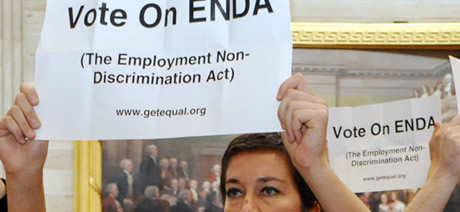
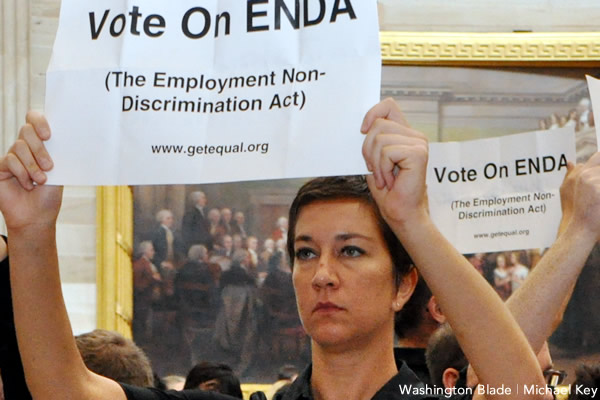
The U.S. Senate invoked cloture on the Employment Non-Discrimination Act. (Washington Blade file photo by Michael Key)
In another milestone moment in the pursuit of equal rights for LGBT Americans, the U.S. Senate voted by a narrow margin on Monday to bring to the floor the Employment Non-Discrimination Act.
By a vote of 61-30, senators invoked cloture on the legislation as Sen. Mazie Hirono (D-Hawaii) presided. The vote enables up to 30 hours of debate and amendments before a vote for final passage, which is expected Wednesday.
The 54 Democrats who voted for ENDA, whose chief sponsor is Sen. Jeff Merkley (D-Ore.), consisted of the Democrats who co-sponsored ENDA as well as Sens. Cory Booker (D-N.J.), Joe Manchin (D-W.Va.) and Mark Pryor (D-Ark.). Sen. Claire McCaskill (D-Mo.), an ENDA co-sponsor, didn’t vote.
On the Republican side, additional votes came from Sens. Kelly Ayotte (R-N.H.), Rob Portman (R-Ohio) and Pat Toomey (R-Pa.). Other votes came from Sens. Orrin Hatch (R-Utah), who voted for the bill in committee, and Sen. Dean Heller (R-Nev.), who articulated his support earlier in the day. Sen. Lisa Murkowski (R-Alaska), who also voted for ENDA in committee, didn’t vote.
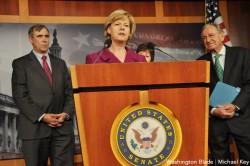
Sen. Tammy Baldwin (D-Wis.) addressed reporters following the vote. (Washington Blade photo by Michael Key)
Including the Republican original co-sponsors of ENDA — Sens. Susan Collins (R-Maine) and Mark Kirk (R-Ill.) — the bill had seven Republican votes. As he indicated he would, Sen. Jeff Flake (R-Ariz.) voted “no” after entering the Senate chamber following Sen. Tammy Baldwin (D-Wis.), apparently after a conversation with her.
As the vote took place, there were concerns there would be insufficient votes to invoke cloture on ENDA because of Murkowski’s absence, but Portman and Toomey, after intense conversations with colleagues, entered the Senate chamber just before the vote was called to vote “yes.”
The roll call of the vote for cloture on ENDA can be found here.
Prior to the vote, lawmakers who support the legislation spoke out in favor of the bill, touting it as a means of advancing equal opportunity and the “American Dream.”
Senate Majority Leader Harry Reid (D-Nev.) said ENDA is necessary because discriminating against gay workers is legal in 29 states and for being transgender in 33 states.
“The patchwork of state laws excludes tens of millions of Americans from basic protection against discrimination,” Reid said. “It is simply not good enough. It is [time to] pass a federal law that ensures all Americans regardless of where they live can go to work unafraid to be who they are. As long as hardworking, qualified Americans can be denied job opportunities, fired, or harassed because of their sexual orientation or gender identity, all workers are at risk.”
Sen. Tom Harkin (D-Iowa), chair of the Senate Health, Education, Labor & Pensions Committee from which the legislation originated, said passage of ENDA would say LGBT Americans “deserve the same civil rights protections as all other Americans.”
“We are here because, even though most Americans believe firing or refusing to hire someone based their sexual orientation is illegal, they are incorrect,” Harkin said. “The majority of Americans, more than 56 percent, live in states where it is perfectly legal to fire someone or to refuse to hire them because of who they are, a lesbian, gay, bisexual or transgender citizen.”
Amid concerns that the religious exemption is too broad and calls from some LGBT advocates for lawmakers to speak out against it, Harkin said the language is necessary to ensure bipartisan support.
“This is a compromise that has been hard for strong advocates of civil rights and civil liberties, including me, to accept,” Harkin said. “But it is an exemption that has helped to persuade some members of strong faith that ENDA should become law. I would point to my friend Sen. Hatch, who supported this bill in committee, as just one important example of senators who are satisfied that this exemption serves to reconcile the strictures of their faith with fundamental fairness in the workplace.”
Sen. Tammy Baldwin (D-Wis.), the only openly gay member of the Senate, said she understands some lawmakers may have political difficulties in supporting the legislation, but encouraged her colleagues to stand on the right side of history.
“I realize that for some, this is not an easy vote,” Baldwin said. “I understand that for some they may believe that it’s not good politics. But I want to say that I have a deep respect for those who choose to stand on the side of progress for our country this week. So for those that stand up this week and answer the call for courage, I can say with confidence your courage will be respected and remembered when this struggle is written.”
Sen. Mark Kirk (R-Ill.), a Republican and original co-sponsor of ENDA, spoke on the Senate floor for the first time in two years after suffering a stroke.
“I have been silent for the last two years due to a stroke a little under two years ago,” Kirk said. “I have risen to speak because I’m so passionate in enacting the ENDA statute.”
It’s the first time a version of ENDA with transgender protections has come to the floor of either chamber of Congress. In 2007, controversy ensued after gay former Rep. Barney Frank dropped the transgender provision from the bill over the concern an inclusive bill couldn’t be passed.
Mara Keisling, executive director of the National Center for Transgender Equality, said the cloture vote on ENDA is “an important step” toward ensuring workplace fairness for everyone, including transgender workers.
“Tonight’s procedural vote is an important step toward making sure our country gives every worker, including transgender workers, the same chance at having security at work and caring for the ones they love,” Keisling said. “The Employment Non-Discrimination Act does just that.”
It’s also the first time the Senate has considered ENDA since 1996, when the bill came to the floor as part of a deal to consider the Defense of Marriage Act and failed by one vote.
The cloture vote is also significant because the 60-vote threshold necessary to overcome a filibuster is higher than the simple majority needed for final passage. It means the legislation is almost certain win final approval in the Senate.
Amendments are expected in the coming days. After his “yes” vote on cloture, Portman announced he’ll introduce an amendment that would prevent retaliation against religious organizations and make changes to the introductory section that highlight and explain the importance of religious liberty.
White House Press Secretary Jay Carney praised lawmakers for voting for cloture on the legislation, saying President Obama welcomes the bipartisan support for the bill.
“He thanks the lawmakers from both sides of the aisle who have stood up for America’s core values of fairness and equality, and looks forward to the Senate’s consideration of ENDA,” Carney said. “He also encourages lawmakers to ensure that the legislation remains true to its goals as it is considered.”
LGBT advocates praised the vote on ENDA as a milestone moment in anticipation of additional debate that will take place in the days to come.
Chad Griffin, president of the Human Rights Campaign, said the cloture vote indicates the time has come for ENDA’s passage.
“Today we saw American democracy in action with the U.S. Senate finally following the will of a diverse and bipartisan collection of Americans calling for workplace fairness,” Griffin said. “With a super majority of Senators, more than 100 major American companies, and more than two-thirds of Americans all standing proudly in support of ENDA, there is tremendous momentum behind this common-sense bill. ENDA’s time has come, and we’re not going to stop fighting until it is passed once and for all.”
Tico Almeida, president of Freedom to Work, drew attention to the bipartisan support the legislation won on the Senate floor.
“The U.S. Senate has taken a historic step toward ensuring that gay and transgender Americans have the same workplace protections that give all Americans a fair shot to succeed on the job,” Almeida said. “Today’s strong bi-partisan vote total for the Employment Non-Discrimination Act reflects that majorities of Americans from both parties believe nobody should get fired or harassed just because of who they are or whom they love.”



World
Companies participate in ‘Pride on the Promenade’ at World Economic Forum
GLAAD co-organized initiative
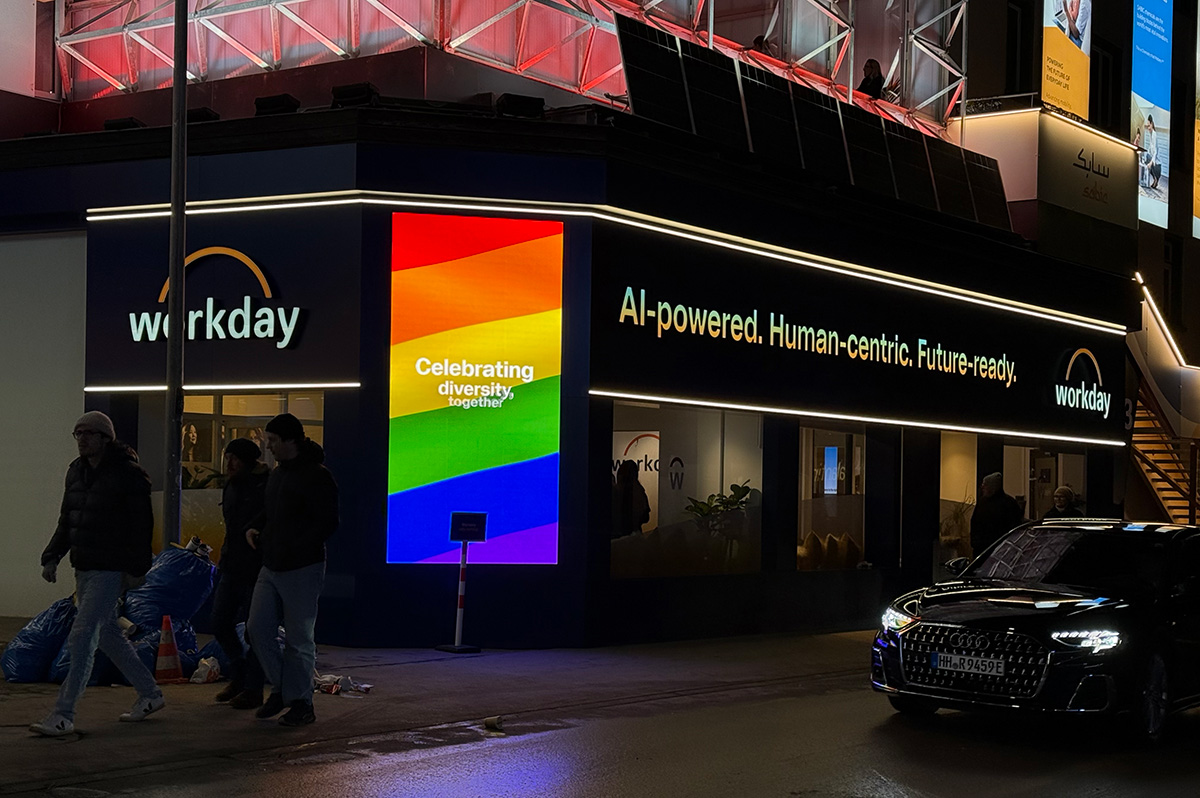
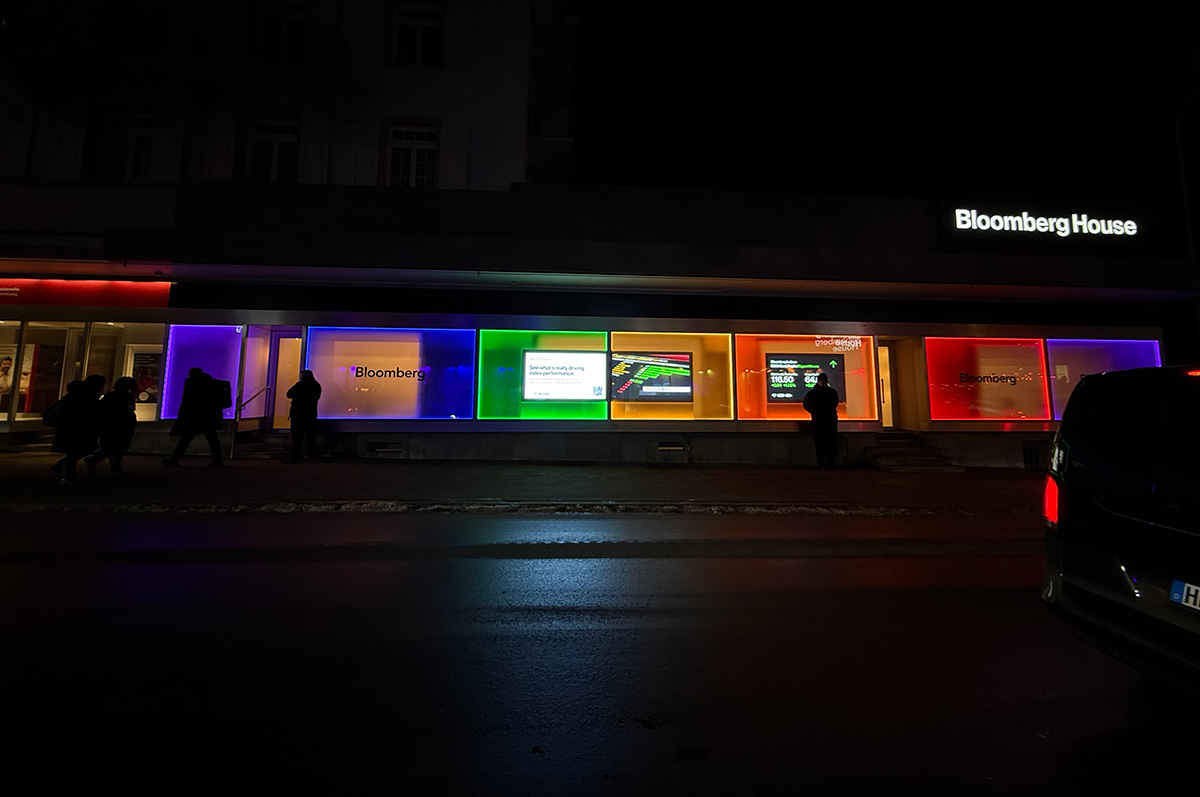
A dozen companies that are participating in the World Economic Forum on Wednesday lit up their venues on the Davos promenade in rainbow colors.
Amazon, Axios, Bloomberg, Circle, Cisco, Cloudflare, Edelman Trust House, Hub Culture, Salesforce, SAP, Snowflake, and Workday participated in the “Pride on the Promenade” that GLAAD, Open for Business, and the Partnership for Global LGBTIQ+ Equality organized. It is the fourth year the organizations have organized the initiative during the World Economic Forum.
The annual event is taking place this week in the Swiss ski resort town of Davos.
GLAAD CEO Sarah Kate Ellis on Wednesday moderated a panel in which Open for Business CEO Ken Janssens and Iris Bohnet, co-director of the Harvard Kennedy School’s Women and Public Policy Program, among others, participated. President Donald Trump earlier in the day spoke at the World Economic Forum.
“World leaders, corporate executives, and global media are discussing new ways to evolve inclusion and social issues, but leaders in those institutions and our community as a whole need to do more to support LGBTQ people globally,” said Ellis in a statement that GLAAD sent to the Washington Blade on Thursday. “At a time when decades-old alliances are being challenged, the importance of this visible show of solidarity at the largest convening of global decision makers cannot be understated. Inclusion remains a necessary business practice and companies that demonstrate shared values of family and freedom know this helps grow the bottom line.”
Virginia
LGBTQ rights at forefront of 2026 legislative session in Va.
Repeal of state’s marriage amendment a top priority
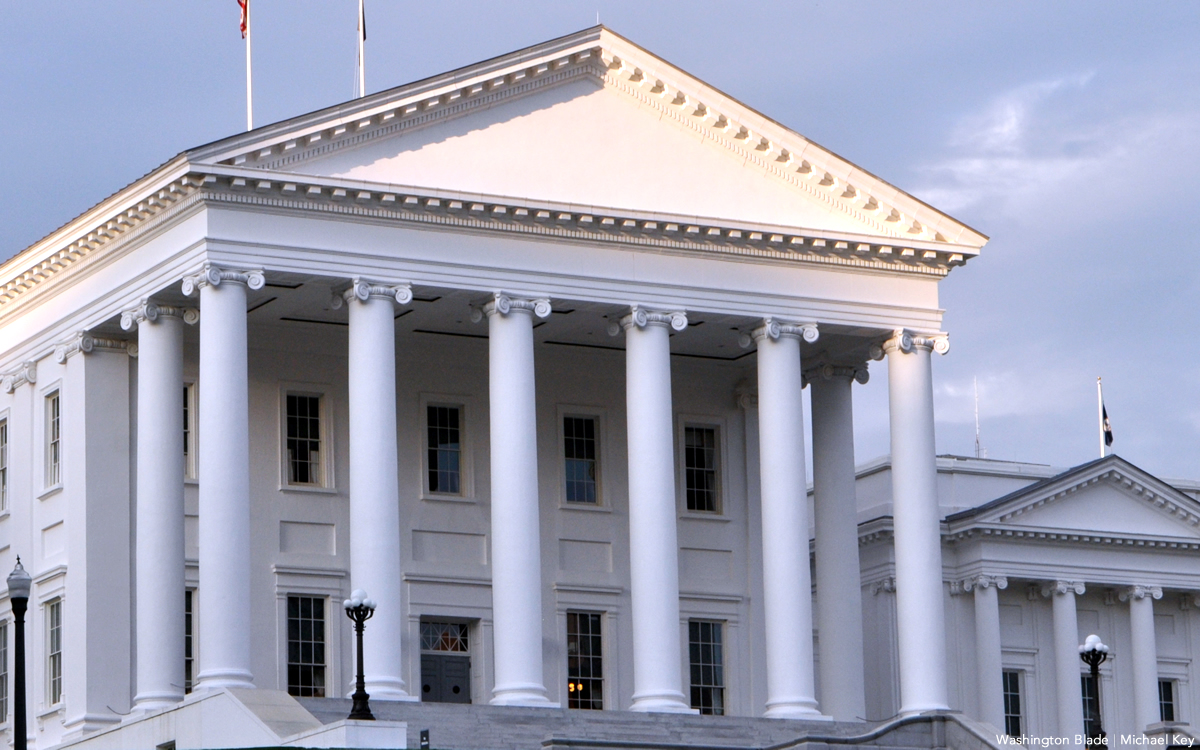
With 2026 ramping up, LGBTQ rights are at the forefront of Virginia politics.
The repeal of Virginia’s constitutional amendment that defines marriage as between a man and a woman is a top legislative priority for activists and advocacy groups.
The Virginia Senate on Jan. 17 by a 26-13 vote margin approved outgoing state Sen. Adam Ebbin (D-Alexandria)’s resolution that would repeal the Marshall-Newman Amendment. The Virginia House of Delegates earlier this month passed it.
Two successive legislatures must approve the resolution before it can go to the ballot.
The resolution passed in 2025. Voters are expected to consider repealing the amendment on Nov. 3.
The Virginia General Assembly opened with an introduction of a two-year budget — Virginia’s budget runs biannually.
In 2024 some funding was allocated to LGBTQ causes, and others were passed over. This year’s proposed budget leaves room for funding for a host of LGBTQ opportunities. One specific priority that Equality Virginia is promoting would ensure the state budget expands healthcare for LGBTQ individuals and extending gender affirming care.
Equality Virginia Communications Director Reed Williams told the Washington Blade the organization is also focused on passing three main budget amendments, and ensuring “LGBTQ+ students and their teachers have resources to navigate and address mental health challenges in K-12 schools.”
Along with ensuring school training, the organization wants funding in hopes of “establishing enhanced competency training for Virginia’s 988 Lifeline counselors and support staff to provide affirming care for LGBTQ+ youth.” This comes after the Trump-Vance administration shut down the specific hotline for LGBTQ young people that callers could previously reach if they called 988.
On a federal level, protections and health care access for LGBTQ people has taken a hit, as the Trump-Vance administration has continued to issue executive orders affecting the health care system. LGBTQ people no longer have federal legal health care protections, so local and state politics has become even more important for LGBTQ rights groups.
Equality Virginia has urged its supporters to call their local senators and stress the importance of voting to expand health care protections for LGBTQ people. The organization also plans to hold information sessions and a lobby day on Feb. 2.
Equality Virginia is tracking bills on its website.
District of Columbia
Faith programming remains key part of Creating Change Conference
‘Faith work is not an easy pill to swallow in LGBTQ spaces’
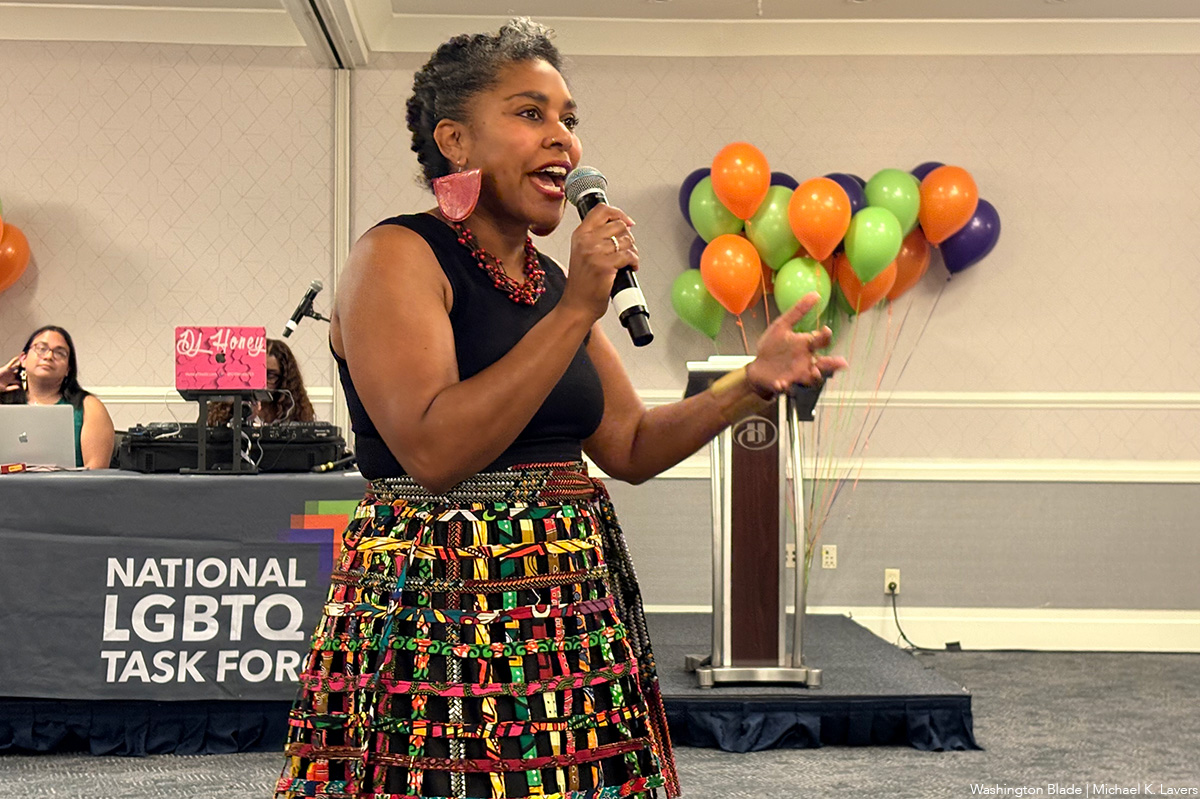
The National LGBTQ Task Force kicked off the 38th annual Creating Change conference in D.C. this week. This year, as with years past, faith and interfaith programming remains a key part of the conference’s mission and practice.
For some, the presence of faith work at an LGBTQ+ conference may seem antithetical, and Creating Change does not deny the history of harm caused by religious institutions. “We have to be clear that faith work is not an easy pill to swallow in LGBTQ spaces, and they’re no qualms about saying that we acknowledge the pain, trauma, and violence that’s been purported in the name of religion,” Tahil Sharma, Faith Work Director for the National LGBTQ Task Force, said.
In fact, several panels at the conference openly discuss acknowledging, healing from, and resisting religious harm as well as religious nationalism, including one scheduled today titled “Defending Democracy Through Religious Activism: A panel of experts on effective strategies for faith and multi-faith organizing” that features local queer faith activists like Ebony C. Peace, Rob Keithan, and Eric Eldritch who are also involved in the annual DC Pride Interfaith Service.
Another session will hold space for survivors of religious violence, creating “a drop-in space for loving on each other in healing ways, held by Rev. Alba Onofrio and Teo Drake.”
But Sharma and others who organized the Creating Change Conference explained that “a state of antipathy” towards religious communities, especially those that align with queer liberation and solidarity, is counterproductive and denies the rich history of queer religious activism. “It’s time for us to make a call for an approach to LGBTQ+ liberation that uses interfaith literacy as a tool rather than as a weapon against us,” Sharma explained.
Recognizing a local queer faith icon
Along with the panels, fighting religious nationalism and fostering communion with aligned faith activists and communities is at heart of this year’s faith work. As Sharma shared, “the person that we’re honoring this year for the faith award is Rev. Dr. Sofía Betancourt, and Dr. Betancourt is an amazing leader and someone who really stands out in representing UUs but also representing herself unapologetically.”
Based in the Washington, D.C. area, Dr. Betancourt has more than 20 years of experience working as a public minister, seminary professor, scholar, and environment ethicist, and public theologian. Her activism is rooted in her lived identities as a queer, multiracial, AfroLatine first-generation daughter of immigrants from Chile and Panama, and has been a critical voice in advancing the United Universalism towards anti-racist and pluralistic faith work.
Creating a faith-based gathering space
Sharma also said that faith fosters a unique space and practice to encounter grief and joy. For this reason, Sharma wants to “create a space for folks to engage in curiosity, to engage in spiritual fulfillment and grounding but also I think with the times that we’re in to lean into some space to mourn, some space to find hope.” The Many Paths Gathering Space serves this purpose, where visitors can stop for spiritual practice, speak with a Spiritual Care Team member, or just take a sensory break from the bustle of the conference.
This also means uplifting and foregrounding queer religious ephemera with an ofrenda to honor those who have passed, a display of nonbinary Korean American photographer Salgu Wissmath’s exhibition Divine Identity, and the Shower of Stoles, a collection of about 1,500 liturgical stoles and other sacred regalia representing the lives of lesbian, gay, bisexual, and transgender people of faith.
The Shower of Stoles
The collection was first started in 1995 by Martha Juillerat and Tammy Lindahl who received eighty stoles that accompanied them and lent them solace as they set aside their ordinations from the Presbyterian Church. The whole collection was first displayed at the 1996 General Assembly of the Presbyterian Church in New Mexico. The stoles, according to the Task Force, “quickly became a powerful symbol of the huge loss to the church of gifted leadership.”
Each stole represents the story of a queer person who is active in the life and leadership of their faith community, often sent in by the people themselves but sometimes by a loved one in their honor. About one third of all the stoles are donated anonymously, and over three-quarters of the stoles donated by clergy and full-time church professionals are contributed anonymously.
The collection shows “not just the deep harm that has been caused that does not allow people to meet their vocation when they’re faith leaders, but it also speaks to how there have been queer and trans people in our [faith] communities since the beginning of our traditions, and they continue to serve in forms of leadership,” Sharma explained.
Explicit interfaith work
Along with creating a sacred space for attendees, hosting workshops focused on faith-based action, and recognizing DC’s rich queer religious history, Creating Change is also hosting explicitly faith services, like a Buddhist Meditation, Catholic Mass, Shabbat service, Jummah Prayer Service, and an ecumenical Christian service on Sunday. Creating Change is also welcoming events at the heart of queer religious affirmation, including a Name/Gender/Pronoun/Identity Blessing Ritual and a reading and discussion around queer bibles stories with Rev. Sex (aka Rev. Alba Onofrio).
But along with specific faith-based programs, Sharma explained, “we’re looking to build on something that I helped to introduce, which was the separation of the interfaith ceremony that’s happening this year which is a vigil versus the ecumenical Christian service which is now the only thing that takes place on Sunday morning.”
This includes an Interfaith Empowerment Service this evening and an Interfaith Institute tomorrow, along with “Sing In the Revolution,” an event where folks are invited “to actually engage in the joy and rhythm of resolution and what that looks like,” Sharma said. One of the key activators behind this work is Rev. Eric Eldritch, an ordained Pagan clergy person with Circle Sanctuary and a member of the Pride Interfaith Service planning committee.
Affirming that queer faith work is part of liberation
The goal for this year, Sharma noted, alongside holding space and discussions about faith-based practice and liberation and intentional interfaith work–is to move from thinking about why faith matters in queer liberation spaces to “how is interfaith work the tool for how we’re engaging in our understanding of de-escalation work, digital strategies, navigating a deeper visioning that we need for a better world that requires us to think that we’re not alone in the struggle for mutual abundance and liberation,” Sharma explained.
It may surprise people to learn that faith work has intentionally been part of the National LGBTQ+ Task Force since its beginning in the 1980s. “We can really credit that to some of the former leadership like Urvashi Vaid who actually had a sense of understanding of what role faith plays in the work of liberation and justice,” Sharma said.
“For being someone who wasn’t necessarily religious, she certainly did have a clear understanding of the relationship between those folks who are allies, those folks who stand against us, and then those folks who sit in between–those folks who profess to be of religious and spiritual background and also are unapologetically LGBTQ+,” he continued.
This year’s faith programming builds on this rich history, thinking about “a way to kind of open doors, to not just invite people in but our people to go out into the general scene of the conference” to share how faith-based work is a tool, rather than a hindrance, to queer liberation work.

Few openly queer nominees land Oscar nominations

Companies participate in ‘Pride on the Promenade’ at World Economic Forum

El 2026 bajo presión

The felon in the White House must be stopped

MISTR’s Tristan Schukraft on evolution of HIV prevention

Top buyer-friendly markets for the LGBTQ community

Abigail Spanberger sworn in as Va. governor

Hot rod heaven: Chevy Corvette, Dodge Charger

Two gay candidates running in ‘firehouse’ Va. House of Delegates primary in Alexandria

PHOTOS: Mr. Mid-Atlantic Leather 2026
-

 Real Estate5 days ago
Top buyer-friendly markets for the LGBTQ community
-
Virginia5 days ago
Abigail Spanberger sworn in as Va. governor
-
Autos4 days ago
Hot rod heaven: Chevy Corvette, Dodge Charger
-
Virginia4 days ago
Two gay candidates running in ‘firehouse’ Va. House of Delegates primary in Alexandria