Arts & Entertainment
Blind to barriers
Bi theater head recalls emerging sexuality
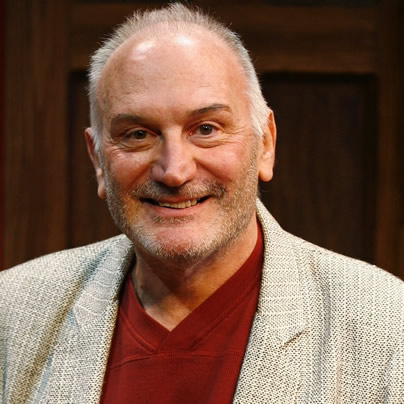
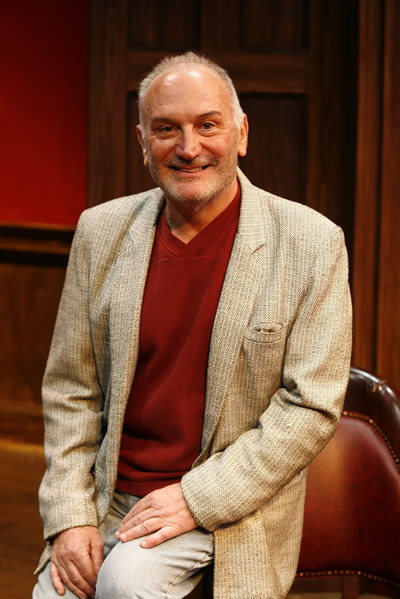
Ike Schambelan, artistic director of Breaking Through Barriers, an off-Broadway theater outfit in New York. (Photo courtesy Ike Schambelan)
The artistic director of the only disability-specific off-Broadway theater in New York, knows a few things about being different.
The 72-year-old head of Breaking Through Barriers recalls during a phone interview his early sexual explorations.
“I’d gone to a folk sing in a dorm,” Ike Schambelan says. He was at Swarthmore College when another male student invited him to his room. “I was told,’ Don’t do that, stay on the sofa,” he says. “I knew without anything being verbalized that I was being protected. I did not want to be protected.”
He co-founded Theater Breaking Through Barriers (then known as Theater By the Blind) in 1979 not to be altruistic, but to “support my directing addiction,” Schambelan says.
It’s the only off-Broadway theater, and one of the few in the country, dedicated to advancing actors and writers with disabilities. The company can be a tough sell to people wary of disability, Schambelan says.
“They spend five minutes trying to figure out who’s disabled and who’s not, often getting it wrong. But, then they relax and get into the play.”
Schambelan, who was raised in West Philadelphia with the theater bug embedded in his DNA, grew up with many of the conflicts around sexuality held by many of his generation.
“My grandmother, who went blind, lived with us until I was 10,” he says. “Every Monday night, we’d listen to Lux Radio Theater and I’d brush her hair. I came to associate blindness, affection and theater.”
When Schambelan was in junior high a friend invited him to go to a drama at school.
“I was hooked,” Schambelan says. “I acted in high school. When I went to college I mostly stage managed, which I loved, as I wasn’t a very good actor.”
In his junior year, Schambelan directed the annual Thanksgiving musical.
“It was a big hit and I was hooked to a discipline, directing,” he says.
After graduating from Swarthmore in 1961, Schambelan earned a degree from Yale Drama School in 1967.
There, his passion for the theater and his burgeoning, conflicted sexuality merged.
“On my first night at the Drama school, a med student picked me up,” Schambelan says. “We had sex. Then, I … didn’t have sex until the end of the year. I dated women a little, but I didn’t do a lot of sex.”
In the 1960s during the pre-Stonewall era, being queer was more openly accepted at the Drama School and in the theater than in other parts of society, Schambelan says. Despite this, he was “conflicted.”
“It was internalized homophobia — feeling it was wrong to have sex with men.”
In the ‘60s and ‘70s, Schambelan directed productions at such companies as Playwrights Horizons and the George St. Playhouse. He shot a TV commercial with Farrah Fawcett (“She was lovely to work with,” he says) before she was famous.
Over these years, Schambelan dated women and men.
“I’d take up with a woman during the summer and the romance would last until the fall,” he says.
He married a woman in 1980, Joan, who remains his wife. She’d been a dancer so she’d known gays and just felt her husband’s bisexuality made him “more interesting.”
For years, he saw a psychotherapist who “… wanted me to be straight,” Schambelan says. “But, then, being gay had just been removed as the list of mental illnesses by the American Psychiatric Association.”
The therapist he sees today is completely accepting of his bisexuality, Schambelan says.
He admits it’s not always an easy thing to explain.
“The LGBT community doesn’t always get what it means to be bisexual,” he says. “Sometimes people have worked so hard to come out as gay, they have difficulty understanding the greater complexity of being bi. They want you to be gay.”

Friday, April 10
Center Aging Monthly Luncheon With Yoga will be at 12 p.m. at the DC Center for the LGBT Community. Email Mac at [email protected] if you require ASL interpreter assistance, have any dietary restrictions, or questions about this event.
Women in their Twenties and Thirties will meet at 8 p.m. on Zoom. This is a social discussion group for queer women in the Washington, D.C. area. For more details, visit Facebook.
Saturday, April 11
Go Gay DC will host “LGBTQ+ Community Brunch” at 11 a.m. at Freddie’s Beach Bar & Restaurant. This fun weekly event brings the DMV area LGBTQ+ community, including allies, together for delicious food and conversation. Attendance is free and more details are available on Eventbrite.
The DC Center for the LGBT Community will host a screening of “Love Letters” at 1:30 p.m. This movie is a tender, intimate look at love, parenthood, and the quiet fight to claim your place in your own family. For more details, visit the DC Center’s website.
Sunday, April 12
Spark Social will host “Tea Time! A Local DC Drag Comedy Show” at 3 p.m. This event features the hilarious TreHER and Tiara Missou Sidora. This dynamic duo will have guests cackling as they discuss the “Latest Tea” in DC. Have drama in your own life? TrevHER and Tiara are ready to provide advice and rate how hot your tea is. Hottest tea wins a piece of Spark merch. Tickets cost $13.26 and can be purchased on Eventbrite.
Just Kidding Comedy Collective will host “Best of DC at the Woke Mob Comedy Festival” at 5 p.m. at Pikio Taco. The Woke Mob Comedy Festival celebrates everything that makes this region the best and showcases the DMV’s funniest comedians, especially highlighting BIPOC, women, LGBTQ+ and gender-queer performers, plus a few “prodigal” comics who got their start here before heading national. Tickets cost $15.18 and can be purchased on Eventbrite.
Monday, April 13
Center Aging: Monday Coffee Klatch” will be at 10 a.m. on Zoom. This is a social hour for older LGBTQ adults. Guests are encouraged to bring a beverage of choice. For more information, contact Adam ([email protected]).
Genderqueer DC will be at 7 p.m. on Zoom. This is a support group for people who identify outside of the gender binary, whether you’re bigender, agender, genderfluid, or just know that you’re not 100% cis. For more details, visit www.genderqueerdc.org or Facebook.
Tuesday, April 14
Trans Discussion Group will be at 7 p.m. on Zoom. This event is intended to provide an emotionally and physically safe space for trans people and those who may be questioning their gender identity/expression to join together in community and learn from one another. For more details, email [email protected].
Coming Out Discussion Group will be at 7 p.m. on Zoom. This is a safe space to share experiences about coming out and discuss topics as it relates to doing so — by sharing struggles and victories the group allows those newly coming out and who have been out for a while to learn from others. For more details, visit the group’s Facebook.
Wednesday, April 15
Job Club will be at 6 p.m. on Zoom upon request. This is a weekly job support program to help job entrants and seekers, including the long-term unemployed, improve self-confidence, motivation, resilience and productivity for effective job searches and networking — allowing participants to move away from being merely “applicants” toward being “candidates.” For more information, email [email protected] or visit thedccenter.org/careers.
The DC Center for the LGBT Community will host “Movement for Healing” at 3 p.m. This trauma- and yoga therapy–informed class is designed to help guests gently reconnect with their body and their breath. Through mindful movement, somatic awareness, and grounding practices, guests will explore how to release tension, increase mobility, and cultivate a deeper sense of safety and ease within. For more details, visit the DC Center’s website.
Thursday, April 16
The DC Center’s Fresh Produce Program will be held all day at the DC Center for the LGBT Community. People will be informed on Wednesday at 5:00 pm if they are picked to receive a produce box. No proof of residency or income is required. For more information, email [email protected] or call 202-682-2245.
Virtual Yoga Class will be at 7 p.m. on Zoom. This free weekly class is a combination of yoga, breathwork and meditation that allows LGBTQ+ community members to continue their healing journey with somatic and mindfulness practices. For more details, visit the DC Center’s website.
Movies
A Sondheim masterpiece ‘Merrily’ rolls onto Netflix
Embracing raw truth lurking just under the clever lyrics
It’s been long lamented by fans of the late Stephen Sondheim – and they are legion – that Hollywood has hardly ever been successful in transposing his musicals onto the big screen.
Sure, his first Broadway show – “West Side Story,” on which he collaborated with the then-superstar composer Leonard Bernstein – was made into an Oscar-winning triumph in 1961, but after that, despite repeated attempts, even the most starry-eyed Sondheim aficionados would admit that the mainstream movie industry has mostly offered only watered-down versions of his works that were too popular to ignore: “A Little Night Music” was muddled into an ill-fitted star vehicle for Liz Taylor, “Sweeney Todd” became a middling entry in the Tim Burton/Johnny Depp canon, “Into the Woods” mutated into a too-literal all-star fantasy with most of its wolf-ish teeth removed, and we’re still waiting for a film version of “Company” – not that we would have high hopes for it anyway, given the track record.
Of course, most of those aficionados would also be able to tell you exactly why this has always been the case: erudite, sophisticated, and driven by an experimental boldness that would come to redefine American musical theater, Sondheim’s musicals were never about escapism; rather, they deconstructed the romanticized tropes and presentational glamour, turning them upside down to explore a more intellectual realm which favored psychological nuance and moral ambiguity over feel-good fantasy. Instead of pretty lovers and obvious villains, they showcased flawed, complicated, and uncomfortably relatable people who were just as messed-up as the people in the audience. Any attempt to bring them to the screen inevitably depended on changes to make them more appealing to the mainstream, because they were, at heart, the antithesis of what the Hollywood entertainment machine considers to be marketable.
To be fair, this often proved true on the stage as well as the screen. Few of Sondheim’s shows, even the most acclaimed ones, were bona fide “hits,” and at least half of them might be considered “failures” from a strictly commercial point of view – which makes it all the more ironic that perhaps the most purely “Sondheim” of the stage-to-screen Sondheim efforts stems from one of his most notorious “flops.”
“Merrily We Roll Along” was originally conceived and created more than 40 years ago, a reunion of Sondheim with “Company” book-writer George Furth and director Harold Prince, based on a 1934 play by George Kaufman and Moss Hart. Telling the 20-year story of three college friends who grow apart and become estranged as their lives and their goals diverge, it wasn’t ever going to be a feel-good musical; what made it even more of a “downer” was that it told that story in reverse, beginning with the unhappy ending and then going backward in time, step by step, to the youthful idealism and deep bonds of camaraderie that they shared in their first meeting. On one hand, getting the “bad news” first keeps the ending from becoming a crushing disappointment; but on the other hand, the irony that results from knowing how things play out becomes more and more painful with each and every scene.
The original production, mounted in 1981, compounded its challenging format with the additional conceit of casting mostly teen and young adult actors in roles that required them to age – backwards – across two decades; though the cast included future success stories (Jason Alexander and Giancarlo Esposito, among them), few young actors could be expected to convey the layered maturity required of such a task, and few audiences were capable of suspending their disbelief while watching a teenager play a disillusioned 40-year old. This, coupled with a minimalist presentation that left audiences feeling like they were watching their nephew’s high school play, turned “Merrily We Roll Along” into Sondheim’s most notorious Broadway flop – despite raves reviews for the show’s intricately woven score and the xtinging candor of its lyrics.
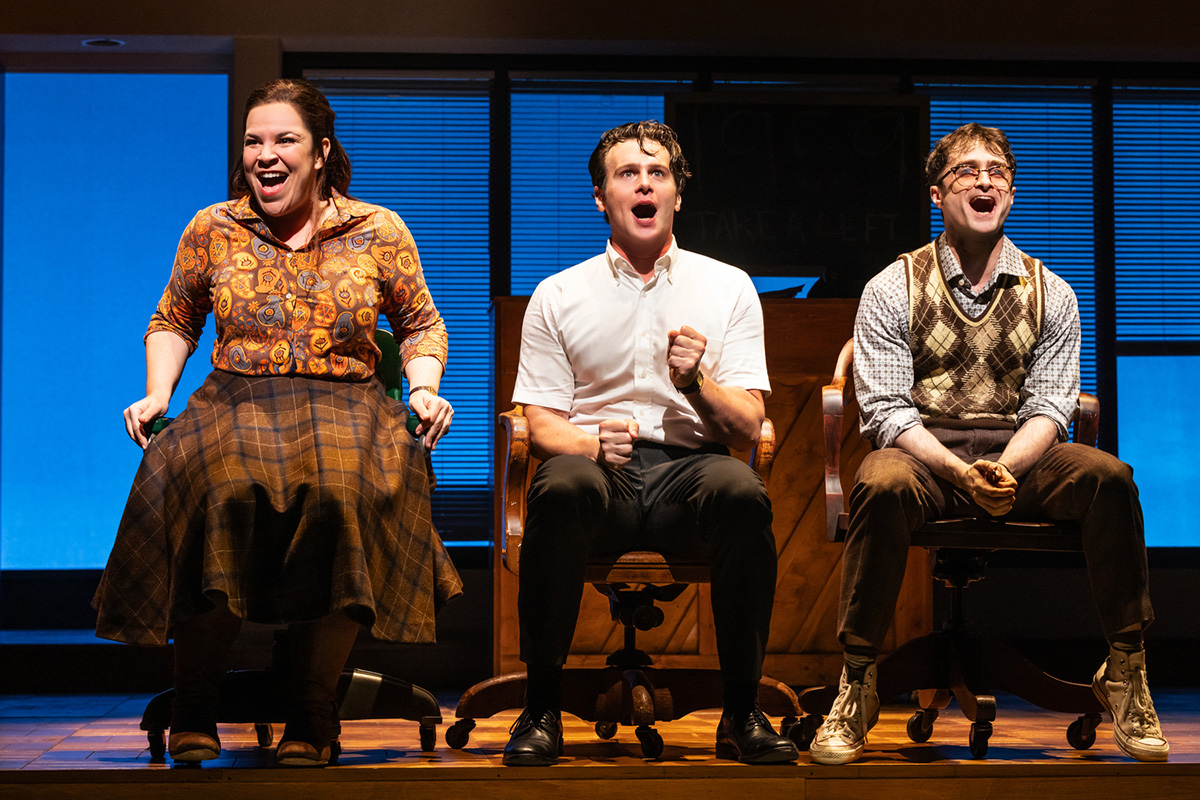
Fast forward to 2022, when renowned UK theater director Maria Friedman staged a new revival of the show in New York. In the interim, “Merrily” had undergone multiple rewrites and conceptual changes in an effort to “fix” its problems, abandoning the concept of using young performers and opting for a more “fleshed-out” approach to production design, and the show’s reputation, fueled by a love for its quintessentially “Sondheim-esque” score, had grown to the level of “underappreciated masterpiece.” Inspired by an earlier production she had helmed at home a decade earlier, Friedman mounted an Off-Broadway version of the show starring Jonathan Groff, Daniel Radcliffe, and Lindsay Mendez – and suddenly, as one critic observed, Sondheim’s biggest failure became “the flop that finally flew.” The production transferred to Broadway, winning Tony Awards for Groff and Radcliffe’s performances, as well as the prize for Best Revival of a Musical, in 2024.
Sondheim, who died at 91 in 2021, participated in the remount, though he did not live to see its premiere, nor the success that officially validated his most “problematic” work.
Fortunately, we DO get the chance to see it, thanks to a filmed record of the stage performance, directed by Friedman herself, which was released in limited theaters for a brief run last year, but which is now streaming on Netflix – allowing Sondheim fans to finally experience the show in the way it was designed to be seen: as a live performance.
Embracing the conventions of live theatre into its own cinematic ethos, this record of the show gives viewers the kind of up-close access to its performances that is impossible to experience even from the front-row of the theatre. The performances it gives us are impeccable: Groff’s raw and deeply deluded Frank Shepard, the ambitious composer who sells out his values and alienates his friends on the road to success and wealth; Radcliffe’s mawkishly loyal Charlie Kringas, who remains loyal to the dream he shared with his best friend until he can’t anymore; and Mendez’ heartbreaking perfection as Mary Flynn, the wisecracking good-time girl who rounds out their trio while concealing a secret passion of her own – each of them bring the kind of raw and vulnerable honesty to their roles that can, at last, reveal both the deep insights of Sondheim’s intricate lyrics and the discomforting emotional conflicts of Furth’s mercilessly brutal script.
Yes, it’s true that any filmed record of a live performance loses something in the translation; there’s a visceral connection to the players and a feeling of real-time experience that doesn’t quite come through; but thanks to unified vision that Friedman shepherded and instilled into her cast – including each and every one of the brilliant ensemble, who undertake the show’s supporting characters and embody “the blob” of show-biz hangers-on who are central to its cynical theme.
Honestly, we can’t think of another Sondheim screen adaptation that comes close to this one for embracing the raw truth that was always lurking just under the clever lyrics and creative rhyme schemes. For that reason alone, it’s essential viewing for any Sondheim fan – because it’s probably the closest we’ll ever get to having a “real” Sondheim film that lives up to the genius behind it.
a&e features
New book celebrates 1970s dance music icons
‘A Night at the Disco’ features interviews with Donna Summer, Debbie Harry, more
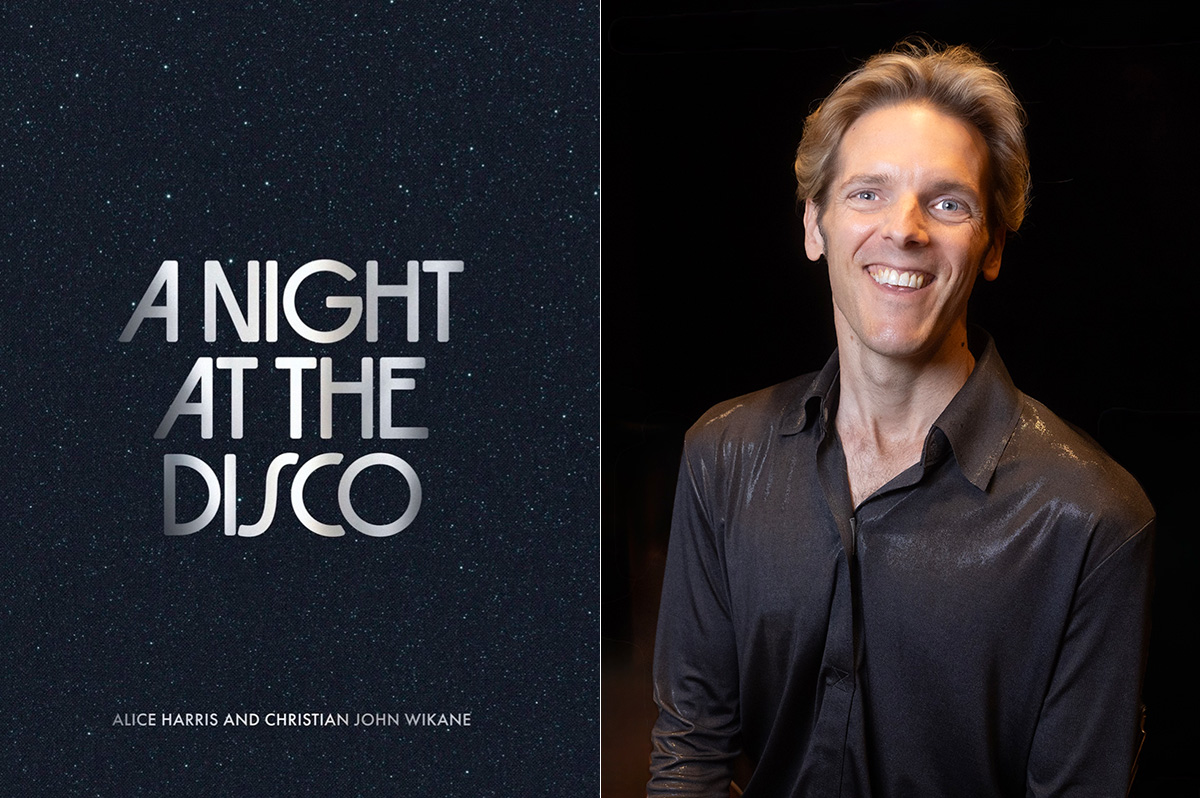
If you’re a fan of 1970s-era dance music, don’t miss the irresistible new book by Christian John Wikane and Alice Harris, “A Night at the Disco,” which revisits more than 90 interviews conducted with some of the biggest names in pop culture.
“A Night at the Disco” (ACC Art Books) was published on March 24, and distributed by Simon & Schuster. It celebrates more than 100 artists who sparked a phenomenon in dance music from 1970-1979 and features excerpts from interviews with everyone from Donna Summer to Debbie Harry.

Lost City Books (2467 18th St., N.W.) will welcome author Christian John Wikane for a book signing and conversation about “A Night at the Disco” on Thursday, April 16 at 6 p.m. Details at lostcitybookstore.com. Bird in Hand Coffee & Books in Baltimore (11 E. 33rd St.) )will also host a Q&A with the author on Wednesday, April 15 at 6 p.m. Details at theivybookshop.com.
Below is an excerpt from “A Night at the Disco.”
“I’ll let in anyone who looks like they’ll make things fun.” Steve Rubell is guiding a New York Times reporter through Studio 54 as resident DJ Richie Kaczor dazzles the crowd with records by CHIC, Odyssey, and T-Connection. “Disco, that’s where the happy people go,” The Trammps sing as dancers spin and twirl underneath tubes of flashing lights. Seven months since Rubell and co-owner Ian Schrager opened Studio 54 in April 1977, it’s welcomed untold numbers of “happy people” … at least those lucky enough to pass through the doors.
“We were part of the chosen few,” says André De Shields, who immortalized the title role in The Wiz on Broadway at the time. “We could show up at Studio 54 and the doorman at the velvet stanchion would look over everyone and point to us from The Wiz to come in, that kind of thing.” As the lead vocalist in the GRAMMY-nominated Dr. Buzzard’s Original Savannah Band, whose debut modernized big band sophistication for the discothèques, Cory Daye had carte blanche in the club. “The energy was like a New Year’s Eve party every night,” she says. “I would go up to the mezzanine and watch the mechanical light pillars go up and down, metallic confetti falling from the ceiling, the spoon and the moon. I was so fascinated and enamored by it.
“When a certain song came on, the people would just rush to the dance floor. There was no contact dancing — the hustle was pretty much on its way out — but it was just an amazing experience to see all the cultures together. It was a fusion of cultures, which described my life and my band, so I was right at home there.”
“Studio 54 was the place,” adds Linda Clifford. “Crazy parties. If you could think it, you would see it. It was like a circus. Just an amazing place to be. I worked 54 so many times. It was like a second home to me. The people there treated me so well. The crowd always seemed to enjoy my show. I always had a good time with them. That was the most important thing: making sure that they had fun.”
Well before Studio 54 opened, disco had become a business juggernaut. “A four billion dollar market and still growing,” Billboard announced in February 1977, with dance music offering more variety than ever. “There is no longer a single, readily identifiable disco beat, but a kaleidoscope of sounds that are melodic and danceable,” Tom Moulton told the magazine. In the clubs, records by veteran artists like Stevie Wonder and the Bee Gees were mixed in with a range of new acts like Grace Jones, Boney M., and The Ritchie Family, while everyone from ABBA to Marvin Gaye scored number one pop hits with songs that had club-centric storylines.
Beyond the charts, disco itself remained as idiosyncratic as ever, especially on several productions by Laurin Rinder and W. Michael Lewis, whose studio creations, El Coco (“Let’s Get It Together,” “Cocomotion”) and Le Pamplemousse (“Le Spank”), joined their own “Lust” from Seven Deadly Sins (1977) among the most tantalizing releases on AVI Records. Rinder & Lewis also produced acts for the newly hatched Butterfly Records in Los Angeles, where Saint Tropez (“On a Rien à Perdre”) and Tuxedo Junction (“Moonlight Serenade”) reflected the duo’s high gloss sound, spanning everything from European sophistication to a more literal translation of the ’40s sensibilities popularized by Dr. Buzzard’s Original Savannah Band.
12-inch singles had also grown as the preferred format to approximate the club music experience at home. Nearly a year after Atlantic Records introduced its series of promotional 12-inch singles for DJs, New York-based Salsoul Records released the industry’s first commercially available 12-inch single, “Ten Percent” by Double Exposure, in May 1976. A year later, T.K. Records was the first label to certify a gold record for a 12-inch single when Peter Brown’s “Do You Wanna Get Funky With Me” tallied one million sales.— Christian John Wikane
(From “A Night at the Disco” by Alice Harris & Christian John Wikane. Published by ACC Art Books.)
The Blade may receive commissions from qualifying purchases made via this post.

Calendar: April 10-16

BLUF leather social set for April 10 in Rehoboth

Celebrations of life planned for Sean Bartel

The ‘X’ returns to court

LGBTQ community explores arming up during heated political times

D.C. is the place for the Democratic Socialists of America

PHOTOS: The Bonnet Ball

Key lifestyle changes can help patients cope with diabetes

Trump budget would codify expanded global gag rule