News
Cameroonian LGBT rights advocate murdered
The State Department described Eric Ohena Lembembe’s death as a “terrible act”

Yaounde, Cameroon (Photo by Mac9 via Wikimedia Commons)
Human Rights Watch said advocates found Eric Ohena Lembembe’s body on his bed in his home in Yaoundé, the country’s capital, after they were unable to reach him for two days.
One of Lembembe’s friends told Human Rights Watch that his neck and feet “appeared to be broken.” An iron was also reportedly used to burn Lembembe’s face, hands and feet.
Lembembe, who was the executive director of the Cameroonian Foundation for AIDS, worked with Human Rights Watch and two other LGBT advocacy groups in the country — Alternatives-Cameroun and the Association for the Defense of Homosexuals — to document anti-gay persecution in the nation. He also contributed to Erasing 76 Crimes, a blog that chronicles efforts to report on efforts to decriminalize homosexuality around the world.
“Eric was an inspiring activist whose work was deeply appreciated by human rights activists in Cameroon and around the world,” Neela Ghoshal, a researcher for Human Rights Watch’s Lesbian, Gay, Bisexual and Transgender Rights Program, said. “Advocating for equal rights in Cameroon, where LGBTI people face severe discrimination and violence, takes tremendous courage. Eric’s activism paved the way for a society based on equality and nondiscrimination.”
State Department spokesperson Marie Harf also condemned Lembembe’s murder.
“We condemn this terrible act in the strongest terms and urge the Cameroonian authorities to thoroughly and promptly investigate and prosecute those responsible for his death,” she said in a statement issued late on Tuesday.
Lembembe’s death comes against the backdrop of ongoing anti-gay persecution and violence in the country.
Cameroonian authorities since 2010 have prosecuted more than 30 people under the section of the country’s penal code that imposes a sentence of up to five years in prison and a roughly $400 fine against anyone convicted of same-sex sexual activity.
Police in Yaoundé in March 2011 arrested Jean-Claude Roger Mbede after sending a flirtatious text message to another man. Authorities later that year arrested Jonas Kimie and Franky Ndome outside a nightclub in the Cameroonian capital and charged them under the country’s anti-homosexuality law.
A judge sentenced Kimie and Ndome to five years in prison, but an appellate court in January released them. The Washington Blade’s attempts to interview the men earlier this year were unsuccessful because they had gone into hiding.
Human Rights Watch said a group of unidentified assailants torched Alternatives-Cameroun’s headquarters in the city of Douala on June 26. The organization noted burglars took legal files and a laptop from the Yaoundé office of Michel Togué, a lawyer who represents gay men charged under the country’s anti-homosexuality law, when they broke into it 10 days earlier.
Togué said during a forum at the Robert F. Kennedy Center for Justice and Human Rights in D.C. in February that he moved his family to Maryland because of death threats he and his colleagues received.
“Gay people are not seeking everyone to approve of their behavior,” he said. “They are seeking freedom.”
The State Department and Amnesty International are among the government agencies and human rights organizations that have criticized Cameroon’s LGBT rights record in recent years.
President Paul Biya told journalists in January after a meeting with French President François Hollande that attitudes towards gay Cameroonians are changing.
Ghoshal and other human rights advocates continue to urge Cameroonian authorities to publicly condemn Lembembe’s murder and arrest those responsible for his death.
“We don’t know who killed Eric Lembembe, or why he was killed, but one thing is clear: the Cameroonian authorities’ utter failure to stem homophobic violence sends the message that these attacks can be carried out with impunity,” Ghoshal said. “The police should not rest until the perpetrators of this horrific crime are brought to justice. President Biya should break his silence on the wave of homophobic violence in Cameroon and publicly condemn this brutal attack.”


News
An effort to increase the number of psychiatrists of color
After 35 years in law and advocacy, Rawle Andrews Jr. returns to his roots
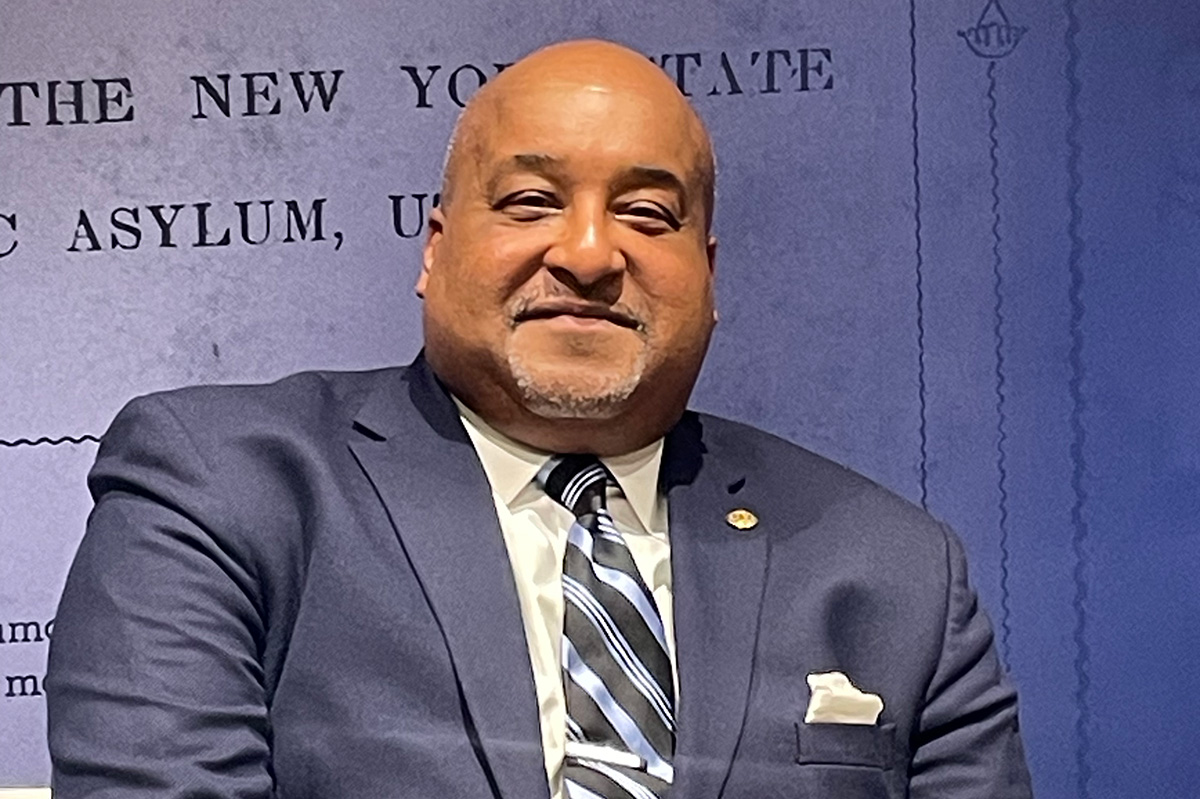
Rawle Andrews Jr. took an indirect path to become executive director of the American Psychiatric Association Foundation (APAF).
From a psychology major in college to becoming a lawyer, the passion for equity and inclusion that fueled him during his years at AARP and as a professor at Howard and Georgetown universities serves as the foundation for his career in mental health.
Andrews has made it his mission at APAF to prioritize youth mental health — including in schools in D.C. and across the country — and to reduce stigma around mental illness and increase the number of psychiatrists of color practicing in the U.S.
Andrews, who began his educational career studying psychology, said he felt out of place in college when his classmates were pursuing medical careers and he was more interested in law.
“I was the only person in my cohort who was going to law school,” he said. “Everybody else wanted to be a doctor and go to medical school.”
Everything changed for Andrews during the COVID-19 pandemic and after George Floyd was killed by police in Missouri: Those pivotal moments reshaped national conversations about health, race, and inequality, and pushed Andrews to rethink his career.
“I saw people deathly afraid of some disease, but also mortified by the fact that they witnessed somebody die on TV,” he said.
After nearly 16 years working as a lawyer in private practice and 15 years at AARP, Andrews found himself pulled back to mental and “whole body” health.
“My goal in law school was to be a courtroom lawyer all the time. If you had told me in 1990 that I would be a practicing lawyer going to court every day, I would have laughed you out of this room. If you had told me in 2010 that I wouldn’t be an in-house lawyer every day … I would have laughed you out of this room,” he said. “Everybody thinks you’re going to go straight from A to B. Life doesn’t work A to B.”
Now, Andrews says, he has the “ability to serve the whole house.” He can help “the eight-year-old who’s struggling in middle school … the parent who’s trying to get that child through, but also caring for an older loved one … who might have some cognitive decline or mobility challenges.”
Building a pipeline of Black mental health professionals
In his role at APAF, Andrews has his sights set on increasing the number of psychiatrists nationwide by reducing barriers to study and success, particularly for practitioners of color, who are vastly underrepresented.
Only about 5% of physicians are Black, and the number for Black psychiatrists is even lower at just 2%, according to the American Psychiatric Association. Widespread stigma around mental illness in communities of color, combined with “systemic barriers that keep persons of color from getting into medical school and matching for residency with teaching hospitals after graduating,” have contributed to the low numbers, Andrews says.
Financial pressures, limited residency slots, and a lack of exposure to psychiatry as a viable career all play important roles in limiting Black representation in the field. At the same time, stigma surrounding mental health — especially in Black communities — can discourage both patients and future physicians, according to Andrews.
He explains that this stigma is rooted in underlying fear, shame, and historic discrimination, and the only way to deal with those issues is directly. If you break those down, Andrews said, you can actually address them.
There are signs of change, though. “In the digital world, more and more people are seeing and talking about mental health all the time,” Andrews said. “And I believe more and more young doctors of all colors are deciding, ‘we need more psychiatrists, and I want to be a part of that solution.’”
Not having enough psychiatrists of color has far-reaching consequences. If you are a “non-diverse” physician or a physician practicing without humility or cultural competency, you may over-diagnose or misdiagnose a patient, said Andrews. You might assume a patient has symptoms due to your own cognitive biases.
A 2024 study in the Journal of General Internal Medicine revealed that mistrust and suspicion were high among dozens of Black patients with serious mental illness, who said they felt doctors did not take their concerns seriously or took a condescending tone with them during appointments.
This type of treatment does not promote trust or disclosure, Andrews said. “What is my advantage to be vulnerable with people who don’t think much of me, because you already thought I was broken?”
To combat medical racism and bias, APAF runs one of the largest psychiatry pipeline programs in the world. It provides more than 1,000 medical students from underrepresented and marginalized communities with training and professional development. Programs like the Diversity Leadership Fellowship emphasize cultural competency and evidence-based practices to better serve diverse groups and at-risk populations.
These programs have had tangible success in producing leadership in the field of psychiatry: APA’s CEO Dr. Marketa Wills, the first CEO of color and first female CEO in the APA organization’s 180-year history, was a trainee with the APAF nearly three decades ago.
Despite efforts to make healthcare more equitable for patients of color and members of the LGBTQ+ community, many experts believe that racism and biases are more deeply ingrained in the system than many realize. For example, a 2019 study found that Black patients suffering from depression are often misdiagnosed with schizophrenia, and a 2016 study revealed that many doctors wrongly believe that Black patients have higher thresholds for pain tolerance.
“If you don’t have cultural humility or cultural competency, you could over-diagnose somebody because you’re looking for them to be ADHD, you’re looking for them to be bipolar, you’re looking for them to be schizophrenic,” said Andrews. “And then, because of the fears, the stigmas, the shame, people don’t want to go and get tested either.”
Youth mental health focus
Andrews says many fear that telling someone else about their struggles will cause that person to look down on them. That unwillingness to share about mental health challenges can start at a young age.
That’s why the APAF has partnered with local organizations in the Washington, D.C., area to help young people address mental health concerns. One of the programs, Our Minds Matter, operates in D.C.-area schools and other states to educate students on signs of emotional distress and how to address it. APAF also runs the Notice.Talk.Act. at School program, which helps train school staff to recognize and address student mental health issues and connect them to resources. The program was recently adopted at Jefferson Middle School Academy.
The program is “the ‘stop, drop and roll’ of mental health,” Andrews said. “How do I notice signs and symptoms of distress in a student? How do I create an open space to talk and be a better active listener with a student who wants to share their mental health concerns and then act?”
APAF’s program, funded by the Substance Abuse and Mental Health Services Administration (SAMHSA) and free to schools, trained about 890 school staff members across the country in 2024, and boasts a 70% reduction in truancy and 89% reduction in disciplinary referrals, according to the foundation.
Notice.Talk.Act. is not just in schools — there are versions for home, for college, for the workplace.
Andrews hopes that this work with the APAF will reduce the stigma surrounding mental health struggles and improve access to culturally competent care. But he acknowledges there’s still a long way to go.
“We are planting and sowing seeds now and fertilizing the soil and tilling the soil,” he said. “We know that the next generation of doctors is going to look closer to the way the population looks. But ultimately, we still haven’t done enough.”
(This work is part of a partnership between the Washington Blade Foundation and Youthcast Media Group, funded through the FY26 Community Development Grant from the Office of D.C. Mayor Muriel Bowser. Jebeh Pajibo is a senior at Bard High School Early College DC, one of Youthcast Media Group’s journalism class partners. Sarah Gandluri, a UNC-Chapel Hill sophomore, is an intern and former high school participant with YMG. YMG founder, former USA Today health policy reporter Jayne O’Donnell, contributed to this report.)
Rehoboth Beach
BLUF leather social set for April 10 in Rehoboth
Attendees encouraged to wear appropriate gear

Diego’s in Rehoboth Beach hosts a monthly leather happy hour. April’s edition is scheduled for Friday, April 10, 5-7 p.m. Attendees are encouraged to wear appropriate gear. The event is billed as an official event of BLUF, the free community group for men interested in leather. After happy hour, the attendees are encouraged to reconvene at Local Bootlegging Company for dinner, which allows cigar smoking. There’s no cover charge for either event.
District of Columbia
Celebrations of life planned for Sean Bartel
Two memorial events scheduled in D.C.

Two celebrations of life are planned for Sean Christopher Bartel, 48, who was found deceased on a hiking trail in Argentina on or around March 15. Bartel began his career as a television news reporter and news anchor at stations in Louisville, Ky., and Evansville, Ind., before serving as Senior Video Producer for the D.C.-based International Brotherhood of Electrical Workers union from 2013 to 2024.
A memorial gathering is planned for Friday, April 10, 11:30 a.m.-1:30 p.m. at the IBEW International Office (900 7th St., N.W.), according to a statement by the DC Gay Flag Football League, where Bartel was a longtime member. A celebration of life is planned that same evening, 6-8 p.m. at Trade (1410 14th St., N.W.).

An effort to increase the number of psychiatrists of color

Calendar: April 10-16

BLUF leather social set for April 10 in Rehoboth

Celebrations of life planned for Sean Bartel

The ‘X’ returns to court

Police mental health struggles gain growing attention

Trump budget would codify expanded global gag rule

Man faces first S.C. ‘hate intimidation’ charge

Cuba under pressure and without answers