Connect with us

News

White House responds to Cheney feud over marriage

Carney takes opportunity to reiterate Obama’s support for ENDA
Published

on

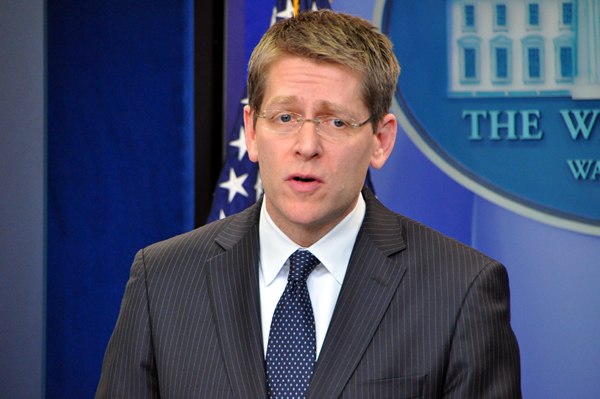
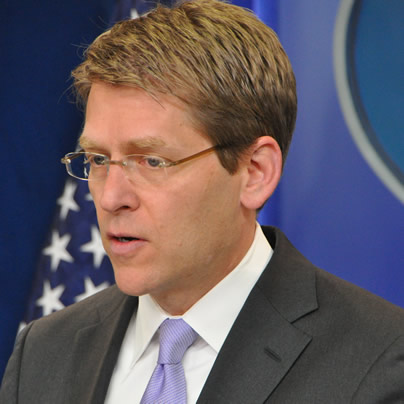
White House Press Secretary Jay Carney answers questions at the White House daily briefing

White House Press Secretary Jay Carney responded to the Cheney feud by talking ENDA. (Blade file photo by Michael Key)

White House Press Secretary Jay Carney responded on Monday to the public feud between the Cheney sisters over same-sex marriage, taking the opportunity to reiterate President Obama’s support for the Employment Non-Discrimination Act.

Under questioning from ABC News Radio’s Ann Compton, Carney said he hasn’t had any conversations with Obama about criticism lesbian Mary Cheney has directed toward her sister Liz Cheney over her opposition to same-sex marriage.

“I would only say that like so many other Americans, former Vice President [Richard] Cheney has come to view equality as something that we need to make fact, and not just an aspiration,” Carney said. “And that’s certainly where the president is, and that’s reflected in his very strongly held view that the House of Representatives ought to follow the Senate’s lead and pass the Employment Non-Discrimination Act, for example, because in the not-too-distant future, we in this country will look back at this moment and pretty clearly recognize that those who oppose ENDA were wrong.”

Carney acknowledged that the issue of LGBT rights “is a tough issue, and can be a tough issue” for a lot of families, but concluded “it is a very American value to pursue equality for everyone.”

Pressed by Compton about whether progress has been made in the country for LGBT rights, Carney replied, “Without question.”

“You’ve heard the president discuss this many times, including, I think, in the interview he gave with Robin Roberts last year — that was last year, right?” Carney said. “There’s no question there’s been enormous progress. I think that anybody who looks at LGBT rights and the road travelled in this country just in the past decade would rightly be pleased by the significant progress that’s been made, even as we acknowledge that more work needs to be done, more progress need to be done.”
Advertisement
FUND LGBTQ JOURNALISM
SIGN UP FOR E-BLAST

The White House

‘Lavender Scare 2.0’: inside the White House’s campaign against LGBTQ federal employees

LGBTQ federal workers organization sounding the alarm

Published

on

Frank Kameny led the first gay rights protest outside the White House on April 17, 1965. Protesters demanded an end to federal government discrimination against LGBTQ people, including the firing of federal employees. (Photo courtesy of the Washington Historical Society)

Since the beginning of the modern LGBTQ civil rights movement, there have been small but meaningful shifts in policy and public attitudes over the past 55 years that have allowed many within the LGBTQ community to feel safe in their right to love. The Trump-Vance administration is dramatically eroding that sense of security by enacting policies that directly harm LGBTQ people.

The Lavender Scare 2.0 is here, LGBTQ advocates warn, with stark decisions regarding LGBTQ federal employees that harken back to a time when you could be arrested — or worse— for not being a straight, cis citizen.

The Washington Blade spoke with Lucas F. Schleusener, the co-founder and CEO of Out in National Security, a nonprofit and nonpartisan organization that works to “empower queer national security professionals,” about the change in tone coming from the White House on LGBTQ government employees in national security and other federal circles.

There are almost 2.3 million federal government employees — not including uniformed military personnel, U.S. Postal Services employees, employees of federal contractors, and employees of federal grants — but only 7.3 percent of federal employees identified as LGBQ, and less than one percent identified as transgender, according to the 2023 Federal Employee Viewpoint Survey. Despite these numbers showing that this population is a minority within federal government employees, the steps the Trump-Vance administration is taking to erode LGBTQ federal workers’ protections seem to be of grave importance — especially within the military.

There are many things that caused shifts in public opinion of LGBTQ people (and their rights). Small victories over time build up and can change how the public views a particular issue — from the beginning legal fights for LGBTQ rights, which started nearly a decade before Stonewall by Frank Kameny, to the assassination attempt of the first openly gay public official Harvey Milk, to even the widespread humanizing impact of the HIV/AIDS epidemic on LGBTQ people who have suffered the most from the disease. All help make up the concept of American LGBTQ rights. Trump — laid out by Project 2025 and aided by other conservative politicians — is beginning to erode these rights.

One of the clearest ways the slow erosion of this protective space for LGBTQ federal employees can be seen, Schleusener explained, is through destabilization efforts within the bureaucratic system coming from the Oval Office — and with that is the return of 1980s–90s–style harassment.

“There’s an overwhelming bureaucratic trauma happening — a destabilization that feels intentional,” Schleusener said. “And underneath that, we’re seeing a return of different flavors of workplace harassment across national security agencies, from the CIA to the Import-Export Bank.”

GLIFAA, an employee resource group founded in 1992 that advocates for LGBTQ inclusion, equality, and workplace protections within U.S. foreign affairs agencies, was forced to have its entire board resign to comply with Trump’s “Defending Women from Gender Ideology Extremism and Restoring Biological Truth to the Federal Government” executive order the Blade covered in January, ultimately removing an important social and professional group that supported public servants. Since the executive order, the GLIFAA website has removed most of it’s content and contacts.

Schleusener continued, explaining that this policy will hurt LGBTQ federal workers.

“The administration has dissolved all minority employee resource groups, destroying networks of belonging and leaving queer federal employees in a state of psychological precarity,” he said.

Other organizations that have had to change their approach to supporting LGBTQ federal employee worker rights include the American Federation of Government Employees’ PRIDE program, a subsection of the largest federal employee union representing 820,000 federal and D.C. government workers. AFGE PRIDE was founded in 2015 to get more LGBTQ-inclusive contracts for federal workers and educate all members on LGBTQIA+ workplace and safety issues. AFGE has had numerous public disagreements with both Trump administrations’ anti-LGBTQ policy, notably when the federal employee union criticized the government’s multiple implementations of transgender military bans, and when it called out questionable budget-cutting techniques within the Centers for Disease Control and Prevention and multiple LGBTQ specific organizations by flagging — and subsequently removing — funding for anything with “transgender” in it.

Beyond minimizing the power of official structures created to specifically protect workers’ rights, the current administration and some members of the Republican Party have started to use “digital witch-hunts,” using social media to harass, dox, and lie about LGBTQ federal employees. While not as bad as denying a job to a deserving candidate for past homosexual “proclivities” like what happened with Frank Kameny, there are consequences to this shift in what is deemed acceptable for the online appearances of LGBTQ federal workers inside and outside of federal buildings.

“It’s not clearances being denied so much as it is targeted harassment. Laura Loomer has essentially declared herself the new Joe McCarthy, going through the Plum Book to identify anyone with ‘LGBT,’ ‘DEI,’ ‘equity,’ or ‘trans’ in their job titles and doxxing them.”

This intolerance promoted by the Trump-Vance administration and his party is not like whistleblowing on a State Department official for selling secrets to foreign governments, Schleusener explained, but rather attacking a part of LGBTQ federal workers’ human identity.

“These are ordinary federal workers — not public figures — whose home addresses end up on the internet simply for doing their jobs.”

Recently Laura Loomer, the far-right political activist, conspiracy theorist, internet personality, and Trump confidante, accused the trans community of playing some role in the assassination of right-wing political pundit Charlie Kirk, even going as far as to say that transgender people are “a national security threat” and constitute a terrorist movement, despite the shooter not being trans.

Trans federal employees have been facing a particularly difficult time under Trump’s second presidency. From bathroom bans restricting what gender bathrooms people can use to harassment on behalf of the federal government to remove them from military positions, there is a hyper-critical lens being placed on trans federal workers.

“There’s an organization called STARRS that combs through Instagram and LinkedIn looking for minority service members who show any pride in their identity. If you’re LGBTQ, a person of color, or even an ally who took your kids to Pride, they will tag and harass you — and they have a direct line into the Pentagon,” Schleusener pointed out. “People have been removed from their posts because of this, including the Navy’s top West Coast endocrinologist, whose only ‘offense’ was having a rainbow banner and pronouns on LinkedIn.”

Commander Janelle Marra was the medical director of Expeditionary Medical Facility 150 Bravo in San Diego until the TikTok account “Libs of TikTok” posted about her role as the Navy deputy medical director for trans healthcare, which was listed on her LinkedIn page, leading Defense Secretary Pete Hegseth to publicly order her removal from the role.

In addition to formally using the government to be hostile — if not outright discriminatory — against LGBTQ federal employees, the Trump-Vance administration has also fostered more informal harassment directed toward LGBTQ federal employees.

“It’s a climate of fear without any logical pattern — people doing important, everyday work suddenly find themselves targeted. These are not public political actors; they’re regular federal employees who now have to manage LinkedIn as if they were cabinet officials,” the former Pentagon employee and Obama national security associate shared.

“Between the administration’s formal hostility and these informal digital witch-hunts, queer employees are being squeezed from every direction.”

While there are some very clear discriminatory policies being put out by the White House, there is clear pushback from LGBTQ, human rights, and democracy advocates to stop them within the courts. With such a high amount of discriminatory action being taken by the Trump-Vance administration, it leaves the possibility for “legal chaos” within an already unhelpful system and the risk of a bad U.S. Supreme Court precedent.

“A lot of what we’re dealing with legally is documenting enough harassment to file viable claims, but the system is stacked against us. Even when we find a legal path — like restoring pensions for trans service members whose retirement benefits were revoked — everything is designed to be slow, difficult, and demoralizing,” Schleusener said. “And the frightening question is always whether fighting back could result in a bad Supreme Court precedent that hurts queer workers nationally.”

These pointed actions taken to harm LGBTQ federal worker protections by Trump and his followers in the federal system warrant a declaration of a second Lavender Scare, Schleusener told the Blade.

“Yes — this absolutely constitutes a second Lavender Scare. The federal government is saying trans people don’t belong in the military, even after spending billions training them for an all-volunteer force, which is both dangerous and absurd. Combined with attacks on ERGs, human rights reporting, and attempts to purge queer employees, it mirrors the patterns of the Cold War era.”

But this isn’t your grandparents’ Lavender Scare with vice squad cops trying to catch federal employees cruising like in the 60s. This is a whole other beast, Schleusener said.

The escalation of offenses, particularly for trans women within the government, is a major concern. The distaste for the trans community within the White House and among the president’s supporters on Capitol Hill makes this worse than a fine or a night in jail. The attempts to expand laws and policy regarding gender identity — particularly related to the National Defense Authorization Act and passport approvals — could have lasting impacts on LGBTQ federal workers’ ability to live in the U.S.

“This Lavender Scare is escalating: the NDAA moving through Congress includes a ban on trans women at service academies, and the administration is using Cold War statutes like the Walter McCarran Act to bar trans foreign nationals from entering the country.

Every opportunity they’ve had to go further, they have taken — and there’s no indication they plan to stop at trans people.”

Schleusener explained that although they are different in implementation, this new Lavender Scare is taking just as much of a toll on LGBTQ federal workers as it did the first time around — most of whom just want to help make the U.S. a better place.

“Like the original Lavender Scare, this is a manufactured moral panic weaponized through bureaucracy. Back then, the State Department bragged about driving queer employees to suicide; now we’re seeing trans service members taking their lives under the pressure of these policies. The difference today is that social media makes the harassment instantaneous and far-reaching, even as queer visibility also makes it harder to shove an entire community back into the closet.”

He also pointed out the growing purges of women and people of color from federal roles alongside the targeting of queer federal employees. This is a time to be aware of how federal work policies could shift the culture — and the safety of some of the most disenfranchised citizens.

“This isn’t only about LGBTQ people — there’s a broader purge underway targeting women and people of color in the senior ranks of the military. The first woman to take command of the SEALs was pushed out purely because she was a woman.

It’s a coordinated effort to turn back the clock across multiple identities simultaneously,” Schleusener said.

This manufactured climate of fear for LGBTQ federal employees is causing some to hide, delete, or exit the federal workforce altogether.

“We’ve seen a huge uptick in people trying to scrub their names from websites, delete their public bios, or step back from leadership programs out of fear of being hunted by Laura Loomer or similar groups. Even something as basic as using the bathroom has become a fraught question because the Pentagon now requires people to use facilities based on sex assigned at birth,” Schleusener added. “It’s driving people out of public service early, especially those with skills that are highly valued in the private sector.”

The Blade attempted to speak to multiple LGBTQ federal workers on record about their experience in seeing an overall shift in policy and tone directed toward the LGBTQ community — either anonymously or with their name attached — but no one wanted to speak for fear of losing their job. The Blade also reached out to the White House Press Office but has not received a response to the request for a statement on these allegations.

Continue Reading

District of Columbia

Activists praise Mayor Bowser’s impact on city, LGBTQ community

‘She made sure LGBTQ residents knew they were seen, valued, loved’

Published

on

Mayor Muriel Bowser has one more year in her term but announced she will not seek re-election next year. (Washington Blade file photo by Michael Key)

Members of D.C.’s LGBTQ community offered their thoughts on the impact Mayor Muriel Bowser has had on them, the city,  and LGBTQ people in statements and interviews with the Washington Blade in the week following Bowser’s announcement that she will not run for re-election in 2026.

Bowser’s Nov. 25 announcement came during the third year of her third four-year term in office as mayor and after she served as a member of the D.C. Council representing Ward 4 from 2007 to Jan. 2, 2015, when she took office as mayor.

The LGBTQ activists and mayoral staffers who spoke to the Blade agreed that Bowser has been an outspoken and dedicated supporter on a wide range of LGBTQ-related issues starting from her time as a Council member and throughout her years as mayor.

Among them is one of the mayor’s numerous openly LGBTQ staff members, Jim Slattery, who has served in the Cabinet-level position as the Mayor’s Correspondence Officer since Bowser first became mayor. 

“As Mayor Muriel Bowser’s longest serving LGBTQIA+ staffer – dating back to her first term as the Ward 4 Council member – and a proud member of her Cabinet since day one of her administration, I have had the opportunity to witness her at work for the people she serves and leads,” Slattery said in a statement. “Noteworthy is that throughout the entirety of my 27 years in District government, I have always been able to do so as an out and proud gay man,” he stated.

Slattery added that he has witnessed first-hand Bowser’s “absolute belief” in supporting the LGBTQ community. 

Mayor Muriel Bowser, center, joins Jim Slattery and Andrew McCarty at the 2015 Brother, Help Thyself grant awards ceremony. (Washington Blade file photo by Michael Key)

“She has led on HIV/AIDS prevention and treatment, on shelter for vulnerable members of our community, housing for older members of the community, and has been a reliable and constant presence at events to LGBTQIA+ residents,” Slattery said. Among those events, he said, have been World AIDS Day, the D.C. Pride Parade, the 17th Street LGBTQ High Heel Race, and WorldPride 2025, which D.C. hosted with strong support from the mayor’s office.

Ryan Bos, CEO & president of Capital Pride Alliance, the D.C. group that organizes the city’s annual LGBTQ Pride events and served as lead organizer of WorldPride 2025, praised Bowser for being a longtime supporter of that organization.

“She played a very supportive role in helping us as an organization grow and to be able to bring WorldPride to Washington, D.C.,” Bos told the Blade. “And we commend her years of service, And our hope is that she helps us to continue to advocate for the support from the D.C. government of the LGBTQ+ community, especially during these times,” Bos said.

Bos, who was referring to the Trump administration’s hostility toward LGBTQ issues and sharp cutbacks in federal funds for nonprofit organizations, including LGBTQ organizations, said Capital Pride Alliance appreciated  Bowser’s efforts to provide city funding for events like WorldPride.

“She provided support through the event process of WorldPride and ultimately along with the D.C. Council provided necessary funding to ensure WorldPride was a success,” Bos said. “And we are proud that we are able to show that Capital Pride and WorldPride had such a large economic impact for D.C. and the D.C. government,” he added. 

Marvin Bowser, Mayor Bowser’s gay brother who operates a local photography business and has been active in the D.C. LGBTQ community for many years,  said he has also witnessed first-hand his sister’s support for the LGBTQ community and all D.C. residents since the time she became a Council member and even before that.

Among his vivid memories, he said, was his sister’s strong support for the marriage equality law legalizing same-sex marriage in D.C. that the Council approved in 2009 under then-Mayor Adrian Fenty.

“I remember the first time she was standing up and giving clear and unequivocal support to the community when that law passed,” Marvin Bowser told the Blade. “And she was front and center in speaking very strongly in support of marriage equality,” he said.

Marvin Bowser also credits his sister with expanding and strengthening the then-Mayor’s Office of GLBT Affairs, among other things, by appointing advocate Sheila Alexander Reid as the office’s director in 2015. 

Reid, who for many years prior to becoming director of the GLBT Affairs office was founder and publisher of the national lesbian publication Women In The Life, had the reputation of a “rock star,” according to Marvin Bowser.

He recalls that Mayor Bowser also played a lead role in D.C.’s bid to host to the quadrennial international LGBTQ sports competition Gay Games for 2022.

D.C lost its bid for the 2022 Gay Games after the Federation of Gay Games selected Hong Kong to host the event in an action that Marvin Bowser says was unfair and based on the effort to hold the Gay Games for the first time in Asia even though D.C. had a stronger bid for carrying out the event.

“Everything she’s done for the community has been very visible and from the heart,” he said of Muriel Bowser. “And in my personal relationship with her, she has also been nothing but absolutely supportive of me and my partner over the years,” he said.

“And we were just at her house helping her put up Christmas decorations,” he added. “And so, it’s been wonderful having her as a sister.”

Veteran D.C. LGBTQ advocate Japer Bowles, who serves as the current director of the Mayor’s Office of LGBTQ Affairs, discussed the mayor’s record on LGBTQ issues in his own statement to the Blade. 

“Mayor Muriel Bowser has been an unwavering champion for D.C.’s lesbian, gay, bisexual, transgender, queer, intersex, and asexual community and movement,” he said. “Her more than 20 years of leadership brought consistent and historic investments for our LGBTQIA+ youth, seniors, veterans, and residents experiencing homelessness as well as impactful violence-prevention initiatives,” he added.

 “Under her leadership, the Mayor’s Office of LGBTQ Affairs grew into a national leader, delivering more than $10 million in community grants for LGBTQIA+ programs and managing 110 Housing Choice vouchers,” Bowles said in his statement.

“Because of her work, we are stronger, safer, more visible, and, proudly, ‘the gayest city in the world,’” he said in quoting Bowser’s often stated comment at LGBTQ events about D.C. being the world’s gayest city.  

In a statement that might surprise some in the LGBTQ community, gay D.C. small business owner Salah Czapary, who served from 2022 to 2024 as director of the Mayor’s Office of Nightlife and Culture as a Bowser appointee, criticized some of the city’s non-LGBTQ related polices under the Bowser administration as being harmful to small businesses.

Bowser appointed Czapary, a former D.C. police officer, to the nightlife office position shortly after he lost his race as an openly gay candidate for the Ward 1 D.C. Council seat held by incumbent Brianne Nadeau.

“Mayor Bowser led D.C. through turbulent years and major growth, and we can all be proud of her leadership on many fronts,”  Czapary said in a statement to the Blade. “She is also setting an example that more leaders should follow by stepping aside to allow a new generation to lead,” he said. “But as we turn the page, we must be honest about what the next mayor should deliver,” he says in his statement.

Without mentioning Bowser by name, he went on to list at least four things the next mayor should do that implied that Bowser did not do or did wrong. Among them were treating the D.C. Council as a “true governing partner,” not letting residents and small businesses “feel the weight of outdated, slow, and unresponsive systems,” and the need for leadership that “values competence over loyalty.”

He added that a “reversal” by the city of the city’s streetery program that was put in place during the COVID pandemic to allow restaurants to install outdoor seating into street parking lanes, was a “roll it back” on progress for small businesses.

He concluded by stating, “LGBTQ rights and inclusion are among the many fronts on which we can be very proud of the mayor’s leadership.” 

The mayor’s office did not immediately respond to an offer by the Blade to give the office an opportunity to respond to Czapary’s statement.  

A significantly different perspective was given by Sheila Alexander Reid, who said she was proud to serve as director of the Mayor’s LGBTQ Affairs Office during the first six-and-a-half years of Bowser’s tenure as mayor.

“I watched her evolve from a newly elected mayor finding her footing into a confident, seasoned leader who met every challenge head-on and time after time slayed the competition,” Alexander Reid said in a statement to the Blade.

Sheila Alexander-Reid and Mayor Muriel Bowser attend the opening of the DC Center for the LGBT Community inside the Franklin D. Reeves Municipal Center on April 21, 2015. (Washington Blade file photo by Michael Key)

“With each year in office, her voice grew stronger, more grounded, and more fearless,” her statement continues. “And she needed that strength, because being a Black woman mayor is not for the faint of heart, But Mayor Bowser never backed down. Instead, she showed the city what courageous, compassionate leadership truly looks like.”

Alexander Reid added that Bowser funded a new LGBTQ Community Center facility, expanded a workforce development program for the transgender community, and “made D.C. the first jurisdiction in the nation to require LGBTQ+ cultural competency training for healthcare providers.” 

She also pointed to the mayor’s LGBTQ “safety nets” through low-barrier shelters and housing vouchers and her support for LGBTQ celebrations like the 17th Street High Heel Race.

“But what inspired me most was this,” Alexander Reid stated. “At a time when some elected officials across the country were retreating from LGBTQ support, Mayor Bowser was doing the opposite. She leaned in, she doubled down. She made sure LGBTQ residents knew they were seen, valued, protected, and loved by their city.”

Continue Reading

National

Trans women in state prisons on being targeted by Trump

Uncloseted Media spoke with five incarcerated trans women in state prisons

Published

on

(Design by Sophie Holland)

Uncloseted Media published this article on Dec. 3.

Editor’s Note: This article includes references to topics such as rape, sexual assault, and violence. Reader discretion is advised.

By HOPE PISONI | Being a transgender woman in prison has always been hard for Lexie Handlang. At 38 years old, she’s a writer for the Prison Journalism Project and is currently working on a kids’ fantasy book starring a young trans girl and her friend who encounter a mysterious magical being.

Handlang has been incarcerated in men’s prisons in Missouri for 11 years, where she says she’s experienced a great deal of violence and discrimination.

She says her fears today are at an all-time high. After Trump passed an executive order on his first day in office that rolled back a suite of the scant and hard-won rights of trans women in federal prisons, Handlang remembers prison staff gleefully gloating.

“Transgenders don’t exist no more.”

“It’s not a thing.”

“I’m not gonna call you by your preferred pronouns.”

“I’m gonna call you ‘sir.’”

The executive order, titled “Defending Women from Gender Ideology Extremism and Restoring Biological Truth to the Federal Government,” includes a mandate requiring trans women to be housed in men’s prisons and a ban on the use of federal funds for gender-affirming care.

The following month, the Bureau of Prisons issued a memo banning gender-affirming items like chest binders and undergarments and requiring staff to refer to incarcerated people by their “legal name or pronouns corresponding to their biological sex.”

While the order does not apply to state prison systems, Uncloseted Media spoke with five trans women incarcerated in three different states who say Trump’s crackdown has created a trickle-down effect. They say it has produced a climate where staff are ramping up their mistreatment of trans women, federal grants for prisons are at risk as the Trump administration feuds with states, and anti-trans propaganda is turning fellow prisoners against them.

“There’s a lot of wardens who’ve been waiting for this — the discrimination has increased and it’s not anything new,” says Kenna Barnes, advocacy manager at Black and Pink, a nonprofit focused on prison abolition and the rights of incarcerated trans people. “It’s happening in every faction of the carceral system, and they are getting very emboldened, and this is a cue for them.”

Escalating attacks

Even though the Trump administration can’t force anti-trans policies on state prisons, they have still been pushing for them. In April, the Department of Justice pulled $1.4 million in funds from Maine’s Department of Corrections, the bulk of which had been allocated to support a substance use treatment program for all incarcerated people. The funding was pulled in retaliation for continuing to allow a trans woman, Andrea Balcer, to be housed in the women’s section of the Maine Correctional Center.

“You asked my feelings on being in the center of this feud between Trump and Maine — I am not in the center, I am underneath the feet of these two giants colliding, a mecha and a kaiju if you will,” Balcer, 24, told Uncloseted Media in a phone interview from the prison. “So I am not so much the center as I am collateral damage.”

Balcer was transferred to the women’s section of the prison in November 2023 due to concerns about her safety in men’s prisons, which are notoriously dangerous for trans women.

She spends much of her time playing Pathfinder, a role-playing game based on Dungeons & Dragons, and has been trying to start a group to host discussions on paganism and monthly full-moon rituals.

Balcer says she tries to keep a low profile and was getting along fairly well with her fellow prisoners after a period of adjustment.

But that changed when Attorney General Pam Bondi bullied her on Fox and Friends by calling her a “giant, 6-foot-1, 245-pound guy” and claimed that funding cuts “will protect women in prisons.” Balcer says some women at the facility turned on her and started to parrot Bondi’s rhetoric about a “man in a woman’s prison.”

“The cultural backlash has been astounding,” she says. “And it’s not that I don’t understand these women — I 100 percent understand their position. Things that have helped them and things that have done so many good things for them are being taken away, and they’re angry, as they have every right to be. But they can’t take out their anger on the people who quite frankly deserve it, [so] they take out their anger on the people that are the indirect cause of this.”

While Balcer says things have slightly improved since Maine successfully appealed the funding cuts, life is still much harder under Trump 2.0.

And she’s not the only trans woman who has a target on her back. Michelle Kailani Calvin was housed at the Central California Women’s Facility since the state’s Transgender Respect, Agency and Dignity Act — which she advocated for — passed in 2021. The act allowed trans women to be housed in women’s facilities.

Calvin, 54, was one of several trans women whose photos were included in a consequential advertisement for Trump’s 2024 campaign, which criticized Kamala Harris for supporting gender-affirming surgery in California prisons and included the infamous slogan “Kamala’s for they/them, not you.”

Difficulty accessing gender-affirming care

While gender-affirming surgeries in prison are still legally accessible in California, Calvin told Uncloseted Media via a phone call from CCWF that she has found it “very difficult … to get any kind of care” since Trump’s reelection.

She says she was scheduled for facial feminization surgery and a revision to her bottom surgery earlier this year to address complications including pain, bladder leakage and intense bleeding. Staff kept delaying them, however, claiming that she hadn’t passed a psychiatric evaluation and that she had a “dirty” toxicology report. According to Calvin, the substance that had been flagged was prescription gabapentin.

Calvin believes this foot-dragging is due to the Trump administration’s threats to cut funding, as they did with Maine.

“This is the game that the institution plays. Instead of just saying, ‘We’re not giving you a surgery because Trump ain’t giving us our money,’” she says.

Emboldened staff

Beyond having limited access to health care, Calvin says trans women face emboldened staff in Trump’s new America. In her case, this has involved increased scrutiny: After three years of no rule violations, she says she was hit with five in the span of four months.

She says several of those cases were provoked by abuse from guards. In one instance, which was documented in a report reviewed by Uncloseted Media, a guard forcefully removed her from her wheelchair and slammed her on the ground after he squeezed her shoulder without consent. She was later written up for resisting an officer.

And in March, the prison began investigating Calvin on allegations that she had assaulted her partner, who is also incarcerated. This led the prison to file a case with the California Department of Corrections and Rehabilitation’s Departmental Review Board to have her moved to a men’s prison.

Calvin says that numerous advocacy groups then sent letters to CDCR calling on them to reject the push. One lawyer, Jen Orthwein, wrote that “claims made against Ms. Calvin were submitted long after the alleged event by unnamed confidential informants, with no supporting documentation or medical evidence” and that the alleged victim “has indicated that the accusations are entirely false.” Uncloseted Media also spoke with the alleged victim from the prison where she is housed, and she affirmed that “Michelle never hurt me or any other female.”

“[The prison] feels like the Trump administration’s gonna have their back on whatever that they do, so they’re taking more bolder chances to isolate us or send us back to a men’s facility,” says Calvin.

While Calvin is still at a women’s facility, not everyone has been so lucky. CDCR recently proposed new guidelines that explicitly create a process for trans women to be transferred back to men’s prisons if they have “two or more serious Rules Violation Reports within a 12-month period.” Kelli Blackwell, 58, told Uncloseted Media on a phone call from CCWF that at least three trans women have been transferred to men’s prisons since 2024, which we confirmed on the California Incarcerated Records and Information Search website.

Blackwell is hopeful she’ll get released soon. With that in mind, she got her dentistry license and is set to earn a degree in sociology next spring. She also has a partner living with her in the women’s facility. But with increased scrutiny from CDCR and pressure from the Trump administration, she fears that a transfer to a men’s prison could disrupt all of that.

“You have trans women here that’s actually had the surgery, had the vaginoplasty — they’re still finding ways to send them back to a men’s prison,” she says.

In an email, CDCR said that they are “committed to providing a safe, humane, respectful and rehabilitative environment for all incarcerated people.” They also noted that the department “has a detailed process for patients seeking gender-affirming care, including hormonal treatment.”

Support systems have become ‘useless’

Trans women in prison are also losing the little support they had. Patricia Trimble, a 66-year-old trans woman, writer and advocate, has been incarcerated in men’s facilities in Missouri since 1979. While in prison, she’s pursued paralegal studies at Platt Junior College, theology at St. Louis University and business at Central Methodist University.

She’s used her education to advocate for herself, often through the Transgender Committee, a group of staff members required by law at each Missouri prison. The committee is meant to help the prison “make informed recommendations regarding the health and safety of transgender and intersex offenders.”

However, Trimble says that since the start of the year, the committee has become “absolutely useless.”

“At one point in time, I could sit down with the Transgender Committee … and we would discuss things that make the prison safer, and they were receptive,” Trimble told Uncloseted Media on a phone call from the Southeast Correctional Center.

“Since Trump, there are no conversations like that. When I go to the Transgender Committee, the deputy warden just kinda looks at me with that smile on her face like ‘you ain’t gettin’ nothing here, and I already know what you’re gonna ask, so let’s just go through the motions and then you can go away.’”

Trimble says this makes every issue harder to fight. In a recent incident, she tried to get transferred after being housed with a transphobic cellmate who would “bully” and “constantly pick on” her.

Trimble says that even though there were empty cells in her wing, she was sent back and forth between the Transgender Committee, case workers and her unit manager before getting approved to move into one of them. While she had the know-how to stand up for herself, most people don’t.

Even with her experience in advocacy, she says staff have been harder than usual on her. Earlier this year, after advocating for gender-affirming surgery, she says the prison put her on a call with a doctor who said she “will not be filing a report recommending any further treatment.”

“She had the audacity to tell me that she finds that I no longer suffer from gender dysphoria,” Trimble says. “And I just kinda laughed and said, ‘Okay, I guess we’re done here,’ and I got up and left.”

In an email, the Missouri Department of Corrections wrote that they do not “tolerate unprofessional conduct by staff,” and that “no changes [have been] made to policies pertaining to transgender residents of Missouri state prisons after the 2024 election.”

The danger of men’s prisons

While life in the women’s facilities is far from perfect, the people we spoke with say it’s worth fighting to stay.

According to a 2016 analysis by the Williams Institute at UCLA, 37 percent of incarcerated trans people — the overwhelming majority of whom are housed in prisons that do not match their gender identity — had experienced sexual assault within a one-year period, compared to just over 3 percent of cis people.

Blackwell says physical violence at the men’s prison, often spurred by gang activity, is “structured” and “can get you killed.” Calvin says she was raped multiple times at the men’s prison, and Trimble recounted numerous instances when guards strip-searched her in the presence of men.

Handlang says she’s experienced extreme abuse by guards at the men’s prison: “They went in my cell and they were ripping up pictures of family, trying to get me to react, ripping up my clothes, ripping up my bras, ripping up panties, destroying my makeup.” When she tried to fight back, she says “they went off camera and they broke my ankle and my foot and stomped on me and punched on me.”

As threats continue to escalate, and Trump’s policies continue to trickle down, Trimble fears she could lose the few rights she has left.

“I know that all it would take is a phone call from Trump or one of Trump’s surrogates to the governor, and the governor simply signs an executive order and everything we’ve got is taken away and we would end up having to go to court again,” she says. “If the governor wanted to, he could make our lives a lot worse with just a stroke of the pen.”

Fighting back

In the face of all these horrors, these women are advocating for themselves and caring for their trans sisters.

Handlang says that this often involves the most basic gestures: listening to their troubles, teaching them how to do their makeup and helping them buy hygiene products.

Calvin and Blackwell are still working to defend and uphold the trans-inclusive bills they helped pass, and Trimble has used her years of experience to work with legal advocacy groups to get support for things like name changes and to pressure the state to address mistreatment.

“If you’re going to be an advocate or an activist … it can never be about you,” Trimble says. “It’s about our boys and girls that are suffering in this oppressive system.”

Continue Reading

Popular