National
Michael Sam could be NFL’s first openly gay player
“I just want to own my truth,” says Missouri defensive lineman in coming out interview

MIssouri defensive lineman Michael Sam has come out as gay and could be the NFL’s first out player. (Photo by Marcus Qwertyus; courtesy Wikimedia Commons)
In an announcement that will likely shake up professional sports, Missouri defensive lineman Michael Sam came out as gay Sunday night and declared his intention to be the National Football League’s first out player.
Sam, 24, a potential mid-round NFL draft pick in May, announced he’s gay in multiple media outlets, including articles in The New York Times and ESPN.
“I just want to make sure I could tell my story the way I want to tell it,” Sam told the Times. “I just want to own my truth.”
According to The New York Times, Sam had previously declared his sexual orientation to teammates during a team-building exercise last year at the University of Missouri, where he played for the Mizzou Tigers in Southeastern Conference Division I football.
“I’m gay,” he reportedly recalled saying on Sunday. “I looked in their eyes, and they just started shaking their heads — like, finally, he came out.”
It’s unclear what will happen with Sam, a senior listed at 6-foot-2 and 260 pounds, in the aftermath of his decision to come out because no gay person has ever played in a major North American league while being open about their sexual orientation.
Sam, a Hitchcock, Texas, native, has won accolades from his performance as a college player. The Associated Press named him the Southeastern Conference’s Defensive Player of the Year and he was selected as one of 10 unanimous first-team All-Americans.
In a statement Sunday night, the NFL praised Sam for his decision to come out and said his performance as a college player speaks for itself. In 2011, the NFL added sexual orientation to its list of protected classes.
“We admire Michael Sam’s honesty and courage,” the statement says. “Michael is a football player. Any player with ability and determination can succeed in the NFL. We look forward to welcoming and supporting Michael Sam in 2014.”
LGBT advocacy groups praised Sam for making the decision to come out and said it would prove to be a milestone in sports history.
Sarah Kate Ellis, president of GLAAD, said the NFL hopeful has shown leadership that demonstrates he will be an exceptional football player.
“By rewriting the script for countless young athletes, Michael has demonstrated the leadership that, along with his impressive skills on the field, makes him a natural fit for the NFL,” Ellis said. “With acceptance of LGBT people rising across our coasts — in our schools, churches, and workplaces — it’s clear that America is ready for an openly gay football star.”
Chad Griffin, president of the Human Rights Campaign, said Sam is “making history” and has provided “essential hope to millions of LGBT young people from the South.”
“Trailblazers like Michael are tearing down barriers to equality almost daily, and I sincerely believe that the young person who will go on to become the first openly LGBT president of the United States watches today’s news somewhere in this country and is inspired,” Griffin said.
Via Twitter, Sam confirmed his decision to come out and thanked those who helped him with his decision.
I want to thank everybody for their support and encouragement,especially @espn, @nytimes and @nfl. I am proud to tell my story to the world!
— Michael Sam (@MikeSamFootball) February 10, 2014
Sam’s announcement is along the lines of former Washington Wizards center Jason Collins’ decision last year to come out as gay in a Sports Illustrated article. Following that announcement, despite the praise he received, including from President Obama, Collins hasn’t yet been picked up by a team and remains a free agent.
The coming out decision was coordinated by Sam’s publicist Howard Bragman, who also handled the coming out announcements for Collins, openly gay former NFL players Dave Kopay and Wade Davis Jr. as well as gay former Major League Baseball player Billy Bean. He’s the fifth professional athlete that Bragman has helped come out of the closet.
At the same time that major media outlets published the news that Sam was gay, Outsports.com ran its own piece about the internal deliberations leading up to the announcement.
According to the article, Sam decided the he won’t lend his name to LGBT organizations and will simply play the sport as an openly gay man.
Cyd Zeigler, a sports journalist, said Sam has a tremendous chance of success in his bid to play in the NFL following his announcement.
“Every NFL draft expert has Sam being selected in the first to fifth round of this year’s NFL draft,” Zeigler said.

Federal Government
Republicans attach five anti-LGBTQ riders to State Department funding bill
Spending package would restrict Pride flags on federal buildings, trans healthcare, LGBTQ envoys
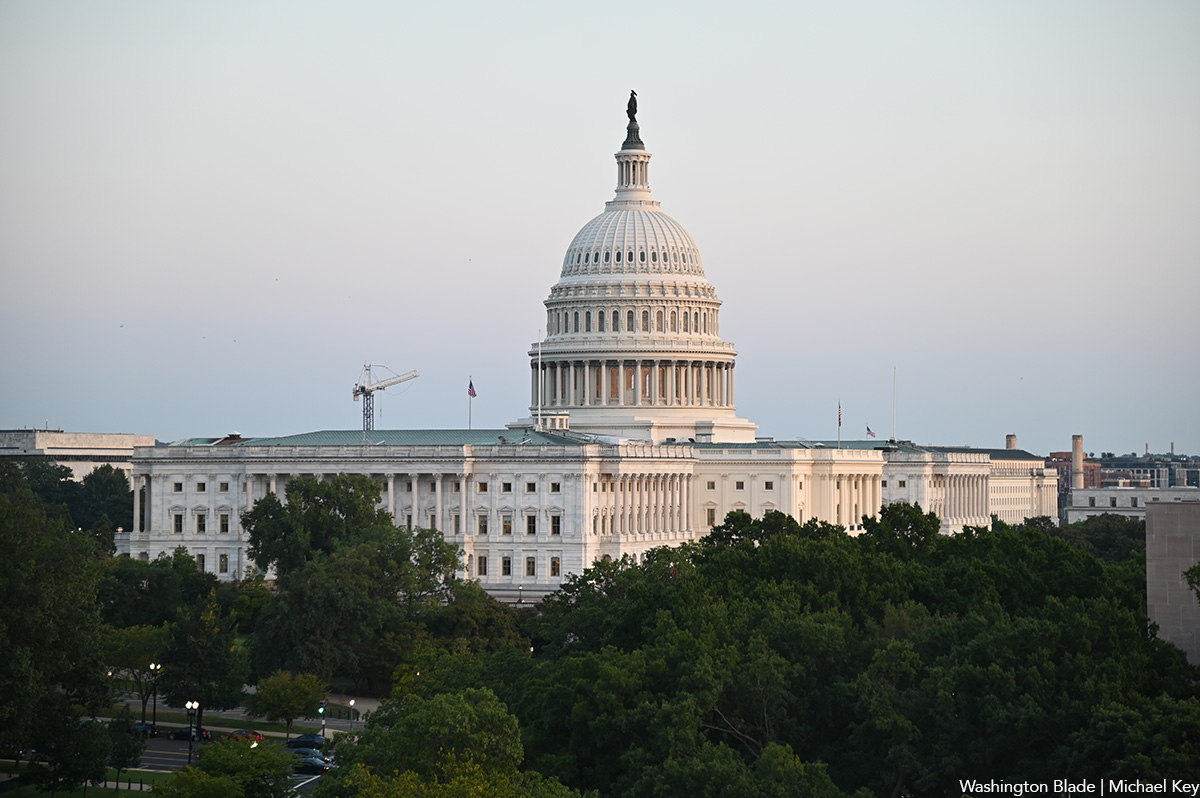
As Congress finalizes its funding for fiscal year 2027, Republicans are attempting to include five anti-LGBTQ riders in the National Security and Department of State Appropriations Act.
A rider is an unrelated provision tacked onto a bill that must pass — in this instance, the bill provides funding for national security policy and for the State Department.
The riders range from restricting Pride flags in federal buildings to banning transgender healthcare, but all aim to limit the visibility and rights of LGBTQ Americans.
The five riders are:
Section 7067(a) prohibits Pride flags from being flown over federal buildings.
Section 7067(c) restricts the United States’ ability to appoint special envoys, representatives, or coordinators unless expressly authorized by Congress. These roles have historically been used to promote U.S. interests in international forums — including advancing human and LGBTQ and intersex rights and other policy priorities. The change would halt what the Congressional Equality Caucus describes as providing “critical expertise to U.S. foreign policy and leadership abroad.”
Section 7067(d) reinforces multiple anti-equality executive orders signed by President Donald Trump, effectively requiring that foreign assistance funded by the United States comply with those orders. This includes rescinding federal contractor nondiscrimination protections, including for LGBTQ people.
Section 7067(e) prohibits funding for any organization that provides or promotes medically necessary healthcare for trans people or “promotes transgenderism” — effectively banning funds for organizations that recognize trans people exist. This is despite the practice of gender-affirming care being supported by nearly every major medical association.
Section 7067(g) reinforces two global gag rules put forward by the Trump-Vance administration. One is the Trans Global Gag Rule, which prohibits foreign assistance funding for organizations that acknowledge the existence of trans people or advocate for nondiscrimination protections for them, among other activities. The second is the DEI Global Gag Rule, which prohibits foreign assistance funding for organizations that engage in efforts to address the ongoing effects of racism, sexism, and other forms of bigotry outside the United States.
The global gag rule has its roots in anti-abortion policy introduced by President Ronald Reagan in 1984, when the 40th president barred foreign organizations receiving U.S. global health assistance from providing information, referrals, or services for legal abortion, or from advocating for access to abortion services in their own countries. Planned Parenthood notes that the policy also affects programs beyond abortion, including efforts to expand access to contraception, prevent and treat HIV/AIDS, combat malaria, and improve maternal and child health.
If organizations funded by the State Department engage in these activities, they could lose funding.
This anti-LGBTQ push aligns with broader actions from the Trump-Vance administration since the start of Trump’s second term, which have focused on restricting human rights — particularly those of trans Americans.
The House Appropriations Committee is responsible for drafting the appropriations legislation. U.S. Rep. Tom Cole (R-Okla.) serves as chair, with U.S. Rep. Rosa DeLauro (D-Conn.) as ranking member. The committee includes 34 Republicans and 27 Democrats.
For FY27 appropriations, Congress is supposed to pass and have the president sign the funding bills by Sept. 30, 2026.
Noticias en Español
The university that refuses to let go
Joanna Cifredo is a trans woman participating in University of Puerto Rico strike
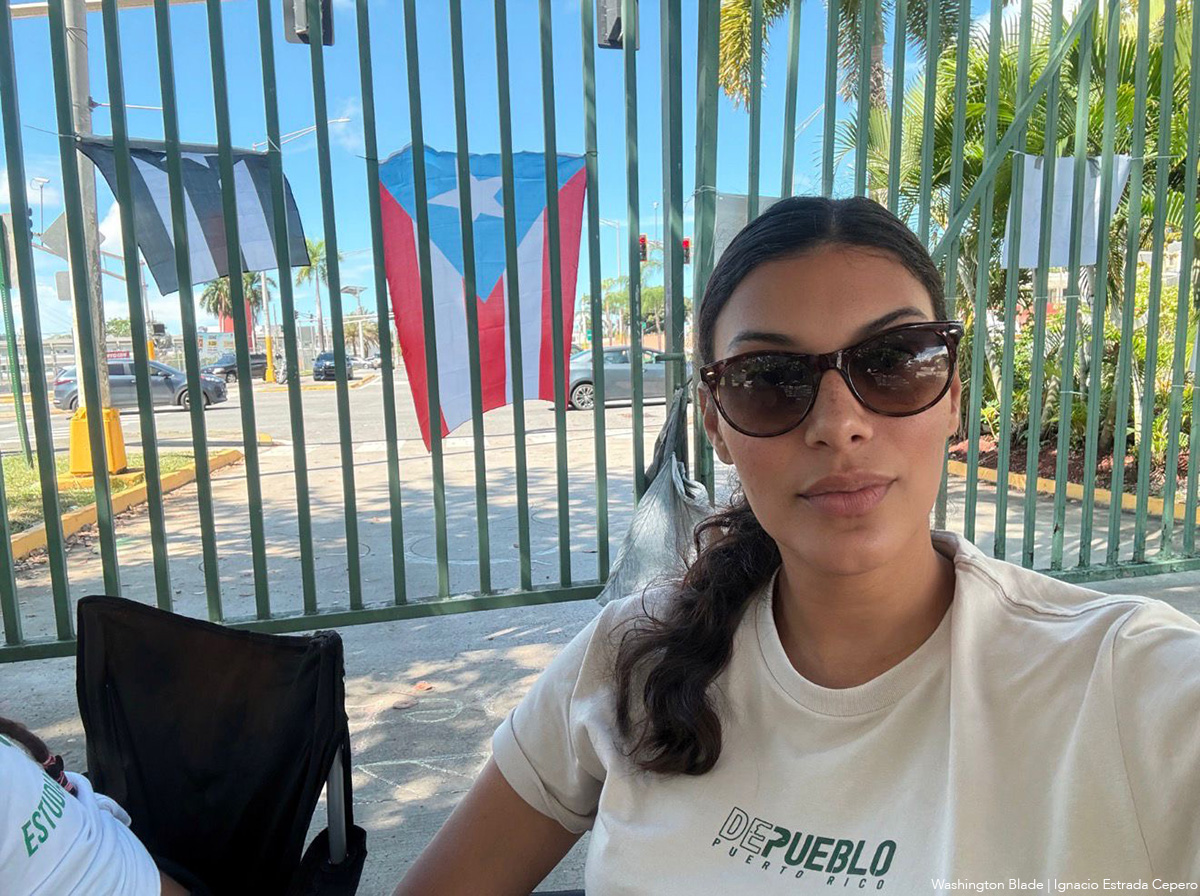
Over the past days, I have been walking with a question that refuses to leave me. Not the kind of question you answer from a desk or from a distance, but one that grows out of what you witness in real time, at the gates, in the faces of those who remain there without knowing how any of this will end. What is truly happening inside the University of Puerto Rico, and why have so many students decided to risk everything at a moment when they can least afford to lose anything.
I write as someone who lives just steps away from the Río Piedras campus. These days, the silence has replaced the constant movement that once defined this space. The absence is felt in every corner where students used to pass at all hours. Since arriving in Puerto Rico three years ago, I have come to know firsthand stories that rarely make it into reports or official statements. One of the reasons I chose to stay was precisely this, to serve the university community, to help create a space where students could find something as basic as a safe meal at night and, in some way, ease burdens that are often carried in silence.
I have listened, asked questions, and tried to understand without imposing answers. What I have found is not a collective outburst or a generational whim. What exists is a fracture, a deep break between those making decisions and those living with their consequences every single day.
There has been an effort to reduce this strike to an issue of order, scheduling, or academic disruption. Conversations revolve around missed classes, delayed semesters, and students supposedly unaware of the consequences of their actions. What is rarely addressed are the conditions that lead an entire student body to pause its own future to sustain a protest that offers no guarantees.
Because that is the reality. These are students who fully understand what they are risking, and yet they remain. When someone reaches that point, the least they deserve is not judgment, but to be heard.
From the outside, there have also been attempts to discredit what is happening. Familiar narratives are repeated, legitimacy is questioned, and doubt is cast over intentions. It is easier to do that than to acknowledge that this did not begin at the gates, but long before, in decisions made without building trust.
And something must be said clearly. This is not limited to the gates of Río Piedras. What we are witnessing extends across every unit of the University of Puerto Rico system. Mayagüez, Ponce, Arecibo, Bayamón, Cayey, Humacao, Carolina, Aguadilla, Utuado, and the Medical Sciences Campus. This is not an isolated reaction. It is a movement that runs through the entire institution. Río Piedras may be more visible, but it is not alone. What is happening there reflects a broader unrest felt across the system.
Within that context, one demand has grown increasingly present, the call for the resignation of University of Puerto Rico President Zayira Jordán Conde. This is not the voice of a small group. It reflects a deeper level of mistrust that has spread across multiple campuses.
The Puerto Rican Association of University Professors has also made it clear that this is not solely a student issue. There is real concern among faculty, and a shared recognition of the conditions currently shaping the university. When students and professors arrive at the same conclusion, the problem can no longer be minimized.
Meanwhile, the administration continues to speak in the language of dialogue. But dialogue is not a word, it is a practice. And when trust has been broken, it cannot be restored through statements alone, but through decisions that prove a willingness to truly listen.
In the midst of all of this, there are voices that cannot be ignored. Voices grounded not in theory, but in lived experience. One of them is Joanna Cifredo, a student at the Mayagüez campus, a young Puerto Rican trans woman, and someone widely recognized for her advocacy.
I spoke with her in recent days. What follows is her voice, exactly as it is.
How would you describe what is happening inside the University of Puerto Rico right now, beyond what people see from the outside?
Estamos viviendo momentos muy difíciles, en el sentido de que hay mucha incertidumbre y una presión constante por parte de la administración para reabrir el recinto, pero, entre todo el caos e inestabilidad provocado por las decisiones de esta administración, también hemos vivido momentos muy poderosos. Esta lucha ha sacado lo mejor de nuestra comunidad.
Lo vimos en las asambleas y plenos, donde 1,500, 1,700, hasta 1,800 estudiantes llegaron —bajo lluvia, bajo advertencias de inundaciones— y aun así se quedaron, participaron y votaron a favor de una manifestación indefinida hasta que se atiendan nuestros reclamos.
He conocido a tantas personas en los diferentes portones, estudiantes graduados, aletas, estudiantes de intercambio, estudiantes de todo tipo de concentraciones y se unieron para apoyar el movimiento estudiantil. Estudiantes que vienen a los portones después del trabajo o antes de trabajar. Estudiantes que vienen a dejar agua y suministros entre turnos de trabajo. Viejitos que vienen a los portones con desayuno, almuerzo o cena.
Más allá de lo que se ve desde afuera, lo que estamos viviendo es una mezcla de tensión y resistencia, pero también de comunidad, solidaridad y compromiso colectivo.
Much of what is discussed remains at the level of headlines or social media. From your direct experience, what specific decisions or actions from the administration have led to this level of mobilization?
Desde el inicio, la designación de la Dra. Zayira Jordán Conde careció de respaldo dentro de la comunidad universitaria. No contaba con experiencia administrativa en la UPR ni con un conocimiento básico de nuestros procesos, cultura y reglamentos. Por eso, en asamblea, el estudiantado votó para solicitarle a la Junta de Gobierno que no considerara su candidatura, y múltiples organizaciones docentes hicieron lo mismo. Existía un consenso amplio de que no tenía la experiencia necesaria para liderar una institución como la nuestra.
A pesar de ese rechazo claro, la Junta de Gobierno decidió ignorar los reclamos de la comunidad universitaria e imponer su nombramiento.
Una vez en el cargo, su estilo de gobernanza ha sido poco transparente y poco colaborativo. Sin embargo, el detonante principal de la movilización en el Recinto Universitario de Mayagüez fue su decisión de destituir, de manera unilateral y en medio del semestre, a cinco rectores, incluyendo al nuestro, el Dr. Agustín Rullán Toro, para reemplazarlo por un rector interino, el Dr. Miguel Muñoz Muñoz.
Esta acción, tomada de forma abrupta, provocó de inmediato un clima de caos e inestabilidad dentro de la institución. Y deja una pregunta inevitable: ¿no anticipó el impacto de esa decisión, lo que evidenciaría una falta de experiencia? ¿O lo anticipó y aun así decidió proceder? No está claro cuál de las dos es más preocupante.
Además, esta decisión tuvo consecuencias concretas para el estudiantado, incluyendo el retiro de becas educativas para nuevos integrantes del RUM por parte de la Fundación Ceiba, que calificó la movida como “sorprendente” y “preocupante”. Decisiones impulsivas como la que tomó la presidenta ponen en peligro la estabilidad de nuestra institución y la acreditación de la universidad.
As a trans woman within this movement, how does your identity intersect with what is happening, and why does this also shape the future of people like you?
Soy una de varias chicas trans que formamos parte activa de este movimiento estudiantil.
For those outside the UPR who believe this does not affect them, what are the real consequences of this crisis?
La Universidad de Puerto Rico se fundó para servir al pueblo.
It is impossible to overstate the role the University of Puerto Rico and its students have played in shaping the social, cultural, and economic life of this country. Its impact extends into science, medicine, and every profession that has sustained Puerto Rico over time. No other educational institution has contributed more.
After listening to her, one thing becomes undeniable. This is not just another protest, but a generation refusing to let go of what little remains within its reach. And when a generation reaches that point, the issue is no longer the strike, the issue becomes the country itself.
National
Advocacy groups issue US travel advisory ahead of World Cup
Renee Good’s death in Minneapolis among incidents cited

More than 100 organizations have issued a travel advisory for the U.S. ahead of the 2026 World Cup.
The World Cup will take place in the U.S., Canada, and Mexico from June 11-July 19.
“In light of the deteriorating human rights situation in the United States and in the absence of meaningful action and concrete guarantees from FIFA, host cities, or the U.S. government, the undersigned organizations are issuing this travel advisory for fans, players, journalists, and other visitors traveling to and within the United States for the June 2026 FIFA Men’s World Cup. World Cup games will be played in 11 different cities across the United States, which, like many localities, have already been the target of the Trump administration’s violent and abusive immigration crackdown,” reads the advisory that the Council for Global Equality and other groups that include the American Civil Liberties Union issued on April 23. “The impacts of these policies vary by locality.”
“While the Trump administration’s rising authoritarianism and increasing violence pose serious risks to all, those from immigrant communities, racial and ethnic minority groups, and LGBTQ+ individuals have been and continue to be disproportionately targeted and affected by the administration’s policies and, as such, are most vulnerable to serious harm when traveling to and/or within the United States,” it adds. “This travel advisory calls on fans, players, journalists, and other visitors to exercise caution.”
The advisory specifically mentions Renee Good.
A U.S. Immigration and Customs Enforcement agent on Jan. 7 shot and killed her in Minneapolis. Good, 37, left behind her wife and three children.
The full advisory can be read here.

Tennessee’s trans data bill a frightening omen

The queer appeal of ‘The Devil Wears Prada’

Lesbifriends Travel to host queer night out

Republicans attach five anti-LGBTQ riders to State Department funding bill

Calendar: May 1-7

House Republicans push nationwide ‘Don’t Say Gay’ bill

European Parliament backs EU-wide conversion therapy ban

LGBTQ people are leaving Orthodox Judaism behind

Rep. Sarah McBride reflects on first year in Congress amid political backlash

Democracy Forward files FOIA request for State Department bathroom policy records
-

 Federal Government4 days ago
House Republicans push nationwide ‘Don’t Say Gay’ bill
-
European Union2 days ago
European Parliament backs EU-wide conversion therapy ban
-
News4 days ago
LGBTQ people are leaving Orthodox Judaism behind
-
Delaware3 days ago
Rep. Sarah McBride reflects on first year in Congress amid political backlash