News
Panel of journalists, activists tackles outing, Russia, ENDA
‘LGBTs In The News’ series next heads for NYC
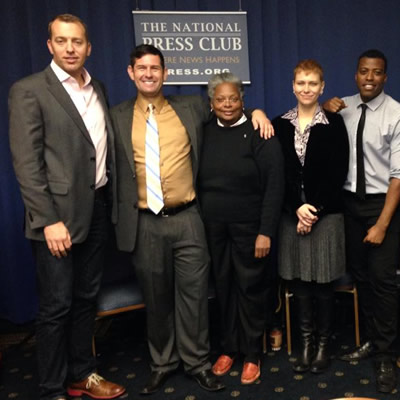
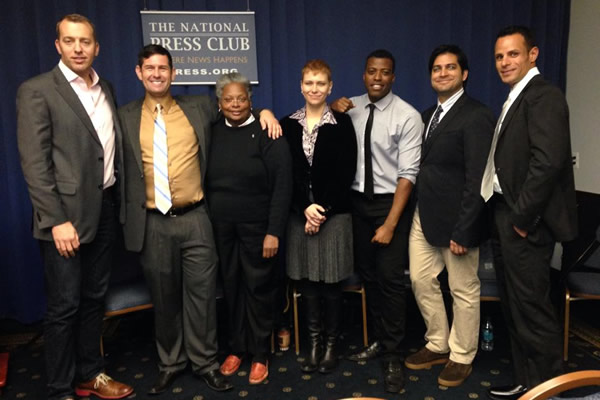
Panelists included (left to right) Kevin Naff, Thom Senzee, Mandy Carter, Sarah Blazucki, Rob Smith, Adam Moore and Will Walters. (Photo courtesy of Thom Senzee)
Last week’s engagement at the National Press Club of the “LGBTs In The News” panel series, currently on a nationwide tour, revealed differences in opinion about the ethics of outing.
Comprised of leaders from the fields of journalism, entertainment and activism, the panel also shed light on the need for greater opportunities for LGBT actors and broadcast personalities and for better coverage of people of color at the front lines of the LGBT-equality movement.
Citing a landmark report his organization released last year, which was researched and compiled by the Williams Institute at UCLA, SAG-AFTRA’s national director of EEO and diversity, Adam Moore noted that the entertainment industry in the U.S. is the “most visible workplace on Earth,” and that as LGBT actors and media professionals gain parity in job opportunities, the entertainment industry and news business can lead by example as models of equal opportunity.
“We’ve already come a long way in our industries,” said Moore. “But you might be surprised how far we still have to go. This is an industry that is still run by a lot of very traditional, very conservative and highly risk-averse people at the top.”
Perhaps surprisingly, the controversy surrounding the 2014 Winter Olympics at Sochi vis-à-vis Russia’s anti-gay-propaganda law was, for all intents and purposes, only modestly grazed as a point of discussion during the panel.
However, passage of the Employment Non-Discrimination Act was a hot topic among the panelists.
“What I believe, and as Arizona Governor Jan Brewer learned recently, corporations that have already instituted non-discrimination policies for LGBT workers are inclined to put pressure on congress to pass ENDA,” said panelist Will Walters, whose civil rights education organization, FreeWillUSA is a major sponsor of the panel series. “Ironically, big business may force ENDA to a ‘yes’ vote in the long run.”
The discussion, which was also sponsored by the Washington Blade and SAG-AFTRA (formerly the Screen Actors Guild) and held in the National Press Club’s Edward R. Murrow Room, soon turned to the enduring question of whether it is ethical for, or even incumbent upon, reporters to disclose secretly gay public figures’ sexual orientation.
“If you’re a private citizen with no public persona, that’s one thing,” Blade editor, Kevin Naff said. “However, there’s an entirely different set of rules that are specific to people in the public eye. They’ve chosen a path in the limelight and they are fair game—especially when they’re hurting other gay people and being hypocritical at the same time.”
According to Naff, ultimately it matters not whether a closeted public figure is hostile to the cause of LGBT equality.
“If they’re a public figure, reporting their sexual orientation is fair game,” he said. “If you’re in the public eye, this is part of what you signed up for.”
But author-activist and Iraq war veteran, Rob Smith disagreed.
“It’s not up to me to tell someone, even if they are against us publicly, ‘you’re going to be outed whether you like it or not,’” he said. “I’m sorry, but that’s not right; and it hurts us all in the long run.”
At least one other panelist, civil rights leader Mandy Carter, agreed with Smith.
“It can cause all kinds of damage in a person’s life to be outed, including loss of career and even suicide,” said Carter, who is co-founder of the National Black Justice Coalition. “I’m not going to be the one to decide for you whether or not you should come out of the closet.”
Working with other individuals and organizations, not least among them, Walter Naegle, surviving partner of the late Bayard Rustin, Carter has been a key figure in helping increase awareness about Rustin’s role alongside civil rights activist, A. Philip Randolph as chief organizer of the 1963 March on Washington for Jobs and Freedom, where Dr. Martin Luther King delivered his famous “I Have a Dream” speech.
There was consensus among all of the panelists about the importance of educating the world about Bayard Rustin, who was openly gay in the 1940s, ‘50s, ‘60s and beyond, but who—despite being among Dr. King’s closest advisers—was kept out of the public eye as much as possible for fear that the Civil Rights movement might be “tarnished” by Rustin’s homosexuality.
All of the panelists agreed that passing ENDA was probably the most important goal the LGBT community has on its plate at the moment. Yet, each agreed that passage of ENDA in 2014 is all but impossible.
“I think 2015 looks a little more plausible,” said National Lesbian and Gay Journalists Association vice president of print and online media, Sarah Blazucki.
The next “LGBTs In The News” panel will be in late spring in New York City and will feature the theme: “LGBTs and Our Allies: We couldn’t do it without you.”
“New York promises to be a decidedly star-studded panel, as we expect to have some of the music industry’s most illustrious LGBT allies and community members on the panel,” said series founder and panel moderator, Thom Senzee, a freelance journalist.
“Stay tuned for a major announcement about our confirmed panelists for the New York engagement of LGBTs In The News.”
Visit lgbtsinthenews.com for more information.





Senegal
Senegalese president signs bill that further criminalizes homosexuality
Measure passed in National Assembly with near unanimous support
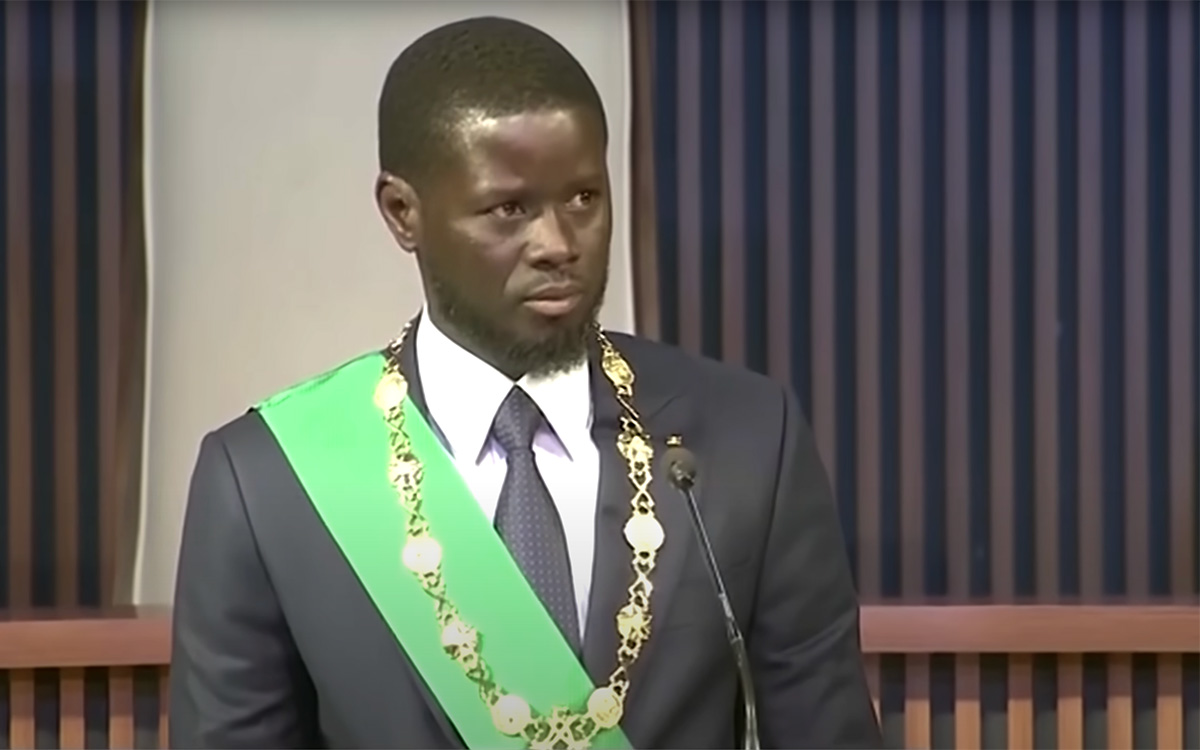
Senegalese President Bassirou Diomaye Faye on Tuesday signed into law a bill that further criminalizes consensual same-sex sexual relations in the country.
Lawmakers in the African country on March 11 nearly unanimously passed the measure that increases the penalty for anyone convicted of engaging in consensual same-sex sexual relations from one to five years in prison to five to 10 years. The bill that Prime Minister Ousmane Sonko introduced also prohibits the “promotion” or “financing” of homosexuality in Senegal.
Reuters on March 16 reported MassResistance, an anti-LGBTQ group based in the U.S., worked with Senegalese groups that support the bill. Volker Türk, the U.N. high commissioner for human rights, is among those who urged Faye not to sign it.
The Senegalese National Assembly in 2021 rejected a bill that would have further criminalized homosexuality in the country.
Police in February arrested a dozen men and charged them with committing “unnatural acts.”
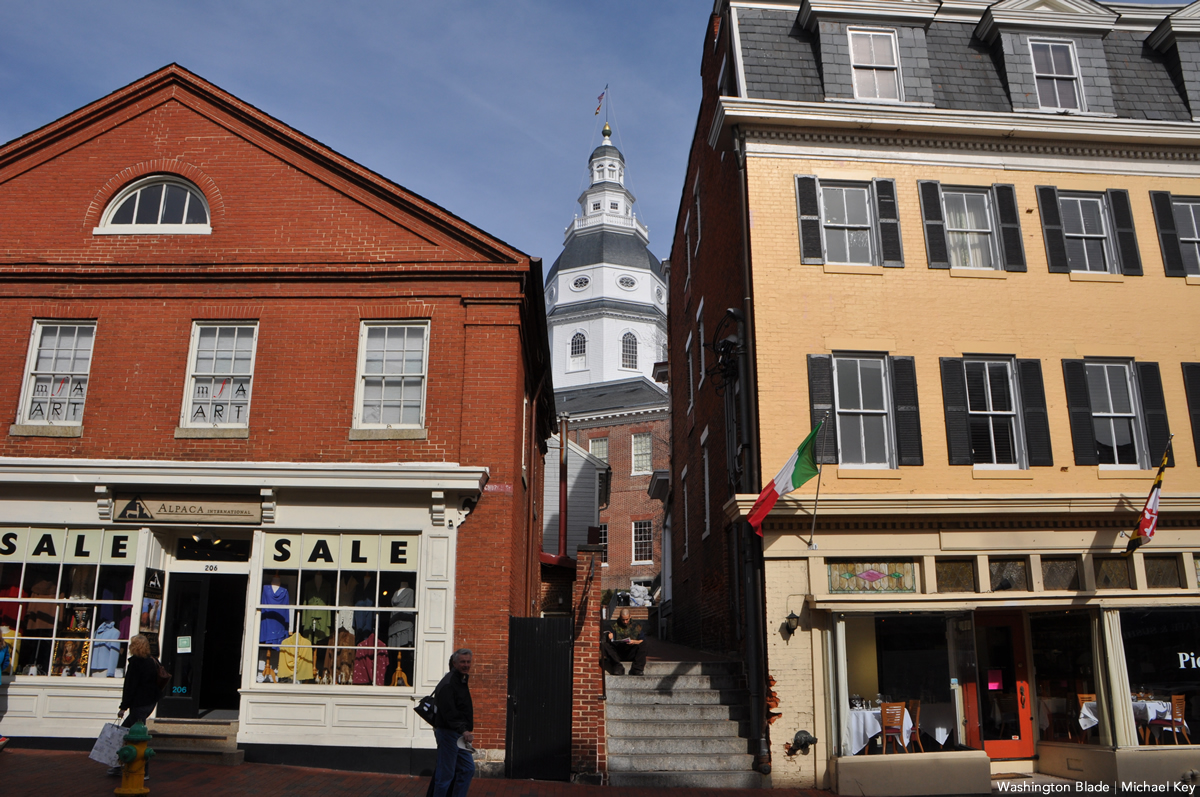
Maryland’s legislative caucuses outlined their legislative priorities heading into the final weeks of the 2026 General Assembly during a joint press conference on March 24.
The press conference was titled “We are Maryland,” where a representative for each of the legislative caucuses outlined priorities.
State Del. Kris Fair (D-Frederick County) of the LGBTQ+ Caucus opened the press conference with a statement on the unity of Maryland’s caucus.
“Together we can show our state and our community a different world, one where we mutually support one another and through that support uplift every Marylander,” he said.
In a press conference on March 5, the LGBTQ+ Caucus outlined its top legislative priorities. Fair highlighted two of those bills again during the “We are Maryland” press conference.
The first of the two highlighted pieces of legislation was Senate Bill 626 and House Bill 1589.
The bills would simplify the process of updating an individual’s birth certificate and align the Department of Health and DMV systems to reflect those changes. The bill is being led by state Sen. Clarence Lam (D-Anne Arundel and Howard Counties) and state Del. Ashanti Martinez (D-Prince George’s County).
The second piece of legislation is Senate Bill 950 and House Bill 1209, which would update and modernize laws and regulations around so-called conversion therapy. The bills have failed to pass either chamber thus far. They are being led by state Sen. Cheryl Kagan (D-Montgomery County) and state Del. Bonnie Cullison (D-Montgomery County).
(The U.S. Supreme Court on Tuesday ruled against a Colorado law that bans so-called conversion therapy for minors. Maryland is among the U.S. jurisdictions that prohibit the widely discredited practice for anyone under 18.)
Martinez and Lam have introduced bills in their respective chambers that would expand PrEP access in Maryland. Martinez did not attend the press conference, and Fair did not mention it when he spoke.
State Del. N. Scott Phillips (D-Baltimore County) represented the Black Caucus during the press conference. State Del. Dana Jones (D-Anne Arundel County) spoke on behalf of the Women’s Caucus, State Del. Teresa Woorman (D-Montgomery County) represented the Latino Caucus, and State Del. Lily Qi (D-Montgomery County) represented the Asian-American and Pacific Islander Caucus. State Del. Jared Solomon (D-Montgomery County) represented the Jewish Caucus, and state Del. Sean Stinnett (D-Baltimore County) represented the Muslim Caucus during the press conference.
Solomon ended the press conference by explaining the importance of all the caucuses coming out together.
“We are stronger when we’re together, and many of these issues that we have talked about, again, impact all of us,” said Solomon.
U.S. Supreme Court
Supreme Court rules against Colo. law banning conversion therapy for minors
8-1 decision could have sweeping impact
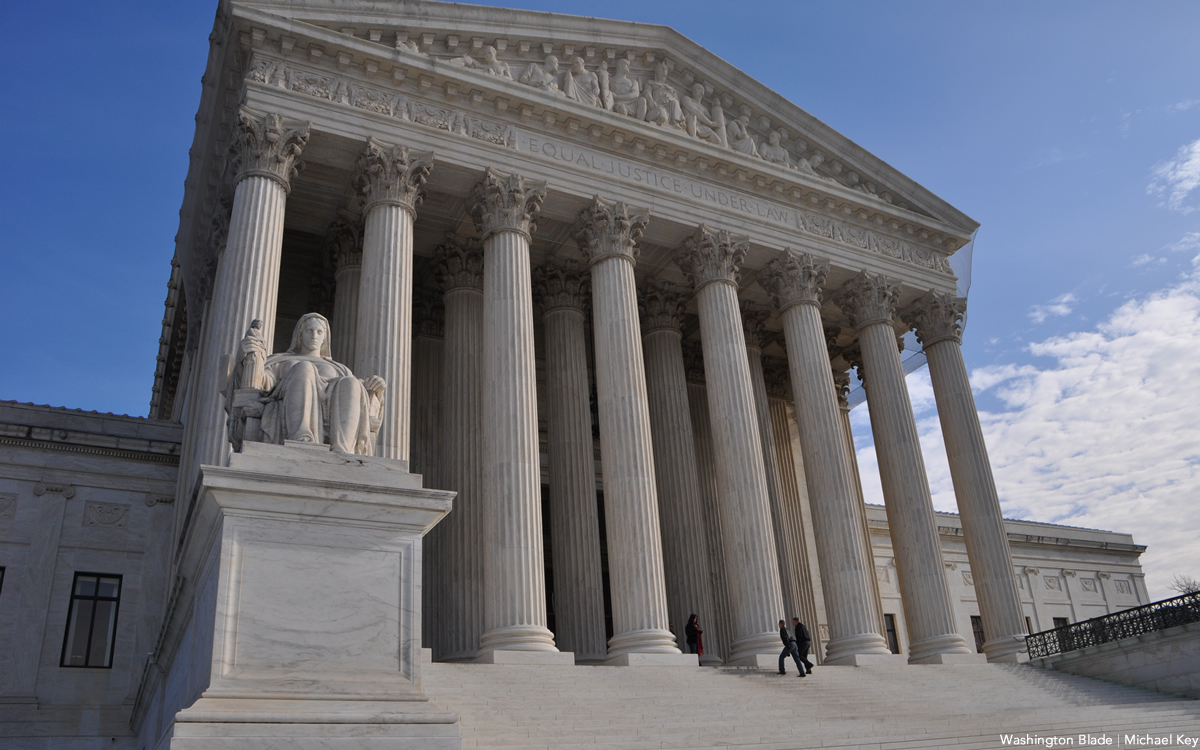
The U.S. Supreme Court on Tuesday ruled against a Colorado law that bans so-called conversion therapy for minors.
The justices last October heard oral arguments in Chiles v. Salazar. Today they ruled 8-1 in favor of Kaley Chiles, a Christian therapist who challenged the 2019 law.
In the case, which was heard by the justices in October 2025, Chiles successfully argued to the court that the law restricting this type of therapy was unconstitutional, leading to it being struck down.
The Supreme Court ultimately found that lower state and federal courts has “erred by failing to apply sufficiently rigorous First Amendment scrutiny,” ultimately reversing the widely discredited “medical” treatment that has support by a very narrow margin of mental health specialists — specifically religious and socially conservative ones. This is despite the fact that Colorado state officials have never enforced the measure in practice, and included a religious exemption for people “engaged in the practice of religious ministry.” The now moot law carried fines of up to $5,000 for each violation and possible suspension or revocation of a counselor’s license.
In the ruling, the court said the law, that specifically applies to talk therapy “impermissibly” interferes with free speech rights of Americans, and despite it being “regard[ed] its policy as essential to public health and safety, but the First Amendment stands as a shield against any effort to enforce orthodoxy in thought or speech in this country,” Justice Neil Gorsuch wrote for himself and seven other justices from across the ideological spectrum who overturned the low court’s ruling. He went on to add that the original ban “trains directly on the content of her speech and permits her to express some viewpoints but not others.”
Only Justice Ketanji Brown Jackson dissented, which included an in depth summary of her departure from the other eight justices, explaining her fears about the verdict — and its eventual chilling effect on legislation that could attempts to restrict regulatory speech for religious attitudes— despite that these regulations are often made as a direct creation of years of essentially unanimous research, and are vetted though regulatory boards for specific jobs.
“This decision might make speech-only therapies and other medical treatments involving practitioner speech effectively unregulatable,” Jackson wrote on page 32 of the 35-page opinion issued by court in response to her opposing eight members comments on the bench.
Since the ruling late Tuesday morning, a slew of LGBTQ advocacy groups have issued statements on the directly harmful effects the rule reversal will have across the country.
Polly Crozier, director of family advocacy at GLBTQ Legal Advocates & Defenders (GLAD Law), provided a statement to the Washington Blade on the court’s decision.
“Today’s Supreme Court ruling limited Colorado’s statute that preemptively shielded minors from conversion therapy, but it leaves open avenues for states to protect families from harmful, unscrupulous, and misleading practices that divide parents from their children and put LGBTQ+ youth at risk,” Crozier wrote, pointing to the overwhelming evidence on conversion therapy that argues this type of regulatory legislation is helping those suffering rather than harming. “The evidence is clear that conversion practices lead to increased anxiety, depression, and suicidality. This is a dangerous practice that has been condemned by every major medical association in the country. Today’s decision does not change the science, and it does not change the fact that conversion therapists who harm patients will still face legal consequences, and that family advocates, mental health practitioners, and all of us who care about the wellbeing of youth will continue working to shield LGBTQ+ young people and their families from this dangerous practice.”
Human Rights Campaign President Kelley Robinson, who leads the nation’s largest LGBTQ advocacy group, also provided a statement, calling the courts choice a “reckless decision.” The statement also points out how their own data (from the group’s philanthropic arm of the organization) was cited in Brown Jackson’s dissent in the amicus brief.
“The court has weaponized free-speech in order to prioritize anti-LGBTQ+ bias over the safety, health and wellbeing of children,” her statement reads. “So-called ‘conversion therapy’ is pseudoscience, not real therapy. It has been condemned by every mainstream medical and mental health association and harms families, traumatizes children, and robs people of their faith communities. It is cruel and should never be offered under the guise of legitimate mental healthcare. To undermine protections that keep kids and families safe from these abusive practices is shocking — and our children deserve better.”
Liberty Counsel, a nonprofit, tax-exempt Christian ministry that uses litigation to promote evangelical Christian values and limit LGBTQ protections, which was designated as a hate group by the Southern Poverty Law Center, was also cited in the court’s amicus brief, but in support of overturning the law.
“The U.S. Supreme Court’s resounding decision in Chiles v. Salazar is a major victory for the integrity of the counseling profession,” Mat Staver, Founder and Chairman of Liberty Council said today. “This ruling ensures the government cannot strip the First Amendment away from licensed counselors and dictate a state-mandated ideology between counselor and client. Talk therapy is speech, and the government has no authority to restrict that speech to just one viewpoint. Counseling bans can now be struck down nationwide so that people can get the counseling they need.”
GLAAD, one of the nation’s oldest non-profit organizations focused on LGBTQ advocacy and cultural change issued a statement pon the verdict, emphasizing what multiple advocate groups have said – this decision will impact an already vulnerable youth population at an elevated high risk.
“The Court once again prioritized malice over best practice medicine,” Sarah Kate Ellis, President and CEO of GLAAD said in a statement. “In the face of this harmful decision, we need to amplify the voices of survivors of this dangerous and disproven practice, and continue to hold anyone who peddles in this junk science liable.”
Adrian Shanker, the former Deputy Assistant Secretary for Health Policy at Health and Human Services under President Biden, who also led LGBTQI+ policy at the agency, spoke about the detrimental impact this will have on rules and regulations within the healthcare field that are supposed to be inherently secular by nature.
“No matter what the Supreme Court decided today, it is irrefutable that conversion therapy is harmful to the health and wellbeing of LGBTQI+ youth,” Shanker told the Blade. “That’s why in the Biden administration we advanced policies to safeguard youth from this harmful practice.”
In an consistently updated document started in 2018 that cites the major harms risks conversion therapy poses to LGBTQ people, the Trevor Project, the leading suicide prevention and crisis intervention organization for LGBTQ young people, included that the federal government’s own research proved the practice at best questionable and at worst deadly.
“In a 2023 report entitled Moving Beyond Change Efforts: Evidence and Action to Support and Affirm LGBTQI+ Youth, the U.S. Department of Health and Human Services’ Substance Abuse and Mental Health Services Administration stressed that “[sexual orientation and gender identity] change efforts are harmful practices that are never appropriate with LGBTQI+
youth, and efforts are needed to end these practices,” the summary of the fight against conversion therapy in the U.S. reads.
More than 20 states and D.C. banned the widely discredited practice for minors prior to the Supreme Court’s ruling.
The Blade last October spoke to conversion therapy survivors after the justices heard oral arguments in the Chiles case.

Senegalese president signs bill that further criminalizes homosexuality

Md. lawmakers reaffirm legislative priorities

Supreme Court rules against Colo. law banning conversion therapy for minors

Thousands attend ‘No Kings’ protests in D.C.

Blade contributor, husband exchange vows in D.C.

‘No Kings’ protests set for D.C.

Celebrate cherry blossoms the drag way

Lorato ke Lorato: marriage equality, democracy, and the unfinished work of justice in Botswana

The outrage economy is not the LGBTQ community

Japanese Supreme Court to consider marriage equality
-

 District of Columbia5 days ago
‘No Kings’ protests set for D.C.
-
Out & About4 days ago
Celebrate cherry blossoms the drag way
-
Botswana4 days ago
Lorato ke Lorato: marriage equality, democracy, and the unfinished work of justice in Botswana
-
Opinions4 days ago
The outrage economy is not the LGBTQ community