News
Clinton’s VP pick Kaine reliable on LGBT rights
Running mate called ‘solidly pro-LGBT equality’ after evolution
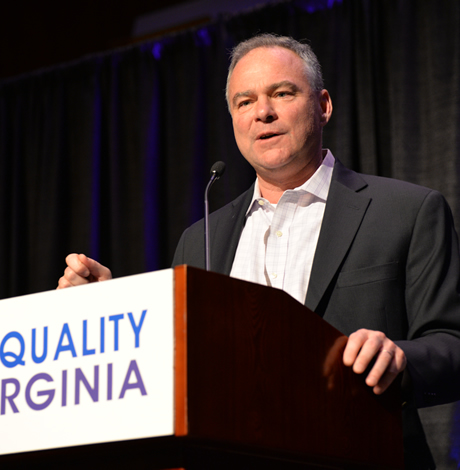
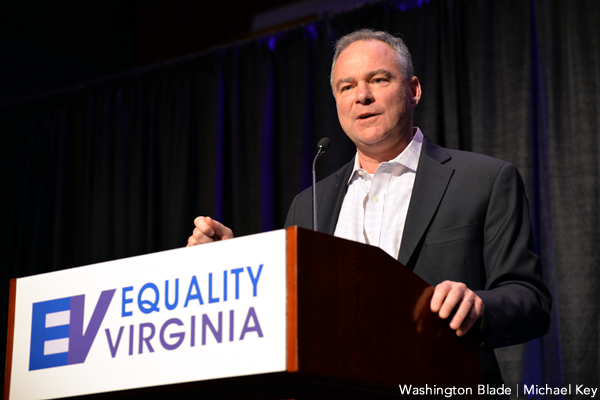
Hillary Clinton has selected Sen. Tim Kaine (D-Va.) as her running mate. (Washington Blade file photo by Michael Key)
Hillary Clinton has selected as her running mate a U.S. senator from Virginia who’s been a largely reliable voice in support of LGBT rights.
As first reported by The New York Times, Clinton announced late Friday her choice is Sen. Tim Kaine (D-Va.), who’s also former chair of the Democratic National Committee and former Virginia governor. A Spanish speaker, Kaine is set to make his joint campaign appearance with Clinton on Saturday in Miami.
Since his tenure as Virginia governor between 2006 and 2010, Kaine has taken action on behalf of LGBT rights. Upon taking office, Kaine signed an executive order barring anti-gay discrimination in the state workplace (the direction didn’t contain explicit protections on the basis of gender identity). His Republican successor, Virginia Gov. Bob McDonnell reversed the order, but Gov. Terry McAuliffe, a Democrat, reinstated it and added protections for gender identity.
Upon election to the U.S. Senate in 2012, Kaine generally hasn’t been at the forefront of initiatives advancing LGBT rights, but has rose to the occasion as needed. In the Human Rights Campaign’s most recent congressional scorecard, Kaine scored a “90” out of possible “100,” losing points for not co-sponsoring the Student Non-Discrimination Act and the Safe Schools Improvement Act.
Kaine is an original co-sponsor of comprehensive LGBT non-discrimination legislation known as the Equality Act. The senator also cast votes in favor of the Employment Non-Discrimination Act and an amendment along the lines of the Student Non-Discrimination Act. However, he isn’t a co-sponsor of the Therapeutic Fraud Prevention Act, which seeks to ban widely discredited “ex-gay” therapy nationwide by classifying it as fraud.
Kaine has signed amicus briefs urging the U.S. Supreme Court to overturn the Defense of Marriage Act and state bans prohibiting same-sex marriage. More recently, Kaine signed a brief urging the U.S. Second Circuit Court of Appeals to find sexual orientation discrimination is prohibited under current law.
In 2010, Kaine, as chair of the Democratic National Committee, took part in a three-and-a-half minute video to answer on questions on LGBT rights, outlining accomplishments already made under the Obama administration.
“We have a long way to go, but we’re already making progress for LGBT individuals,” Kaine says. “President Obama and congressional Democrats have already begun to address barriers to equality for LGBT Americans by guaranteeing these families the right to visit and make medical decisions for a partner in America’s hospitals, by enacting hate crimes legislation to protect LGBT Americans — to name just two significant accomplishments.”
Chad Griffin, president of the Human Rights Campaign, drew a stark contrast between Kaine and Indiana Gov. Mike Pence, whom Donald Trump has selected as his running mate.
“While Donald Trump doubled down on discrimination by picking Mike Pence, Hillary Clinton has bolstered her campaign’s historic commitment to LGBTQ equality by choosing Tim Kaine,” Griffin said. “Having proven time and time again that they have the experience, determination, and leadership needed to move equality forward for all Americans, we are confident Clinton and Kaine will tear down the walls of discrimination that hold all of us back.”
But Kaine, like many Americans, including President Obama and Clinton, appears to have gone through an evolution on LGBT rights. When running to become Virginia governor in 2006, Kaine said he didn’t support adoption by gay couples, but reversed his position by 2011.
Kaine was also initially opposed to same-sex marriage. Although he now supports marriage equality, it’s hard to say exactly when he changed his mind. In 2012, he sought to find a middle ground, not yet clearly supporting same-sex marriage, but backing some kind of relationship recognition.
“The underlying issue is, should committed couples have the same legal rights and responsibilities, and the answer to that is an unequivocal yes,” Kaine said, according to The Washington Post.
In 2013, when many U.S. senators declared their newfound support for same-sex marriage, Kaine joined them in declaring his support for marriage equality.
“I believe all people, regardless of sexual orientation, should be guaranteed the full rights to the legal benefits and responsibilities of marriage under the Constitution,” Kaine said at the time. “I hope the Supreme Court will affirm that principle.”
Rick Zbur, executive director of Equality California, said Kaine is “now solidly pro-LGBT equality” after undergoing the same kind ‘evolution’ on LGBT rights as the nation as a whole.
“With her selection of Sen. Tim Kaine, Hillary Clinton has highlighted the stark differences between her ticket and her opponent’s,” Zbur said. “In contrast to the extremes of racism, xenophobia, misogyny, and homo- and transphobia on display this week at the Republican National Convention, Kaine presents an alternative: a pragmatist who works across ideologies and across the aisle to get things done.”






Rehoboth Beach
Women’s FEST returns to Rehoboth Beach next week
Golf tournament, mini-concerts, meetups planned for silver anniversary festival

Women’s+ FEST 2026 will begin on Thursday, April 9 at CAMP Rehoboth Community Center.
The festival will celebrate a remarkable milestone in 2026: its silver anniversary. For 25 years, Women’s+ FEST has brought fun and entertainment for all those on the spectrum of the feminine spirit. There will be a variety of events including a golf tournament, mini-concerts and happy hour meetups.
For more information, visit Camp Rehoboth’s website.
Belarus
Belarusian lawmakers approve bill to crackdown on LGBTQ rights
Country’s president known as ‘Europe’s last dictator’

Lawmakers in Belarus on Thursday approved a bill that would allow the government to crack down on LGBTQ advocacy.
The Associated Press notes the bill would punish anyone found guilty of “propaganda of homosexual relations, gender change, refusal to have children, and pedophilia” with fines, community labor, and 15 days in jail.
The House of Representatives, the lower house of the Belarusian National Assembly, last month approved the bill. The Council of the Republic, which is the parliament’s upper chamber, passed it on Thursday.
President Alexander Lukashenko is expected to sign it.
Belarus borders Poland, Ukraine, Russia, Latvia, and Lithuania. Lukashenko — known as “Europe’s last dictator” is a close ally of Russian President Vladimir Putin.
Kazakhstan is among the countries that have enacted Russian-style anti-LGBTQ propaganda laws in recent years.
Vika Biran, a Belarusian LGBTQ activist, is among those arrested during anti-Lukashenko protests that took place in 2020 after he declared victory in the country’s presidential election.
District of Columbia
How new barriers to health care coverage are hitting D.C.
Federally qualified health centers bracing for influx of newly uninsured patients

Washington, D.C. has the second-lowest rate of people who lack health insurance in the country, but many residents are facing new barriers to health care due to provisions of the sweeping federal law passed in July, which threatens access for thousands.
Changes to insurance eligibility and the rising cost of premiums, which kicked in for some in October and others more recently, are expected to leave many more patients uninsured or unable to afford medical care. Federally qualified health centers, including D.C.’s Whitman-Walker Health, where 10 to 12 percent of patients are uninsured, are bracing for an influx of newly uninsured patients while facing their own financial challenges.
Even in D.C., where uninsured rates have been among the lowest in the country, changes brought on by the passage of the Republican mega bill (known as the “Big Beautiful Bill”) will have major effects.
The changes from the bill affect Medicaid, which is free to low-income patients, and subsidies for insurance that people buy on the health insurance exchanges that were started under the Affordable Care Act, which were allowed to expire on Dec. 31.
Erin Loubier, vice president for access and strategic initiatives at Whitman-Walker Health, says some Whitman-Walker Health patients have received notices about premium increases, including several who say the increases are up to 1,000 percent more than they were paying.
“That is like paying rent,” she says. “We live in an expensive city, so any increases are going to be really, really hard on people.”
Whitman-Walker Health and other healthcare providers are expecting the changes to have multiple effects — some patients may not be able to afford coverage or may avoid going to the doctor and allow health conditions to worsen because they can’t afford care, and many more will be seeking care who don’t have insurance.
“I’m worried that we’re going to not just have people who can’t get care, but that they delay care until they’re really sick, and then the care is not as effective because they might have waited too long, and then we may have a less healthy population,” Loubier says.
Loubier says delaying care, and serving more people without insurance has major implications for Whitman-Walker Health and other health centers serving the community.
“There’s going to be a lot of pressure on us to try to find and raise more money, and that’s going to be harder, because I think all organizations who provide health care are going to be facing this,” she says.
The U.S. health care system is the most expensive in the world, and has much higher out-of-pocket costs for individuals. But in other countries like the United Kingdom, Australia, Canada, and many others, health care is much less expensive — or even free.
Even though the U.S. has a high-priced healthcare system, critics say there are still ways to bring down costs by forcing insurance and pharmaceutical companies to absorb more of the costs, rather than transferring the costs to patients.
“In the U.S., they end up trying to cut costs at the person’s level, not at the level of the different corporations or structures that are making a lot of money in healthcare,” said Loubier. “Our system is so complicated and there is probably waste in it, but I don’t think that that cost and waste is at the ‘people’ level. I think it’s higher up at the system level, but that is much, much harder to get people to try to make cuts at that end.”
Ultimately at Whitman-Walker Health, healthcare providers and insurance navigators are planning to help with everyday necessities when it comes to healthcare coverage and striving to provide healthcare in partnership with patients, said Loubier.
“The key here is we’re going to have a lot of people who may lose insurance, and they’re going to rely on places like Whitman-Walker Health and other community health centers, so we have to figure out how we keep providing that care,” she said.
(This article was written by a student in the journalism program at Bard High School Early College DC. This work is part of a partnership between the Washington Blade Foundation and Youthcast Media Group, funded through the FY26 Community Development Grant from the Office of D.C. Mayor Muriel Bowser.)

Women’s FEST returns to Rehoboth Beach next week

Belarusian lawmakers approve bill to crackdown on LGBTQ rights

Calendar: April 3-9

How new barriers to health care coverage are hitting D.C.

Kenyan advocacy groups launch LGBTQ voter mobilization campaign

‘Out for McDuffie’ event held at D.C. gay bar

‘Jonah’ an undeniably compelling but unusual memory play

The Oscar-losing performance that’s too good to miss

Thousands attend ‘No Kings’ protests in D.C.