Sports
‘They’re cowards’ — gay athletes still refuse to come out
‘Big five’ men’s leagues embrace LGBT inclusion, so why aren’t more pros leaving the closet?

 Major League Soccer player Robbie Rogers of the Los Angeles Galaxy and Minor League Baseball player David Denson of the Wisconsin Timber Rattlers, currently are the only openly gay players associated with the five major U.S. sports leagues for men.
Yet despite the longstanding absence of out gay players, LGBT sports advocates say the big five leagues in recent years have adopted an unprecedented array of LGBT-supportive policies and outreach programs.
The leagues include Major League Baseball, the National Football League, the National Basketball Association, the National Hockey League, and Major League Soccer. The Washington Blade also reviewed the policies of the United States Tennis Association, which has adopted LGBT-related outreach programs and tournaments.
Although the advocates acknowledge the LGBT supportive policies of the five leagues haven’t had an immediate effect of prompting more gay players to come out, they say the policies and programs have laid the groundwork for gay players to come out in the coming years.
“I would say that almost every league has a non-discrimination policy and every league that we work with has an inclusive policy,” said Wade Davis, a gay former NFL player, in referring to the big five leagues’ LGBT programs and policies.
Davis serves as executive director of the You Can Play Project, a New York-based group that advocates for LGBT inclusion in professional sports. Among other things, he conducts LGBT training sessions on behalf of You Can Play for players, coaches and upper management officials at several of the leagues, including the NFL.
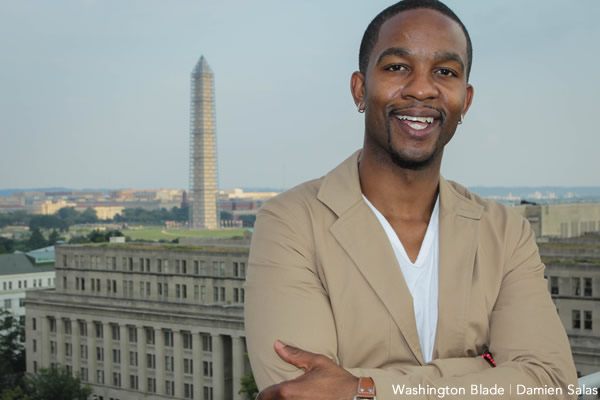
‘I would say that almost every league has a non-discrimination policy and every league that we work with has an inclusive policy,’ said Wade Davis, a gay former NFL player. (Washington Blade file photo by Damien Salas)
He says nearly all of the players and coaches he talks to have expressed strong support for treating a gay player as a fully accepted and respected member of their teams if and when a gay player comes out.
The national advocacy group Athlete Ally, founded by former college wrestler Hudson Taylor, has lined up more than 100 professional athletes who, like Taylor, have become straight allies and “ambassadors” of their respective sports for the purpose of advocating on behalf of LGBT inclusion in sports. Among those who have signed on as ally ambassadors are players in each of the big five major men’s sports leagues, including the NFL, NBA and Major League Baseball. Taylor has said the players who sign on as ally-ambassadors do so with the full support of their teams and respective leagues.
In addition to adopting policies and programs aimed at supporting out gay players, Major League Baseball, the Super Bowl, the U.S. Tennis Association, and the Professional Golf Association recently have expanded their LGBT inclusion policies to welcome LGBT-owned businesses.
In a development that drew attention in the professional sports world, Major League Baseball announced in March of this year that it entered into a first-of-its-kind partnership with the National Gay and Lesbian Chamber of Commerce. The partnership is aimed at helping LGBT-owned businesses to become official suppliers of products and services for MLB.
NGLCC President Justin Nelson said the partnership would enable hundreds of LGBT-owned businesses like construction companies and equipment suppliers to compete for business with the league and its baseball teams.
Nelson has said the partnership with MLB comes after his organization entered into similar partnerships with the NFL’s Super Bowl, the U.S. Tennis Association, and the PGA.
NGLCC has served as a clearinghouse for corporations and local and federal government agencies interested in reliable business suppliers and contractors by certifying LGBT-owned businesses deemed to be capable of providing products and services. The certification qualifies them to compete as an LGBT/minority owned business.
BASEBALL
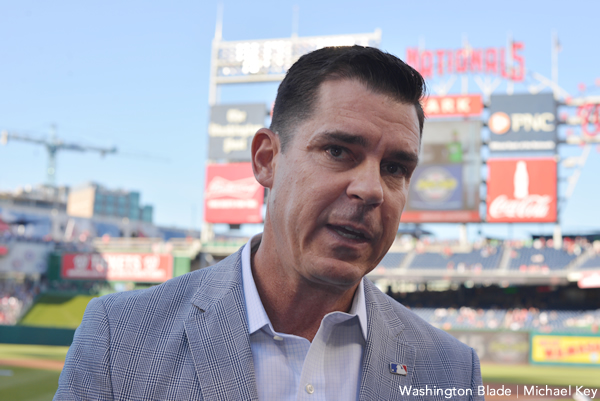
Baseball Commissioner Rob Manfred this year promoted gay former MLB player Billy Bean to the newly created position of Vice President for Social Responsibility and Inclusion. (Washington Blade photo by Michael Key)
LGBT sports advocates point to Major League Baseball as one of the most LGBT supportive of the big five professional men’s sports leagues. In July 2014, then Commissioner of Baseball Bud Selig hired gay former Major League player Billy Bean as a consultant on LGBT issues under the title of Ambassador for Inclusion.
After assessing Bean’s work in organizing and conducting LGBT-related training sessions and meetings with players, managers, and coaches in his first year and a half on the job, Selig’s successor, Baseball Commissioner Rob Manfred in January of this year promoted Bean to the newly created position of Vice President for Social Responsibility and Inclusion.
“In his elevated role, Bean will be responsible for many of the League’s social responsibility initiatives, including oversight of MLB’s Workplace Code of Conduct and anti-bullying programming, while continuing to facilitate inclusion strategies with a focus on the LGBT community,” MLB said in a statement at the time of Bean’s promotion.
“Billy has really taken his role and made it very, very important and special for us,” Michael Teevan, MLB’s vice president for communication, told the Washington Blade. “He’s an amazing human being. We have really enjoyed working with him.”
Teevan said Manfred named another former MLB player, Curtis Pride, who’s deaf, to replace Bean as the league’s Ambassador for Inclusion. Pride isn’t gay but has been an advocate for minorities in sports, and Teevan said he will continue the work Bean started in the ambassador’s position.
Teevan said as far as he knows, David Denson is the only current out gay player in MLB system. He noted that Denson talked to Bean before deciding to publicly disclose he’s gay while playing for his minor league team associated with the Milwaukee Brewers system.
Sean Conroy, another minor league player affiliated with an independent league not part of the MLB system, also recently came out as gay.
Teevan was asked why he thought an out gay player has yet to emerge on a major league team despite the MLB’s LGBT-supportive policies and programs.
“What I would say is we would love it if it happens and if the player wants to do it we tried to build a foundation that would make it comfortable to do so,” he said.
Teevan added, “We have tried to make it clear that baseball is inclusive and that it’s a game for everybody and that we tried to install the attitude that if a player wanted to make such an announcement he would get absolute support and respect.”
FOOTBALL
The NFL’s stated commitment to LGBT inclusion is said to have been first observed in August 2011 when it agreed to a labor contract with the NFL Players Association that added sexual orientation to the league’s existing non-discrimination policy.
“There will be no discrimination in any form against any player by the Management Council, any Club or by the NFLPA because of race, religion, national origin, sexual orientation, or activity or lack of activity on behalf of the NFLPA,” the contract states.
Davis of You Can Play has been credited with playing an important role in promoting LGBT inclusiveness within the NFL since the labor contract was signed, including following two developments that some LGBT activists viewed as signs of homophobia.
In February 2013, three college football players participating the NFL’s annual tryout gathering in Indianapolis, where NFL scouts and coaches evaluate prospective candidates for the NFL draft, told the media they were asked if they like girls. Some criticized the action as an attempt to screen out gay players.
The development prompted New York State Attorney General Eric Schneiderman to invite NFL officials to a meeting where he brokered an agreement by the NFL to conduct year-round seminars for players and officials involved in hiring players that discuss the league’s non-discrimination policies, according to media accounts of the meeting.
Notices of the NFL’s non-discrimination and anti-harassment policies, including the ban on sexual orientation discrimination, would be posted in locker rooms throughout the NFL under terms of the agreement.
Davis said You Can Play quickly approached the Atlanta Falcons with suggestions on diversity training earlier this year after news surfaced that a coach asked one of the players about his sexual orientation.
“They will do about two or three events to make sure their players know and their coaches know that this is something that’s not tolerable and there needs to be education that’s happening on their team,” Davis said.
For the most part, Davis said, NFL teams and players have engaged in positive activities on the LGBT front, including a parking lot tailgate event designated as You Can Play Day with the Tampa Bay Buccaneers. He noted that last year, his group arranged for New York Giants players to visit an LGBT youth service agency in Manhattan, the Hetrick-Martin Institute, where they met and spoke with LGBT youth.
A short time later, We Can Play arranged for a group of about 30 LGBT youth to attend a Giants game, where they were invited onto the field before the game started to visit with the players. Davis said it was part of his group’s ongoing “High Five” events associated with NFL games.
BASKETBALL
Similar to the NFL, the NBA adopted a sexual orientation non-discrimination policy in 2011 but went a step further by announcing that players making anti-LGBT slurs on the basketball court would be subjected to a fine of $50,000.
LGBT sports advocates praised the NBA and its players for expressing strong support for then-Washington Wizards player Jason Collins when he came out as gay in April 2013, becoming the first out gay person in any of the big five men’s sports leagues. Collins, at age 35 and after 13 years as an NBA player with several teams, announced his retirement from basketball in November 2014.
Earlier this year, the NBA, in partnership with the Gay, Lesbian and Straight Education Network, embarked on a campaign to sell LGBT Pride Month T-shirts in which the logo of every NBA team was altered to show a rainbow design. The NBA donated the proceeds from the sales to GLSEN, which advocates for LGBT youth in the nation’s schools.
“Support from professional sports for LGBT people has been one of the biggest cultural developments in the past five years, and the NBA has consistently led the way,” GLSEN Executive Director Eliza Byard said.
The NBA was further praised by GLSEN and other LGBT advocacy organizations last month when it announced it was withdrawing its 2017 All-Star Game from Charlotte, N.C., to protest the approval by the North Carolina Legislature earlier this year of an anti-LGBT law known as HB-2.
HOCKEY
The NHL, which has a sexual orientation non-discrimination policy, in 2013, became another one of the big five major league sports for men to enter into a partnership with You Can Play. Hockey officials said the partnership formalized and advanced the league’s existing commitment to inclusiveness in sports.
“The NHL sets the standard for professional sports when it comes to LGBT outreach and we are incredibly grateful for their help and support,” said Philadelphia Fliers scout Patrick Burke, co-founder of the You Can Play Project.
“While we believe that our actions in the past have shown our support for the LGBT community, we are delighted to reaffirm through this joint venture with the NHL Players’ Association that the official policy of the NHL is one of inclusion on the ice, in our locker rooms and in the stands,” said NHL Commissioner Gary Bettman. Bettman was referring to the NHL Players’ Association joining the NHL in its partnership with You Can Play.
Earlier this year, the Edmonton Oilers Community Foundation, which is affiliated with the Oilers team, announced it had become the founding partner of Pride Tape, an NHL program aimed at supporting LGBT equality by asking players to attach rainbow colored tape to their hockey sticks.
“Pride tape is described as a badge of support from the teammates, coaches, parents and pros to young LGBTQ players,” a statement released by organizers of the project says.
SOCCER
Similar to the NHL and other major sports leagues, Major League Soccer has adopted a sexual orientation non-discrimination policy and a partnership with You Can Play. The partnership with MLS and the other leagues involves an agreement where MLS invites a You Can Play representative, usually Wade Davis, to conduct LGBT-related training sessions for players, coaches, and other league employees.
TENNIS
The U.S. Tennis Association bills itself as the “national governing body for the sport of tennis and the recognized leader in promoting and developing the sport’s growth on every level in the United States, from local communities to the crown jewel of the professional game, the U.S. Open.”
The USTA’s website includes a sweeping diversity and inclusion statement adopted in 2012 that calls for “removing barriers to allow us to be inclusive so that tennis reflects all of America.” Although the statement doesn’t specifically mention LGBT people or any other minority, other sections of the website promote specific LGBT-related programs and tournaments.
Among them is the announcement in February of this year of an expansion of a first-of-its-kind same-gender couple’s tennis tournament launched in Palm Springs, Calif.
“The USTA is proud to recognize this tournament as an official USTA National Championship event,” said Katrina Adams, the USTA board chair and CEO and president, in a statement. “We were thrilled at the success of last year’s inaugural event, and sincerely hope that giving the event National Championship status will allow it to continue to grow and attract even more same-gender couples to the competition,” she said.
Cyd Ziegler, co-founder and co-editor of the LGBT sports news website OutSports, points out that the USTA’s same-sex couples tournaments are limited to the association’s amateur division and that the USTA has no same-sex couples tournaments in its professional tennis division.
“In the history of tennis they’ve never had a ranked [male] player come out publicly,” said Ziegler in referring to professional tennis tournaments.
A USTA spokesperson couldn’t immediately be reached to determine whether the USTA has plans for a professional tennis tournament for same-sex couples.
Why don’t more gay athletes come out?
Ziegler, a recognized expert on LGBT sports issues, and You Can Play’s Davis agree that the big five men’s sports leagues have made dramatic changes in recent years to become open to LGBT athletes. But the two, like many LGBT sports observers, disagree sharply over why more gay athletes don’t come out in those leagues.
“Tomorrow somebody could decide to come out or could be caught literally with his pants down,” Ziegler told the Blade. “All professional sports leagues are quote-unquote ready for an out player. But the gay athletes are just afraid. They’re cowards.”
He added, “The definition of a coward is somebody who lets fear govern his actions. And the gay athletes in the major men’s professional sports today are cowards. And even worse than the athletes that are active in sports are the dozens or hundreds of gay athletes who are retired who won’t come out,” he said.
“I mean, they have nothing to lose in the sports world. And for them to not come out really shows the disdain for the mental health of America’s youth,” especially LGBT youth who look to professional athletes as role models, Ziegler said.
“Cyd is a friend of mine,” Davis said. “But Cyd has never been a professional athlete. And everyone’s coming out experience is very different. Everyone’s experience growing up as a gay person is very, very different,” said Davis.
“So I find it a little disingenuous and a little hard to hear that everyone who’s not out is a coward,” Davis told the Blade.
Davis said he has spoken to closeted gay athletes in recent years and has learned that their individual situations are complex and nuanced.
“You’re not just coming out to your team,” he said. “You have to realize that when you come out on a professional sports team, you still have a family to deal with. So your family situation may be set up in a certain way that you also have to deal with now. Maybe my father is not going to be accepting.”
According to Davis, most of the gay athletes are aware of experiences of other gays who have come out in college sports and the rare cases of someone coming out in professional sports like Jason Collins.
“And what most people don’t understand – I have talked to a lot of closeted players,” Davis said. “And they will tell you as soon as you come out as an openly gay player in a sport you become just that…The focus would be on whether or not this gay person can survive in the locker room,” Davis continued.
“And I don’t know too many athletes I’ve spoken to who want to be engaged in that conversation when at the same time they have to perform on the field or on the court,” he said.
Ziegler praised organizations like You Can Play for working with professional sports leagues to put in place policies and practices that are inclusive of gay players. But he said the sports-related LGBT advocacy groups should also be encouraging more athletes to come out.
“At this point the most important thing any of these advocacy groups can do is identify professional LGBT athletes and work with them to come out publicly. I don’t think any of them are doing that,” he said.
“That’s not our job,” said Davis. “That’s not our responsibility. The responsibility of our organization is to make the culture safe,” he said. “Those players are human beings. They know their lives better than we do. They have agency, which means they have the free will to decide what’s best for their lives.”




Sports
2 former NBA players launch cheap anti-trans stunt to exploit WNBA rules
Enes Kanter Freedom and Royce White are attempting to extend their finished sports careers through vague gender eligibility policy in the WNBA.

As transgender sports policy continues to make headlines, two former NBA players are attempting to use vague WNBA wording on players’ gender identity to extend their finished professional sports careers.
Enes Kanter Freedom and Royce White, two male former professional basketball players who have aligned themselves with the ‘far-right’ political spectrum, have announced that they plan to self-identify as transgender in order to meet the requirements to declare themselves eligible for the WNBA draft.
Freedom last played for the NBA in 2022, while White played his last professional game in 2018.
Both players have explicitly stated that this choice is an attempt to exploit the policy currently in place in the WNBA — one that assumes those who say they identify as transgender women are women — unlike what these two have done.
The WNBA’s collective bargaining agreement states that “only players who are women are eligible to play in the WNBA,” but it does not include more specific language about gender identity or sex assigned at birth, according to The Athletic, The New York Times’s sports publication.
Neither Freedom nor White has previously made any statements about being trans.
“If simply declaring who you are is all that’s required, then I meet every single requirement necessary to compete in the WNBA,” Freedom wrote on X. “Based on the current guidelines, I can and am officially declaring my eligibility for the upcoming WNBA draft in April 2027.”
Hours later, White made a similar statement to Fox News, emphasizing that this was solely an attempt to exploit the policy — an attempt at inclusion — and use it as a loophole to stay relevant in the sport he left in 2018.
“I’m transgender. I’m a woman. I identify as sometimes identifying as a woman for purpose of basketball, professional basketball, so I’ll be declaring for the WNBA draft in 2027 as well,“ White told Fox News. “I think I’d be unstoppable. But I’m a team-first guy. I’m a pass-first kind of player. I do the little things. I led my team in all five major stat categories at Iowa State University, so I do a little bit of everything. I’ll do whatever the coach needs me to do. I’ll do whatever the girls need me to do.”
White also said that he would be open to suing the WNBA if he were not allowed to be a part of the draft, while making transphobic comments about genitalia in the same breath.
“I think the WNBA could come out and make a definitive statement about guys with a pair of balls playing in the Women’s Association,“ White said, saying he doesn’t “want to be discriminated against.”
“I want fair treatment,” White continued while also using the opportunity to promote his run for the U.S. Senate seat in Minnesota. “I’m a young Black, hopefully United States Senator that would like a fair chance to participate as a sometimes-identifying-as-a-transgender-woman athlete.”
“We’re gonna have to have a huge legal battle about discrimination if I can’t play,” he added.
White has made multiple failed attempts to run for office as a Republican since leaving the NBA, with statements surrounding conspiracy theories and his support for Trump coming under fire.
He has faced court actions after falling behind on court-mandated child support payments and has faced family repercussions for his political activities.
White’s grandfather has distanced himself from White, stating: “There’s no way I can support my grandson supporting the GOP, and in essence, Trump.”
In response to Freedom’s X post and White’s announcement, the Women’s National Basketball Players’ Association, the players’ union for the WNBA, released a statement doubling down on its commitment to inclusivity in the sport.
“We embrace justice, equity, diversity, and inclusion. Those are the values that unite this Union and allow it to protect women’s sports while creating transformational change,” the statement said in a post on Instagram.
“Hate, abuse, and demonization of any person or group of people, including transgender people, only fuel fear, division, and harm. We will continue to have hard conversations,” the post continued. “But we will not be used as political pawns.”
The statement comes just days after WNBA Commissioner Cathy Engelbert sent a memo to teams attempting to address ongoing discussions around transgender athletes in women’s basketball.
“I know many of you have received questions in recent weeks regarding transgender athlete participation in women’s basketball, and I expect this topic will continue to receive significant attention,” Engelbert wrote in the memo, which was sent Friday afternoon and published in the Associated Press. “I wanted to reach out to share how we are approaching these conversations at the league office and to thank those of you who have responded to questions from the media with thoughtfulness and professionalism.”
“We recognize that this is a complex and nuanced topic, and we will continue to have important conversations with all of you and the Players Association in the weeks and months ahead,” Engelbert said. “We also plan to convene additional discussions and offer listening sessions for any team leaders who would like to participate. Your perspectives and feedback are invaluable, and I appreciate those who have already reached out to share their thoughts.”
The memo, which does not clarify whether the league’s stance on gender eligibility will change or what the ongoing conversations have looked like, comes as political figures — particularly those on the right — continue to fuel debates over transgender participation in women’s sports across the country and across sports.
Republican Florida Gov. Ron DeSantis also commented on the ongoing eligibility meetings the WNBA is holding, using the issue to criticize transgender participation in women’s sports.
“WNBA meeting to decide whether 2+2=4 or 2+2=5,” Desantis wrote on X on Saturday.
Indiana Fever player Sophie Cunningham voiced support for barring transgender girls and women from girls’ and women’s sports. Cunningham’s comments sparked small rallies and protests in Seattle and Portland when the Fever were on the road last week.
Despite the loudest voices — and those being covered by non-LGBTQ outlets — highlighting negative takes on transgender inclusion on female sports teams, multiple WNBA members have voiced their support for transgender women participating in sports.
Seattle Storm center Stefanie Dolson and Minnesota Lynx coach Cheryl Reeve have used their platforms to continue their vocal support for transgender women participating in sports.
“We need to protect trans kids,” Reeve said on Aug. 1. “To me, it’s a human rights issue. Every kid has a right to sports.”
A source familiar with the league told the Blade that the WNBA is not taking Freedom and White’s announcements seriously and is not entertaining what the source characterized as bad-faith efforts to demonize the transgender community. The source emphasized that there are no serious or immediate eligibility issues involving the two men and said their attempts to enter women’s sports do not represent an effort to protect women’s sports.
“The WNBA will not allow bad-faith publicity stunts designed to mock or demean others to dictate serious conversations about league policy,” the source told the Blade on Tuesday. “There are no immediate eligibility issues affecting the WNBA.”

Iran and Egypt on Friday faced off during the World Cup’s “Pride Match” in Seattle.
Iran is among the handful of countries in which consensual same-sex sexual relations remain punishable by death. Discrimination and persecution based on sexual orientation and gender identity is commonplace in Egypt.
Friday’s match coincided with Pride weekend in Seattle. The Egyptian Football Association and the Football Federation Islamic Republic of Iran both objected to playing in the “Pride Match.”
Egypt and Iran tied 1-1.
FIFA, for its part, allowed Pride flags inside the stadium during the match.
“The FIFA World Cup 2026 is an inclusive event that welcomes people from all backgrounds,” a FIFA spokesperson told the Washington Blade in a statement. “Fans of all sexual orientations and gender identities are welcome at matches and events. General statements of human rights, including rainbow flags and other flags representing sexual orientation and gender identity, are permitted under the FIFA World Cup 2026™ Stadium Code of Conduct and may be displayed inside stadiums provided they are used in a manner consistent with the code.”
Human Rights Watch welcomed FIFA’s decision to allow Pride flags inside the stadium. Outright International, a global LGBTQ and intersex rights group, distributed Pride flags in Seattle on Friday, which was Pride Match Day.
“Visibility matters,” said Outright International Executive Director Maria Sjödin. “Pride is now being celebrated in more than 100 countries, including this weekend in Seattle. For many LGBTIQ people, seeing a Pride flag in public is a reminder that they are not alone, and that their rights and dignity are recognized.”
FIFA President Gianni Infantino earlier this year told Die Weltwoche, a Swiss magazine, that “there will be no ‘Pride Match’ at the (FIFA) World Cup.”
“There will be a FIFA World Cup match in Seattle, and on the same day, events organized by external organizations will be taking place in the city,” said Infantino. “But that has nothing to do with the match itself.”
Peter Tatchell, a long-time LGBTQ activist from the U.K. who is director of the Peter Tatchell Foundation, was among those who traveled to Seattle for Friday’s match. Tatchell accused FIFA of not vetting World Cup teams — specifically Iran, Egypt, Saudi Arabia, Ghana, Senegal, Qatar, Tunisia, Morocco, Iraq, Uzbekistan, and Algeria — over whether they would allow gay players.
“FIFA is protecting LGBT+ visibility in the stands while failing to protect LGBT+ players on the pitch,” said Tatchell.
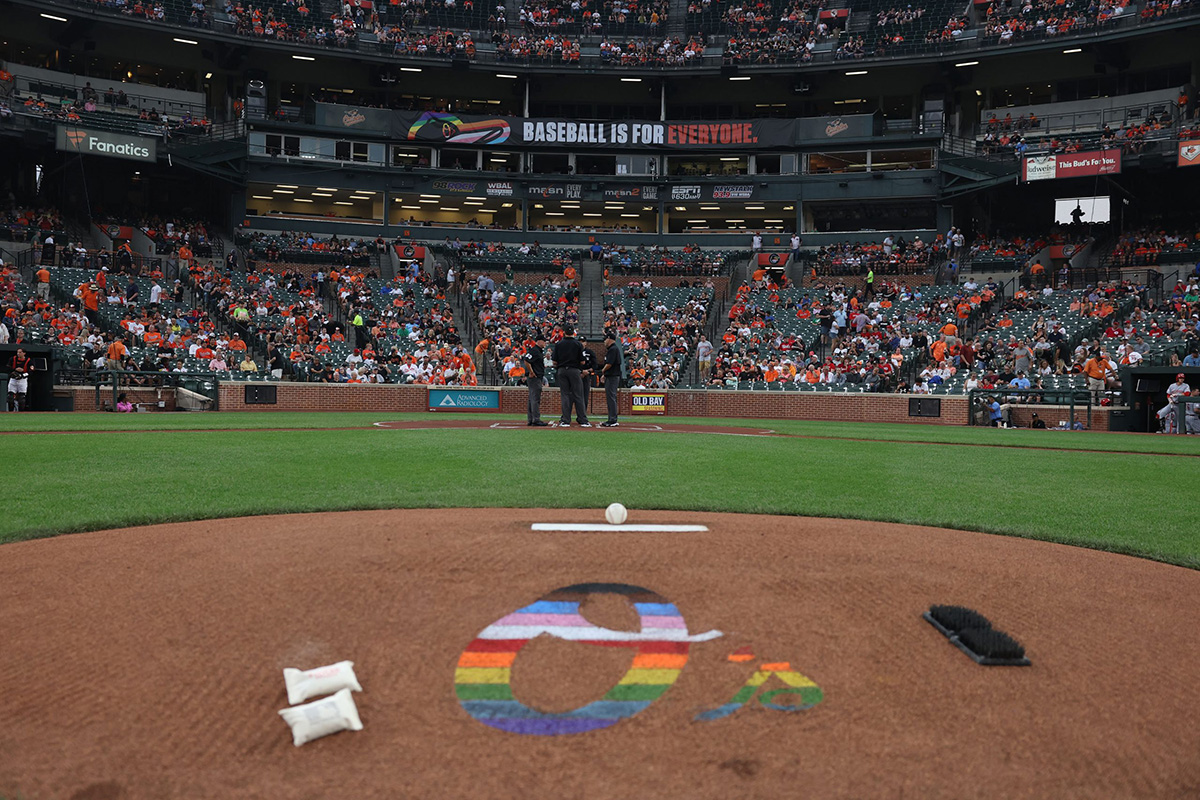
The Baltimore Orioles will take on the Washington Nationals on Friday, June 26 at 7 p.m. for Pride Night at Oriole Park.
The first 15,000 fans will receive an exclusive Pride Night Orioles jersey. The Washington Blade is a media sponsor of this event.
To purchase tickets, visit Orioles.com/Tickets.

Jeremy Moss looks to bring LGBTQ advocacy from Lansing to Capitol Hill

Parties, dinners, concerts and more on tap for fall nightlife

All the queer things to watch this fall

Gun reform is an LGBTQ rights issue

Trump’s Cabinet: Dumb, dumber, dumbest, and evil

Dolly Parton biography puts her hardships into context

PHOTOS: SMYAL Fall Brunch

Fashion icon Bob Mackie dead at 87

New Hungarian government to scrap anti-LGBTQ adoption law