News
Grenell emails reveal internal talk on Trump era policy against Pride flag
U.S. embassies barred from rainbow flag on official poles
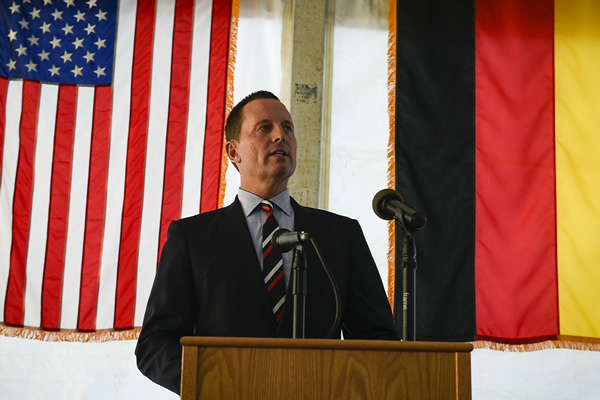
The latest emails from the State Department obtained by the Washington Blade via its lawsuit under the Freedom of Information Act reveal internal deliberation in the Trump administration over news reports about the prohibition of displaying Pride flags on the official pole at U.S. embassies.
Former U.S. Ambassador Richard Grenell, whose emails the Blade is seeking as the public face of a global initiative that pledged to decriminalize homosexuality, is repeatedly shown in the communications instructing his aides at the embassy in Berlin to give no comment to the media, including in response to an inquiry at the time from the Blade, on the flag policy for embassies.
“Thanks. Say nothing. I’m working it internally,” Grenell responds in an email chain after being updated on the latest media inquiries, which included requests from ABC’s Conor Finnegan, the Huffington Post, Buzzfeed, and CBS.
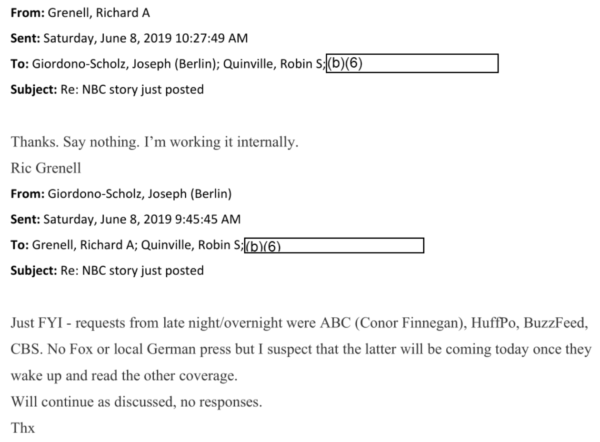
It’s unclear what, if anything, Grenell was doing as part of “working it internally” as news broke that embassies were barred from flying Pride flags on the official pole, or even whether he was seeking a substantive change as opposed to crafting talking points to mitigate the appearance of the Trump administration being anti-LGBTQ.
“No Fox or local German press but I suspect that the latter will be coming today once they wake up and read other coverage,” writes Joseph Giordono-Scholz, who was handling media relations for the embassy. “Will continue as discussed, no responses.”
In 2019, shortly after Grenell announced he’d spearhead a global initiative to decriminalize homosexuality on behalf of the Trump administration, U.S. embassies that had sought to raise the rainbow flag in recognition of June as Pride month were barred from doing so under guidance from the State Department.
Critics at the time jumped on the policy as further evidence the Trump administration was anti-LGBTQ, despite having recently launched the decriminalization initiative. Trump defenders pointed out the prohibition was limited to the official pole, was a general ban of flying any flag other than the U.S. flag, and embassies found other ways to display the Pride flag on their grounds.
Grenell didn’t respond Tuesday to the Blade’s request for comment on the meaning of “working it internally,” but Log Cabin Republicans, an organization close to Grenell, volunteered a message shortly after the Blade sent its inquiry to him.
Charles Moran, managing director of Log Cabin Republicans, said in the email the conception the Trump administration banned Pride flags at embassies is erroneous.
“We were very pleased that President Trump made it clear that pride flags could continue to be flown at embassies around the globe, despite logistical discussions internally being had at the State Department,” Moran said.
Attached in the email is an image of Moran standing below a pole with both a U.S. flag and a rainbow flag, which Moran said was taken at the U.S. Embassy Berlin on July 26, 2019, when he was en route to a decriminalization discussion forum being hosted there.
Asked by the Blade whether that was the official pole, Moran replied, “I don’t know what an ‘official pole’ is. It was a professionally installed flag pole, on the embassy next to the front door.” Moran didn’t respond to an additional follow up question on what he meant by Trump making it clear Pride flags would be allowed at embassies.
Morgan Ortagus, then-spokesperson for the State Department, defended former Secretary of State Mike Pompeo’s policy against Pride flags on as she acknowledged “Pride Month that we’re in right now celebrated around the world by many State Department employees, by many embassies.”
“The secretary has the position that, as it related to the flag pole, that only the American flag should be flown there,” Ortagus said.
The email chain within the U.S. embassy in Berlin on the news development began with Giordono-Scholz forwarding Grenell a link to a story from NBC News’s Josh Lederman, who broke the story on U.S. embassies being unable to fly Pride flags, followed by a subsequent email with the text of his article. The immediacy with which the aide sends the link in an email first before the story itself in a subsequent message suggests a sense of urgency in distribution and awareness the article would be forthcoming.
Other news outlets were quick to follow up, including the Blade, as evidenced by Giordono-Scholz’s follow up question to Grenell after sharing the initial NBC News story.
“CNN (Michelle Kosinski) just called, asked if we had anything to add,” Giordono-Scholz writes. “Wash Blade also just emailed. How would like me to respond to these and coming inquiries — just point them to the NBC statement you gave and refer back to DC on questions about the Dept?”
Grenell was succinct in response: “Say nothing. Right now don’t respond.”
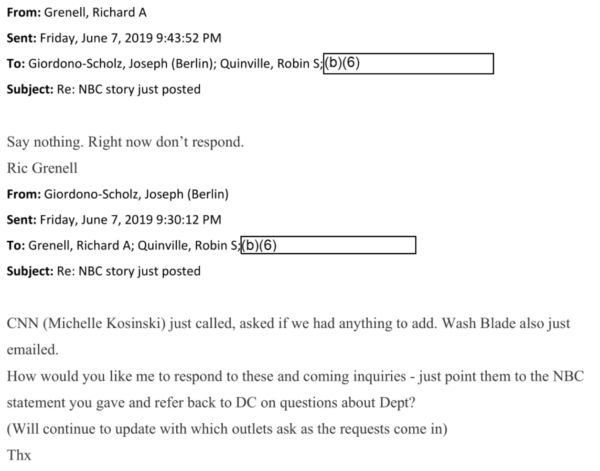
Giordono-Scholz acknowledges the instructions from Grenell in a subsequent email, which also notifies him of an inquiry from the Washington Post’s Carol Morello.
“Will continue to let you know about inquires but not respond to any,” Giordono-Scholz writes.
The emails were obtained in a FOIA production from the State Department this week as a result of a lawsuit filed by the Blade with attorneys at the law firm Davis Wright Tremaine LLP. The litigation was filed in August 2021 after interminable delays in production of communications, which the Blade initially sought by a FOIA request in September 2020.
The State Department has identified tens of thousands of emails potentially responsive to the Blade’s request and is expected to release those it deems to be responsive periodically as a result of an agreement in the litigation.
Also ensnared in the latest email dump are communications on other foreign policy topics, including the Nord Strom 2 pipeline and Iran’s seizure of oil tankers. Many of these emails reveal a preoccupation with using tweets as a tool to convey foreign policy messages with little else mentioned in terms of engagement.
“I’m watching. Already tweeted about it ;)” Grenell responds when an aide informs him that Iran has seized oil tankers.
Evyenia Sidereas, political minister-counselor at the U.S. embassy in Berlin, responds: “My twitter alerts can’t keep up :),” which prompts Grenell to reply: “I’ve been a little busy today. Lol.”
The emphasis on Twitter is also seen after an aide in May 2019 brings to Grenell’s attention the Kenya high court has affirmed the country’s law against homosexuality. An aide (whose name the State Department redacted in the email) informs him then-U.S. Ambassador Kyle McCarter is set to have a meeting with staff “to discuss whether he’ll issue a statement” and the embassy in Nairobi had updated the State Department while awaiting further guidance.
“I’ll tweet about this one, too,” Grenell says. “Can you make a suggestion and I’ll tweet Hungary today. Kenya tomorrow.” (It’s unclear what the reference to Hungary was regarding.)
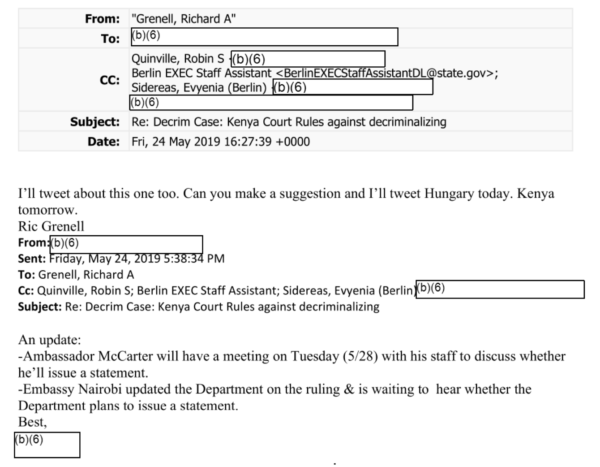
In terms of discussion at the U.S. embassy on the Kenya decision, whatever was considered apparently didn’t bear fruit. The Blade couldn’t immediately find any public statement on the Kenya decision from McCarter in his capacity as a U.S. ambassador during the Trump administration. McCarter didn’t respond to the Blade’s request to comment for this article.
In 2018, McCarter was grilled during his Senate confirmation hearing on his record as an Illinois state legislator who opposed LGBTQ rights, including his vote against an anti-bullying measure after stating he believed it would promote homosexuality. McCarter also had a history of misogynistic tweets and in 2016 tweeted: “Hillary for Prison. No, really.”
Much of the focus on the Trump administration’s global initiative appeared to be Iran, which has been an antagonist on the global stage and more so after Trump withdrew from the Iran deal. Iran is also one of the countries where homosexuality is not only criminalized, but punishable by death.
Although Grenell has publicly disputed Iran was the focus, he was quick to provide a quote to his assistant seeking a response from him after the country’s foreign minister affirmed its anti-gay policy in response to questions from a reporter with a German newspaper.
“The UN’s Declaration of Human Rights makes clear that these answers from the Iranian regime are violating basic UN principles,” Grenell writes. “UN members should agree with the Declaration in order to be members. Criminalizing homosexuality violates the Declaration, plain and simple.”
Grenell’s response was later found online in an article in The Jerusalem Post, which covered reaction to the news in an article titled, “Iran’s FM affirms right to execute gays and blasts U.S. and Israel.”



The White House
Trump tells Fox News he won the ‘gay vote’ — but polls tell a different story
Trump falsely claims LGBTQ support on Fox despite polling showing overwhelming opposition.
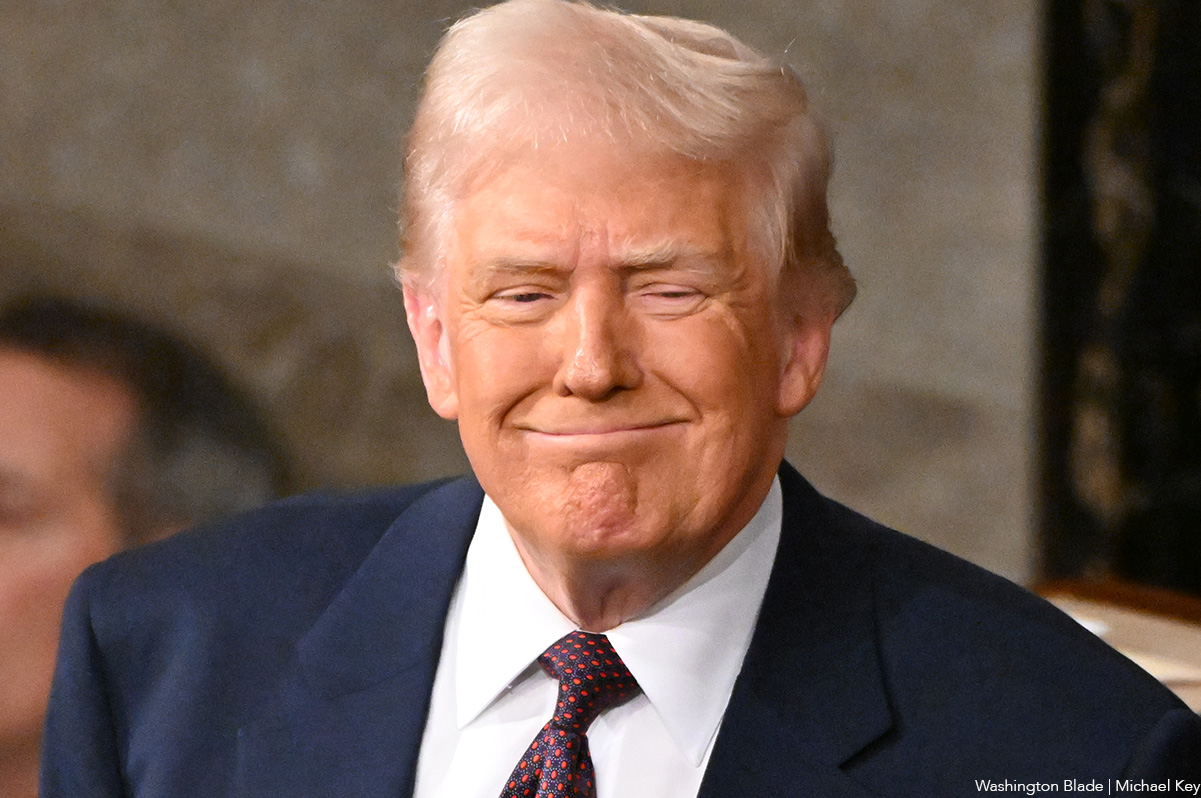
President Donald Trump claimed he won the “gay vote” in 2024, despite evidence showing otherwise.
While appearing by phone on Fox News’s panel show “The Five” on Thursday, Trump falsely claimed he performed particularly well among gay voters while discussing the ongoing war in Iran — a conflict he initiated without formal congressional approval.
“Now I think I did very well with the gay vote, OK? I even played the gay national anthem as my walk-off, OK?” Trump said on air.
“And I think it probably helped me. But I did great. No Republican’s ever gotten the gay vote like I did and I’m very proud of it, I think it’s great. Perhaps it’s because I’m from New York City, I don’t know…”
His claim contradicts 2024 polling from NBC News, which found that the GOP presidential ticket captured fewer than 1 in 5 LGBTQ male voters — a figure that may also include bisexual and transgender men. Trump’s support among LGBTQ female voters was even lower, at just 8%.
White LGBTQ voters favored Vice President Kamala Harris over Trump by a margin of 82% to 16%, while LGBTQ voters of color backed Harris by an even wider 91% to 5%.
Trump also used the appearance to criticize “Gays for Palestine,” saying: “Look at ‘Gays for Palestine’… they kill gays, they kill them instantly, they throw them off buildings, and I’m saying, ‘Who are the gays for Palestine?’”
He further pointed to his campaign’s use of the song “Y.M.C.A.” by the Village People — which he has repeatedly described as a “gay national anthem” — noting that it was frequently used as a walk-off song at rallies, as an indication that he and his campaign were supported by the gay community. The track, long associated with camp and hyper-masculine gay imagery, became a staple of Trump campaign events.
The Village People were later booked to perform at Turning Point USA’s inaugural ball celebrating Trump’s second inauguration. Lead singer Victor Willis previously criticized Trump’s use of the song dating back to 2020 and considered legal action to block it, but ultimately said there was “not much he can do about it.” He later acknowledged the renewed exposure was “beneficial” and “good for business,” boosting the song’s popularity and chart performance.
Despite Trump’s claims of strong support from gay voters, polling has consistently shown otherwise — even as several prominent gay men have held roles in or around his orbit, sometimes dubbed the “A-gays.” These include Richard Grenell, former executive director of the Kennedy Center and Special Presidential Envoy for Special Missions; Treasury Secretary Scott Bessent; Under Secretary of State Jacob Helberg; Department of Energy official Charles T. Moran; and longtime supporter Peter Thiel, co-founder and CEO of Palantir.
His efforts to portray himself as aligned with the gay community stand in conflict with policies advanced under his leadership. These include removing LGBTQ-related data from State Department reports, attempting to narrowly redefine gender identity in federal policy, restricting access to gender-affirming health care, and rolling back anti-discrimination protections. His administration also rescinded initiatives focused on LGBTQ health equity, data collection, and nondiscrimination in health care and education — moves advocates say contribute to stigma and worsen mental health outcomes.
Additionally, some HIV programs and community health centers have lost funding from the federal government after supporting initiatives inclusive of transgender people as a direct result of Trump-Vance policies.
National
Anti-trans visa ruling echoes Nazi regime destroying trans documents
Trump administration escalates attacks on queer community

The Lemkin Institute for Genocide Prevention and Human Security earlier this month released its third Red Flag Alert for the United States about the Trump administration’s anti-trans legislation. As the Lemkin Institute shared in the press release, “the Administration has moved from identifying transgender people as as threat to the family and to the nation’s military prowess to claiming that transgender people constitute a cosmic threat to the spiritual health of the nation and the great direct threat to the US national security in the world.”
The news came the same day that the State Department issued a new rule, “Enhancing Vetting and Combatting Fraud in the Immigrant Visa Program.” Under this new guidance, all visa applicants are required to disclose their “biological sex at birth” during all stages of the process, “even if that differs from the sex listed on the applicant’s foreign passport or identifying documentation.”
This rule also orders that applicants to the green card lottery program share their passport information, so in knowingly collecting passport information that the agency knows will not match a person’s biological sex at birth, it’s creating grounds to deny trans peoples’ biases on the basis of “fraud,” Aleksandra Vaca of Transitics explains.
As is written in the new ruling, “the Department is replacing ‘gender’ with ‘sex’ in accordance with E.O. 14168, Defending Women From Gender Ideology Extremism and Restoring Biological Truth to the Federal Government, which provides that the term ‘sex’ shall refer to an individual’s sex at birth. Only male and female sex options are available for entrants completing the Diversity Visa entry form.”
Along with outright denying the existence of nonbinary, genderqueer and gender expansive people, this policy creates a precedence for trans people to be stripped of their visas and deported because under 8 U.S.C. § 1182(a)(6)(C)(i), any foreigner found to have obtained or possess a visa “by fraud or willfully misrepresenting a material fact” will have their visa revoked and face deportation.
By requesting information on “biological sex at birth,” the State Department is forcing a mismatch between documents and enabling officials to accuse trans, nonbinary, and gender expansive immigrants of fraud. Thus, trans and nonbinary immigrants can have their visas revoked and can be deported, and information gathered from immigrants during the visa request process can be added to federal databases and used by immigration authorities, including ICE agents.
With the Supreme Court’s decision this past year allowing ICE officers to use racial profiling, Vaca argues that “now, The Trump administration has given ICE the reason it needs. Under this rule, ICE agents now have the enforcement rationale to assert that trans people–especially those belonging to racial minority groups–are more likely than cis people to have ‘misrepresented’ themselves during the visa process, and therefore, are more likely to enter the country ‘unlawfully.’”
This would enable ICE agents to target trans individuals specifically for being trans. If the goal of this were unclear, a day later the Trump administration released its statement for Women’s History Month 2026, writing that “we are keeping men out of women’s sports, enforcing Title IX as it was originally written and ensuring colleges preserve–and, where possible, expand–scholarships and roster opportunities for female athletes. We are restoring public safety and upholding the rule of law in every city so women, children, and families can feel safe and secure.”
And this is not the first time that ICE has targeted and harmed trans and nonbinary immigrants. Last June, Vera reported that ICE is not including trans people in detection in their public reports, and back in 2020, AFSC reported that trans people held in ICE detention faced “dreadful, ugly” conditions.
While it seems like a new development in Trump’s anti-trans escalation, it echoes a deeply upsetting history of denying and destroying transgender people’s documents following members of the Nazi party seizing power in 1933.
In the early 20th century, Weimar, Germany was an epicenter for gender affirming care with Maganus Hirschfeld’s Institute for Sexual Science. One of the first book burnings of the rising Nazi regime destroyed the Institute’s extensive clinical records and library on trans health and history by Nazi students and stormtroopers. In doing so, the Nazis effectively destroyed the world’s first trans health clinic and one of the richest and most comprehensive collective of information about trans healthcare.
Similarly, the Nazi government invalidated or refused to recognize what was called “transvestite passes,” or passing certificates that allowed trans people to avoid arrest under Paragraph 175 which prohibited cross-dressing. During the Weimar Republic — the regime that preceded the Third Reich — recognized and affirmed the identities of trans people (in limited ways) with specific documentation that helped prevent them from arrest. Invalidating and disregarding these passes allowed police and Nazi officials to target trans people and harass, extort and arrest them, and the record of passes themselves helped officials target trans people.
The changes to visa guidelines — alongside Kansas’s move to revoke trans drivers’ licenses last month — is reflective of this escalation of violence against trans people during the Nazi’s rise to power, which scholars like Dr. Laurie Marhoefer is just beginning to uncover. And along with the revocation of identification documents this past week, a recent Fourth Circuit Court ruled that states can deny Medicaid coverage for gender-affirming surgery.
The Fourth Circuit Court decision affirmed the Supreme Court’s decision in Skrmetti, which ruled that bans on gender affirming healthcare for young people are constitutional. This ruling extends this ban to include adult healthcare bans, allowing West Virginia’s exclusion of Medicaid coverage for adult gender affirming healthcare to take full effect. Even more upsetting was what the ruling itself said, calling gender affirming healthcare “dangerous.”
As was written in the Fourth Circuit Opinion, “it’s not irrational for a legislature to encourage citizens ‘to appreciate their sex’ and not ‘become disdainful of their sex’ by refusing to fund experimental procedures that may have the opposite effect.”
In reality, what this ruling and the opinion reflect, is the next step in government regulation and oversight over marginalized peoples’ bodies. From the overturn of Roe v. Wade, which removed federal protection of access to abortion, this next step represents the denial of people’s access to vital, lifesaving care–and to be clear, gender affirming care is not just for trans, nonbinary, and intersex people. It’s a dangerous escalation and one that echoes previous violence against trans people under fascist regimes; the Lemkin Institute is right to raise concern.
Japan
Japanese Supreme Court to consider marriage equality
Japan only G7 country that does not legally recognize same-sex couples
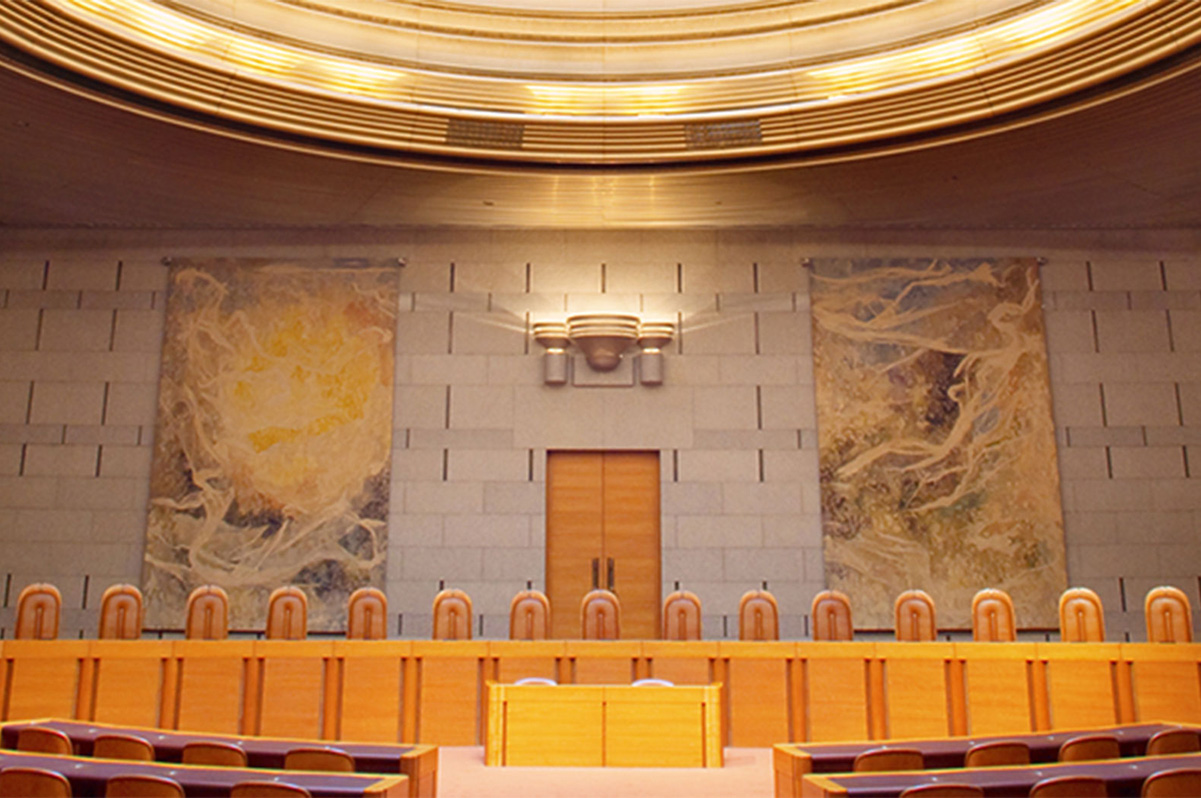
The Japanese Supreme Court on Wednesday said it will consider six marriage equality lawsuits.
NHK, the country’s public broadcaster, noted all 15 of the court’s justices will consider the case.
Japan is the only G7 country that does not legally recognize same-sex couples, despite several court rulings in recent years that found the denial of marriage benefits to gays and lesbians unconstitutional.
Tokyo High Court Judge Ayumi Higashi last November upheld Japan’s legal definition of a family as a man and a woman and their children.
Prime Minister Sanae Takaichi, who became the country’s first female head of government last October, opposes marriage rights for same-sex couples. She has also reiterated the constitution’s assertion that the family is an institution based around “the equal rights of husband and wife.”
Same-sex couples can legally marry in Taiwan, Nepal, and Thailand.
NHK reported the Supreme Court is expected to issue its ruling in early 2027.

Trump tells Fox News he won the ‘gay vote’ — but polls tell a different story

Anti-trans visa ruling echoes Nazi regime destroying trans documents

Japanese Supreme Court to consider marriage equality

The outrage economy is not the LGBTQ community

Calendar: March 27-April 2

Trans Day of Visibility events planned

Virginia General Assembly’s 2026 legislative session ends

Markwayne Mullin confirmed as next DHS secretary

Gay man murdered in Va.