European Union
Dutch ambassador to U.S. reaffirms country’s commitment to LGBTQ, intersex rights
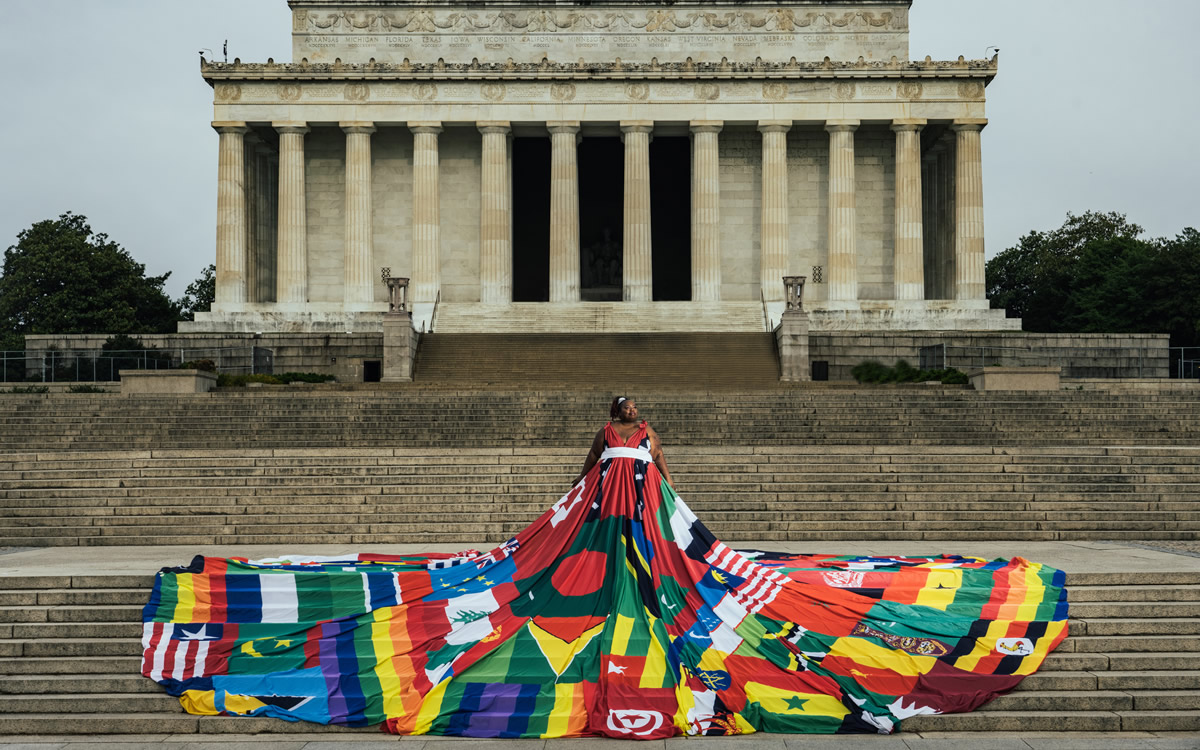
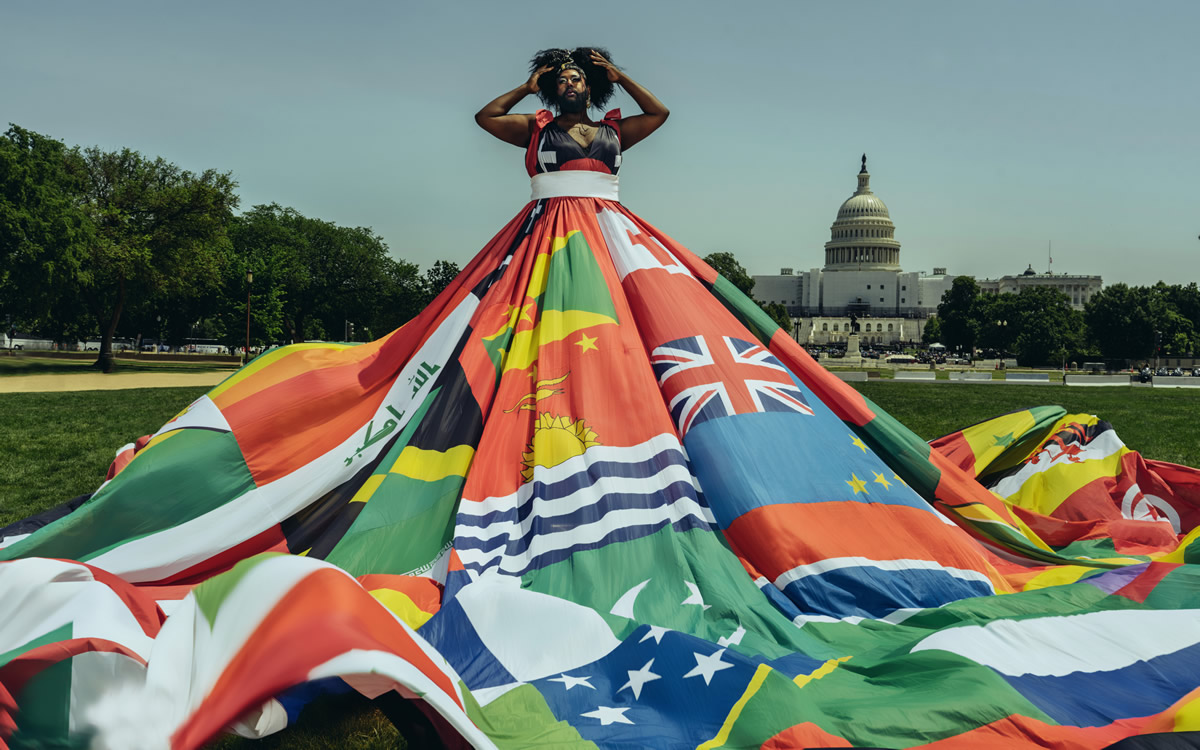
Amsterdam Rainbow Dress displayed at Lincoln Memorial on Monday

Dutch Ambassador to the U.S. André Haspels on Tuesday said the Netherlands remains committed to LGBTQ and intersex rights in his country and around the world.
Haspels spoke with the Washington Blade a day after the embassy, the Capital Pride Alliance and the Amsterdam Rainbow Dress Foundation showcased the Amsterdam Rainbow Dress at the Lincoln Memorial.
The dress, which has a 52′ circumference, contains the flags of the 68 countries in which consensual same-sex consensual relations remain criminalized.
The Netherlands in 2001 became the first country in the world to extend marriage rights to same-sex couples. The dress’ bodice, which is made with Amsterdam’s city flag, commemorates this watershed moment in the global LGBTQ and intersex rights movement.
A press release from the Dutch Embassy notes the dress was made in 2016 and was first displayed at Rotterdam Pride.
Models in the U.S., Spain, South Africa, Greece, Australia and other countries have worn it. Makia Green, an LGBTQ and intersex rights activist, and Vagenesis, a drag performer and advocate, wore the dress while it was in D.C.
“We invited the Rainbow Dress to come over to the United States, to Washington, to show our support for LGBTIQ+ rights worldwide,” said Haspels. “What better location is there in front of the Lincoln Memorial, because LGBTIQ+ rights are part of a broader aspect of human rights.”
“The main issue is to focus on the importance of LGBTQI rights, and also understanding and promoting the fact that it is important to ensure freedom for everyone to decide whom they want to love and to identify and whom they want to identify with as they wish,” he added. “That’s our goal for the Amsterdam Rainbow Dress.”
Haspels spoke with the Blade a day before the International Day Against Homophobia, Transphobia and Biphobia, which commemorates the World Health Organization’s declassification of homosexuality as a mental disorder on May 17, 1990.
Kyiv Pride on Wednesday noted its staffers visited the Dutch Embassy in the Ukrainian capital, “where the flag of the LGBTIQ+ community was solemnly raised in honor of the Day Against Homophobia, Transphobia and Biphobia.”
“This was an extremely important event for our community,” tweeted Kyiv Pride.
Today, KyivPride had the honor of visiting the Embassy of the Netherlands, where the flag of the LGBTIQ+ community was solemnly raised in honor of the Day Against Homophobia, Transphobia and Biphobia. This was an extremely important event for our community. @NLinUkraine pic.twitter.com/c48JtIHsTR
— KyivPride (@KyivPride) May 17, 2023
Ukrainian President Volodymyr Zelenskyy on May 4 met with Dutch Prime Minister Mark Rutte and other members of his government while he was in the country. Zelenskyy also visited the International Criminal Court in The Hague.
The ICC in March issued arrest warrants for Russian President Vladimir Putin and Russian Children’s Rights Commissioner Maria Lvova-Belova. The Netherlands-based court accuses them of abducting children from Ukraine.
“It is important to continue to support Ukraine in many different ways,” Haspels told the Blade. “We continue to support them with military aid, with rehabilitation aid. We also receive refugees from Ukraine.”
Haspels said his government continues to gather “information about war crimes to make sure those who are responsible for this terrible war will be held accountable.” He also said the Netherlands continues to “welcome all Ukrainians, irrespective of their backgrounds, and who they are.”
“They are most welcome,” said Haspels.
Haspels noted WorldPride 2026 will take place in Amsterdam. (The biennial event will take place in D.C. in 2025.)
The Netherlands is a member of the Global Equality Fund, a U.S. initiative that seeks to promote LGBTQ and intersex rights around the world. Haspels pointed out to the Blade that his country also works with the European Union on these issues, and has invited activists from Uganda and other countries to the Netherlands.
Ugandan lawmakers earlier this month once again approved their country’s Anti-Homosexuality Act, which contains a death penalty provision for anyone found guilty of “aggravated homosexuality.” The Netherlands is among the countries that have urged Ugandan President Yoweri Museveni to veto the bill.
“We have to be honest, it’s not always an easy environment,” Haspels told the Blade in response to a question about the Anti-Homosexuality Act and supporting LGBTQ and intersex activists and rights around the world. “Sometimes you have to be cautious also not to bring people, in this case, Ugandan people, into danger.”
“It’s not easy, but we have no alternative than to continue focusing on these rights and strive for improvement,” he added.
‘We also can improve’
The Netherlands received a 56 percent score in the annual ILGA-Europe Rainbow Map and Index report that the European LGBTQ and intersex rights group last week. ILGA-Europe made three specific recommendations to the Dutch government.
• Prohibiting medical interventions on intersex minors when the intervention has no medical necessity and can be avoided or postponed until the person can provide informed consent.
• Reforming the legal framework for legal gender recognition to be fair, transparent, based on a process of self-determination and free from abusive requirements (such as GID/medical diagnosis or age restriction.)
• Banning so-called “conversion practices” on the grounds of sexual orientation and gender identity.
Haspels acknowledged his government can do more to extend rights to LGBTQ and intersex people.
“There’s the law, and there’s the rules and regulations, which are very important,” he said. “We also can improve.”
Haspels noted there is “still a lot of legislation in preparation in order to improve the situation.” Haspels also specifically pointed to violence against LGBTQ and intersex rights activists where the “police did not act responsibly.”
“We’re struggling with that,” he said.
“There’s scope for improvement for my country as well, but again, I think the most important thing is to bring it out in the open, to start a discussion,” added Haspels. “That’s also the idea of the Rainbow Dress, and we’re also working together with United States. Also there in the United States, things can still be improved … We follow closely what’s going on in other countries, but the most important thing is to have a dialogue.”





European Union
Poland’s top court rejects recognition of same-sex marriages from other EU countries
Ruling sets up potential clash with bloc

Poland’s top court this week rejected the recognition of same-sex marriages legally performed in other EU countries.
The EU Court of Justice in Luxembourg last November ruled in favor of a same-sex couple who challenged Poland’s refusal to recognize their German marriage. Poland’s Supreme Administrative Court in March reaffirmed the decision.
The couple, who lives in Poland, brought their case to Polish courts in 2019. The Supreme Administrative Court referred it to the EU Court of Justice.
The Polish government in May announced it will recognize same-sex marriages legally performed in other EU countries. Polish President Karol Nawrocki on July 17 vetoed bills that would have extended rights to same-sex couples.
The Constitutional Tribunal ruling, which it issued on July 28, was unanimous and final. It also sets up a potential clash between it and the EU Court of Justice.
European Union
European Commission says all EU countries should ban conversion therapy
Recommendation ‘an important step forward for LGBTI rights across Europe’

The European Commission on Wednesday said all European Union countries should ban so-called conversion therapy.
The recommendation comes weeks after the European Parliament voted in favor of prohibiting the widely discredited practice across the EU. More than 1.2 million people signed a campaign in support of the ban that ACT (Against Conversion Therapy) LGBT launched in 2024 through the EU’s European Citizens Initiative framework.
“We warmly welcome today’s commitment from the European Commission to a recommendation on ending conversion practices, an important step forward for LGBTI rights across Europe,” said ILGA Europe in a statement.
Seven EU countries — Belgium, Cyprus, France, Malta, Norway, Portugal, and Spain — have banned conversion therapy outright.
Greece in 2022 banned the practice for minors. German lawmakers in 2020 passed a law that prohibits conversion therapy for minors and for adults who have not consented to undergoing the widely discredited practice.
ILGA Europe said the European Commission’s recommendation “highlights how much work remains to be done.”
“Ending conversion practices cannot stop at symbolic commitments or fragmented national approaches,” stressed the advocacy group. “We need coordinated EU action, proper training for professionals, and survivor-centered support systems that recognize the serious harm these practices cause.”
“More than one million people supported the European Citizens’ Initiative calling for change,” added ILGA Europe. “The message is clear: conversion practices are not therapy or belief, they are a form of violence that Europe can and should end.”
European Union
European Parliament backs EU-wide conversion therapy ban
More than 1.2 million people backed campaign
The European Parliament on Wednesday voted in favor of banning so-called conversion therapy across the European Union.
ACT (Against Conversion Therapy) LGBT in 2024 launched a campaign in support of the ban through the EU’s European Citizens Initiative framework. More than 1.2 million people ultimately signed it.
The proposed ban had the support of 405 MEPs. The European Commission is expected to formally respond to it by May 18.
Seven EU countries — Belgium, Cyprus, France, Malta, Norway, Portugal, and Spain — have banned conversion therapy outright.
Greece in 2022 banned the practice for minors. German lawmakers in 2020 passed a law that prohibits conversion therapy for minors and for adults who have not consented to undergoing the widely discredited practice.

Center for Black Equity honors leaders, activists at BE. Gala

In ‘The Lost Brontë,’ a complicated lie can lead to danger

CAMP Rehoboth Block Party returns Oct. 18

Essential queer horror classics for Halloween

Solidarity beyond the parade: the actual cost of Pride

Trump uses anti-trans slur against Democratic Senate candidate

U.S. int’l trade negotiator, consultant James Bedore dies at 82

Calif. GOP gubernatorial candidate ad ‘disgusting attempt to exploit lesbian intimacy’

Campaign urges Virginia High School League to reverse stance on trans athletes

Center Arts Gallery celebrates 10 years with reception, auction
-

 2026 Midterm Elections5 days ago
Trump uses anti-trans slur against Democratic Senate candidate
-
Obituary4 days ago
U.S. int’l trade negotiator, consultant James Bedore dies at 82
-
California4 days ago
Calif. GOP gubernatorial candidate ad ‘disgusting attempt to exploit lesbian intimacy’
-
Virginia4 days ago
Campaign urges Virginia High School League to reverse stance on trans athletes