The White House
White House IDAHOBiT statement acknowledges LGBTQ rights advances, setbacks
World Health Organization declassified homosexuality as mental disorder on May 17, 1990

The Biden-Harris administration on Wednesday used the International Day Against Homophobia, Biphobia and Transphobia to reiterate its support of LGBTQ and intersex rights.
“Everyone is entitled to be treated with dignity and equality — no matter whom they love, or how they identify,” said President Joe Biden in a statement the White House released. “On the International Day Against Homophobia, Biphobia, and Transphobia, we reaffirm our commitment to this ongoing work and stand with lesbian, gay, bisexual, transgender, queer, and intersex (LGBTQI+) people around the world.”
IDAHOBiT commemorates the World Health Organization’s declassification of homosexuality as a mental disorder on May 17, 1990.
“More than 30 years ago today, thanks to the tireless advocacy of LGBTQI+ activists the World Health Organization took the long overdue step of declassifying ‘homosexuality’ as a mental health disorder,” said Biden. “Since then, we’ve seen real progress — including a powerful movement for LGBTQI+ liberation, more protections for LGBTQI+ people, and more spaces that recognize and affirm that our diversity is our strength. But sadly, we continue to see reminders of how much work remains.”
Biden in his statement notes consensual same-sex sexual relations remain criminalized in more than 60 countries around the world. Biden also points out that some governments still consider LGBTQ and intersex people mentally ill and support so-called conversion therapy.
“Right here at home, violent attacks on LGBTQI+ individuals and community spaces have risen dramatically, and more than 600 hateful laws have been introduced this year targeting the LGBTQI+ community, particularly youth,” said Biden.
“All of us have a responsibility to speak out and stand up against hate and violence in any form,” added Biden. “When the rights of any group or individual are under attack, it endangers our own freedom, and the freedom of people everywhere. So today, let us join together across our country — and around the world — to stand with the LGBTQI+ community. Let us renew our work to combat homophobia, biphobia, and transphobia — and put an end to the harmful violence and discrimination that stems from it.”
Secretary of State Antony Blinken echoed Biden in his own IDAHOBiT statement.
“As we mark this year’s IDAHOBiT, the United States reaffirms our commitment to exposing the harm conversion therapy practices cause to LGBTQI+ persons,” said Blinken. “We reaffirm the importance of ensuring access to evidence-based healthcare without discrimination or stigma regardless of sexual orientation, gender identity or expression, or sex characteristics. We recommit to opposing the criminalization of LGBTQI+ status or conduct, which can drive the pathologizing of LGBTQI+ persons and the practice of so-called conversion therapy. We confirm that conversion therapy practices are inconsistent with U.S. nondiscrimination policies and ineligible for support through taxpayer-funded foreign assistance grants and contracts.”
UNAIDS in its IDAHOBiT statement notes criminalization laws “hurt the public health of everyone, costing lives.” U.N. Secretary-General António Guterres on Wednesday acknowledged discrimination and violence based on sexual orientation and gender identity remains commonplace around the world.
“In every corner of the world, LGBTQI+ people continue to face violence, persecution, hate speech, injustice and even outright murder,” said Guterres. “Each assault on LGBTQI+ people is an assault on human rights and the values we hold dear.”
In every corner of the world, LGBTQI+ people continue to face violence, persecution, hate speech, injustice and even outright murder.
Each assault on LGBTQI+ people is an assault on human rights and the values we hold dear.
We cannot and will not move backwards.
— António Guterres (@antonioguterres) May 17, 2023
The U.N. LGBTI Core Group, a group of U.N. countries that have pledged to support LGBTQ and intersex rights, on Wednesday held an event in support of transgender rights. Advocacy groups in the U.S. and around the world also acknowledged IDAHOBiT.
“We stand in solidarity with Afghan LGBTI people; advocating for love, acceptance and equal rights,” said the Afghan LGBT Organization on Instagram. “Let’s keep fighting together for a more inclusive and tolerant world.”
Rightify Ghana in its IDAHOBiT comments noted the Promotion of Proper Human Sexual Rights and Ghanaian Family Values Bill in the country’s Parliament that would, among other things, fully criminalize LGBTQ and intersex people and anyone who advocates for them.
Reportar sin Miedo, the Washington Blade’s media partner in Honduras, reported activists organized an IDAHOBiT march in Tegucigalpa, the country’s capital.
🚨Comienza la movilización en #Tegucigalpa, en conmemoración al #DiaContraLaLGTBIfobia 🏳️🌈🏳️⚧️
🧵Aquí te mostramos la galería: 👇🏼
Cobertura: @KateO_06 pic.twitter.com/ES8oiHV1tU— Reportar Sin Miedo (@ReportarsinMied) May 17, 2023
Cuba’s National Center for Sexual Education on May 13 organized a march with the theme “socialism yes, homophobia no” in which LGBTQ and intersex activists who do not work with CENESEX or its director, Mariela Castro, did not participate. Sydney Gay and Lesbian Mardi Gras organizers on Wednesday urged Australians to sign a petition that calls upon lawmakers to enact hate crimes laws.
“There are no national laws and at the state level, SA (South Australia), WA (Western Australia) and VIC (Victoria) have no laws protecting the LGBTIQ+ community from hate speech and vilification,” reads the petition. “With attacks on the rise, especially against the trans community, there is urgent need for stronger measures to protect the community.”
Human Rights Campaign Director of Global Partnership Jean Freedberg on Tuesday told the Washington Blade during a telephone interview that IDAHOBiT is a day “when we really focus on the situation of LGBTQ+ people around the world and focus on the violence and discrimination that people continue to experience in their daily lives.”
“Every year we join with people in the United States and around the world to raise up our voices, to shine light on the issues that we all face and to look at ways that we can, as a global community, work together to keep striving forward, to protect our community for the future from harm, to lift up who we are and to keep moving forward to ensure dignity and respect for all LGBTQ+ people around the world,” said Freedberg.




The White House
Report: Grenell wants Russian ambassadorship
Country’s anti-LGBTQ record a reported barrier

Richard Grenell, President Donald Trump’s special envoy for “special missions,” is making it known that he is interested in the Russian ambassadorship.
According to reporting by the Daily Mail, Grenell has “floated” his interest in the role to coworkers, but issues surrounding the former German ambassador’s sexuality have made securing the position more difficult.
“He had an interest in the job — or at least he floated the idea to select colleagues. But Putin’s regime is extremely anti–LGBTQ, so I’m sure they didn’t take that thought too seriously,” one source close to Grenell told the Daily Mail. “That would never happen anyway.”
Grenell has long been one of Trump’s closest allies and was the first openly gay person to hold a Cabinet-level position. He was ousted last month as acting director of the Kennedy Center, a position he had held since Trump reestablished the board to be composed of his political supporters in 2025.
In addition to leading the nation’s cultural arts center, Grenell previously served as the U.S. ambassador to Germany from 2018 to 2020, and as the special presidential envoy for Serbia and Kosovo peace negotiations from 2019 to 2021. He was also a State Department spokesperson to the U.N. under the George W. Bush administration and a Fox News contributor.
Russia has a longstanding history of being anti-LGBTQ.
In 2013, the country passed a law banning any public endorsement of “nontraditional sexual relations” among minors. In December 2022, Putin signed legislation expanding the ban, making it illegal to promote same-sex relationships or suggest that non-heterosexual orientations are “normal” for people of any age, widening censorship across media and public life.
The Russian courts have also supported the restriction of LGBTQ identity in the country. In November 2023, Russia’s Supreme Court granted a request from the Justice Ministry to outlaw the “international LGBT movement” as “extremist,” allowing authorities to criminalize advocacy and potentially prosecute individuals for expressions of LGBTQ+ identity or support.
In addition to LGBTQ rights issues, the war between Russia and Ukraine has become a global concern. Ukraine, which was part of the former Soviet Union, includes the territory known as Crimea, which Russia annexed in 2014. The annexation remains a major point of international dispute over sovereignty. Since 2022, Russia’s large-scale invasion of Ukraine has escalated the conflict, drawing global attention and sanctions while straining U.S.-Russia relations.
The U.S. has spent $188 billion in total related to the war in Ukraine since the Russian invasion in February 2022, according to the Council on Foreign Relations.
The Russian ambassadorship seems to be a difficult role to fill, according to additional information presented by the Daily Mail. With Trump already being seen as relatively positive by Russian President Vladimir Putin, and with close ties to members of his Cabinet and family — like son-in-law Jared Kushner — the ambassadorship is complicated and viewed as less critical than in previous administrations.
“There is no rush to fill that role because it has now been deemed unnecessary,” another source told the U.K.-based publication.
Bob Foresman, a seasoned businessman with decades-long ties to the Kremlin, was reportedly once the frontrunner, according to the Daily Mail. Foresman served as vice chair of UBS Investment Bank and Deputy Chairman of Renaissance Capital between 2006 and 2009, and earlier led investment banking for Russia at Dresdner Kleinwort Wasserstein from 1997 to 2000.
“This is a pattern, especially in the Trump administration — special envoys big–footing the ambassadors,” a source told the Daily Mail. “It is shocking that we are already in April and we don’t have an ambassador to one of the most important countries in the world.”
Iran
LGBTQ groups condemn Trump’s threat to destroy Iranian civilization
Ceasefire announced less than two hours before Tuesday deadline

The Council for Global Equality is among the groups that condemned President Donald Trump on Tuesday over his latest threats against Iran.
Trump in a Truth Social post said “a whole civilization will die tonight” if Tehran did not reach an agreement with the U.S. by 8 p.m. ET on Tuesday.
Iran is among the handful of countries in which consensual same-sex sexual relations remain punishable by death.
Israel and the U.S. on Feb. 28 launched airstrikes against Iran.
One of them killed Supreme Leader Ayatollah Ali Khamenei. Iran in response launched missiles and drones against Israel and other countries that include Kuwait, Bahrain, Qatar, the United Arab Emirates, Jordan, Saudi Arabia, Azerbaijan, and Cyprus.
Gas prices in the U.S. and around the world continue to increase because the war has essentially closed the Strait of Hormuz, a strategic waterway that connects the Persian Gulf and the Gulf of Oman through which roughly 20 percent of the world’s crude oil passes.
Trump less than 90 minutes before his deadline announced a two-week ceasefire with Iran that Pakistan helped broker.
“We the undersigned human rights, humanitarian, civil liberties, faith-based and environmental organizations, think tanks and experts are deeply alarmed by President Trump’s threat regarding Iran that ‘a whole civilization will die tonight’ if his demands are not met. Such language describes a grave atrocity if carried out,” reads the statement that the Council for Global Equality more than 200 other organizations and human rights experts signed. “A threat to wipe out ‘a whole civilization’ may amount to a threat of genocide. Genocide is a crime defined by the Genocide Convention and by the Rome Statute of the International Criminal Court as committing one or more of several acts ‘with intent to destroy in whole or in part a national, racial or religious groups as such.'”
The statement states “the law is clear that civilians must not be targeted, and they must also be protected from indiscriminate or disproportionate attacks.”
“Strikes on civilian infrastructure — such as the recent attack on a bridge and the attacks President Trump is repeatedly threatening to carry out to destroy power plants — have devastating consequences for the civilian population and environment,” it reads.
“We urge all parties to respect international law,” adds the statement. “Those responsible for atrocities, including crimes against humanity and war crimes, can and must be held accountable.”
The Alliance for Diplomacy and Justice, Amnesty International USA, Human Rights Watch, the American Civil Liberties Union, the NAACP, MADRE, and the Robert and Ethel Kennedy Human Rights Center are among the other groups that signed the letter.
Hungary
Vance speaks at Orbán rally in Hungary
Anti-LGBTQ prime minister trailing ahead of April 12 vote
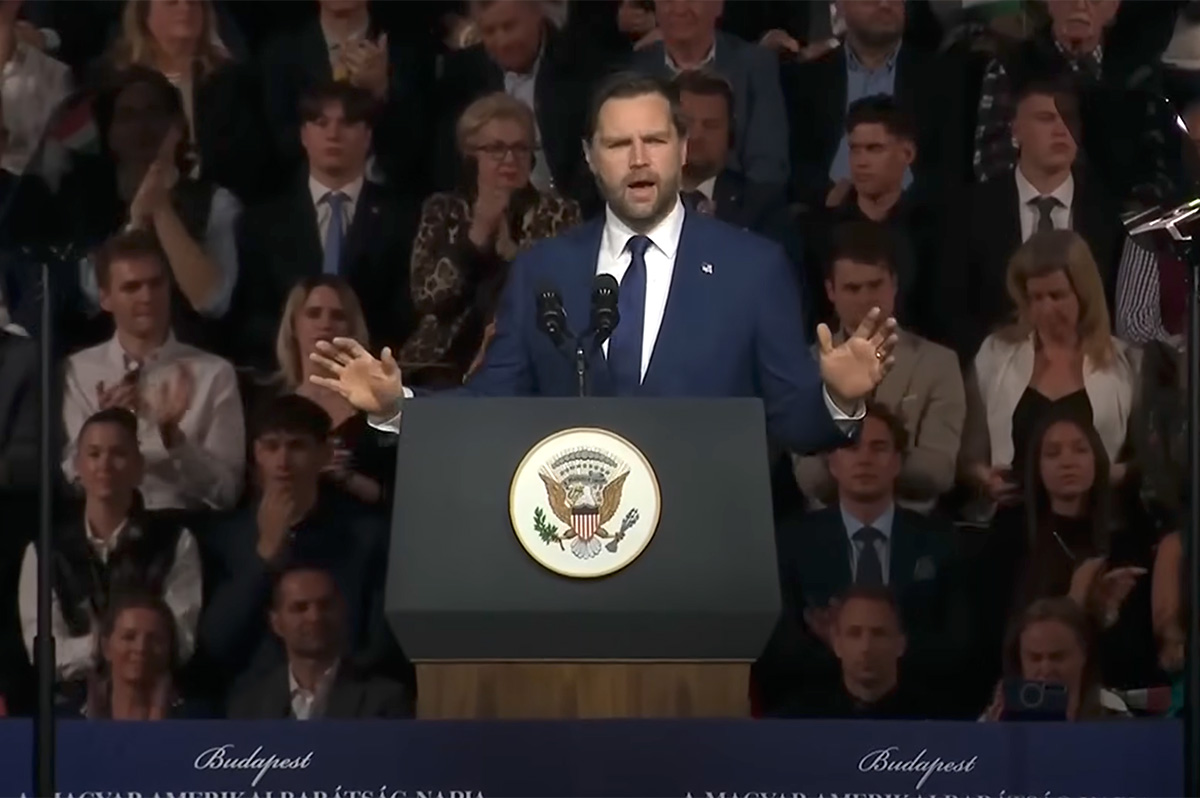
Vice President JD Vance on Tuesday urged Hungarians to support Prime Minister Viktor Orbán in the country’s April 12 elections.
“We have got to get Viktor Orbán re-elected as prime minister of Hungary,” Vance told Orbán supporters who gathered at Budapest’s MTK Sportpark.
Vance and Orbán on Tuesday met before they held a press conference in Budapest. Orbán also spoke at the rally.

The U.S. vice president after he took to the stage called President Donald Trump, who told the crowd he is “a big fan of Viktor” and is “with him all the way.” Vance, as he did during Tuesday’s press conference with Orbán, criticized the European Union.
“We want you to make a decision about your future with no outside forces pressuring you or telling you what to do. I’m not telling you exactly who to vote for, but what I am telling you is that the bureaucrats in Brussels, those people should not be listened to,” said Vance. “Listen to your hearts, listen to your souls, and listen to the sovereignty of the Hungarian people.”
Vance in his speech noted “across the West, we’ve got a small band of radicals” who, among other things, “condemn children to mutilization and sterilization in the name of gender care.” Vance also criticized a “far-left ideology given quarter in university circles, in the media, and in our entertainment industry, and increasingly among bureaucrats on both sides of the Atlantic.”
Vice President JD Vance speaks at MTK Sportpark in Budapest, Hungary, on April 7, 2026
Orbán has been in office since 2010. He and his Fidesz-KDNP coalition government have faced widespread criticism over its anti-LGBTQ crackdown.
A Hungarian activist with whom the Washington Blade previously spoke said it is “impossible to change your gender legally in Hungary” because of a 2020 law that “banned legal gender recognition of transgender and intersex people.” Hungarian MPs the same year effectively prohibited same-sex couples from adopting children and defined marriage in the country’s constitution as between a man and a woman.
The European Commission in 2022 sued Hungary, which is a member of the EU, over the country’s anti-LGBTQ propaganda law.
Hungarian lawmakers in March 2025 passed a bill that banned Pride events and allowed authorities to use facial recognition technology to identify those who participate in them. MPs later amended the Hungarian constitution to ban public LGBTQ events.
Upwards of 100,000 people last June defied the ban and marched in Budapest’s annual Pride parade.
Polls indicate Orbán is trailing Péter Magyar and his center-right Tisza party ahead of the April 12 election. Vance at Tuesday’s rally told Orbán supporters that he and Trump “want you to make a decision about your future with no outside forces pressuring you or telling you what to do.”
“I’m not telling you exactly who to vote for, but what I am telling you is that the bureaucrats in Brussels, those people should not be listened to,” said Vance. “Listen to your hearts, listen to your souls, and listen to the sovereignty of the Hungarian people.”
“Unlike some of the leadership of Brussels, I’m not threatening you or telling you that we’re going to withhold funds to which you’re legally entitled,” he added. “You will make the decision about Hungary’s future.”
Magyar on Tuesday appeared to dismiss Vance’s comments.
“No foreign country may interfere in Hungarian elections. This is our country. Hungarian history is not written in Washington, Moscow, or Brussels — it is written in Hungary’s streets and squares,” said Magyar on his X account.
A spokesperson for the Háttér Society, a Hungarian LGBTQ rights group, told the Blade that neither Magyar, nor his party have reached out to the organization.
The spokesperson said the group does not “campaign directly for them or for any other political party.” The Háttér Society, however, is encouraging LGBTQ Hungarians to vote.
“Ahead of election day, we will encourage everyone on our social media channels to go out and vote, as this is the only way we can act against a system that has been working against the LGBTQI community for many years,” said the spokesperson.

Calendar: April 10-16

BLUF leather social set for April 10 in Rehoboth

Celebrations of life planned for Sean Bartel

The ‘X’ returns to court

LGBTQ community explores arming up during heated political times

D.C. is the place for the Democratic Socialists of America

Key lifestyle changes can help patients cope with diabetes

Trump budget would codify expanded global gag rule

Man faces first S.C. ‘hate intimidation’ charge

Police mental health struggles gain growing attention
-

 Opinions5 days ago
D.C. is the place for the Democratic Socialists of America
-
District of Columbia5 days ago
Key lifestyle changes can help patients cope with diabetes
-
The White House4 days ago
Trump budget would codify expanded global gag rule
-
South Carolina4 days ago
Man faces first S.C. ‘hate intimidation’ charge