National
212 congressional Dems call on court to overturn DOMA
In first, Senators join House Dems in saying anti-gay law is unconstitutional
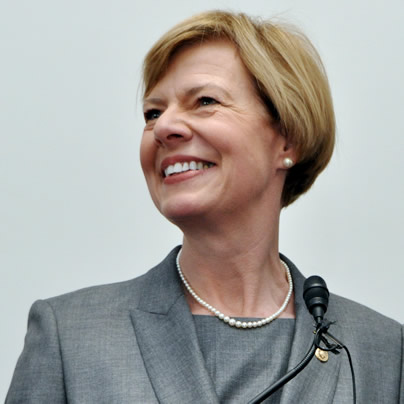
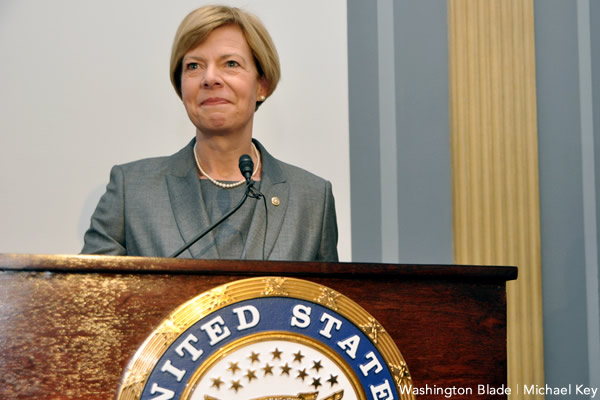
Sen. Tammy Baldwin was among the signers of the congressional Democrats brief against DOMA (Washington Blade photo by Michael Key)
An unprecedented coalition of 212 House and Senate Democrats have joined together in calling on the U.S. Supreme Court to strike down the anti-gay Defense of Marriage Act.
In a 35-page brief filed on Friday, congressional Democrats argue DOMA should be struck down because the law should be subject to heightened scrutiny and the law singles out gay and lesbian couples for harm. The case challenging the statute is Windsor v. United States.
“DOMA imposes a sweeping and unjustifiable federal disability on married same-sex couples,” the brief concludes. “It is ‘class legislation’ that lacks any rational connection to legitimate federal interests, thus violating the Fifth Amendment’s equal-protection guarantee.”
While House Democrats have filed friend-of-the-court briefs in cases challenging DOMA at lower appellate courts, the latest brief is unprecedented because for the first time Senate Democrats have signed on as well. The 172 House Democrats who signed the brief were joined by 40 Senate Democrats.
House Democrats who signed the brief include House Minority Leader Nancy Pelosi (D-Calif.) and Rep. Jerrold Nadler (D-N.Y.), who lead the effort to gather signatures, as well as the six openly LGB members of the U.S. House: Reps. Jared Polis (D-Colo.), David Cicilline (D-R.I.), Sean Patrick Maloney (D-N.Y.), Mark Pocan (D-Wis.), Kyrsten Sinema (D-Ariz.) and Mark Takano (D-Calif.).
Senators who joined in the effort are lesbian Sen. Tammy Baldwin (D-Wis.) as well as Senate Majority Leader Harry Reid (D-Nev.), Assistant Majority Leader Richard Durbin (D-Ill.) and Senate Judiciary Committee Chair Patrick Leahy (D-Vt.).
The brief devotes significant attention to disputing the arguments in favor of DOMA made by the House Republican-led Bipartisan Legal Advisory Group — which has taken up defense of DOMA in place of the administration — particularly BLAG’s argument that gays enjoy political power and thus aren’t a suspect class.
Congressional Democrats take note of how the LGBT people unable has been unable pass legislation to institute federal protections against job bias — the Employment Non-Discrimination Act — as an example of their political powerlessness.
“In fact, in the nearly twenty years since it was first introduced, ENDA passed only once in the House and never in the Senate,” the brief states. “That gay men and lesbians have been unable to achieve even the modest goal of obtaining basic protection against employment discrimination — despite the fact that 89 percent of the American people supports such protection — shows that BLAG is flat wrong in contending that gay men and lesbians enjoy ‘remarkable political clout.'”
The brief also details harm that DOMA causes same-sex couples who are unable to receive federal benefits of marriage — as well as the harm the statute causes children living in these families.
“Many married lesbians and gay men raise children together,” the brief states. “DOMA harms them and their children, and affords no benefit to different-sex couples or their children. It thus cannot survive equal protection review.”
Notably, the brief refrains from making the argument that Congress passed DOMA in 1996 out of animus — a position held by many LGBT advocates — and instead maintains it was made law because members of Congress at the time didn’t know gay people.
“From our perspective — including those of us who voted for DOMA — debate and passage of the law did not necessarily arise ‘from malice or hostile animus,’ but instead from ‘insensitivity caused by simple want of careful, rational reflection or from some instinctive mechanism to guard against people who appear to be different in some respects from ourselves,'” the brief states. “While fear and distrust of families different from our own may explain why DOMA passed by comfortable majorities in 1996, it does not obviate the need for a constitutionally permissible justification for the law.”
Evan Wolfson, president of Freedom to Marry, commended congressional Democrats speaking out against DOMA before the Supreme Court.
“It’s a key indicator of how indefensible the so-called Defense of Marriage Act is that now literally hundreds of members of Congress are signing a brief repudiating it,” Wolfson said. “These senators and representatives, like the American people they serve, know that the government shouldn’t be assigning second-class status to legally married same-sex couples.”
No Republicans signed the brief. Even though Reps. Ileana Ros-Lehtinen (R-Fla.) and Richard Hanna (R-N.Y.) have signed on as co-sponsors to legislation that would repeal DOMA — and penned their names to another brief from 131 Republicans arguing that California’s Proposition 8 is unconstitutional — their names are absent from the DOMA brief.
Ilan Kayatsky, a Nadler spokesperson, deferred comment on the absence of any Republican names from the DOMA brief to Republicans. Neither Ros-Lehtinen’s nor Hanna’s office immediately responded to a request to comment.
The argument presented in the brief is along the lines of the argument that the Obama administration made against DOMA in the brief the Justice Department filed last month.
On Thursday, the administration also filed a brief before the Supreme Court arguing Prop 8 is unconstitutional in addition to the DOMA brief. However, congressional Democrats didn’t do the same and only submitted on brief on DOMA.
Drew Hammill, a Pelosi spokesperson, said the Democratic leader was focused on building support for the DOMA brief and its argument that DOMA should be subject to heightened scrutiny will assist in efforts to overturn California’s marriage ban.
“The brief provides the congressional members’ perspective on why there is absolutely no legitimate federal interest in discrimination, and why, given the history of how DOMA was enacted, heightened judicial scrutiny is needed for federal laws that discriminate against the LGBT community,” Hammill said. “In making the case for heightened scrutiny, the amicus brief will assist the efforts to overturn Proposition 8.”
Hammill also said Pelosi has spoken out against Prop 8 and “appreciates” the Justice Department’s filing against the constitutional ban on same-sex marriage in California.
“From the outset, Leader Pelosi has strongly opposed Proposition 8, and believes that the legal advocacy by opponents of Proposition 8 has been outstanding,” Hammill said. “The Leader looks forward to the day when all Californians – and indeed, all Americans everywhere – have the right to marry who they love. She appreciates the President’s strong leadership in favor of overturning Proposition 8 and of striking down DOMA.”
Asked in a follow-up email to clarify whether Pelosi believes Prop 8 is unconstitutional, Hammill replied, “She has said so repeatedly.”




Pennsylvania
Pa. House passes bill to codify marriage equality in state law
Governor supports gay state Rep. Malcolm Kenyatta’s measure
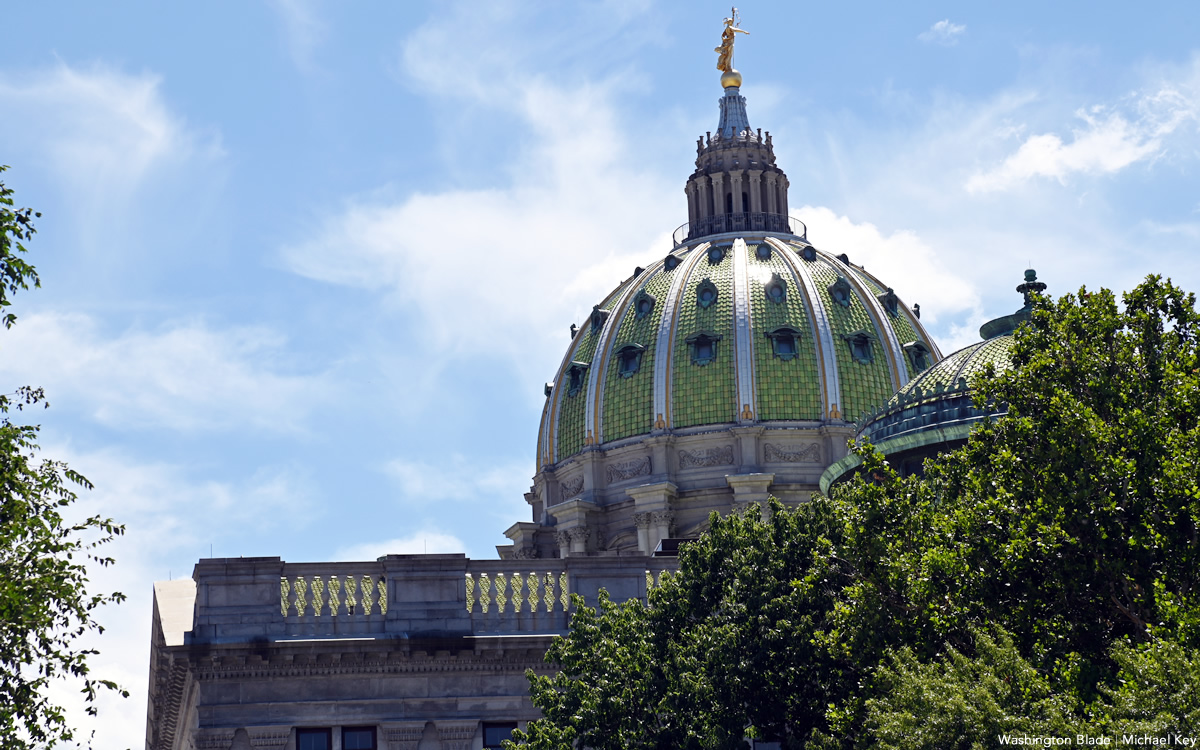
The Pennsylvania House of Representatives on Wednesday passed a bill that would codify marriage equality in state law.
House Bill 1800 passed by a 127-72 vote margin. Twenty-six Republicans voted for the measure.
The Republican-controlled Pennsylvania Senate will now consider the bill that state Rep. Malcolm Kenyatta (D-Philadelphia), who is the first openly gay person of color elected to the state’s General Assembly, introduced. Democratic Gov. Josh Shapiro supports the measure.
“Here in Pennsylvania, we believe in your freedom to marry who you love,” said Shapiro on Wednesday. “Today, the House has stepped up to protect that right.”
BREAKING: The Pennsylvania House just passed @RepKenyatta's bill to codify marriage equality into law in PA — and they did it with broad bipartisan support.
— Governor Josh Shapiro (@GovernorShapiro) March 25, 2026
Here in Pennsylvania, we believe in your freedom to marry who you love. Today, the House has stepped up to protect that…
Florida
DeSantis signs emergency bill that restores Fla. ADAP funding
Temporary funds to last through June 30
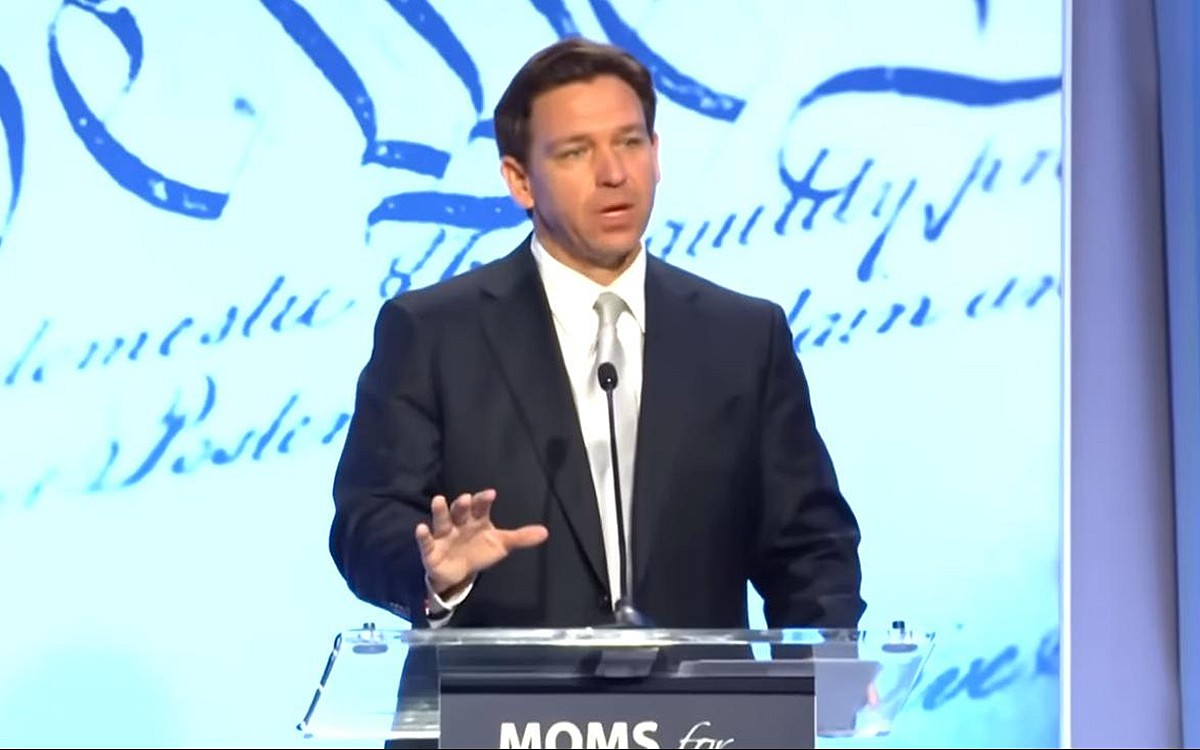
After the Florida Department of Health made huge cuts to the AIDS Drug Assistance Program in January, Republican Gov. Ron DeSantis has signed emergency legislation restoring HIV access to more than 12,000 Floridians.
Two months ago, as the Washington Blade reported, the Sunshine State cut the vast majority of those in ADAP by shifting the income levels required for eligibility — without following standard procedure when changing government policy outside of legislative or executive action.
The bill, signed by DeSantis on Tuesday, passed both chambers of the Florida Legislature unanimously and appropriates $30.9 million in emergency bridge funding through June 30, 2026. It restores Florida’s ADAP income eligibility to 400 percent of the Federal Poverty Level — the level it was prior to the January cuts. The legislation also requires the FDOH to submit detailed monthly financial reports to legislative leadership beginning April 1.
Under the old policy, eligibility would have been limited to those making no more than 130 percent of the federal poverty level, or $20,345 per year.
“For 10 weeks, 12,000 Floridians living with HIV did not know if they could fill their next prescription. Today, they can,” Esteban Wood, director of advocacy and legislative affairs at AIDS Healthcare Foundation, said in a statement.
The detailed reports now required to be sent to legislative leadership must include all federal revenues and expenditures, including manufacturer rebates; enrollment figures by county and insurance status; prescription utilization by drug class; and any projected funding shortfalls. This is the first time the Legislature has required this level of financial transparency from the program.
DeSantis signed the legislation one day after a Leon County Circuit Court judge denied AIDS Healthcare Foundation’s request for an injunction to block the significant changes the DeSantis administration is making to the program, which it claims faces a $120 million shortfall for calendar year 2026.
AIDS Healthcare Foundation, a national organization focused on protecting and expanding HIV healthcare access and prevention methods, filed a lawsuit over the change in eligibility, arguing the Florida Department of Health did not follow the laid out path for formally changing policy and was acting outside established procedures.
Typically, altering eligibility for a statewide program requires either legislative action or adherence to a multistep rule-making process, including: publishing a Notice of Proposed Rule; providing a statement of estimated regulatory costs; allowing public comment; holding hearings if requested; responding to challenges; and formally adopting the rule. According to AIDS Healthcare Foundation, none of these steps occurred.
The long-term structure of ADAP will be determined by the 2026–2027 fiscal year state budget, something that lawmakers have until June 30 to finish.
Federal Government
Markwayne Mullin confirmed as next DHS secretary
Okla. senator to succeed Kristi Noem
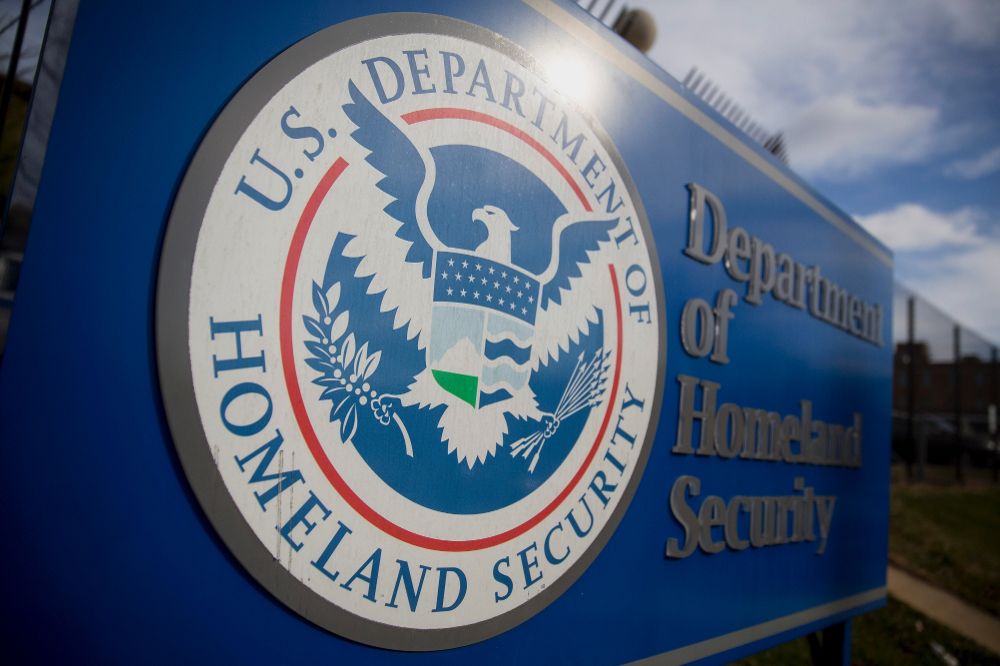
The U.S. Senate confirmed Markwayne Mullin as the next secretary of Homeland Security on Monday, as the agency continues to grapple with what lawmakers have described as a “never-ending” funding standoff, with Democrats attempting to withhold funding from one of the nation’s largest and most costly agencies.
Mullin — a Republican senator from Oklahoma, former mixed martial arts fighter, and plumbing business owner — was confirmed in a 54–45 vote. Two Democrats — U.S. Sens. John Fetterman (D-Pa.) and Martin Heinrich (D-N.M.) — sided with Republicans in supporting his confirmation.
The new agency head is expected to follow the policy direction set by President Donald Trump, emphasizing stricter immigration enforcement. This includes proposals to support immigration agents at polling sites and to cut funding to so-called “sanctuary cities.”
Mullin replaces Kristi Noem, who was fired earlier this month following a widely scrutinized 2-day congressional hearing on Capitol Hill.
During the hearing, Noem faced intense questioning over her response to several crises, including the fatal shooting of two American citizens in Minneapolis by U.S. Immigration and Customs Enforcement agents, a $220 million border security advertising campaign that featured her on horseback near Mount Rushmore amid one of the largest federal workforce reductions in U.S. history, and the federal response to major natural disasters such as the July 2025 Texas floods and Hurricane Helene in 2024.
Noem had previously drawn criticism for a series of policy decisions in South Dakota that broadly focused on restricting the rights of LGBTQ individuals. In 2023, she signed House Bill 1080, banning gender-affirming medical care for transgender minors. She also signed legislation and executive orders restricting trans athletes’ participation in women’s sports, as well as the state’s “Religious Freedom Restoration Act,” which critics argued enabled discrimination against LGBTQ individuals. Additionally, the state canceled contracts related to LGBTQ support services — including suicide prevention and health care navigation programs‚ and later agreed to a $300,000 settlement with trans advocacy group, The Transformation Project.
Despite her removal from DHS, Noem will remain in the Trump-Vance administration as a special envoy for the “Shield of the Americas,” an initiative aimed at promoting U.S. influence in the Western Hemisphere, including efforts to counter cartel networks, reduce Chinese influence, and manage migration.
The new head of DHS has served in Congress since 2013, in both houses of the federal legislature. While in the Senate and a member of the Health, Education, Labor, and Pensions (HELP) Committee, Mullin has been a vocal critic of policies aimed at expanding LGBTQ inclusion. He led a group of lawmakers in urging the Administration for Community Living to reverse a rule requiring states to prioritize Older Americans Act services based on sexual orientation and gender identity, arguing the policy could have unintended consequences.
Mullin also makes history as the first Native American — and a citizen of the Cherokee Nation — to lead the Department of Homeland Security. He was also among the 147 Republicans who voted to overturn the 2020 presidential election results despite no evidence of widespread fraud, and was present in the U.S. House of Representatives chamber on Jan. 6.

‘No Kings’ protests set for D.C.

Border to border: modern slavery and human trafficking in refugee movements across East Africa

New IOC policy bans trans women from Olympics

Introducing the Torchbearers Awards honoring queer, trans women and nonbinary people

Pa. House passes bill to codify marriage equality in state law

PHOTOS: Capital Stonewall Democrats 50th anniversary

‘Inherit the Wind’ isn’t about science vs. religion, but the right to think

Small is beautiful: subcompact SUVs

Polish court rules country must recognize same-sex marriages from EU states

Capital Stonewall Democrats 50th anniversary gala draws sold out crowd
-

 Photos4 days ago
PHOTOS: Capital Stonewall Democrats 50th anniversary
-
Theater5 days ago
‘Inherit the Wind’ isn’t about science vs. religion, but the right to think
-
Autos5 days ago
Small is beautiful: subcompact SUVs
-
Poland4 days ago
Polish court rules country must recognize same-sex marriages from EU states