National
Pentagon sets early release for ‘Don’t Ask’ report
Gates calls for expedited release of study on Nov. 30
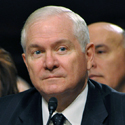

Defense Secretary Robert Gates has called on Pentagon staff to make the "Don't Ask, Don't Tell" study ready by Nov. 30. (Blade photo by Michael Key)
The Pentagon has announced its study on “Don’t Ask, Don’t Tell” will be complete a day earlier than previously scheduled following requests from U.S. senators and LGBT advocates to make the report available as soon as possible.
In a statement, Geoff Morrell, a Pentagon spokesperson, said Defense Secretary Robert Gates is “pushing all involved” with the Pentagon “Don’t Ask, Don’t Tell” working group to have the study ready for the public by Nov. 30.
“Frankly, December 1st was already an aggressive deadline by which to complete the report, incorporate the views of service secretaries and chiefs and for the Secretary to make a recommendation on the way ahead, but he has further compressed the timeline in order to support Congress’ wish to consider repeal before they adjourn,” Morrell added.
Morrell said Gates has instructed his staff to make the report available a day sooner “without cutting any corners” because the secretary wants members of the Senate Armed Services Committee to be able to “read and consider the complex, lengthy report before holding hearings with its authors and the Joint Chiefs of Staff.”
A measure to repeal “Don’t Ask, Don’t Tell” is currently pending before U.S. Senate as part of the fiscal year 2011 defense authorization bill. LGBT advocates are urging Congress to pass the legislation during the lame duck session adjourning for the year.
Last week, Sens. Joseph Lieberman (I-Conn.) and Susan Collins (R-Maine) sent the Pentagon a letter asking officials to make the report available prior to the Dec. 1 deadline. The Human Rights Campaign had also issued a statement calling on the Defense Department to make the report available “as soon as possible,” arguing that its release could prompt more senators to support “Don’t Ask, Don’t Tell” repeal.
In a joint statement, Lieberman and Collins thanked Gates for expediting the release of the report “so that Congress will have as much time as possible to review the findings and proceed with repeal this year.”
“Secretary Gates’ decision to release the report early as we requested and Secretary Gates’ leadership calling for repeal are two more reasons why we think Congress can and should repeal this discriminatory policy now,” the senators said.
Collins was among the senators who voted with the GOP to block consideration of the defense authorization bill when a previous attempt was made to bring the legislation to the Senate floor in September. She said she wanted a more open amendment process as part of consideration of the legislation.
During a congressional hearing last week, Senate Armed Services Committee Chair Carl Levin (D-Mich.) also asked Army Gen. Carter Ham, a co-chair of the Pentagon working group, to make the study available as s0on as possible.
In a statement, Levin also said he’s “pleased” Gates has made the decision to release the report on an expedited basis and said he plans to make final plans soon for hearings on the study.
“I believe our hearings on the report will be a boost to the goal of passing a National Defense Authorization Act, including provisions related to repeal of “Don’t Ask, Don’t Tell,” Levin said.
Alex Nicholson, executive director of Servicemembers United, said the earlier release of the report is beneficial because “time is going to be in very short supply” after lawmakers return from Thanksgiving recess.
Nicholson said he had been “begging” Senate Majority Leader Harry Reid (D-Nev.) to start the process for consideration of the defense authorization bill prior to Thanksgiving break to allow more time for consideration of the legislation. Lawmakers have now gone on break and aren’t set to return until Nov. 29.
“The report coming out on November 30th might make the difference between being able to hold hearings the first week of December versus the second week, which may be too late,” Nicholson added. “Hopefully Sen. Levin will now schedule a hearing for December 1st or December 2nd so that the process considering the full bill can get under way.”



Arizona
Shooting outside gay bar in Ariz. leaves three dead
Tucson police investigating double murder-suicide as a hate crime

Three people were fatally shot outside a gay bar in Tucson, Ariz., early Monday morning, about a mile from the city’s nightlife district.
Police have said the shooting, which took place in the parking lot of Venture-N bar at 1239 N. 6th Ave., was likely a hate crime and a double murder-suicide following a verbal altercation.
The suspect, Ousman Ceesay, allegedly shot Vincent Anthony Siqueiros and Cameron Davis Capara while they were outside the club around 12:30 a.m. Monday.
Reports show Capara and Siqueiros were pronounced dead at the scene. Ceesay died after being taken to a local hospital with gunshot wounds.
Police have also said that Ceesay was carrying a list of LGBTQ businesses at the time of the shooting.
Arizona Public Media has said police are investigating the case as a hate crime because the suspect was carrying a note containing the names of multiple LGBTQ-associated businesses.
“I am deeply saddened that another senseless loss of life has happened in our community,” Tucson Police Chief Monica Prieto said in a statement. “Bias-based crimes are especially heinous and have no place in our community.”
According to Prieto, there is no imminent threat to the community, and the Tucson Police Department is working to provide extra protection to various LGBTQ businesses across town.
Congresswoman Adelita Grijalva, who represents the area, issued a statement condemning the act of violence, which appears to have been at least in part motivated by homophobia.
“I am disgusted and deeply saddened to learn of a targeted act of hate and the cold-blooded murder of two members of our LGBTQIA+ community, Vincent Siqueiros and Cameron Capara, at the Venture-N bar in Tucson last night. This horrific attack is a painful reminder that even in welcoming communities like Tucson, hate and violence against the LGBTQIA+ community still exist.”
“When that hate is combined with easy access to firearms, the consequences can be deadly. I am sick and tired of Congress refusing to lift a finger to protect our communities while, every day, dozens of people are shot and killed across the country. It does not have to be this way. The House of Representatives is returning to session this week, and our first action should be passing common-sense gun safety reforms that we know can save lives.”
Other federal lawmakers also condemned the shooting.
The Congressional Equality Caucus, which is made up of federal legislators advancing LGBTQ interests, issued a statement after news broke.
“Our hearts are with the friends and loved ones of the victims of this devastating attack outside a Tucson gay bar and with the Tucson LGBTQI+ community,” it said on X. “No one should fear violence because of who they are — and we’re going to continue fighting to build a world where no one does.”
The Human Rights Campaign, the largest LGBTQ organization in the country, released a statement following the shooting.
“We are heartbroken by the loss of Vincent Anthony Siqueiros and Cameron Davis Capara and our hearts are with their families, loved ones, and the entire Tucson LGBTQ+ community. Once again, we are reminded that gun violence robs people of their lives, destroys families, and devastates communities.”
A candlelight vigil honoring the victims is planned for Sept. 2 at 6:30 p.m. at Catalina Park in North Tucson.
Congress
HRC president campaigns for Chris Pappas in NH
Gay congressman running to succeed retiring U.S. Sen. Jeanne Shaheen

Human Rights Campaign President Kelley Robinson on Sunday campaigned for U.S. Rep. Chris Pappas (D-N.H.) in New Hampshire.
Robinson traveled to Manchester, the state’s largest city, nine days before the Sept. 8 primary that will determine who will vie for retiring U.S. Sen. Jeanne Shaheen (D-N.H.)’s seat.
We’re hitting the pavement across New Hampshire to fight for a freer, fairer future for everyone.
Glad to have Human Rights Campaign President @KelleyJRobinson join us for a canvass launch in Manchester today. pic.twitter.com/XWCEaQxy4o
— Chris Pappas (@ChrisPappasNH) August 30, 2026
Former U.S. Sen. John E. Sununu, who represented New Hampshire in the U.S. Senate from 2003-2009, will face off against former U.S. Sen. Scott Brown, who represented Massachusetts in the U.S. Senate from 2010-2013, in the Republican primary.
Karishma Manzur is among the Democrats challenging Pappas.
A poll the University of New Hampshire Survey Center released on Aug. 26 shows Sununu is ahead of Brown. The same survey shows Pappas ahead of Manzur and his other Democratic challengers.
The UNH Survey Center poll shows Sununu ahead of Pappas by a 45-43 percent margin if they were to face off in the general election. The margin of error is +/-2.1 percent.
Pappas would become the first openly gay man elected to the U.S. Senate if he were to win in November.
National
Milo Yiannopoulos deported to UK
ICE arrested far-right provocateur in New Orleans on Thursday

Editor’s note: The Department of Homeland Security on Saturday said Milo Yiannopoulos has been deported to the U.K.
U.S. Immigration and Customs Enforcement on Thursday arrested far-right provocateur Milo Yiannopoulos.
A DHS spokesperson in a statement sent to the Washington Blade said ICE arrested Yiannopoulos, who they described as “an illegal alien from the United Kingdom,” at Louis Armstrong New Orleans International Airport.
The DHS spokesperson said Yiannopoulos “legally entered the country” in New York on May 14, 2019.
“He chose to overstay his welcome in violation of our nation’s laws,” said the spokesperson.
The DHS spokesperson said an immigration judge on July 22 “issued a final order of removal” for Yiannopoulos “after failing to show up for his immigration hearing.” The Times-Picayune newspaper in New Orleans on Friday reported Yiannopoulos is being held at an ICE detention center in Alexandria, La., which is about 200 miles northwest of the Crescent City.
“He will remain in ICE custody pending removal,” said the DHS spokesperson.
Yiannopoulos has, among other things, repeatedly targeted transgender people and Muslims.
The American Conservative Union, which organizes the annual Conversative Political Action Conference, in 2017 disinvited Yiannopoulos from speaking at that year’s CPAC after a video in which he appeared to condone sex between adults and underage boys emerged. Yiannopoulos subsequently resigned from Breitbart News, a far-right news website, where he had been a senior editor.
Yiannopoulos later that year married his boyfriend in Hawaii. The far-right provocateur in 2021 claimed he was an “ex-gay.”
The Australian government in 2019 banned Yiannopoulos from entering the country “on character grounds.” Yiannopoulos was also banned from Facebook, Twitter (now X), and other social media platforms.

The Times-Picayune reported Yiannopoulos “most recently worked for” Ye, formerly known as Kanye West.
The controversial rapper is scheduled to perform in New Orleans on Friday.
Laura Loomer, a far-right conspiracy theorist who is close to President Donald Trump, has called for Yiannopoulos’s deportation. Loomer on Friday wrote on X that she “reported him to ICE and the FBI” after he “called for me to be assassinated.”

SUNFESTIVAL takes center stage as Rehoboth Beach closes out summer

Anne Arundel schools now need parent permission to call trans students by preferred names
Shooting outside gay bar in Ariz. leaves three dead

‘People don’t see me. They see a trend’

Gay men linked to 2006 Wone murder failing to make lawsuit settlement payment

San Francisco, long a queer safe haven, remains competitive for homebuyers

Trans, nonbinary Americans find refuge in the Netherlands

Calendar: August 28-September 3

‘Teenage Sex and Death’ has never been more entertaining

Actor Tim Curry dies at 80
-

 California4 days ago
San Francisco, long a queer safe haven, remains competitive for homebuyers
-
Netherlands4 days ago
Trans, nonbinary Americans find refuge in the Netherlands
-
Calendar4 days ago
Calendar: August 28-September 3
-
Movies4 days ago
‘Teenage Sex and Death’ has never been more entertaining