Opinions
5 questions for Trump’s Education nominee
Will DeVos address harassment, bullying of LGBT students?
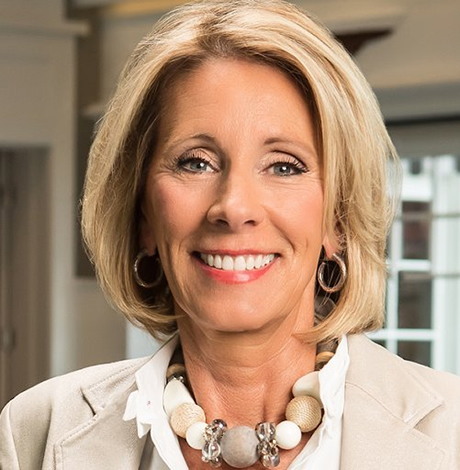
President-elect Donald Trump’s nominee for Secretary of Education Betsy DeVos (Photo courtesy of Twitter)
Donald Trump seems more intent on dismantling the federal government than running it. I hope I’m wrong about this. But in appointment after appointment, the president-elect has chosen cabinet secretaries who disdain the agencies they are being asked to lead. From an EPA chief who is suing the agency, to a Health & Human Services secretary who wants to take away healthcare, the emerging list of Trump administration officials is worrying for many reasons.
For the LGBT community, there are particularly worrisome signs about Trump’s nominees. His choice for Attorney General, Sen. Jeff Sessions of Alabama, voted for a constitutional ban on same-sex marriage and against expanding the definition of hate crimes to include acts based on a victim’s sexual orientation or gender identity. Scott Pruitt, his choice to head the EPA, is so opposed to LGBT equality that he has been called the “head bully.”
But for some of the youngest and most vulnerable LGBT people – our nation’s students – it is Trump’s selection of Betsy DeVos to serve as Secretary of Education that causes great concern. DeVos – who has been a major donor to anti-LGBT organizations like the Family Research Council, Focus on the Family, and the National Organization for Marriage – will now be in charge of America’s public school system. How, or whether, she will address the harassment and bullying LGBT students face in our schools should be among the first questions she is asked during her confirmation hearings. Here’s why.
Over the past eight years, the Department of Education’s Office for Civil Rights (OCR) has played a crucial role in addressing discrimination, harassment, bullying, and violence in our nation’s schools. In my work at Public Justice, we’ve filed complaints with OCR that resulted in investigations of school districts in cases involving sexual violence, gender-based and racial harassment, and dating violence. When OCR opens an investigation, schools pay attention. And when the federal government intervenes to ensure schools are properly applying the law to protect students, parents rest easier.
Now, OCR’s work appears to be in jeopardy. Trump advisers have suggested dismantling or defunding OCR, or moving its work to an entirely different agency. If they succeed in doing so, LGBT students – along with other students who have relied on OCR to address sexual harassment and violence – will be robbed of a key force in battling discrimination in our nation’s schools. If the agency disappears, or is significantly watered down, transgender students will be unable to request an investigation when they are denied access to school facilities, and schools will not be held accountable when students are bullied because of their real or perceived sexual orientation or gender identity.
And that’s just the tip of the iceberg. DeVos will have to decide how to interpret and apply Title IX, the federal civil rights law designed to combat sex discrimination and ensure gender equity in education. OCR has long interpreted Title IX to cover harassment of LGBT students. Will DeVos try to undo this?
In short, on day one, DeVos will be able to continue policies and enforcement that have already helped countless LGBT students or wipe them away. Given her past support of anti-LGBT lobbyists and groups, parents and advocates have cause to be concerned.
Before senators vote on her confirmation, they should insist she lay out her vision for the future of OCR’s policies and enforcement. Specifically, they should insist she answer these five questions:
- Do you intend to continue OCR’s enforcement of students’ rights to an education in a safe environment, free from discrimination and harassment?
- Do you support existing policy guidance on transgender students’ access to school facilities?
- Do you continue to support – financially or otherwise – organizations that have campaigned against LGBT rights or advocate “conversion” therapy?
- Do you believe Title IX’s prohibition against sex discrimination covers discrimination on the basis of sexual orientation and gender identity or expression, and will you implement the law accordingly?
- How will the Department of Education’s Office for Civil Rights address claims of anti-LGBT harassment, discrimination or violence, and how will OCR’s work change, if at all, under your leadership?
Her answers will tell us a lot about whether the department that has made such a difference in the lives of LGBT and other targeted students over the past eight years will continue to be their ally or will be reshaped by groups with a divisive, anti-LGBT political agenda.
Adele P. Kimmel is Senior Attorney at Public Justice, an impact litigation group that pursues high impact lawsuits to combat social and economic injustice, protect the Earth’s sustainability, and challenge predatory corporate conduct and government abuses. For more information, visit PublicJustice.net.


Opinions
Gun reform is an LGBTQ rights issue
‘I am sick of Congress refusing to lift a finger to protect our communities’

Earlier this month, 44-year-old Ousman Ceesay allegedly shot two people in the parking lot of Venture-N, a well-known gay bar in Tucson, Ariz. Both victims — Vincent Anthony Siquerioes and Cameron Davis Capara — died at the scene. Police discovered a list of several LGBTQ businesses on Ceesay’s person, and evidence points to how Ceesay confronted Siquerios and Capara in the bar’s parking lot before killing them. According to a news release, police are investigating the incident as a hate crime.
The event was reminiscent of the 2022 Club Q shooting and the Pulse nightclub shooting, where Omar Mateen shot and killed 49 people and wounded more than 50 more at the gay nightclub in Orlando. Survivors and the wider queer community recognized the 10th anniversary of the shooting this past June 12. As the queer community grieved another shooting targeting LGBTQ safe spaces this month, some members of the LGBTQ community are raising the call for gun reform as a key step to protect LGBTQ rights.
Gun violence is a major issue for the LGBTQ community. LGBTQ people are more than twice as likely to be the victims of violent crime than straight and cisgender people, with one in five hate crimes in the United States motivated by queer phobia. This means that LGBTQ folks are more likely to be violently attacked by a stranger compared to their cisgender, straight counterparts. In school settings, 29% of transgender youth and 16% of gay and lesbian youth have been threatened or injured with a weapon, compared to 7% of cisgender youth.
There is an ongoing epidemic of gun violence injuring and killing trans women of color in the United States today. One study by the nonprofit Everytown for Gun Safety identified that the number of trans people who were murdered in the U.S. doubled between 2017 and 2021, increasing 93% in that time period. Everytown for Gun Safety recognizes that these aren’t even the actual numbers as many trans people are misgendered or deadnamed by the police, media, or their families so their deaths are not incorporated into these numbers and tied to systemic gun violence against the wider LGBTQ community.
As a community with higher rates of self harm and suicide, easy access to firearms increases the risk that a suicide attempt will end in death. This does not mean that LGBTQ people are mentally ill, a popular far right talking point. LGBTQ people are not more likely to experience suicidal ideations and die by suicide not because they are LGBTQ but because of the stigma surrounding their identities. LGBTQ young people are more than four times likely than their non-LGBTQ peers to attempt suicide, and the Trevor Project estimates that 1.8 million LGBTQ people between the ages of 13 and 24 consider suicide in the United States.
As the Williams Institute shows, this makes gun violence a serious public health concern for the queer community. As Dr. David Hemenway, co-author of a 2016 study published in the American Journal of Medicine said, “differences in overall suicide rates across cities, states, and regions in the United States are best explained not by differences in mental health, suicide ideation, or even suicide attempts, but by availability of firearms.”
Gun violence is also a major queer issue given that trans and gender expansive individuals are at greater risk of experiencing intimate partner violence. Compared to the 35% of straight women who experience intimate partner violence, 44% of lesbian and 61% of bisexual women report experiencing rape, physical violence, or stalking by an intimate partner. This number is also higher for bisexual men (37% of whom experience intimate partner violence compared to 29% of straight men). This number is much higher for trans folks; more than half of people surveyed reported some form of intimate partner violence, according to a 2015 survey.
During the second Trump administration, ongoing legal attacks on LGBTQ rights, executive orders that deny the existence and protections of trans, nonbinary, and gender expansive individuals, and virulent opposition to and disbanding and defunding of DEI initiatives, LGBTQ employee resource groups, queer history collections, exhibitions, and education, LGBTQ representation in libraries and school settings, and the firing of federal workers allegedly because they are queer — realizing a new Lavender Scare — have emboldened violent homophobes.
After the Club Q shooting, Rodrigo Heng-Lehtinen, executive director of the National Center for Transgender Equality, explained that “the rhetoric and the legislative attempts to erase transgender people sends a signal that violence toward us is tolerated.” This has become even more dire after a 2025 White House memo prioritized identifying “radically pro-transgender” groups as national security threats, in line with the Heritage Foundation’s plan to designate trans people terrorists. In response, Congresswoman Suzanne Bonamici shared, “the Trump administration’s endorsement and proliferation of hateful and violent rhetoric against the trans community is putting lives at risk,” particularly the push to label trans people and their allies as terrorists.
As Congresswoman Adelita Grijalva said on the House Floor following this latest tragedy, “when that [anti-LGBTQ+] hate is combined with easy access to firearms, the consequences can be deadly. I am sick and tired of Congress refusing to lift a finger to protect our communities while, every day, dozens of people are shot and killed across the country.”
A 2018 survey shows that the wider LGBTQ community supports gun reform — with 93% of lesbian, gay, and bisexual adults supporting background checks and 72% opposing legislation and procedural changes that make it easier to obtain concealed weapon permits. This is not to say that the wider LGBTQ community opposes gun ownership. In fact, a growing cohort of LGBTQ individuals and other members of minority and marginalized groups are investigating gun training and ownership to protect themselves. Part of their motivation is not just protecting themselves against perpetrators of hate-motivated gun violence but also against state and federal agents that are increasingly attacking the LGBTQ community.
After the shooting, Tucson police increased their presence at other LGBTQ businesses in the city, but locals expressed concern that this would alienate some LGBTQ patrons, especially queer and trans patrons of color, and might also lead to further violence knowing that police continue to be instigators in and perpetrators of queer phobic violence. A Williams Institute study published this past year highlighted how LGBTQ people, especially queer people of color, LGBTQ youth, and trans and gender expansive individuals experience higher rates of profiling, discrimination, harassment, and entrapment from law enforcement.
This is one of the reasons that police presence at Pride events continue to be controversial, as community members remember how the police were the major antagonists at the Stonewall and Compton’s Cafeteria riots. The LGBTQ rights movement came to be largely because queer and trans people of color fought back against violent police harassment and abuse.
As someone who was traumatized by active shooter drills in elementary, middle, and high school, I am exhausted and heartbroken by continued gun violence and politicians’ refusal to consider and take action through gun reform legislation. Whether intentional or not, their hesitation to discuss and address this issue publicly and to use their political power to prevent future shootings communicates to LGBTQ+ people that they do not care about us. With gun violence disproportionately affecting our community, their silence and inaction is a form of queer phobic violence itself allowing tragedies like Tucson to continue happening.
(If you or someone you know is in crisis, call or text 988 to reach the Suicide and Crisis Lifeline. You can also text HOME to 741741 or visit SpeakingOfSuicide.com/resources for additional resources. You are not alone.)
Emma Cieslik is a D.C.-based museum worker and public historian.
Opinions
Trump’s Cabinet: Dumb, dumber, dumbest, and evil
Corrupt officials working to undo 250 years of progress
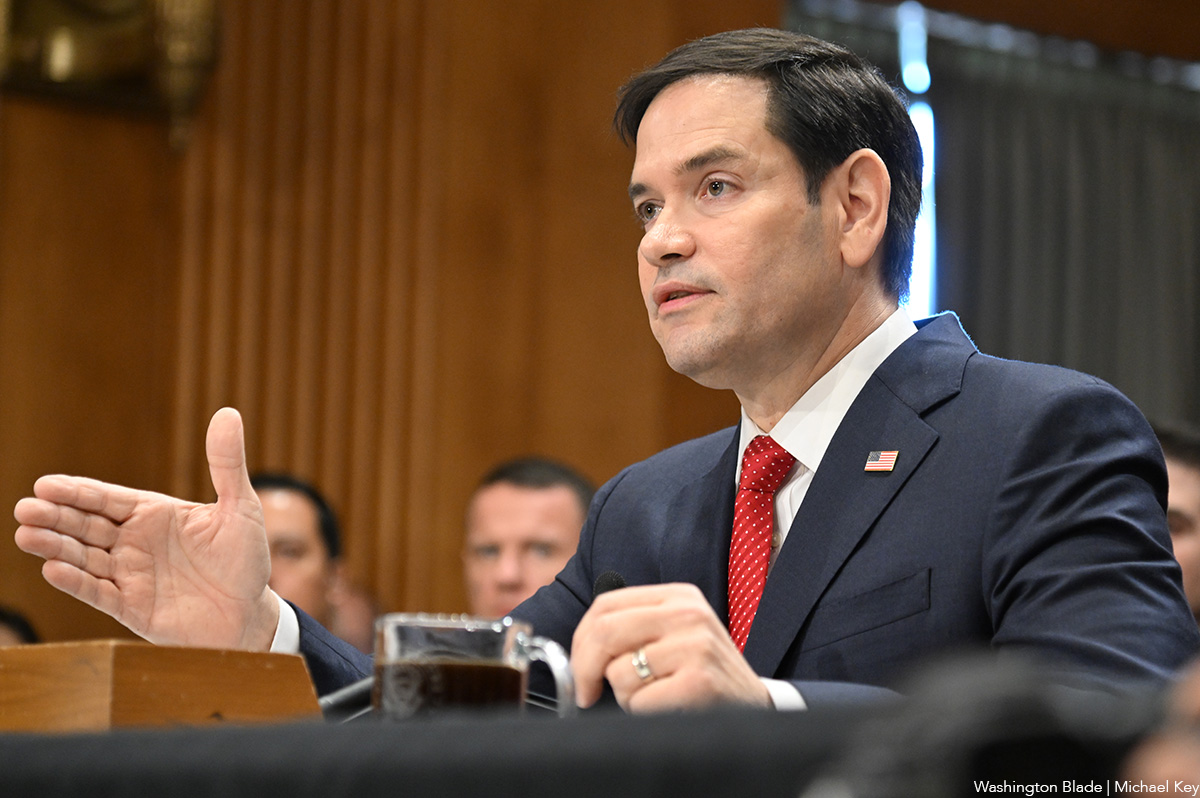
Dumb, dumber, dumbest, and evil. Any of the felon’s Cabinet and close aides could fit these terms depending on the discussion.
You have Commerce Secretary Lutnick saying “no American military were killed in Iran war.” Then it was reported our venal Vice President JD Vance said, “The current hostilities shouldn’t even be called a war, since ‘active combat operations’ ended months ago. Right now, there is no active shooting, Vance insisted. This despite the U.S. and Iran still currently exchanging fire, including around the Strait of Hormuz.
Then the fool-in-chief, the felon in the White House, said about Vance’s comments, “U.S. strikes on Iran are now “intermittent” and a lot of people don’t call it a war. I can understand what he’s saying. I call it a military conflict because it’s small potatoes for us. It’s not a big thing.” All this even though this so called “conflict” has cost U.S. taxpayers more than $37.5 billion and left 18 U.S. service members dead, hundreds injured.
All this after Secretary of State Marco Rubio said, “the Trump administration’s objective in the conflict surrounding the Strait of Hormuz is to restore shipping conditions to what they were before the war with Iran began.” Then self-hating, gay, Secretary of the Treasury, Scott Bessent, chimed in, after two days of meetings with finance ministers from around the world, blaming Ukraine for high oil prices citing “Ukraine’s attacks on Russia’s oil infrastructure as part of the reason for the global energy shock.” These people all belong in an asylum, or jail.
When not talking about the war, as he is losing it badly, the felon-in-chief talks BS at a rally in Texas. Then he talks about redesigning Washington. Lutnick, speaking at a judicial hearing on whether Trump can put his name on the National Monument honoring JFK, said, “Donald Trump is the most credible person in the world” while arguing that the Kennedy Center should bear his name because he’s vowed to raise the funds to renovate it. That, even though the funds were approved by Congress and not raised by Trump. Then Trump’s tariff war on the world, now focused on Canada, which is screwing the American people, and his believing an Executive Order can get the world to call bodies of water like the Gulf of Mexico, and Lake Ontario, by different names. Or that he can change the name of the Department of Defense, to the Department of War, which only Congress can do. With the help of the fascist sycophants around him, he creates chaos in the world.
He has torn down part of the White House, and tries to build an arch. Spent millions and caused the destruction of the reflecting pool. Some of these things will be undone, others will remain, but his name will go down in history, not on buildings, as the worst president ever. People will laugh at him as they move to remove his name from everything they can, just as New Yorkers did when he was first elected, embarrassed to be associated with him.
Now for any sane person looking at, and listening to, this chaos, it is abundantly clear how embarrassing all this is for the country. It is clear he is moving the nation backwards when it comes to the equality and equity we have fought so hard to accomplish. Our country began with us killing, and taking land, from Native Americans. The founders of our nation 250 years ago only recognized white men. They left out women and Black men. We have spent the past 250 years trying to move forward from that beginning. Trying to live up to the statement in the Declaration of Independence that said, “We hold these truths to be self-evident, that all men are created equal, that they are endowed by their Creator with certain unalienable Rights, that among these are Life, Liberty and the pursuit of Happiness.”
We have come a long way, but still have not been able to add women’s equality to our Constitution. But Trump, along with his fascist aides and sycophants in Congress, is trying his best to undo all we have accomplished in those 250 years. Trying either to take away the right to vote, or make it harder to do. They took away the right of women to control their own healthcare, and are making it harder for Black people and the LGBTQ community, to live their lives fully, with dignity and safety. They will accomplish all this, and more, if not enough people come out on Nov. 3 and say, NO MORE. However, if enough decent people vote, we can take back our country, and our future.
Peter Rosenstein is a longtime LGBTQ rights and Democratic Party activist.
Opinions
Gloria Steinem’s life of substance and consequence
Iconic activist never stopped working to make life better for women

Gloria Steinem was an icon, a feminist, a woman of substance and consequence. A rare person who made a difference her entire life; sometimes quietly, sometimes by making noise. She was an incredibly beautiful woman, inside and out.
I heard of Gloria Steinem and admired her for all she was doing. But that was from a distance. I read about her, and saw her on TV. It was 1963 when Steinem wrote and published her undercover Playboy Bunny exposé, “A Bunny’s Tale,” about her going undercover at New York’s Playboy Club. Her account revealed the physical toll, exploitative conditions, and pervasive sexism faced by the women employed there, challenging the magazine’s image of empowerment.
It was 1972 when I first met her in person. That first meeting happened while I was campaigning for Bella Abzug (D-N.Y.) at a street rally. I said “Hello, Ms. Steinem,” and she said “It’s OK to call me Gloria.” I was honored to do so.
Gloria was there to support her friend. Bella had been through a grueling primary against Bill Ryan, after being redistricted out of her seat. She lost, but then Bill died of cancer before the election, and Bella was named the Democratic candidate in the general election for New York’s 20th congressional district. When Bella won that race, I went to work for her full time. It gave me the chance to meet Gloria again a number of times after that, once even with Bella at her apartment. While she was one of the many famous people I met while working for Bella, she was different. She wasn’t Hollywood. She began her career as a reporter, and worked hard for all she believed in. She was a true activist. That was what she saw herself as. She could say she came by the activism gene from her paternal grandmother, Pauline Perlmutter Steinem who Wikipedia reported, “chaired the educational committee of the National Woman Suffrage Association and was a delegate to the 1908 International Council of Women. Also, the first woman to be elected to the Toledo Board of Education and a leader in the movement for vocational education. She helped rescue many members of her family from the Holocaust.”
So yes, in many ways, activism was in Gloria’s genes. She was the one who told me it was OK to call myself a ‘feminist’. That it isn’t only women who can call themselves that, but also men who believed and fought for full social, economic, and political equality of the sexes. She helped me to understand I was brought up by a feminist. My mom, though she never called herself that, was one by dint of how she lived her life, and fought for others.
Gloria never stopped working to make life better for women, and to make sure other women joined her in her activism. In 1969, she co-founded Ms. Magazine. Then in 1971, with Bella Abzug, Betty Friedan and Shirley Chisholm, she founded the National Women’s Political Caucus, which provided training and support for women seeking elected and appointed office. Then in the same year she co-founded the Women’s Action Alliance, which until 1997 supported a network of feminist activists and worked to advance feminist causes and legislation.
Gloria would hold other women to task if they didn’t speak out, even at difficult times, but always with love. In 1986, Bella’s husband Martin died at the young age of 69. We were at the funeral home the night before the funeral, and Bella was sitting with some of us, and saying she didn’t know what she would do without Martin. It had been a true love affair. She was saying things like she didn’t even know where the checkbook was, what their rent was, etc., because Martin handled all that. Well Gloria overheard this and came over and said to Bella, “Don’t you dare say that in public, women look up to you as a feminist, as independent, you can’t say that.” And we all laughed, even Bella, as did Gloria, but she was serious.
Then in the 1990s Gloria helped to establish what she called ‘Take Our Daughters to Work Day.’ She did this to try to have young girls learn about future career opportunities. But her work wasn’t done and in 2005, along with Jane Fonda and Robin Morgan, she co-founded the Women’s Media Center. It is an organization that “works to make women visible and powerful in the media.”
The last time I saw Gloria was at the opening night of “Gloria: A Life,” at Theatre J in D.C. She was 88, as beautiful, and sharp as ever, having just come back from a speaking engagement in some far-off country.
Gloria, the world will miss you, RIP.
Peter Rosenstein is a longtime LGBTQ rights and Democratic Party activist.

Jeremy Moss looks to bring LGBTQ advocacy from Lansing to Capitol Hill

Parties, dinners, concerts and more on tap for fall nightlife

All the queer things to watch this fall

Gun reform is an LGBTQ rights issue

Trump’s Cabinet: Dumb, dumber, dumbest, and evil

Dolly Parton biography puts her hardships into context

PHOTOS: SMYAL Fall Brunch

Fashion icon Bob Mackie dead at 87

Transgender woman killed in Barclay community mourned by friends, advocates