Connect with us

Arts & Entertainment

One final theatrical prank

Cherry Red closes shop this weekend with raunch-fest ‘The Aristocrats’

Published

on

‘The Aristocrats’
Sat at 8:30 and 11 p.m.
Cherry Red Productions
Warehouse Theater
645 New York Ave N.W.
$30
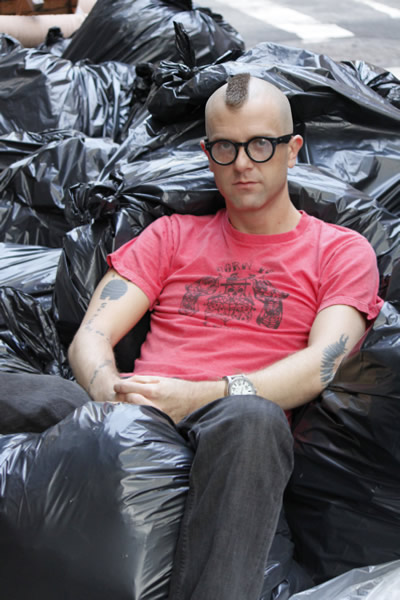
Ian Allen, Cherry Red’s artistic director. He lives in New York but has continued working in Washington. (Photo by Isabel Sinistore; courtesy of Cherry Red)


After 16 years of making D.C. audiences laugh, wince and gag, Cherry Red Productions is calling it quits. Since its creation, the company has attracted a loyal following who appreciate an insane sensibility, late night performances and small venues (sometimes bars). For those reasons, and a vacillating oeuvre of dark and light plays with titles like “Thumbsucker” and “Cannibal Cheerleaders on Crack,” Cherry Red will be sorely missed.

“We knew that we couldn’t go on forever,” says Ian Allen, Cherry Red’s artistic director. “And now that we’re ending, we’re presented with the opportunity to go out on an unmistakable Cherry Red high. Of course that’s something we’d never pass up. It’s going to be awkward, insane and fun.”

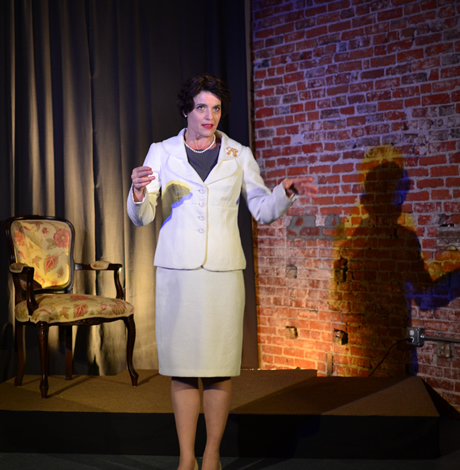
The smutty swan song to which Allen alludes is titled “The Aristocrats.” Inspired by a joke about a showbiz family whose act includes incest, bestiality and murder, the play — written and directed by Allen (who’s gay) and longtime company member Kate Debelack — is rumored to truly go there. Unlike Paul Provenza’s same-titled 2005 documentary, which features comedians telling their own versions of the joke, Cherry Red’s interpretation calls for 40 of the company’s alumni to reenact the filthy gag onstage.

There will be no holding back, promises Allen. Cherry Red’s design teams and actors have developed a lot of skills over time. Past productions have required staging insane violence including scalping, projectile body fluids and all sorts of sex acts. No doubt, there’ll be lots of that. Also, Cherry Red’s website offers a sneak peek featuring an actor igniting a part of his anatomy that is ordinarily kept under wraps. If this is an indication of what’s in store, Cherry Red may be reaching new heights of raunchiness.

After less than two days of rehearsal, “The Aristocrats” will play for one night only (two performances) on Saturday at the Warehouse Theater. Proceeds benefit District of Columbia Arts Center (DCAC), a nonprofit organization that proved instrumental in the company’s early development.

“Cherry Red’s demise is bittersweet,” says Debelack who also teaches acting at Studio Theatre. “Honestly, there’s not a lot left for us to do, but I’ll still miss it. Collaborating on this final project with Ian has been so much fun. Where else will I be able to come up with so much ridiculousness and actually put it onstage?”

She credits the company with allowing her to let go and be bold onstage. And whether attacking a zombie cat or leading a bevy of mean teens in “Worm Girl” (one of my favorites), she has always taken her Cherry Red work seriously.

Cherry Red, says Allen, has always produced shows that speak first to the body and then to the mind. The goal is to elicit an immediate response: sexual arousal, disgust or fear. What’s unique about theater is that it’s always present; it can actually threaten audience members. Allen seamlessly references an example: “When we were doing ‘Dingleberries,’ it called for the actors to eat pooh. From the audience you could smell that it was chocolate — Snickers bars dipped in pudding to be exact — but the impression was still too much for some people and sent them running from the theater.”

“Cherry Red has never been anyone’s day job,” Allen says. “But our company members have always been a combination of experience and enthusiastic youth. We’ve lasted by the sheer indecent determination on the part of many people and now we’re done.”

Eight years ago Allen moved from Washington to New York where he is marketing director for the MCC Theater in the West Village. Since then he has happily made the trip south now and then to work on Cherry Red productions. Despite the company’s closing, Allen hopes to continue to be involved in interesting local projects.

“After all,” he says, “D.C. is where my friends are.”
 

Advertisement
FUND LGBTQ JOURNALISM
SIGN UP FOR E-BLAST

Arts & Entertainment

Sci-fi has long been at vanguard of LGBTQ representation

Story lines now criticized as ‘woke’ is weird

Published

on

Ncuti Gatwa as the Doctor and Jonathan Groff as Rogue lock lips in the long-running sci-fi show, 'Doctor Who.' (Screen capture via Doctor Who/YouTube)

Since I was a teenager, I have liked sci-fi because of the depth with which it explores social issues. At the time, I didn’t know that I was autistic and queer, so I couldn’t see myself in other autistic and queer people. Instead, I saw myself in androids, mutants, telepaths, and sometimes aliens who were portrayed as minorities persecuted by the human majority. It was a universal language for talking about alienation, systemic discrimination, conversion therapy, segregation, and internalized self-hatred.

Now, when so many sci-fi stories are being criticized online as “woke,” it seems weird for me. This is especially true when we are talking about franchises, such as the British TV series “Doctor Who” and American franchise “Star Trek,” both of which have always been remarkably progressive by the standards of their own time. 

Let’s take a closer look at “Doctor Who.”

In June 2026, the BBC cancelled the planned Christmas special, saying that viewers would have to wait longer for the next season after internal studio issues, and now the BBC is looking for new production partners. “Doctor Who” is the longest-running science fiction television series in the world, originally airing from 1963 to 1989 before returning in 2005. The future of the franchise is currently unclear, and many people online immediately began blaming “wokeness” for what had happened to their favorite show.

After all, the Doctor, an alien Time Lord who can regenerate and literally change faces, had traditionally been played by white men. But the last, Fifteenth Doctor was played by Ncuti Gatwa, a Black Scottish-Rwandan actor who has publicly identified as queer (and the doctor himself was first presented as queer character after a queer romantic episode where he kissed a man), while the Thirteenth Doctor was played for three seasons by Jodie Whittaker, the first woman to portray the Doctor. In 2023, the series also introduced Rose Noble, a trans feminine nonbinary teenager and supportive character played by transgender English actress Yasmin Finney.

But despite popular stereotypes online, “Doctor Who” did not suddenly “go woke.” The program has existed in two main eras: the classic series, which aired from 1963 to1989, and the modern revival, which has been broadcast on BBC One since 2005.

Even in the 1960s, one of the program’s earliest stories, “The Daleks” (1963–64), presented an obvious allegory for fascism, racial purity, bigotry and the horrors of war. Throughout the classic era, the Doctor frequently opposed militarism, authoritarian governments, and dictatorships. Many fans have also pointed to moments of queer coding and subtext throughout the classic series.

However, openly queer characters appeared as soon as the modern revival began. 

The 2005 revival introduced Captain Jack Harkness, played by John Barrowman, one of the first openly queer recurring characters in the “Doctor Who” universe. He openly flirted with people regardless of their gender and later became the lead character of the spin-off series “Torchwood.” “Torchwood” went even further with LGBTQ representation, featuring multiple queer characters, including trans and nonbinary characters whose identities were treated as a normal part of the story.

“Doctor Who” has always been remarkably progressive for its time. The franchise doesn’t suddenly change its values, it’s always been “woke.”

The same happened with the American franchise “Star Trek.” 

It is widely known as one of the most openly left-wing and progressive television franchises ever broadcast. The original series, which aired from 1966-1969, was created during the Cold War and featured the utopian United Federation of Planets, a society without poverty or money that can be characterised as socialist or even communist. It also featured Lt. Uhura, played by Nichelle Nichols, a Black woman serving as a highly respected bridge officer at a time when Black women weren’t portrayed in positions of authority on American television. The series also included one of the first interracial kisses in modern American television, between Capt. James T. Kirk (William Shatner) and Uhura in the 1968 episode “Plato’s Stepchildren,” a moment that had a significant cultural impact.

Gene Roddenberry, the creator of the franchise, said that he had wanted to include openly queer characters as well, but believed it would have been impossible to keep the show on the air because it had already pushed social boundaries in so many other ways.

Today, many viewers — including Elon Musk — claim that “Star Trek” has only recently become “woke.” In reality, I think it actually became less radical than the original series. Even queer characters are not a recent addition to the franchise. One of the earliest major queer characters appeared in “Star Trek: Deep Space Nine” (1993–1999): the Trill officer Jadzia Dax, played by Terry Farrell. In the 1995 episode “Rejoined,” she shared one of the first same-sex kisses in the history of the franchise.

However, for some reason, it was the openly gay couple Paul Stamets (Anthony Rapp) and Hugh Culber (Wilson Cruz) inStar Trek: Discovery” (2017–2024), together with the trans Trill character Gray Tal, played by trans actor Ian Alexander, that triggered a major backlash among conservative parts of the fandom. That backlash reached another peak with “Star Trek: Starfleet Academy,” which features the canonically gay Klingon cadet Jay-Den Kraag. The actor has spoken about receiving abuse and threats because of the role, despite the fact that there was nothing especially ideological about his character. He was simply a gay character whose sexuality was only one aspect of who he was. In fact, considering the ideals of the original “Star Trek,” I was more surprised that the franchise still includes relatively few trans or polyamorous characters, and that they are not part of the lead cast. After all, the franchise was created to imagine a future that was ahead of its time.

So why do conservatives and anti-LGBTQ people continue to watch franchises that have always been deliberately progressive? And why do they keep claiming that these shows have only recently “gone woke”?

A more logical explanation is that parts of the audience have become less willing to accept the same kinds of progressive ideas that these franchises have embraced for decades. In other words, it is not the shows that fundamentally changed. Some long-time viewers have become more conservative than they were in their youth, while newer conservative audiences have joined them and begun criticizing franchises without knowing their real history. 

In many ways, geeks have changed more than these shows have. Sci-fi hasn’t “gone woke.” Some of its fans have simply become less comfortable with the same progressive values these franchises have promoted for decades.

Continue Reading

Photos

PHOTOS: Vitamin C at JR.’s

Live drag show follows ‘Drag Race All Stars’ viewing party

Published

on

Brooke N Hymen performs at JR.'s at the Vitamin C drag show on Friday. (Washington Blade photo by Landon Shackelford)

JR.’s Bar held a “RuPaul’s Drag Race: All Stars” watch party followed by a live drag show on Friday, July 17. The Vitamin C weekly drag show was hosted by Citrine with performers Brooke N Hyman and Rosie Beret.

(Washington Blade photos by Landon Shackelford)
Continue Reading

Photos

PHOTOS: Rehoboth Beach Pride Festival

LGBTQ celebration held at convention center

Published

on

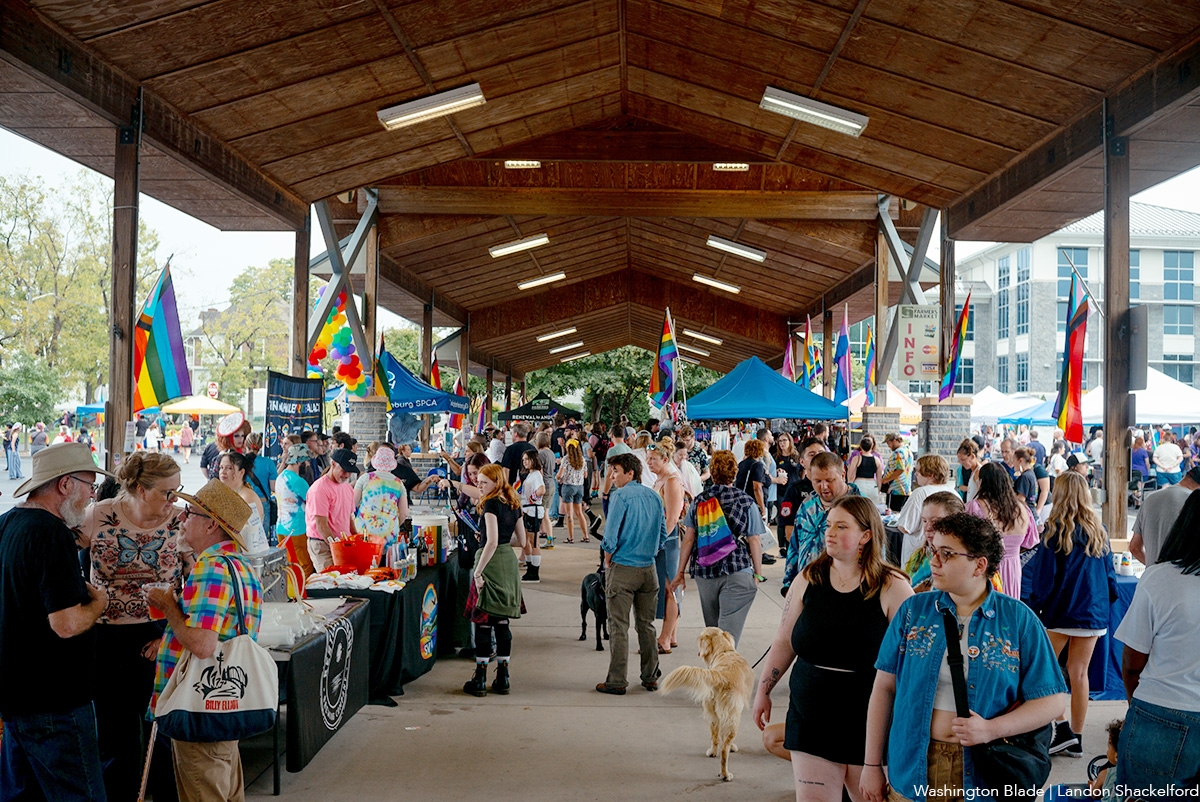
A scene from the 2026 Rehoboth Beach Pride Festival. (Washington Blade photo by Daniel Truitt)

The 2026 Rehoboth Beach Pride Festival was held at the Rehoboth Beach Convention Center on Saturday, July 18.

(Washington Blade photos by Daniel Truitt)

Continue Reading

Popular