National
GOP touts opposition to marriage equality at anti-gay summit
Speakers vow to preserve traditional marriage, attack Obama for pro-LGBT policy
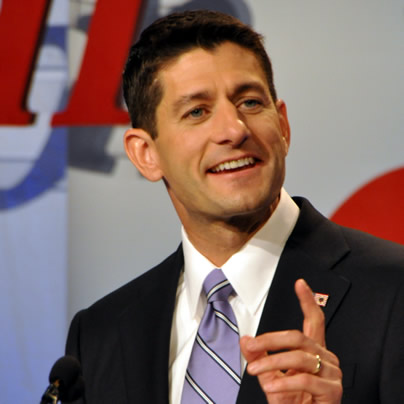
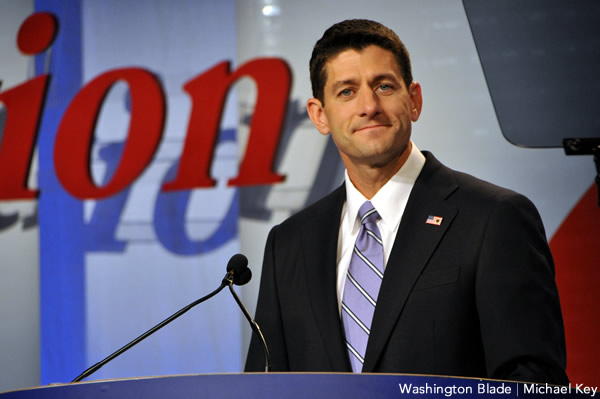
Rep. Paul Ryan (R-Wisc.) (Washington Blade photo by Michael Key)
Republican public officials — including the No. 2 person on the GOP presidential ticket — weaved opposition to same-sex marriage into their speeches during an annual social conservative conference in D.C. as they criticized President Obama’s policies and reaffirmed traditional values.
Speakers at the the 2012 Values Voters Summit, which was hosted at the Omni Shoreham Hotel by the anti-gay Family Research Council, addressed an estimated 2,500 attendees who cheered references to prohibiting marriage rights for gay couples and making abortion illegal.
Perhaps the most high-profile speech at the three-day summit came from GOP vice presidential nominee Paul Ryan, who made a reference to marriage when touting the values of the candidate at the top of the ticket: Mitt Romney.
“We can be confident in the rightness of our cause, and also in the integrity and readiness of the man who leads it,” Ryan said. “He is a solid and trustworthy, faithful and honorable man. Not only a defender of marriage, he offers an example of marriage at its best. Not only a fine businessman, he’s a fine man, worthy of leading our country and ready to lead the great turnaround we have spent four years waiting for.”
Ryan’s description of Romney as a “defender of marriage” directly lifts from the vice presidential candidate’s speech at the Republican National Convention when he gave Romney an identical distinction.
But the reference to marriage didn’t make up a significant portion of Ryan’s remarks. Abortion and the Obama administration’s decision to mandate birth control as part of health insurance policies were more salient.
“In the Clinton years, the stated goal was to make abortion safe, legal and rare,” Ryan said. “But that was a different time and a different president. Now, apparently, the Obama-Biden ticket stands for an absolute, unqualified right to abortion at any time, under any circumstance, and even at taxpayer expense.”
Twice during Ryan’s speech, protestors interrupted and shouted at the vice presidential candidate. The second protestor said something about Romney’s now infamous remarks that “Corporations are people, my friend” before being escorted out of the room. In a YouTube video posted after the speech of one of the protesters being taken away, she was shown decrying the corporate influence over the national political parties.
House Majority Leader Eric Cantor (R-Va.) was also among the speakers at the summit and touted Republicans support “traditional marriage” because of the institution’s ability to keep people out of poverty.
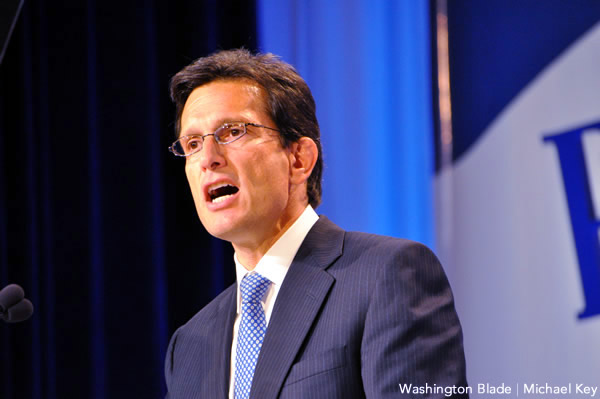
House Majority Leader Eric Cantor (R-Va.) (Washington Blade photo by Michael Key)
“That is why we believe in traditional marriage, because marriage, more than any government program ever has or ever will, has lifted up people out of poverty, even those who felt there was no hope,” Cantor said. “Marriage has proven to be that formula which has been more successful at allowing for that pursuit of happiness. And that is why we stand tall and stand proud for traditional marriage.”
Cantor is among the members of House Republicans who sits on the Bipartisan Legal Advisory Group and voted to take up defense of the Defense of Marriage Act in court after the Obama administration announced it would no longer defend the law.
Romney didn’t make a live appearance at the Values Voter Summit, but spoke to attendees via a recorded video. During the video, Romney talked about his commitment to social issues, saying his administration “will defend marriage, not try to redefine it.”
But Romney’s name didn’t often come up in speeches during the day — except for anomalies such as Ryan’s speech and the vice presidential nominee’s introduction by conservative pundit Bill Bennett — as others took the opportunity on stage to criticize Obama without praising the alternative candidate.
Wayne Besen, who’s gay and executive director of the Truth Wins Out, was in attendance at the summit and took note of the general absence of Romney.
“You’d think that Ronald Reagan was running with Paul Ryan,” Besen said. “There’s almost no mention of Romney except in Bennett’s speech. They’re really not enthusiastic at all.”
Besen also said the emphasis on defending marriage and supporting traditional marriage were coded ways for speakers to communicate to conservatives they don’t support the LGBT community.
“I wouldn’t call it quite red meat, I would call it perhaps a red meat appetizer,” Besen said. “[They’re] talking about supporting traditional marriage, but it’s not outright gay bashing. They’re clearly sending signals to their voters, but … they don’t want to look like they’re attacking LGBT people, and they’re intolerant.”
LGBT and progressive groups decried the event and said public officials were participating in a conference hosted by an extreme right-wing organizations. Earlier this week, several groups, including the Human Rights Campaign, sent a letter to public officials urging them not to attend, although the calls didn’t seem to have an impact on the schedule.
Michael Keegan, president of progressive advocacy group called People For the American Way, said in statement Ryan “sends a clear message” by participating in the summit that he’s “decided to embrace the entrenched bigotry advocated by the farthest of the far right.”
“The Family Research Council and the American Family Association are not mainstream groups,” Keegan continued. “The FRC frequently and falsely links homosexuality to pedophilia. The AFA has claimed that gay men were responsible for the Holocaust. Both have defended laws at home and abroad that criminalize homosexuality. These are not innocent differences of opinion; they are full-scale efforts to smear and denigrate LGBT Americans.
Affirmations of against same-sex marriage and attacks on Obama for his opposition to DOMA and support for same-sex marriage were a prominent feature of many other speeches.
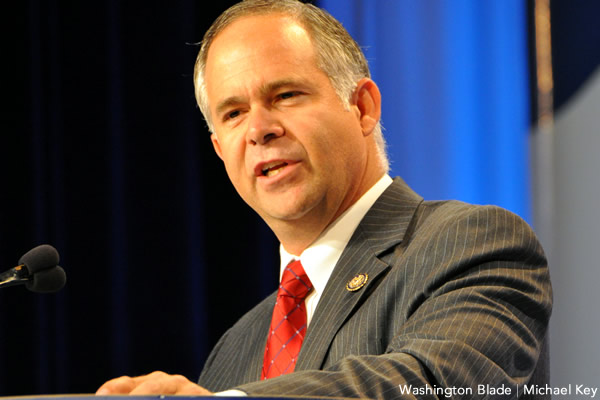
Rep. Tim Huelskamp (R-Kansas)
Rep. Tim Hueslkamp (R-Kansas), a freshman Tea Party lawmaker who this year submitted a DOMA amendment to the House floor, had stern words for the Obama administration over its refusal to defend the anti-gay, misstating the action the administration took by telling his audience Obama isn’t enforcing the law anymore.
“They’re using your taxpayer money to undermine marriage in court, after court, after court,” Hueslkamp said. “Last time I checked, the Constitution doesn’t allow a president to pick and choose … what law to enforce. They’re using those dollars, your taxpayer money, to undo your very values.”
Virginia Gov. Bob McDonnell, co-chair of the Republican Party platform drafting committee, praised how the Republican Party includes language opposing same-sex marriage and his own state’s decision to adopt a constitutional amendment banning same-sex marriage, saying the concept seems “foreign” to the Obama administration.
“We were very clear that we strongly disagree with a president who will not enforce the DOMA law to be able to protect traditional marriage,” McDonnell said. “We’ve already adopted that in the constitution of Virginia; in fact, every state – I think 30 of them now – that have actually voted in their states to protect traditional marriage have done so. And so embracing that concept as a national idea should not be a foreign concept, but it appears to be to this administration.”
Rep. Steve King (R-Iowa), an anti-gay lawmaker who also introduced an amendment to House floor reaffirming DOMA, decried the administration’s decision to no longer defend the anti-gay law in court and its decision to allow same-sex weddings on military bases.
“They’re having them on bases throughout the world in places … same-sex marriage in direct offense to the Defense of Marriage Act,” King said. “This is an undermining of our Constitution, and the rule of law and the separation of powers.”

Members of the LGBT activist group GetEQUAL protest outside of the Omni Shoreham Hotel during the Values Voter Summit. (Washington Blade photo by Michael Key)
Outside the hotel after the first day of conference, a group of LGBT protesters affiliated with the group GetEQUAL demonstrated against the conference over its anti-gay message.
In addition to a banner reading, “Your Values Are Killing Us,” protesters held up photos of gay youths who died in recent years in incidents related to their sexual orientation: Lawrence King, a gay California who was shot at age 15; Justin Aaberg, a gay Minnesota youth who killed himself at age 15; and Seth Walsh, a gay California youth who killed himself at age 13.
Felipe Sousa-Rodriguez, a gay Tampa, Fla., resident and national field director for GetEQUAL, said protesters intended to demonstrates that the “values” espoused at the conference are responsible for the death of gay youths across the country.
“We’re opposed to all of the anti-LGBT equality beliefs that they have, including that in therapy and other things that not only hurt us, but really drive our youth to suicide,” Sousa-Rodriguez said.


2026 Midterm Elections
Chris Pappas wins NH Democratic Senate primary
Gay congressman running to succeed retiring U.S. Sen. Jeanne Shaheen

New Hampshire Congressman Chris Pappas on Tuesday won the Democratic primary in the race to succeed retiring U.S. Sen. Jeanne Shaheen (D-N.H.) in the U.S. Senate.
Pappas defeated Karishma Manzur, who was his primary challenger, by a 61.8-36.1 percent margin.
The gay congressman will face off against former U.S. Sen. John E. Sununu, who defeated former U.S. Sen. Scott Brown in the Republican primary.
“Tonight’s victory sends a clear message that voters are looking for leaders who will fight for their rights, their freedoms, and to be treated with dignity and respect,” said Human Rights Campaign President Kelley Robinson in a statement.
She campaigned for Pappas in Manchester, New Hampshire’s largest city, on Aug. 30.
“Chris Pappas has delivered results, stood up for equality, and showed up for the people he serves,” said Robinson in her statement. “HRC was proud to mobilize Equality Voters across New Hampshire to help power this win. We don’t have a second to waste between now and November. We look forward to continuing our work with Rep. Pappas as he drives toward victory in November so he can help return a pro-equality majority to the United States Senate.”
A poll the University of New Hampshire Survey Center released on Aug. 26 showed Sununu ahead of Pappas by a 45-43 percent margin if they were to face off in the general election. The margin of error is +/-2.1 percent.
Pappas would become the first openly gay man elected to the U.S. Senate if he were to win in November.
Georgia
Everton Blair makes history as first openly gay congressman from Ga.
Former Gwinnett County Board of Education member to serve remainder of David Scott’s term
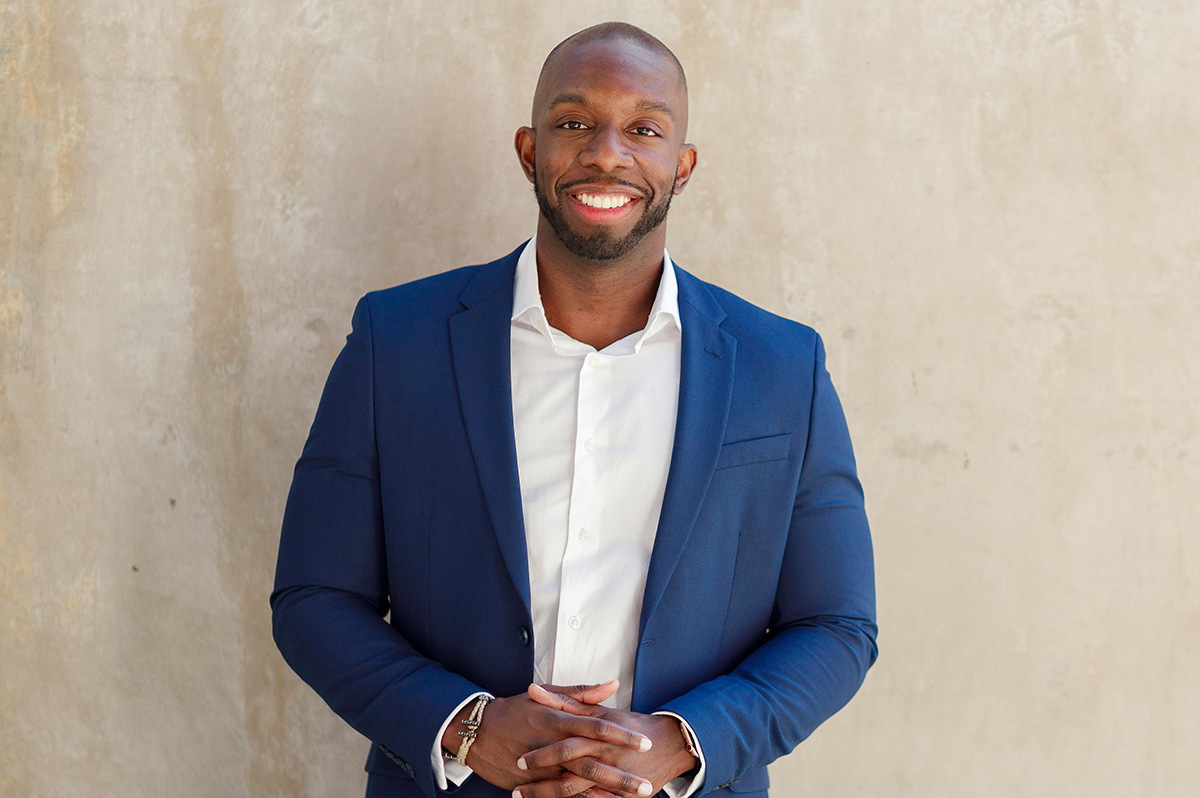
Georgia made history last week when Everton Blair, Jr., was sworn into the U.S. House of Representatives, becoming the state’s first openly LGBTQ member of Congress and the latest LGBTQ addition to the chamber.
Blair, who represents Georgia’s 13th Congressional District, was sworn in on Sept. 1 after winning a special election to fill the vacancy left by the late-Congressman David Scott. Blair defeated Marcye Scott, the late congressman’s daughter, in the Aug. 25 runoff, winning 53.2 percent of the vote to Scott’s 46.8 percent.
He will serve the remainder of Scott’s term through Jan. 3, 2027. Blair is not running in the November general election for a full term.
Blair brings a progressive platform to Congress.
The 34 year-old supports Medicare for All, a Green New Deal, raising the minimum wage, and universal gun background checks. His campaign platform also included positions on LGBTQ rights, reproductive freedom, workers’ rights, climate, and gun violence.
Since joining the House, Blair has joined the Congressional Black Caucus and Congressional Progressive Caucus. He is also a co-chair of the Congressional Equality Caucus.
Before joining the House, Blair served on the Gwinnett County Board of Education, where he became the first Black member and youngest-ever member elected to the board, as well as its first openly gay member. He was later unanimously selected as chair.
Blair also served as a fellow in President Barack Obama’s White House Initiative on Educational Excellence that focused on improving academic outcomes and expanding opportunities for minority students.
The son of Jamaican immigrants, Blair was born and raised in Georgia’s 13th Congressional District. He earned a bachelor’s degree in applied mathematics from Harvard University, a master’s degree in policy, organization, and leadership from Stanford University, and a Doctor of Education Leadership degree from Harvard.
Blair’s campaign received endorsements from a number of organizations, including the LGBTQ+ Victory Fund and progressive Democratic groups such as Future Democrats.
The Equality PAC, a political action committee dedicated to electing openly LGBTQ candidates to office, celebrated Blair’s victory and provided a statement to the Washington Blade about the historic nature of his election.
“This is a historic election for Georgia, the South, and our entire country,” Equality PAC said in an email. “Everton Blair brings a strong record of public service and a deep commitment to making government work for working families.”
The group said Blair would “fight to lower costs, expand access to quality health care, create economic opportunity, and ensure every community has a voice in Washington.”
“At the same time, Everton understands the importance of standing up for equality and defending the rights and freedoms of LGBTQ Americans and every community facing discrimination,” Equality PAC said. “His historic election as Georgia’s first openly LGBTQ Member of Congress and the first openly LGBTQ man elected from the South is a powerful reminder of how far our country has come — and how much work remains.”
Equality PAC said it was “proud to welcome Everton to the House” and looked forward to working with him.
U.S. Military/Pentagon
Pentagon expands testosterone screening as trans troops face hormone therapy restrictions
Defense Department says updated guidelines to be issued shortly

The Pentagon has announced that new clinical guidance will be released establishing mandatory testosterone deficiency screening for active-duty and reserve cisgender male service members ages 30 and older, advancing a policy that expands hormone-related care for cisgender troops.
The Defense Department said the existing clinical guidelines, which are not currently available on the Defense Health Agency’s website, are being updated and that the final guidance will be issued shortly.
The announcement comes amid a wave of anti-transgender policies from both the DoD and the Trump-Vance administration, which continue to prohibit trans men from receiving the same treatment.
Under the forthcoming guidance, men ages 30 and older will be forced to undergo testosterone blood tests as part of their medical care. Younger male service members will be tested if they request screening or if clinicians identify warning signs of low testosterone.
The new guidelines formalize a screening program Defense Secretary Pete Hegseth announced in July, when he said the Pentagon would begin testing service members to ensure that “you have the right testosterone levels to operate at your absolute best.”
“Taking care of your long-term health means ensuring you remain strong, resilient, and capable — not just for your next deployment, but for the rest of your life, so you can thrive long after you take off the uniform,” Hegseth said at the time.
The Defense Health Agency’s clinical guidance says the program is intended to address “hormonal and energy-availability issues.” Hegseth said in July that testosterone replacement therapy would remain voluntary for service members if treatment is recommended.
The Food and Drug Administration is also scheduled to hold a meeting later this month with experts to discuss the medical use of testosterone.
The Pentagon’s push to routinely test testosterone levels runs counter to current medical guidance, which generally recommends considering testosterone therapy only for men who have symptoms consistent with low testosterone and have documented low hormone levels on two separate blood tests.
Testosterone is a sex hormone naturally produced by people of all sexes. It plays a role in regulating muscle mass, bone density, and sex drive. Testosterone levels in men naturally decline with age and have been associated with symptoms including erectile dysfunction, low libido, mood changes and weight gain, although experts continue to debate when testosterone therapy is medically appropriate.
The policy has drawn scrutiny from LGBTQ advocates because the Pentagon and Hegseth have simultaneously cited hormone therapy as part of the rationale for removing trans service members from the military.
Under President Donald Trump’s 2025 executive order, “Prioritizing Military Excellence and Readiness,” the military has moved to bar trans people diagnosed with gender dysphoria from serving and has begun formal administrative separation proceedings against trans personnel.
The Pentagon continues to pursue implementation of the trans military ban as litigation over the policy proceeds. As a result, some trans service members have had their gender-affirming hormone therapy halted even as the Pentagon expands testosterone screening and potential treatment for cisgender service members.
SPARTA Pride, a nonpartisan nonprofit organization made up of trans service members, veterans and their allies, criticized the disparity to the Washington Blade when Hegseth first announced the screening program.
“If hormone therapy helps warfighters perform at their best, then it cannot simultaneously be used as evidence that transgender service members are unfit to serve,” said Kara Corcoran, executive director of SPARTA Pride. “The same class of evidence-based medical treatment cannot be characterized as readiness-enhancing for one group and readiness-destroying for another.”
On June 1, the U.S. Court of Appeals for the D.C. Circuit ruled that trans service members already serving in the military could continue to do so while allowing the armed services to continue refusing to enlist new trans recruits.
The Blade reached out to the Pentagon when the testosterone screening program was first announced in July, asking why cisgender service members could receive testosterone therapy while transgender service members could not. The Pentagon did not respond.

Grindr settles UK lawsuit over claims it shared users’ personal information

Md. groups receive state grants to fight hate crimes

Chris Pappas wins NH Democratic Senate primary

Anti-science, anti-LGBTQ movements go hand in hand

Everton Blair makes history as first openly gay congressman from Ga.

Pentagon expands testosterone screening as trans troops face hormone therapy restrictions

Calendar: September 4-10

‘Here the Whole Time’ delivers queer coming-of-age comedy

Blade Foundation to host fundraiser in Rehoboth on Sept. 12

New book examines fashionista Audrey Smaltz’s fabulous life
-

 U.S. Military/Pentagon5 days ago
Pentagon expands testosterone screening as trans troops face hormone therapy restrictions
-
Calendar5 days ago
Calendar: September 4-10
-
Movies3 days ago
‘Here the Whole Time’ delivers queer coming-of-age comedy
-
Out & About2 days ago
Blade Foundation to host fundraiser in Rehoboth on Sept. 12