Arts & Entertainment
2 memoirs show power of parenthood
Expanding our sense of what an LGBT family looks like

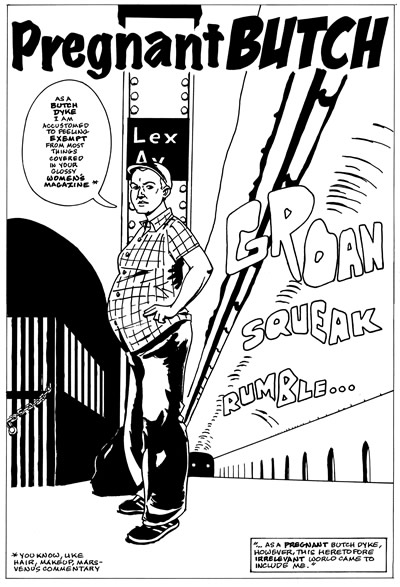
(Image courtesy of Soft Skull Press)
Two new, very different memoirs continue to expand our sense of what an LGBT family looks like. One is the story of a lesbian mom struggling against her son’s anti-gay Catholic school while grappling with her relationship to the church and to her own mother. The other is about a butch lesbian and her experience being pregnant—the print version of a graphic novel first serialized online.
Michelle Theall’s “Teaching the Cat to Sit” (Gallery Books) is a beautifully crafted tale about the power—and pitfalls—of faith, family and love. Theall, the editor-in-chief of Alaska Magazine and an award-winning adventure and fitness writer, weaves the story of attempting to raise her son Catholic with the story of her own childhood and coming out. She deftly intertwines anecdotes that take us back to her childhood in Bible Belt Texas and forward to her life as a parent in Colorado, moving us through her Catholic upbringing, sexual abuse by a neighbor, coming out during college in the 1980s, meeting her now-partner Jill, and adopting their son.
The narrative begins in Colorado in 2009, when she and Jill are first sensing a reluctance from their priest to baptize their son. The boy also attends the Catholic school run by the same church, and the family has been welcomed by the school community. The priest, however, eventually warns them that he is reconsidering whether they can stay, since being gay goes against Catholic teaching.
Despite the insult, Theall hesitates to withdraw their son, knowing that it would hurt her strongly Catholic mother, who also suffers from depression. Theall has struggled her whole life for her mother’s acceptance, and their relationship nearly ended when Theall came out to her.
Through her story, she shows us the harm—to individuals as well as entire families—of a view of the world in which lesbian and gay people exist only as sinners and deviants. While she pulls no punches about the church’s hypocrisy and failings, her book is far from a condemnation of religion.
A. K. Summers’ “Pregnant Butch: Nine Long Months Spent in Drag” (Soft Skull Press) has an entirely different style and tone—irreverent and often caustic, with bold images that both capture the details of everyday life and exaggerate its incongruities. This is not a children’s comic. The tale, first serialized starting in 2011 at the Web comic collective site Act-i-vate, is semi-autobiographical, with the protagonist Teek standing in for Summers.
Summers grew up in California and Georgia, went to college in Ohio and Illinois, and now lives in Rhode Island. Trained as a printmaker, she is the creator of the comic zine Negativa: Chicago’s Astute Lezbo Fantasy Mag, as well as several short animated films.
She was adopted herself, which gave her “an emotional longing to experience a biological relationship to somebody,” she told me in an interview in 2011. Getting pregnant—often seen as the ultimate womanly act—took on different overtones when she did so as a butch woman, however. “Pregnant Butch,” she said, “is about my attempts to hold on to my butch self and also to allow myself to be transformed by the process [of pregnancy], and where that could occur and be positive.”
Summers explores what it means to be butch, the lack of positive role models, and how she and her partner negotiated their relationship and roles as they headed toward parenthood. She charts her changing interactions with friends and neighbors as they encountered the dissonance of her masculine gender expression and her pregnant belly.
Summers writes in her introduction that she thinks there has been a shift in the 10 years since she was pregnant. Young queers are now less likely to use the term “butch.” Nevertheless, Summers felt it was important to capture her experience, both to ”make the unseen visible” and to document a point in time before the enormous positive shift in public attitudes toward gay people in the last few years.
Dana Rudolph is the founder and publisher of Mombian, an award-winning blog and resource directory for LGBT parents.




Out & About
LGBTQ Military Happy Hour set for Sept. 15
In-person gathering to be held at Tom’s Watch Bar

Modern Military Association of America will host “Pride in Service: An LGBTQ+ Military Happy Hour” on Tuesday, Sept. 15 at 4 p.m. at Tom’s Watch Bar.
This in-person gathering is the perfect chance to connect, share stories, and celebrate the diversity within the military community. Come relax, meet fellow LGBTQ+ service members and allies, and enjoy a fun, supportive atmosphere. Don’t miss out on an evening full of pride, camaraderie, and good vibes. Visit Eventbrite for more details.

Friday, September 11
Go Gay DC will host “Out in DC LGBTQ+ Community Social” at 7 p.m. at Hotel Zena.This is a chance to relax, make new friends, and enjoy happy hour specials at this classic retro venue. Attendance is free and more details are available on Eventbrite.
Women in their Twenties and Thirties will meet at 8 p.m. on Zoom. This is a social discussion group for queer women in the Washington, D.C. area. For more details, visit Facebook.
Saturday, September 12
Go Gay DC will host “LGBTQ+ Community Brunch” at 11 a.m. at Freddie’s Beach Bar & Restaurant. This fun weekly event brings the DMV area LGBTQ+ community, including allies, together for delicious food and conversation. Attendance is free and more details are available on Eventbrite.
The DC LGBTQ+ Community Center will host screenings of “Princess Sparkles” and “Kiloran Bay” at 1:30 p.m. “Kiloran Bay” is a 13-minute musical short set amid the wild beauty of the Scottish Hebrides and the fierce joy of a wedding cèilidh. “Princess Sparkles” is about a girl who accidentally signs up to pet-sit a princess only to discover she’s actually a nippy, Fox News-watching pig. More details are available on the DC LGBTQ+ Community Center’s website.
Sunday, September 13
“Nellie’s DC Drag Brunch” will be at 12 p.m. at Nellie’s Sports Bar. Come get served like a queen by a queen. Join Sapphire Blue, Deja Diamond and their team of amazing drag performers for the most fun you’ll have all weekend. Tickets are $58.51 and are available on Eventbrite.
Monday, September 14
“Center Aging: Monday Coffee Klatch” will be at 10:00a.m. on Zoom. This is a social hour for older LGBTQ+ adults. Guests are encouraged to bring a beverage of choice. For more information, contact Adam ([email protected]).
Tuesday, September 15
Center Bi Pan+ Roundtable will be at 7 p.m. on Zoom. This is an opportunity for people to gather in order to discuss issues related to bisexuality or as Bi individuals in a private setting. Visit Facebook or Meetup for more information.
Wednesday, September 16
Job Club will be at 6 p.m. on Zoom upon request. This is a weekly job support program to help job entrants and seekers, including the long-term unemployed, improve self-confidence, motivation, resilience and productivity for effective job searches and networking — allowing participants to move away from being merely “applicants” toward being “candidates.” For more information, email [email protected] or visit thedccenter.org/careers.
The DC LGBTQ+ Community Center will host “Movement for Healing” at 3 p.m. This trauma- and yoga therapy–informed class is designed to help guests gently reconnect with their body and their breath. Through mindful movement, somatic awareness, and grounding practices, guests will explore how to release tension, increase mobility, and cultivate a deeper sense of safety and ease within. For more details, visit the DC Center’s website.
Thursday, September 17
The DC Center’s Fresh Produce Program will be held all day at the DC LGBTQ+ Community Center. People will be informed on Wednesday at 5:00 pm if they are picked to receive a produce box. No proof of residency or income is required. For more information, email [email protected] or call 202-682-2245.
Virtual Yoga Class will be at 7 p.m. on Zoom. This free weekly class is a combination of yoga, breathwork and meditation that allows LGBTQ+ community members to continue their healing journey with somatic and mindfulness practices. For more details, visit the DC LGBTQ+ Community Center’s website.
Books
Historiography with heart
Pioneering author John D’Emilio continues to enlighten us in new book ‘Making Gay History’
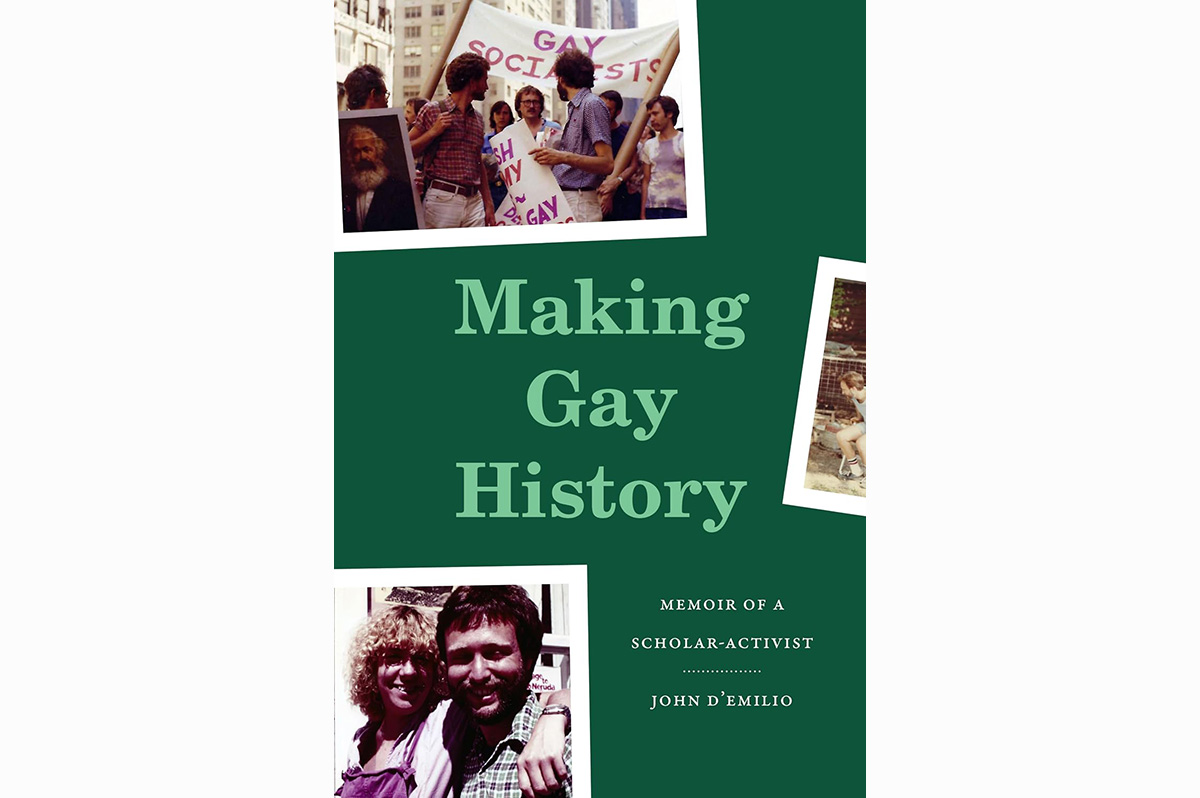
‘Making Gay History, Memoir of a Scholar-Activist’
By John D’Emilio
Dukeupress.edu/making-gay-history
“Dear Dr. Kameny,” wrote the earnest graduate history student almost 50 years ago. “As you know, the academic community only rarely deemed the lives of gay men and women to be worthy of serious scholarly study. To my knowledge, no American history faculty at a major university has yet sponsored a dissertation that deals with gays historically.”
That student was a young man from the Bronx who would change all that. His name is John D’Emilio.
“I must be able to uncover ‘manuscript’ sources, that is unpublished and unique historical materials,” he explained to D.C. gay civil rights pioneer Dr. Franklin E. Kameny who lived in a house stacked to the ceiling with “unique historical materials.” In reality, these were piles of correspondence with government officials and politicians, legal filings, mimeograph copies, gay newspapers, press releases, Mattachine Society brochures and picket signs. Frank Kameny, a self-described “pack rat,” invited D’Emilio into his private world of papers and memorabilia to begin uncovering an erased and forgotten pre-Stonewall history. This was one of many such research forays into “basements, garages and overcrowded living rooms” across America conducted by John D’Emilio. He was a young man on fire to complete a Ph.D. dissertation at the frontier of a distant galaxy — writing a scholarly gay and lesbian history backed by original research where there had been none, only a void.
Reading D’Emilio’s memoir “Making Gay History” (2026, Duke University Press) one has the sense of watching an emerging galaxy spinning around a galactic core of New York scholars and their mentors, young activists, and community historians throbbing with the New York City energy celebrated by Walt Whitman a century before in his epic poem “Mannahatta”. Spinning out of the ‘60s anti-Vietnam War activism; Marxist historical analysis, the Stonewall riots and gay liberation, we can see it coalescing around this one history student’s search for a dissertation topic and himself piecing together a new history that “no one had yet written about … a pioneering work in this newly emerging field.” D’Emilio pitches his idea for a dissertation that “spanned the length of U.S. history, moving from the religious teachings that shaped law and social attitudes … to how the federal government dealt with the increasing visibility of a homosexual world in the twentieth century.” With the blessings of Columbia’s Department of History, he completed his dissertation leading to the publication of his groundbreaking history: “Sexual Politics, Sexual Communities: The Making of a Homosexual Minority in the United States” (1983). When he received his first copy of the bound book in the mail, he “cradled the book in my arm holding it close to my chest….It was as if I had fathered a child.”
More so, D’Emilio fathered a new history. Historiography is the story of how history gets written, conducting original research, uncovering the data and creating the narrative(s) — often a snoozing read of academic process. But not this historiography. “Making Gay History” is a historiography with heart.
“Nothing was going to stop me from giving everything I had to this effort at making change in society and myself,” he declares while connecting with others who share his “boundless excitement for the collection of documents.” There were many others in this spiral with D’Emilio who are mentioned and play important roles. In the spiral were Jonathan Ned Katz (“Gay American History”, 1976); Allan Berube (“Coming Our Under Fire” 1990), Martin Duberman (“Hidden from History”, 1989); Daughters of Bilitis activists Del Martin and Barbara Gittings; Civil War historian Eric Foner and author/activist Larry Kramer. No libertarians among them. Well, maybe the divine Bette Midler who was well known for performing uptown at the Continental Baths who makes an appearance at a Washington Square rally.
He craved his parents’ approval. Among the most riveting scenes in the memoir are a series of family dinners in the Bronx with his old-school parents who go into near shock when he tells them he is gay. How to evade this any longer, especially now that his dissertation is going to be on homosexuality? It is a moving and hilarious sequence. After he says it out loud, “I am gay”: “No. No. No!” his father gasps. “This can’t be true. It can’t be.” D’Emilio thinks, “Oh my God, he’s going to die. I’ve killed my father.”
The D’Emilios — Vincent and Sophie — so resemble the wonderful Castorinis in “Moonstruck,” I am thinking “Oh my God, this is Cher coming out to her parents Cosmo and Rose.” The young graduate student survives the family dramatics even more certain that this was not just his success but “a gay liberation success.” From the family dinner table to the streets, he writes how he marched in the 1973 Pride parade beneath a banner held high: “Gay Socialists.” This man is a born scholar-activist.
D’Emilio does not seem able to pull back. There are passages that veer into autobiographical minutia, detail about the grind to earn a living from the University of North Carolina Greensboro to the University of Illinois Chicago. He writes, ”I would be living on less than half my usual salary for the year, but with the small amount of royalties that I got for my three books, plus some occasional speaking gigs and dipping into savings…”. Much of this is gray matter compared to the galaxy John D’Emilio helped energize that even now brightens our sky.
Charles Francis is president of The Mattachine Society of Washington, D.C. and author of “Archive Activism: Memoir of a ‘Uniquely Nasty’ Journey” (University of North Texas, 2023)

Comings & Goings

LGBTQ Military Happy Hour set for Sept. 15

Calendar: September 11-17

Multi-billion-dollar 9/11 Victim Compensation Fund to continue until 2090

Ind. prosecutor declines to press charges over false Buttigieg child welfare complaint

Blade Foundation to host fundraiser in Rehoboth on Sept. 12

New book examines fashionista Audrey Smaltz’s fabulous life

Actress takes on bisexual ‘Ma’ Rainey in new Round House production

Iceland implements gender-neutral blood donor rules

Anti-science, anti-LGBTQ movements go hand in hand
-

 Out & About5 days ago
Blade Foundation to host fundraiser in Rehoboth on Sept. 12
-
Books5 days ago
New book examines fashionista Audrey Smaltz’s fabulous life
-
Theater5 days ago
Actress takes on bisexual ‘Ma’ Rainey in new Round House production
-
Iceland4 days ago
Iceland implements gender-neutral blood donor rules