Congress
Bill would sanction perpetrators of anti-LGBTQ human rights abuses
U.S. Sens. Jeanne Shaheen and Lisa Murkowski introduced Global Respect Act

Two U.S. senators on Thursday introduced a bill that would sanction those who commit abuses against LGBTQ and intersex people abroad.
U.S. Sens. Jeanne Shaheen (D-N.H.) and Lisa Murkowski (R-Alaska) introduced the Global Respect Act. U.S. Reps. Brian Fitzpatrick (R-Pa.) and Sara Jacobs (D-Calif.) have sponsored an identical bill in the U.S. House of Representatives.
A press release from Shaheen’s office notes the Global Respect Act would do the following:
• Require the Executive Branch to biannually send Congress a list of foreign persons responsible for, or complicit in cruel, inhumane or degrading treatment or punishment of an individual; prolonged detention of an individual without charges or trials; causing the disappearance of an individual by abduction and clandestine detention of an individual; other flagrant denials of the right to life, liberty or the security of an individual;
• Authorize the administration to deny or revoke visas to individuals placed on the list;
• Require the annual State Department Report on Human Rights to include a section on LGBTI international human rights, as well as an annual report to Congress on the status of the law’s effectiveness; and
• Require the Assistant Secretary of State for Democracy, Human Rights and Labor to designate a senior officer responsible for tracking violence, criminalization and restrictions on the enjoyment of fundamental freedoms in foreign countries based on sexual orientation or gender identity.
“It’s unconscionable that LGBTQI communities around the world face persecution, jail and murder because of who they love and how they identify. These communities should be free to express who they are, love who they love and enjoy all the same basic human rights as anyone else. The U.S. has a moral imperative to make clear to the international community that LGBTI rights are human rights, and that we will work to protect these communities regardless of where they are in the world,” said Shaheen. “That’s why I’m leading this bipartisan effort to empower the administration with enhanced authority to bring human rights violators to justice while expanding protections for LGBTQI individuals around the world.”
Murkowski further noted “members of the LGBTQI community” in countries around the world “are subject to discrimination and harm every day.”
“We should not tolerate violence against any group of people,” said the Alaska Republican. “By creating and strengthening consequences for those who carry out human rights violations, my hope is that we prevent it from happening in the first place.”
President Joe Biden in 2021 signed a memorandum that committed the U.S. to promoting LGBTQ and intersex rights abroad as part of the Biden-Harris administration’s overall foreign policy.
U.S. Rep. Dina Titus (D-Nev.) and U.S. Sen. Edward Markey (D-Mass.) last week introduced a bill that would codify this directive into law. The Human Rights Campaign and the Council for Global Equality are among the groups that have endorsed the bill and the Global Respect Act.






Congress
HRC president campaigns for Chris Pappas in NH
Gay congressman running to succeed retiring U.S. Sen. Jeanne Shaheen

Human Rights Campaign President Kelley Robinson on Sunday campaigned for U.S. Rep. Chris Pappas (D-N.H.) in New Hampshire.
Robinson traveled to Manchester, the state’s largest city, nine days before the Sept. 8 primary that will determine who will vie for retiring U.S. Sen. Jeanne Shaheen (D-N.H.)’s seat.
We’re hitting the pavement across New Hampshire to fight for a freer, fairer future for everyone.
Glad to have Human Rights Campaign President @KelleyJRobinson join us for a canvass launch in Manchester today. pic.twitter.com/XWCEaQxy4o
— Chris Pappas (@ChrisPappasNH) August 30, 2026
Former U.S. Sen. John E. Sununu, who represented New Hampshire in the U.S. Senate from 2003-2009, will face off against former U.S. Sen. Scott Brown, who represented Massachusetts in the U.S. Senate from 2010-2013, in the Republican primary.
Karishma Manzur is among the Democrats challenging Pappas.
A poll the University of New Hampshire Survey Center released on Aug. 26 shows Sununu is ahead of Brown. The same survey shows Pappas ahead of Manzur and his other Democratic challengers.
The UNH Survey Center poll shows Sununu ahead of Pappas by a 45-43 percent margin if they were to face off in the general election. The margin of error is +/-2.1 percent.
Pappas would become the first openly gay man elected to the U.S. Senate if he were to win in November.
Congress
Chris Van Hollen says the Democratic Party needs change. Is he the one to lead it?
Senator is backing anti-establishment Democrats across the country
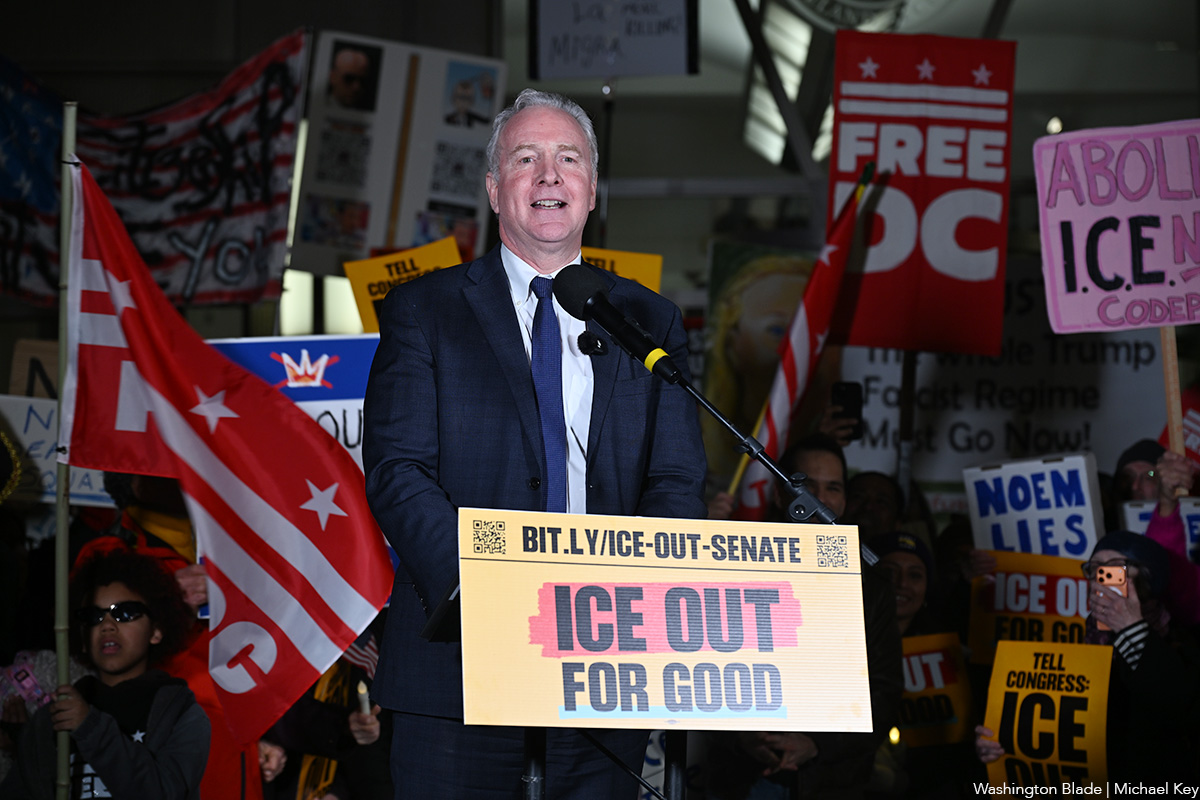
By LEE O. SANDERLIN | The Democratic Party is having something of an identity crisis — losing to President Donald Trump twice in three elections will do that.
Should the party embrace anti-establishment figures who espouse progressive policy ideas like Medicare for all and rhetoric about unrigging the economy for the 1 percent? Or should Democrats try to appeal to moderates who want to return to semi-normalcy in a time of political upheaval?
Although he’s been in Congress since 2002, with key leadership roles throughout his tenure, Maryland Sen. Chris Van Hollen, 67, counts himself firmly in the anti-establishment camp.
The rest of this article can be found on the Baltimore Banner’s website.
Congress
House blocks effort to codify transgender servicemember ban into law
Lawmakers approved two anti-trans NDAA amendments

The U.S. House of Representatives on Tuesday rejected an amendment to the National Defense Authorization Act that would have codified a ban transgender servicemembers in the military.
The bipartisan vote was 212-217.
The NDAA is for the 2027 fiscal year and sets policies for the Defense Department programs and activities and the national security programs of the Department of Energy.
U.S. Rep. Lauren Boebert (R-Colo.) proposed the amendment on July 21. It stated that all personnel are required to serve in accordance with their biological sex, citing military readiness and discipline.
Human Rights Campaign Senior Director of Government Affairs Jennifer Pike Bailey stated that she is grateful for the bipartisan vote that rejected President Donald Trump and Defense Secretary Pete Hegseth’s “dangerous and discriminatory policy that has kicked brave transgender servicemembers out of the military and weakened our national security.”
“Everyone who meets the same rigorous standards should be able to serve their country. We should honor that patriotism, particularly in this moment where we are witnessing brave servicemembers making the ultimate sacrifice for our country, instead of ending their careers and politicizing their existence. We’re grateful that a permanent extension of this ban failed, and we will keep fighting to reverse this senseless policy,” Bailey said.
Mark Takano, chair of the Congressional Equality Caucus, stated that he and his members put in countless hours of work to kill the amendment.
“When Americans know they or their families are going to be targeted by or not supported by the military, that leads them to avoid signing up to serve or staying in the service — making it harder to keep the ranks of the armed services full and our nation safe. My colleagues in the Equality Caucus and I will continue working to prevent these attacks on our servicemembers and their families from becoming law,” Takano said.
According to the Congressional Equality Caucus, two other bills could potentially be passed that would also target the transgender community, both of which were proposed by U.S. Rep. Nancy Mace (R-S.C.).
The first was a bill that would have prohibited gender-related medical care under TRICARE and to prevent TRICARE from covering certain gender-related medical procedures and treatments, which was approved in a vote of 219-208.
The second was a bill that would have prohibited male participation in female sports at DoDEA schools. DoDEA schools are Department of Defense Dependents Schools, which is a network of primary and secondary schools.
The amendment was approved in a vote of 221-203.

Indonesia’s top Muslim clerical body proposes criminalizing LGBTQ people, advocacy

Hands Off the Arts to form ‘human chain’ around Kennedy Center

LGBTQ issues, attacks on Democrats dominate unusual RNC midterm convention

Acclaimed Chef Patrick O’Connell’s memoir reveals the arc of a life well lived

New Hungarian government to scrap anti-LGBTQ adoption law

Ind. prosecutor declines to press charges over false Buttigieg child welfare complaint

Multi-billion-dollar 9/11 Victim Compensation Fund to continue until 2090

LGBTQ Military Happy Hour set for Sept. 15

Calendar: September 11-17

Comings & Goings
-

 Politics5 days ago
Ind. prosecutor declines to press charges over false Buttigieg child welfare complaint
-
National4 days ago
Multi-billion-dollar 9/11 Victim Compensation Fund to continue until 2090
-
Out & About4 days ago
LGBTQ Military Happy Hour set for Sept. 15
-
Calendar4 days ago
Calendar: September 11-17