European Union
Meet Poland’s out gay lawmaker fighting for LGBTQ rights
‘We are the most homophobic country’ in Europe
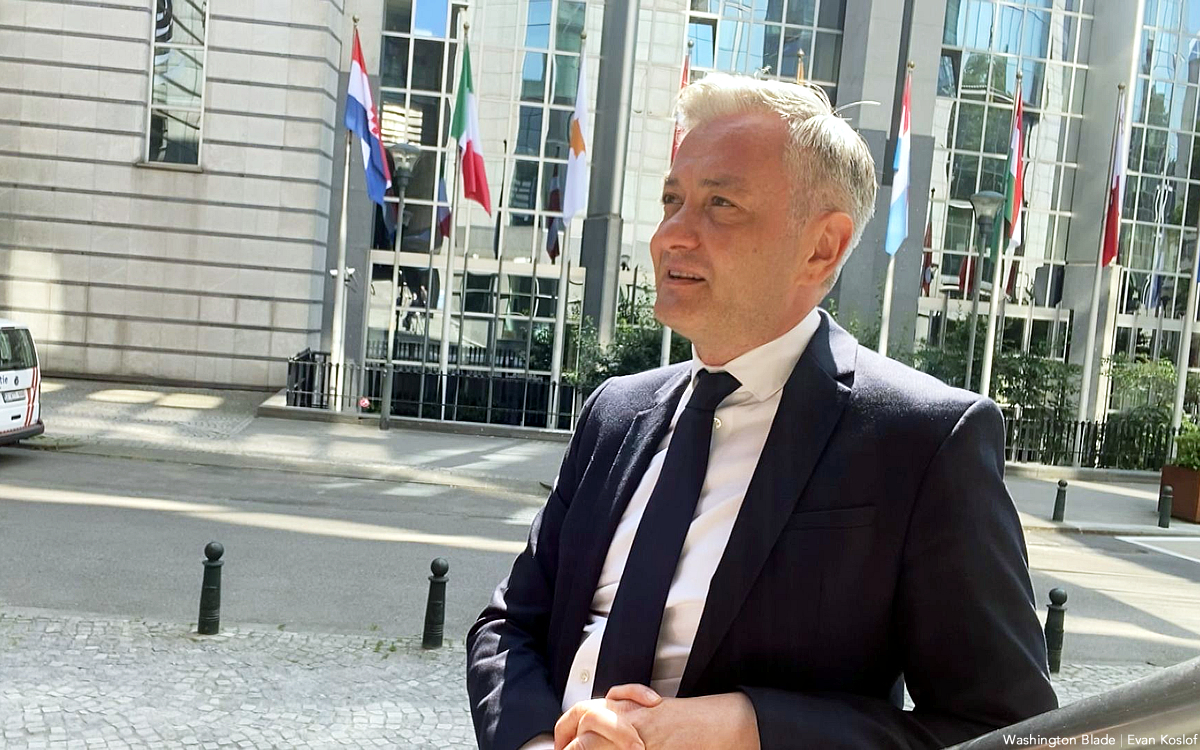
BRUSSELS — Speaking with the Washington Blade outside of the European Parliament building here, Polish lawmaker Robert Biedroń was quick to smile and exuded an unassuming confidence. The openly gay leader has become a well-known figure in the LGBTQ movement in Poland, even as the ruling party has gained international headlines for its anti-LGBTQ stances.
Biedroń grew up in the small southeast city of Krosno, about 80 miles from the Ukrainian border, where he said he struggled to find others who were like him. He said he did not know of a single gay person in his village.
“I was growing up in an area where there was a lot of forest,” he said. “And I had the chance to meet wolves, birds, and foxes. But never any gays.”
Eventually though, Biedroń found books about the LGBTQ experience, and learned of others who were living freely and openly. This opened his eyes and set the course for his career and life.
“The day I found out that there are people who are like me — who can live with dignity,” he said. “This was the day that I knew I’m unstoppable. And nothing will stop me from this fight.”
His home country stands out among European Union countries when it comes to LGBTQ policies. A May ranking by ILGA-Europe, placed Poland at the bottom of the EU, and 42nd of the 49 countries in Europe.
Same-sex couples cannot legally marry in Poland and Article 18 of the Polish Constitution defines marriage as “a union of a man and a woman.” During the 2020 presidential election, leaders of the ruling Law and Justice (PiS) Party made headlines, calling LGBTQ identity an imported “ideology.” During this timeframe, various local and regional governments in Poland established primarily symbolic “LGBT Ideology-Free Zones,” which were condemned by the EU.
“We are the most homophobic country on the map of Europe in the EU,” said Biedroń.
Poland is one of the most conservative countries in the European Union and is heavily Catholic. According to the U.S. State Department, roughly 85 percent of the country identifies as Roman Catholic.
Public opinion has lagged behind Western Europe when it comes to support of the LGBTQ community. Forty-seven percent said “homosexuality should not be accepted by society,” when the Pew Research Center conducted a poll, in between 2015 and 2016.
Despite all this, Biedroń, decided to enter activism, co-founding the Campaign Against Homophobia in 2001.
“Because I have only one life,” he said. “There is no other chance. If I wanted to live in dignity — if I wanted to live my full life — I had to do it. Because nobody else would do it. Besides I knew I’m the ‘only gay in the village.’ The wolves and birds will not fight for my life.”
After years of activism, Biedroń decided to enter politics. In 2011, he became the first openly gay member in the Sejm, the lower House of the Polish Parliament. In 2014, he became the first openly gay mayor in the country, taking the top leadership role in the northwest city of Słupsk.
Then in 2019, he founded a new political party called Spring “Wiosna,” which won more than six percent in the European elections. This election sent Biedroń into the European Parliament, as the first openly gay member from Poland.
“The thing I want to achieve,” he said. “Is that at the end of my life, I will say I’ve done everything to be happy. And if this could help other people it will multiply by millions my happiness.”
Poles are set to cast their votes in parliamentary elections this fall. A coalition led by the PiS currently has the majority in the Sejm. Aaron Korewa, the director of the Warsaw office at The Atlantic Council, said that the Sejm is the dominant chamber in Poland.
“It’s whoever wins the majority in the lower house, in the Sejm, that forms a government with a prime minister,” he said.
Biedroń’s domestic political party is called “The Left,” or “Lewica,” although Korewa said that this is not currently a major party. He said the two dominant parties are the PiS, which formed under an alliance called the “United Right,” and the (CO) “Civic Platform” Party.
Korewa said that these parties are dominated by two strong central figures, Jaroslaw Kaczyński from the PiS and Donald Tusk, from the CO.
“It’s basically Donald Tusk and Jaroslaw Kaczyński having at it again for the future of the country,” he said.
Poland does not have a presidential election until 2025. In 2020, Biedroń ran for president, garnering just over 2 percent of the vote. Biedroń remained coy when asked about his intentions to run for president again in the future.
“Of course it’s good to be a president,” he said. “It’s good to be a member of the parliament. But at the end of the day, the best is to be happy. And that’s what I’m fighting for.”
Biedroń’s fight in Brussels and Warsaw might seem far away from those in the United States, but the lawmaker argued that LGBTQ advocates should not become complacent.
“Democracy, human rights, rule of law,” he said, “they’re like beautiful flowers. You need to water them every day. Otherwise, they fade away. And this is the Polish reality of today.”





European Union
Poland’s top court rejects recognition of same-sex marriages from other EU countries
Ruling sets up potential clash with bloc

Poland’s top court this week rejected the recognition of same-sex marriages legally performed in other EU countries.
The EU Court of Justice in Luxembourg last November ruled in favor of a same-sex couple who challenged Poland’s refusal to recognize their German marriage. Poland’s Supreme Administrative Court in March reaffirmed the decision.
The couple, who lives in Poland, brought their case to Polish courts in 2019. The Supreme Administrative Court referred it to the EU Court of Justice.
The Polish government in May announced it will recognize same-sex marriages legally performed in other EU countries. Polish President Karol Nawrocki on July 17 vetoed bills that would have extended rights to same-sex couples.
The Constitutional Tribunal ruling, which it issued on July 28, was unanimous and final. It also sets up a potential clash between it and the EU Court of Justice.
European Union
European Commission says all EU countries should ban conversion therapy
Recommendation ‘an important step forward for LGBTI rights across Europe’
The European Commission on Wednesday said all European Union countries should ban so-called conversion therapy.
The recommendation comes weeks after the European Parliament voted in favor of prohibiting the widely discredited practice across the EU. More than 1.2 million people signed a campaign in support of the ban that ACT (Against Conversion Therapy) LGBT launched in 2024 through the EU’s European Citizens Initiative framework.
“We warmly welcome today’s commitment from the European Commission to a recommendation on ending conversion practices, an important step forward for LGBTI rights across Europe,” said ILGA Europe in a statement.
Seven EU countries — Belgium, Cyprus, France, Malta, Norway, Portugal, and Spain — have banned conversion therapy outright.
Greece in 2022 banned the practice for minors. German lawmakers in 2020 passed a law that prohibits conversion therapy for minors and for adults who have not consented to undergoing the widely discredited practice.
ILGA Europe said the European Commission’s recommendation “highlights how much work remains to be done.”
“Ending conversion practices cannot stop at symbolic commitments or fragmented national approaches,” stressed the advocacy group. “We need coordinated EU action, proper training for professionals, and survivor-centered support systems that recognize the serious harm these practices cause.”
“More than one million people supported the European Citizens’ Initiative calling for change,” added ILGA Europe. “The message is clear: conversion practices are not therapy or belief, they are a form of violence that Europe can and should end.”
European Union
European Parliament backs EU-wide conversion therapy ban
More than 1.2 million people backed campaign
The European Parliament on Wednesday voted in favor of banning so-called conversion therapy across the European Union.
ACT (Against Conversion Therapy) LGBT in 2024 launched a campaign in support of the ban through the EU’s European Citizens Initiative framework. More than 1.2 million people ultimately signed it.
The proposed ban had the support of 405 MEPs. The European Commission is expected to formally respond to it by May 18.
Seven EU countries — Belgium, Cyprus, France, Malta, Norway, Portugal, and Spain — have banned conversion therapy outright.
Greece in 2022 banned the practice for minors. German lawmakers in 2020 passed a law that prohibits conversion therapy for minors and for adults who have not consented to undergoing the widely discredited practice.

United States Conference on HIV/AIDS grapples with federal budget cuts

For lesbian victims of domestic violence, competent care is scare

UN human rights chief sounds alarm over ‘comprehensive onslaught’ against LGBTQ rights

White House press pool pushes back after Trump bars three outlets

PHOTOS: Shenandoah Valley Pride

Republican challenger misgenders McBride during forum, forced to leave

Queer mega stars coming to D.C. this fall

Activists protest outside Turkish Embassy in D.C.

A roundup of fall events not to be missed