World
Out in the World: LGBTQ news from Europe, Australia, and Canada
Italian lawmakers have passed a bill to ban overseas surrogacy
ITALY
The Italian Senate gave final passage to Prime Minister Giorgia Meloni’s bill to ban criminalize the use of surrogacy overseas, in what LGBTQ activists are saying is a direct attack on same-sex parents.
Surrogacy is already illegal in Italy. The new law cracks down on parents who travel out of the country to obtain surrogacy services where it is legal, like the U.S. or Canada. Under the new law, such parents could be subject to fines of up to €1 million (approximately $1.1 million) or imprisonment for up to two years.
While the vast majority of Italians who engage in overseas surrogacy are heterosexual couples, activists fear the law will be used specifically to target male same-sex couples, who cannot simply pretend not to have used a surrogate.
That would fit with a pattern of attacking same-sex parents since Meloni took office in 2022. Last year, her government issued an order directing municipalities to delete non-biological same-sex parents from birth certificates that had already been issued to children. That decision was condemned by the European Parliament and other world leaders.
Protesters demonstrated in front of the Italian Senate during the debate, carrying signs that read “We are families, not crimes.”
Meloni has long argued for banning surrogacy as a women’s rights issue, claiming that surrogacy commodifies women’s bodies.
She called the law “a common-sense rule against the commodification of the female body and children. Human life has no price and is not a commodity,” in a post on X.
“The alleged defense of women, the vaunted interest in children, are just fig leaves behind which the homophobic obsession of this majority is hidden,” says Laura Boldrini, an opposition lawmaker.
In many places where surrogacy is legal, it is only legal for altruistic, rather than commercial reasons. Surrogates can be reimbursed for legitimate expenses but cannot be otherwise compensated. That’s how surrogacy works in Canada and Australia.
POLAND
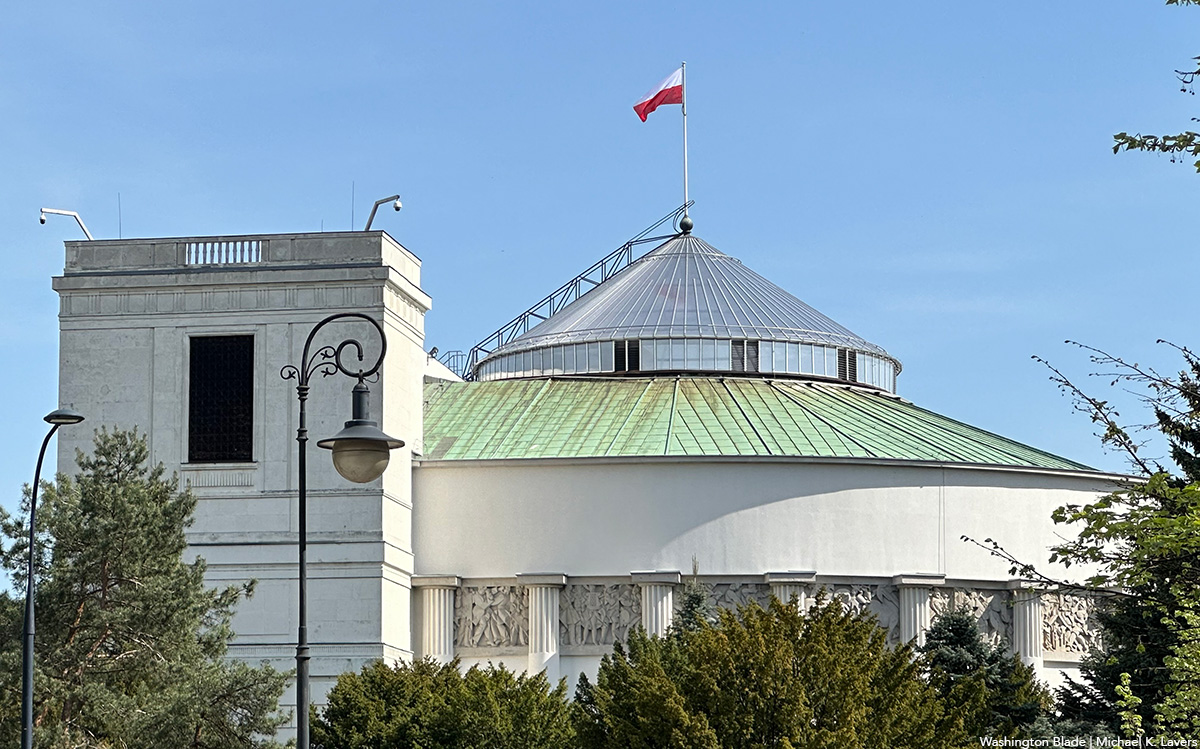
The Polish government introduced its long-awaiting civil union legislation last week, revealing that the government has dropped plans to allow couples in civil unions to adopt children in a compromise meant to get the bills through parliament.
Prime Minister Donald Tusk had pledged to introduce same-sex civil unions within his first 100 days of taking office last year, but that pledge faced numerous roadblocks as the outgoing government initially refused to cede power, and then more conservative parts of his three-party coalition balked at expanding LGBTQ rights.
The bills would allow same-sex and opposite-sex couples to register their partnerships, giving partners rights to inheritance and medical decision-making.
But couples in civil unions would not be allowed to jointly adopt, nor would one partner be allowed to adopt the other’s biological children.
That was a key demand of the junior coalition partner, the Poland Peasants’ Party (PSL). The bills are unlikely to gain any support from the opposition Law and Justice Party or Confederation Party, both of which strongly oppose LGBTQ rights.
The bills may still face opposition from President Andrzej Duda, an ally of Law and Justice who has opposed LGBTQ rights in the past. He has not publicly commented on the bills.
Duda’s term expires next year, and all parties are attempting to position themselves in the election for his replacement, expected in May 2025.
CANADA
Provincial elections in British Columbia remained too close to call a day after polls closed on Oct 19, with the incumbent New Democratic Party leading or elected in 46 seats, while the rival BC Conservatives, who had campaigned on scrapping an anti-bullying program that promoted awareness of LGBTQ people in schools, were leading or elected in 45 seats. The BC Greens were elected in two seats.
Elections BC says it could be a week before results are finalized, due to a number of very close races and the number of mail-in and out-of-district ballots yet to be counted.
If the BC Conservatives lose, it would be the second loss of a provincial election in 2024 for a conservative party that had run on a platform of restricting sex education, discussion of LGBTQ issues, and inclusion of trans kids in schools, after the Manitoba Progressive Conservatives were booted from office in June.
Two more Canadian provinces are heading to the polls in the next week, and in both races, incumbent conservative parties are defending newly introduced policies that require schools to out trans students to their parents and require parental consent if a child wishes to use a different name or pronoun in school.
In New Brunswick, voters head to the polls today, and the incumbent Progressive Conservatives are facing a strong challenge from the New Brunswick Liberals. Liberal leader Susan Holt has promised to scrap the parental-notification policy and put safeguards in place for LGBTQ students if elected.
Saskatchewan Premier Scott Moe has promised to double-down on anti-transgender policies if re-elected Oct 28. This week, he said his first order of business would be passing a policy restricting school change rooms based on sex assigned at birth.
Saskatchewan NDP leader Carla Beck slammed the proposal.
“People see this for what it is,” Beck told a press conference. “It’s the ugliest gutter politics. I think people are tired of it.”
Canadian conservatives have been turning hard against trans people over the past couple of years, reflecting similar culture war divisions in the U.S. and the UK, despite a general consensus on equal rights for trans people that had developed over the previous decade. In fact, Scott Moe was a Cabinet minister in the Saskatchewan Party government that passed that province’s ban on gender identity discrimination.
Meanwhile, in neighboring Alberta, Premier Danielle Smith has proposed a package of legislation that would require parental notification and opt-in for any discussion of sexual orientation or gender identity in classrooms, as well as severely restricting access to gender care for trans youth. The bills are expected to be debated in the upcoming fall session of the legislature.
AUSTRALIA
The New South Wales state legislature passed a bill meant to promote LGBTQ equality on Thursday, but only after it had been watered down in order to gain support from the governing Labor Party.
Independent lawmaker Alex Greenwich had originally proposed a comprehensive bill that would have addressed multiple areas of law that discriminate against queer people.
A key provision would have repealed a loophole in state anti-discrimination law that allows religious schools to discriminate against LGBTQ students and teachers. That provision was dropped.
Greenwich’s original bill also would have established an affirmative right to gender-affirming care and would have decriminalized sex work. Both provisions were also dropped.
Greenwich says his bill faced concerted opposition from religious organizations and he removed the provisions in order to get the bulk of the bill’s reforms passed.
“It’s heartbreaking that I’m in a position where I’m having to remove a reform that I have fought for my entire political career,” Greenwich told ABC News Australia. “There has been a concerted campaign, particularly by some religious organizations, and I’m not wanting to hold up some urgent reforms while we’re still working this through.”
The parts of the bill that have been salvaged are still important reforms for LGBTQ rights.
The bill will update domestic violence laws to apply to same-sex couples and recognize parenting rights for children born through surrogacy overseas. It will also allow trans people to update their legal gender on birth certificates without undergoing surgery — an important reform that is already the norm in the rest of Australia. Nonbinary or non-specified will also be options.
The bill also repeals offenses related to living off the earnings of a sex worker, makes it a criminal offense to threaten to out a person, and adds hate crime protections for trans people.
This year, New South Wales’s Labor government earned plaudits from LGBTQ activists for passing a bill banning conversion therapy, and issuing a historic apology to people persecuted under old anti-LGBTQ laws.
Earlier this year, Australia’s governing Labor Party dropped its promised reform to federal anti-discrimination laws to repeal a loophole allowing anti-LGBTQ discrimination in schools, following backlash from religious groups.





Turkey
Activists protest outside Turkish Embassy in D.C.
Dozens detained during anti-LGBTQ ‘My Family Is Safe’ campaign raids
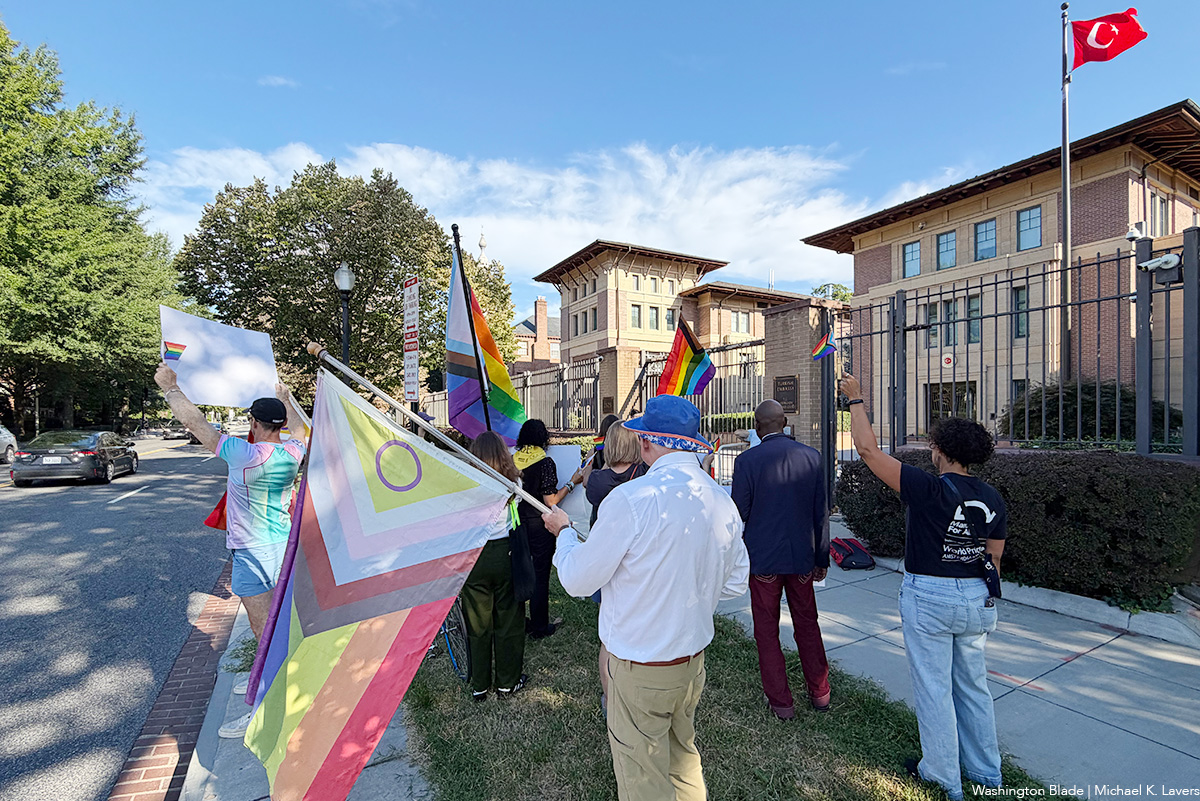
A group of activists on Friday gathered in front of the Turkish Embassy in D.C. to protest the country’s anti-LGBTQ crackdown.
The protest — which the Council for Global Equality, Amnesty International USA, Outright International, and Health GAP organized — took place less than a week after Turkish authorities detained dozens of people during raids that targeted the country’s LGBTQ community and advocacy groups and HIV/AIDS service organizations.
Authorities in Istanbul on Sept. 15 detained more than 150 people who gathered outside a courthouse to protest the raids that are part of the government’s “My Family Is Safe” campaign. Journalists are among those who were taken into custody.
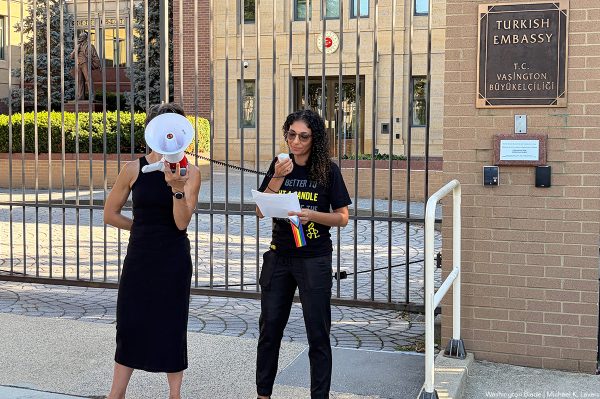
“This crackdown is not making families safer,” said Amnesty International USA Executive Director Nadia Daar, speaking in front of the Turkish Embassy.
Council for Global Equality Managing Director Keifer Buckingham stressed that “homosexuality is not a crime in Turkey.” Health GAP Executive Director Asia Russell and Outright International Senior Director of Law, Policy, and Research Neela Ghoshal also spoke.
View on Threads
Activists in Madrid and in other cities around the world held similar protests on Friday.
Turkey
More than 150 people detained outside Istanbul courthouse
Protesters gathered after raids targeted Turkey’s LGBTQ community
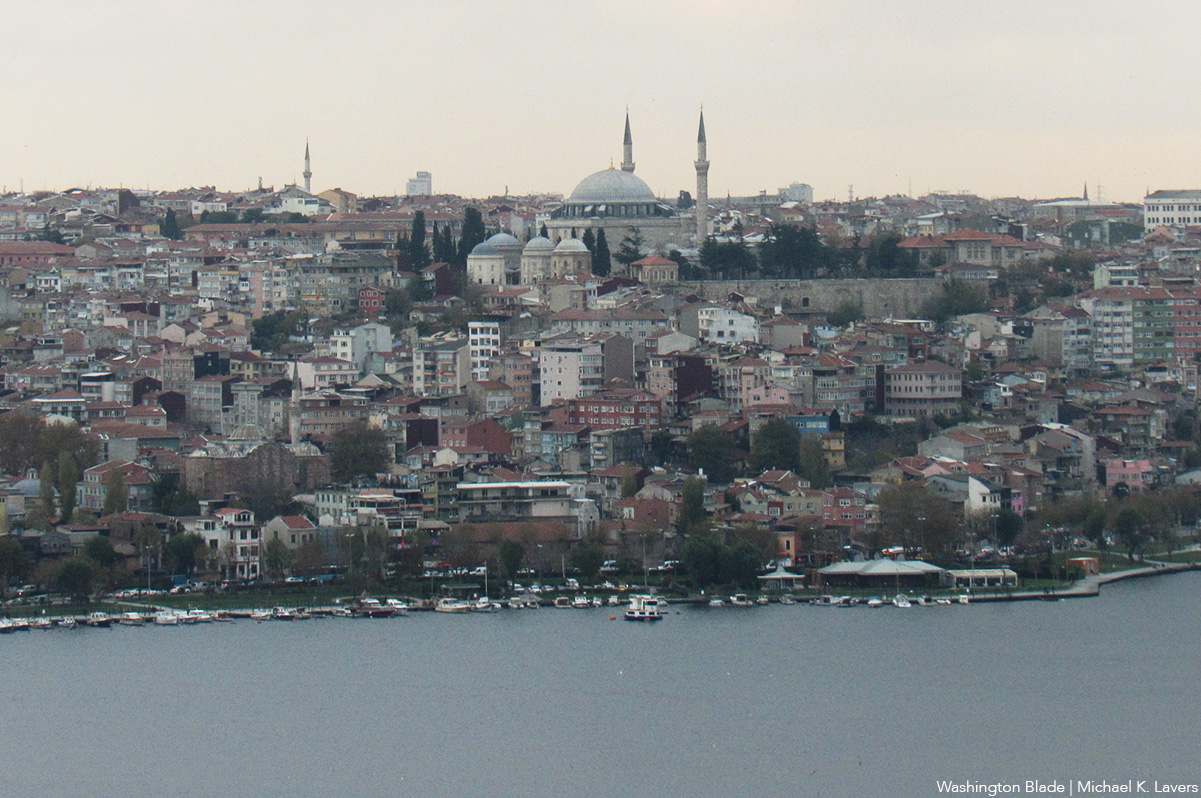
Turkish authorities on Tuesday detained more than 150 people who gathered outside an Istanbul courthouse to protest raids that targeted the country’s LGBTQ community.
CNN reported the protesters had planned to speak with reporters outside the city’s Caglayan courthouse, but authorities prevented them from doing so.
Turkish authorities over the weekend detained dozens of people in Istanbul and in other cities during raids that were part of the government’s “My Family is Safe” campaign.
A statement from a group of Turkish advocacy groups the Washington Blade received on Tuesday notes “at least 112 people have been detained in connection with the operations.” The organizations said 43 of those taken into custody are “LGBTI+ rights defenders,” and “at least” 62 of those detained “have been arrested, while judicial proceedings remain ongoing in Istanbul.”
“Among those arrested, at least 16 are LGBTI+ activists or individuals connected to LGBTI+ associations, including founders and members of association bodies,” reads the statement. “Per press statements by the prosecutor’s offices, dissolution cases will also be launched against associations.”
“The majority of those arrested are trans women who are charged with prostitution-related offences,” it adds. “While authorities have framed the operations as part of investigations into alleged crimes such as obscenity, prostitution and child exploitation, human rights defenders and civil society organizations have raised serious concerns regarding the use of criminal law mechanisms and public morality narratives to target legitimate LGBTI+ rights activities. Civil society views the ‘My Family is Safe’ narrative as a smokescreen to distract the public from deep economic crises and actual domestic violence, weaponizing moral panic to scapegoat LGBTI+ rights defenders, who have long been targeted by the government.”
The raids have sparked outrage among LGBTQ activists in Europe and elsewhere around the world.
The Congressional Equality Caucus and U.S. Rep. Carlos Giménez (R-Fla.) are among those who have publicly condemned them in the U.S. The Council for Global Equality on Friday is scheduled to hold a rally in support of Turkey’s LGBTQ community in front of the Turkish Embassy in Northwest D.C.
Indonesia
Indonesia’s top Muslim clerical body proposes criminalizing LGBTQ people, advocacy
Proposal underscores increased pressure against community
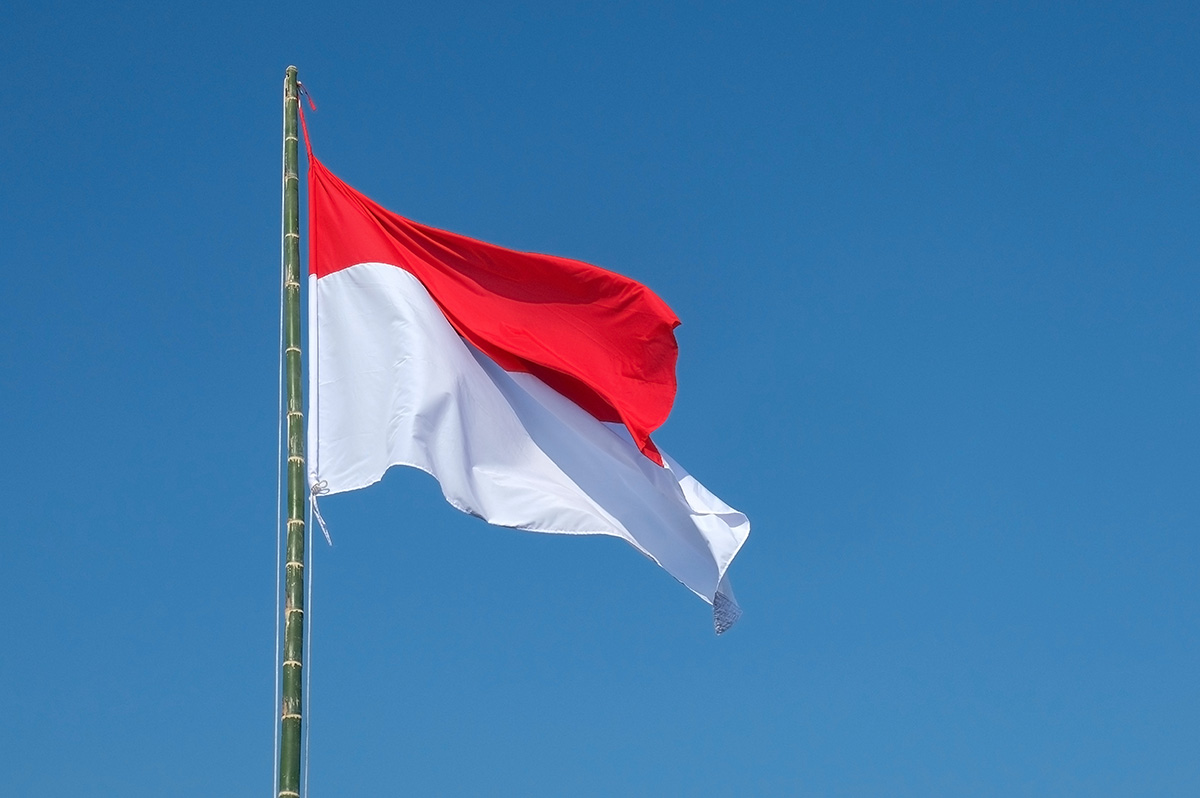
Indonesia’s top Muslim clerical body has proposed replacing the term “LGBT” with “LGSP,” grouping lesbian and gay people with sodomy and sexual abuse, as it prepares a proposed law that would criminalize conduct and advocacy it consideres prohibited.
Asrorun Niam Sholeh, head of the Indonesian Ulema Council’s Fatwa Commission, announced the proposal in Jakarta in late July, saying the council was preparing an academic paper and draft bill to submit to the government and MPs
The council in August also warned men against wearing women’s clothing during Independence Day festivities, despite a long-standing tradition in some Indonesian communities of men dressing in dresses and hijabs to play football as part of the annual celebrations. In a statement issued Aug. 7, the Fatwa Commission said such cross-dressing was “haram,” or forbidden under Islamic law, and linked the practice to what it described as a covert campaign by the “Lesbian, Gay, Sodomy and Obscenity (or LGSP) movement.
Indonesia on Aug. 17 marks its 1945 declaration of independence from the Netherlands with flag ceremonies, neighborhood gatherings, and a lively tradition of community competitions known as “lomba tujuhbelasan.” Children and adults take part in games ranging from sack races and cracker-eating contests to tug-of-war and “panjat pinang” — teams climb a greased pole to reach prizes at the top. Some communities also hold football matches in sarongs or “daster,” a loose-fitting house dress traditionally associated with women, turning the celebrations into an occasion for communal play and laughter.
The pressure extends beyond religious authorities.
In a report published in July, Human Rights Watch said attacks against LGBTQ university students had escalated during June’s Pride Month, while at least 10 public universities had recently adopted discriminatory regulations and curbed student media coverage and social media discussions about gender and sexual diversity. The rights group said the measures undermine freedom of expression and academic freedom.
Reacting to Pride Month celebrations, the Ulema Council called for “sexual deviation” to carry criminal penalties heavier than those for adultery and said it was preparing a draft law to criminalize LGBTQ conduct and campaigning.
President Prabowo Subianto in October 2025 signed Presidential Regulation No. 111 of 2025, which sets Indonesia’s General National Defense Policy for 2025–2029 and classifies the spread of LGBTQ culture as a non-military threat to the state. The provision places it among other perceived threats that include terrorism, radicalism, separatism, and the spread of prohibited ideologies.
The regulation drew public attention in July after Indonesian media reported on the provision, prompting Amnesty International Indonesia Executive Director Usman Hamid to warn that it could institutionalize discrimination against LGBTQ people.
“Amnesty International Indonesia unequivocally condemns these attacks and intimidation by both state and non-state actors based on perceived sexual orientation or gender identity,” said Amnesty International Indonesia. “We urgently call upon the Indonesian government to repeal this regulation and uphold its constitutional mandates and the international human rights treaties it has ratified.”
Indonesia on Jan. 2 began enforcing a new national criminal code, replacing the Dutch-era penal code that had governed the country for more than eight decades.
MPs had approved the 345-page code in December 2022 after years of debate and public protests over provisions concerning morality, religion, and individual rights. Among its new provisions is Article 411, which makes sexual intercourse outside marriage a criminal offense punishable by up to one year in prison.
Article 412 makes living together as husband and wife outside a legally recognized marriage punishable by up to six months in prison. The offenses can be prosecuted only after a complaint by a spouse, parent or child, but rights groups have warned that the provisions can disproportionately affect same-sex couples, whose relationships are not legally recognized in Indonesia.
Purba Widnyana, chairman of GAYa Nusantara, an Indonesian LGBTQ rights organization, told the Washington Blade that the situation for LGBTQ people in Indonesia has become increasingly worrying.
Widnyana told the Blade that the concern extends beyond increasing violence, pointing to stronger anti-LGBTQ sentiment in public spaces, on social media and within educational institutions, as well as in politics, including Presidential Regulation No. 111 of 2025.
“The impact is not always in the form of physical violence. Many LGBT+ people, especially trans women, that mostly work in entertainment or other informal jobs, beginning to lose job opportunities because they are considered to pose a ‘risk’ to the event organizers,” Widnyana said. “There are also concerns that the rising stigma and fear could deter people from accessing health services, including HIV test and STI, due to the fear that their identity or sexual orientation might be revealed.”
Widnyana said the changing environment has placed an additional burden on LGBTQ organizations; making spaces for gatherings, educational activities, and public information campaigns increasingly sensitive.
“We are constantly in alert mode,” he said, adding that since the previous wave of anti-LGBTQ sentiment in 2016, organizations have developed security and risk-mitigation plans before holding events. Previously, he said, the primary concerns were physical attacks, raids and threats that could force venues to cancel events. Now, organizations also have to account for online attacks, including WhatsApp hijacking and social media account hacking, as well as the possibility of an event or organization being targeted after going viral.
“It’s been limiting our movements,” he said.
Asked about the proposed LGSP framework and its decision to replace the term LGBTQ with a classification combining sexual orientation with sexual conduct, Widnyana said the council was conflating fundamentally different concepts.
“I really don’t know where to begin. They are definitely confused by mixing identities, in this case sexual orientation, with sexual behavior and actions that are understood as violations or offenses, that are sodomy and sexual indecencies,” he said.
Widnyana said the change should not be viewed as merely a change in terminology.
“The change shifts how Indonesians understand or perceive LGBT+ issues, moving from identities, rights and existence to behavior, morality, and criminality,” he told the Blade. “We also see it in the context of narrative that has been for so long evolving that frames LGBT+ as the ‘product of the West’ or ‘Western propaganda’,” he said. “In this framework, LGSP can be interpreted as their effort in rejecting how LGBT+ people define themselves and changing it with a category that is defined by those who oppose the existence of LGBT+ people.”
Widnyana also pointed to Indonesia’s long history of diverse gender identities and expressions, citing traditions such as the “bissu,” “calalai,” “calabai,” and “waria,” as well as artistic traditions in which men perform female characters. He cautioned against imposing modern LGBTQ categories on those traditions, but said gender and sexual diversity are not foreign to Indonesian history.
Widnyana said his main concern was the lack of clarity around terms such as “campaigning,” “promoting,” and “spreading LGBT+ culture,” which he said could be interpreted broadly enough to affect legitimate work in education, health care, human rights, and community services. He cited HIV and sexual health information, legal assistance for victims of violence, discrimination research, training on sexual orientation, gender identity and expression, and sex characteristics, and academic discussion as examples. Widnyana also questioned whether a gay man publicly saying he is gay and demanding to live safely, or a transgender woman speaking about discrimination she has experienced, could be deemed “campaigning” or “spreading LGBT+ culture.” Such legislation, he warned, could turn existing social stigma into a tool for systematically limiting the lives, expression, services and LGBTQ organizations.
“For me, the situation is becoming more difficult. And I think we need to look beyond just what the law says. Because sometimes, when we talk about Indonesia, people say, ‘Well, being LGBTQ+ is not generally criminalized under the national criminal law,’” said Arisdo, outreach representative of Pelangi Nusantara, an LGBTQ community group in Indonesia advocating for love, equality, and the right to live with dignity. “technically, that’s an important distinction. But that’s not really what people on the ground are experiencing. What we’re seeing is more pressure. More harassment. More public shaming. More people being targeted simply because they are perceived to be LGBTQ+.”
Arisdo told the Blade that transgender women are facing escalating violence, citing Pelangi Nusantara’s documentation of 10 attacks in Bogor between March and July 2026 involving 45 victim-survivors. He said the emergence of “Boti Hunter” groups was particularly alarming, reflecting a shift from anti-LGBTQ rhetoric toward actively targeting people. He added that fear of being outed or attacked prevents many victims from reporting violence, while doxxing and online harassment are increasingly forcing LGBTQ organizations to limit their visibility.

White House press pool pushes back after Trump bars three outlets

PHOTOS: Shenandoah Valley Pride

Long-time DignityUSA executive director announces retirement

PHOTOS: Walk and 5K to End HIV

PHOTOS: Wanda Alston Foundation Fall Reception

Gun reform is an LGBTQ rights issue

All the queer things to watch this fall

Parties, dinners, concerts and more on tap for fall nightlife

Jeremy Moss looks to bring LGBTQ advocacy from Lansing to Capitol Hill